




Table of Contents
- Why Brand Strategy Is the Foundation of Earned Media
- What 2,000+ Publishers Told Us They Actually Want
- How To Pitch Your Brand Story To Earn Coverage
- Content Types That Earn the Most Coverage
- Measuring Earned Media Impact
- Your Brand Strategy Is Your Earned Media Strategy
- FAQ
Most brands treat brand strategy, content creation, and media pitching as three separate activities. That disconnect is why their earned media efforts underperform.
Over 13 years at Fractl, we’ve surveyed more than 2,000 publishers, generated 41,545+ press mentions, and placed marketing campaigns in media outlets from The Wall Street Journal to CNN. Along the way, we’ve built a dataset on what journalists actually want, what they ignore, and what makes them come back for more.
Earned media (the press mentions, social media shares, word of mouth, and positive reviews you don’t pay for) remains one of the most cost-effective ways to build brand awareness and domain authority. But only if you know what the people on the other side of the inbox actually need.
In this guide, I’ll show you what a strong brand strategy has to do with earning media coverage, which content types publishers are actively looking for, and the specific pitching tactics that get emails opened (not deleted).
Why Brand Strategy Is the Foundation of Earned Media
Most guides on earned media skip straight to pitching tactics. They treat digital marketing outreach like a numbers game: send more emails, follow more templates, hit more inboxes. But the brands that consistently earn coverage aren’t just better at pitching. They have a clearer sense of who they are, what they stand for, and which stories they’re credibly positioned to tell.
That clarity comes from brand strategy.
A strong brand strategy gives you a differentiated brand identity, a consistent brand voice, and a distinct brand personality that translates into stories journalists want to cover.
It establishes your tagline, your style guide for messaging, and the touchpoints where your brand meets its audience. Without one, every pitch is a shot in the dark. With one, you have a roadmap for which conversations your brand belongs in and a long-term plan for building brand recognition through earned media.
Your Brand Story Is Your Pitch’s Foundation
A compelling brand story isn’t just your origin story or your mission statement printed on an about page. It’s the intersection of your brand’s values, your ideal customer’s pain points, and a narrative that connects the two in a way that feels specific and real.
When we surveyed 500+ top-tier publishers, 93% said relevance is the single most important quality of content they want to cover. Relevance starts with knowing what your brand actually stands for and which conversations you have the credibility to join. A great brand story is both your value proposition to customers and the raw material for every pitch your team sends.
Here’s what separates a great brand story from a generic one:
- It’s specific. It addresses a real tension or problem, not a vague aspiration. “We help small business owners avoid cash flow crises” is a good story. “We empower entrepreneurs” isn’t.
- It’s grounded in core values. Your brand’s values aren’t decorative. They define which stories you’re equipped to tell and which ones you should leave to someone else. They also signal your brand purpose to journalists, assessing whether you’re a credible source.
- It creates an emotional connection. Publishers told us that 32.7% value emotion-driven storytelling as a quality of ideal content. Authentic stories about real-life impact create a stronger emotional response than abstract positioning statements.
- It maps to your audience. Your brand story should reflect what your potential customers and target market care about, not just what your marketing team wants to say.
The brand story is the foundation for every pitch, every campaign, and every piece of content your team produces. Brands like Nike, Airbnb, and Apple have built brand personalities so distinct that journalists already understand what stories those companies are positioned to tell. Their brand origin is woven into everything they pitch, and their testimonials and case studies reinforce a consistent narrative across every media touchpoint.
From Brand Identity to Pitchable Angles
Brand identity includes visual identity (your brand colors, typography, fonts, and visual elements), brand messaging, tone of voice, and brand positioning. Those are internal brand guidelines. A pitchable angle requires translating them into something a journalist’s audience cares about.
I’ve found the simplest framework for this is:
Brand position + audience insight + timely hook = pitchable angle
Say your brand is positioned as an authority on personal finance for young professionals. Your audience insight is that Gen Z workers are anxious about retirement savings. A timely hook might be new data on how inflation affects 401(k) contributions. That’s a specific idea a personal finance editor at a major outlet can use, and it’s directly tied to your brand positioning and market position.
The brands that struggle with earned media usually don’t have a pitching problem. They have a brand strategy problem.
Their positioning is too broad, their differentiation is unclear, or their messaging doesn’t map to anything a journalist is actually covering. This is true for startups and enterprise companies alike. Fix the strategy, and the pitchable angles follow.
This is where brand development stops being an internal exercise and starts generating earned media results. A strong brand strategy isn’t just about customer experience and brand loyalty; it’s the engine that produces stories your public relations team can pitch with confidence. Whether you’re launching new products, navigating a rebrand, or scaling partnerships with influencers and media, the strategy is what keeps your marketing efforts focused on angles that actually earn coverage.
What 2,000+ Publishers Told Us They Actually Want
Over 13 years, we’ve run multiple large-scale publisher surveys at Fractl:
- A survey of 500+ top-tier journalists on content formats and preferences
- A survey of 1,300 publishers on pitch behavior and inbox habits
- A study analyzing 291 journalist responses across 1,135 placements
- A qualitative survey of 25 UK journalists at outlets like The Guardian, The Telegraph, and Metro
In this section, I’ve consolidated those findings into one reference. This data is based on direct responses from the people who decide what gets published.
The Content Characteristics Publishers Value Most
When we asked 500+ publishers what makes a “perfect” piece of content, the ranking was clear:
- Relevant content: 93%
- Exclusive research: 59.3%
- Trustworthy methodology: 53.9%
- Breaking news: 46.8%
- Emotional stories: 32.7%
- Interesting graphic visualization: 19.9%
- Compelling video: 10.6%
- Interactive assets (calculators, maps): 10.3%
Three things stand out:
- Relevance dominates. Nearly every publisher we’ve surveyed across every study puts it at the top. If your content doesn’t connect to a journalist’s beat and their audience’s interests, nothing else matters.
- Exclusive research (59.3%) and trustworthy methodology (53.9%) rank far above flashy formats like video or interactive tools. Publishers want data they can’t get anywhere else, and they want to trust it. We’ve heard directly from editors that if they publish a study with a flawed methodology, they’re less likely to work with that source again. The credibility cost is real, and it affects your brand’s reputation with that outlet permanently.
- Emotional stories (32.7%) outrank every visual format. Data gets your foot in the door, but stories about real people, real-life impact, and meaningful outcomes are what make editors want to write about your research. The best campaigns combine both: high-quality original data with a human narrative layered on top.
Kristin Tynski, Fractl’s SVP of Research, explored this dynamic in her Harvard Business Review article on the emotions that make campaigns go viral, finding that content triggering specific emotional responses earns significantly more engagement.
The Content Formats in Highest Demand
There’s a meaningful gap between what publishers currently run and what they wish they received more of. Here’s what the data shows:
| Content format | Currently publish | Wish they saw more |
|---|---|---|
| Long-form content | 76.6% | 39.5% |
| Data visualizations | 29.7% | 36.6% |
| Interactive graphics | 18.9% | 35.5% |
| Infographics | 27.5% | 28.6% |
| Videos | 36.6% | 15.5% |
| Listicles | 40.2% | 12.3% |
| Press releases | 17.2% | 9.3% |
The biggest opportunity is in data visualizations and interactive graphics, where demand significantly outpaces supply. Meanwhile, videos and listicles are oversaturated: Publishers already run them frequently but don’t want more. This is a critical insight for anyone building a content marketing strategy, because it means the formats most brands default to (listicles and video) are exactly the ones publishers are least hungry for.
But what about press releases? Only 5% of publishers in our 500-publisher study said press releases were the content format they wanted. The infographic is decidedly not dead, but the press release as a primary marketing tool has been on life support for years.
The takeaway for your marketing strategies: Invest in original research paired with data visualizations and interactive elements. That’s the combination publishers are actively hungry for, and it’s the foundation of effective link building. If you want to optimize your earned media strategy, start by shifting budget away from press releases and toward the formats publishers told us they actually want.
Why Publishers Reject Pitches (and How To Get Them To Accept Yours)
Our 1,300-publisher survey identified the three fastest ways to get your pitch declined:
- Irrelevant to their beat (80%). This is the top reason by a wide margin. If you haven’t done the market research to understand what a journalist covers, you’ve already lost. Finding the right person at the right outlet is step one of any earned media strategy.
- Overly promotional (56%). Publishers can spot a sales pitch disguised as a story from the subject line. If the content exists to promote your product rather than inform a new audience, it’s getting deleted.
- Boring content (48%). Generic ideas that feel interchangeable, pitches with no unique angle, and content that doesn’t give a journalist something new to say. Decision-makers at publications see hundreds of pitches weekly; yours needs to stand out.
The qualitative feedback from our UK journalist survey reinforces this. A Guardian staff writer told us that pitchers should be able to name a journalist’s main story areas before reaching out. A Telegraph travel editor said a story should be explainable in a sentence or less. And multiple journalists confirmed that no response means no interest; don’t chase with aggressive follow-up emails.
The pattern across every study we’ve run is consistent: publishers don’t reject pitches because they’re too busy (45% often or always read pitches, and only 2% never open them). They reject pitches because the content doesn’t match what they need. That’s a brand strategy problem, not a volume problem. For a deeper look at the pitching mistakes journalists flag most often, see our publisher pet peeves research.
Ready to earn coverage that actually moves the needle? Fractl has spent 13 years building the systems, publisher relationships, and research methodologies that get brands placed in top-tier outlets. Let us build a custom earned media strategy around your brand.
How To Pitch Your Brand Story To Earn Coverage
Knowing what publishers want is step one. Turning that knowledge into pitches that actually get opened, read, and responded to is step two. Whether you’re pitching brands for the first time or refining an existing outreach process, here’s what our data says about the mechanics of a pitch email that works. (And no, you don’t need an elaborate pitch deck or media kit to get started.)
Anatomy of a Pitch That Gets Opened
Our 1,300-publisher survey broke down exactly what determines whether a pitch email gets opened or ignored:
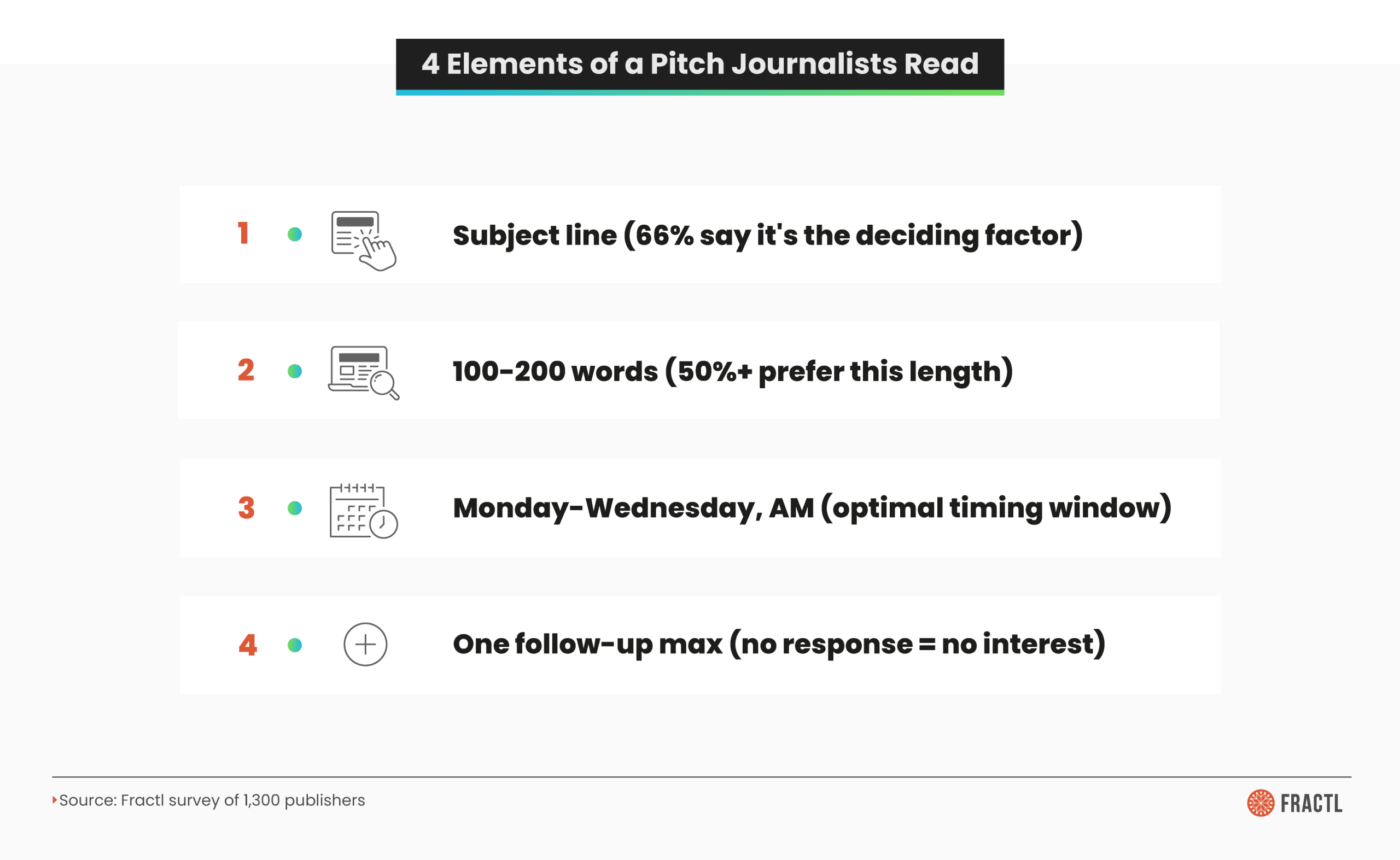
- Subject line is everything. Sixty-six percent of publishers say it’s the single most important factor in whether they open a pitch. Be specific, lead with the data or angle, and keep it concise. “New data: 93% of publishers rank relevance as #1 priority” works as an elevator pitch in your subject line. “Exciting new research opportunity” doesn’t.
- Keep it to 100-200 words. More than 50% of writers and editors across all beats prefer pitches in this range. That’s roughly four to six sentences. Lead with the hook, include a brief intro to the data, state what you’re offering, and make it easy to say yes with a clear call to action.
- Pitch early in the week. Monday through Wednesday, early morning to noon, is the optimal window. Nearly 70% of writers produce one story at most per day, and close to half have a one to two day turnaround time. Pitch when they’re planning their editorial calendar, not when they’re on deadline.
- Don’t over-follow-up. If you don’t hear back, take the hint. UK journalists were particularly blunt about this: no response means no. One polite follow-up is acceptable; repeated follow-up messages damage your brand’s reputation with that journalist.
The good news is that publishers are still reading. Our data shows 45% often or always read pitches, and only 2% never open them. The inbox is crowded (57% of top-tier publishers receive 50-500 pitches per week), but it’s not impenetrable. A perfect pitch doesn’t need to be complicated; it needs to be relevant, concise, and well-timed.
Tailor Pitches by Beat and Publisher Tier
A pitch that works for a lifestyle editor won’t land the same way with a finance writer. Our research shows significant variation across verticals, and understanding these demographics is essential for marketing managers running outreach at scale:
- Most receptive beats. Lifestyle and Food writers are most likely to always read pitches.
- Hardest to reach. Automotive and Finance writers are least likely to read pitches.
- Publishing volume varies dramatically. Entertainment writers publish roughly 16 stories per week, while how-to writers publish about three. Entertainment editors have more slots to fill but move faster; how-to editors are more selective but place longer-lasting content.
- Article length expectations differ by beat. Personal finance articles average 958 words. News articles average 485 words. Tailor the depth and scope of your pitch to match what the outlet typically runs.
Publisher tier matters too: Our analysis of 291 journalist responses found that higher-DA publishers impose stricter editorial standards. They expect stronger methodology, cleaner data, and more exclusive angles. If you’re pitching The New York Times, your content needs to meet a different bar than pitching a mid-tier trade publication. But the reward scales accordingly: higher-authority placements drive more referring domains, more brand awareness, and a stronger positive impact on SEO rankings.
Don’t send the same pitch to every journalist on your list. Segment your outreach by beat, publication tier, and content format preferences.
Your engagement rate will reflect the effort you put into tailoring each pitch to the right person at the right outlet. This kind of segmentation is also relevant for brand collaborations and brand partnerships: whether you’re pitching a YouTube channel, a TikTok creator, or a traditional publisher, the approach needs to match the platform and the audience. Brand deals with influencers follow the same principle: relevance to the creator’s audience matters more than follower count.
Build Publisher Relationships That Compound Over Time
The best earned media strategy isn’t a series of one-off pitches. It’s a system of relationships that compound over time, building brand equity with every successful placement.
Our publisher responses study found that contributors and freelancers (including bloggers and content creators) are more receptive to pitches than staff editors. That’s not surprising: Freelancers are often looking for story ideas and data to pitch to their own editors. They can be a valuable entry point to a publication.
But the real leverage comes from building trust with journalists who cover your industry consistently. When an editor knows your research is credible and your data is solid, they don’t just cover one campaign. They come back. They reach out when they’re working on a news story in your space. They become a recurring source of earned media, similar to how influencer marketing works, except the endorsements come with editorial credibility.
Here’s what our UK journalist survey taught us about relationship building:
- Follow their work first. Use social media channels and LinkedIn to understand what a journalist covers before you pitch them. Reference their recent articles in your outreach.
- Provide value beyond the pitch. Share data, offer expert commentary, and be a resource they can rely on, even when you’re not actively promoting a campaign. Think of it as building a brand partnership based on mutual value, not a transactional exchange.
- Respect boundaries. If a journalist doesn’t respond, don’t follow up repeatedly. Build trust through consistency and high-quality work, not persistence.
- Think long-term. A single placement is nice. A journalist who trusts your brand enough to come back for every relevant story is worth far more to your customer base and business goals.
This is where brand strategy and earned media come full circle.
A clear brand identity makes it easier for journalists to understand what you’re an authority on.
Consistent brand messaging means they know what to expect. And a track record of trustworthy research builds the kind of credibility that turns cold outreach into warm relationships.
For a step-by-step look at how we approach this at Fractl, see our guide to digital PR outreach.
Content Types That Earn the Most Coverage
Based on our publisher research and 13 years of campaign data, here are the forms of earned media content with the strongest track records. These are also examples of earned media initiatives that work across industries, from startups to enterprise brands.
The right content type depends on your brand strategy, your budget, and the search engines and media channels your audience uses.
Data Journalism and Original Research
Original research is the single most effective content type for earning media coverage. When 59.3% of publishers say they value exclusive research and 53.9% prioritize trustworthy methodology, the message is clear: give journalists data they can’t find anywhere else.
Data journalism campaigns combine data-driven storytelling with digital PR outreach to tier 1 news outlets. They typically involve complex methodologies (surveys, data analysis, public records research) on topics with broad consumer appeal, visualized through custom graphics and hosted on a client landing page.
What makes this format a powerful tool for earned media is:
- It gives publishers something exclusive. Journalists need original angles to justify covering a news article. Your proprietary data is that angle, and it’s the kind of content that makes for success stories in your case studies.
- It’s inherently shareable. Data-driven findings with clear visualizations get picked up, syndicated, and referenced across multiple outlets and social media platforms, extending your reach to a new audience. User-generated content and social sharing often amplify the initial placement further.
- It supports SEO long-term. The landing pages that host original research continue earning high-quality backlinks organically as an evergreen industry resource, improving your search engine rankings over time.
We’ve seen this play out across our client work repeatedly. Data journalism is the backbone of scaled link building because it gives publishers exactly what they told us they want: exclusive, relevant, methodologically sound research with visual assets that make the findings easy to communicate. Kelsey Libert has written extensively about what makes content go viral based on Fractl’s research, and the pattern is consistent: Original data paired with emotional storytelling outperforms every other format.
Reactive PR and Newsjacking
When breaking news hits your industry, there’s a narrow window to add value to the conversation. Reactive PR (or newsjacking) means responding to trending stories with rapid consumer surveys, timely data analysis, or expert commentary that gives journalists a fresh angle on a news story they’re already covering.
This matters because 46.8% of publishers value breaking news content. When a story is gaining traction across social media accounts and news outlets, editors are actively looking for supporting data, consumer sentiment, and expert perspectives. If your brand can provide that within 24-48 hours, you’re meeting a real editorial need.
The timeline for reactive PR is tight:
- Ideation approval within 24 hours. The news cycle won’t wait for a week-long approval process. This is where having clear brand guidelines pays off: your team already knows which topics are on brand.
- Production in 24-48 hours. Survey design, data collection, analysis, and visualization need to happen fast. Automation tools can help accelerate this process.
- Outreach in a concentrated burst. Target high-authority and niche-relevant outlets over several days to maximize coverage while the story is still active on social media platforms and digital media.
Reactive PR requires strong brand strategy alignment.
You need to know in advance which news stories your brand has the credibility to comment on.
A fintech company can credibly weigh in on banking regulations. It probably shouldn’t comment on health care policy. Your brand positioning and brand stance on industry issues define which trending topics are yours to own and which ones you should leave alone.
Expert Commentary and Thought Leadership
Proactive PR (placing expert quotes and commentary in articles journalists are already writing) is a high-efficiency format that builds brand awareness through consistent thought leadership and personal branding for your leadership team.
Our UK journalist survey confirmed that publishers value expert-driven content: thought leadership, data-backed commentary, and perspectives that add depth to stories.
The key is positioning your brand’s stakeholders and leadership team as credible voices on specific topics.
This works especially well as a complement to podcast appearances, Instagram Stories, and social media posts that reinforce the same messaging. It’s also a natural fit for sustainability-focused brands or companies with strong positions on industry issues: publishers are actively looking for experts who can speak to topics like corporate responsibility, environmental impact, and ethical practices.
This format works by:
- Monitoring journalist requests. Platforms exist where reporters seek industry experts for quotes and insights on stories they’re developing. Having a system for your social media manager or PR team to respond quickly is essential.
- Developing quotes on behalf of leadership. Your CEO doesn’t need to draft every quote personally, but the perspective needs to be genuine and informed. The best quotes reflect your brand promise and deliver on your brand’s expertise.
- Driving deep-page links. When a journalist references your expert’s commentary, they often link to a relevant page on your site, not just your homepage. This drives SEO value and customer loyalty to specific content.
Expert commentary works best as part of a broader content marketing strategy. It fills the gaps between larger campaigns, keeps your brand visible in industry conversations, and builds the kind of editorial relationships that make your next big campaign easier to place.
It’s also a form of brand marketing that doesn’t require the budget of a full data journalism initiative, making it accessible for brands at every stage of brand development, from collab-stage startups to Fortune 500 companies.
Tools from platforms like HubSpot can help streamline the process of tracking journalist requests and managing your outreach pipeline, though the strategic decisions about which opportunities to pursue still depend on your brand strategy.
Measuring Earned Media Impact
You can’t run an effective brand strategy without measuring what’s working. Yet measurement remains one of the biggest challenges in earned media: 60% of PR teams say measuring earned media impact is a top challenge.
The problem isn’t a lack of metrics; it’s that most teams track vanity metrics (total social media mentions, impressions) instead of tying earned media to business goals and optimization opportunities.
Here are the metrics that actually matter for proving earned media ROI:
- Referring domains. The number of unique websites linking back to your content. This is the most direct measure of earned media’s SEO impact and a key touchpoint between PR and search engine optimization.
- Domain authority growth. Track your site’s DA over time as you earn backlinks from high-authority media outlets. Increased DA lifts your entire site’s keyword rankings, not just the pages that receive links.
- Organic traffic value. What would the traffic you’re earning through improved rankings cost if you had to buy it through paid media or paid advertising? This is the metric that translates SEO gains into dollar terms your stakeholders understand.
- Keyword ranking improvements. Monitor movement on your target keywords as earned media campaigns drive new backlinks and topical authority. This is where earned media connects directly to content marketing performance.
- Press mentions and placement quality. Total mentions matter less than where you’re being mentioned. A single placement in a DA 80+ outlet is worth more than 50 mentions on low-authority blogs or social media channels, because it drives more brand equity and loyal customer trust over time.
- Conversions and leads. The ultimate business goal. Track how earned media placements drive traffic to your site and how that traffic converts. This closes the loop between PR activity and revenue.
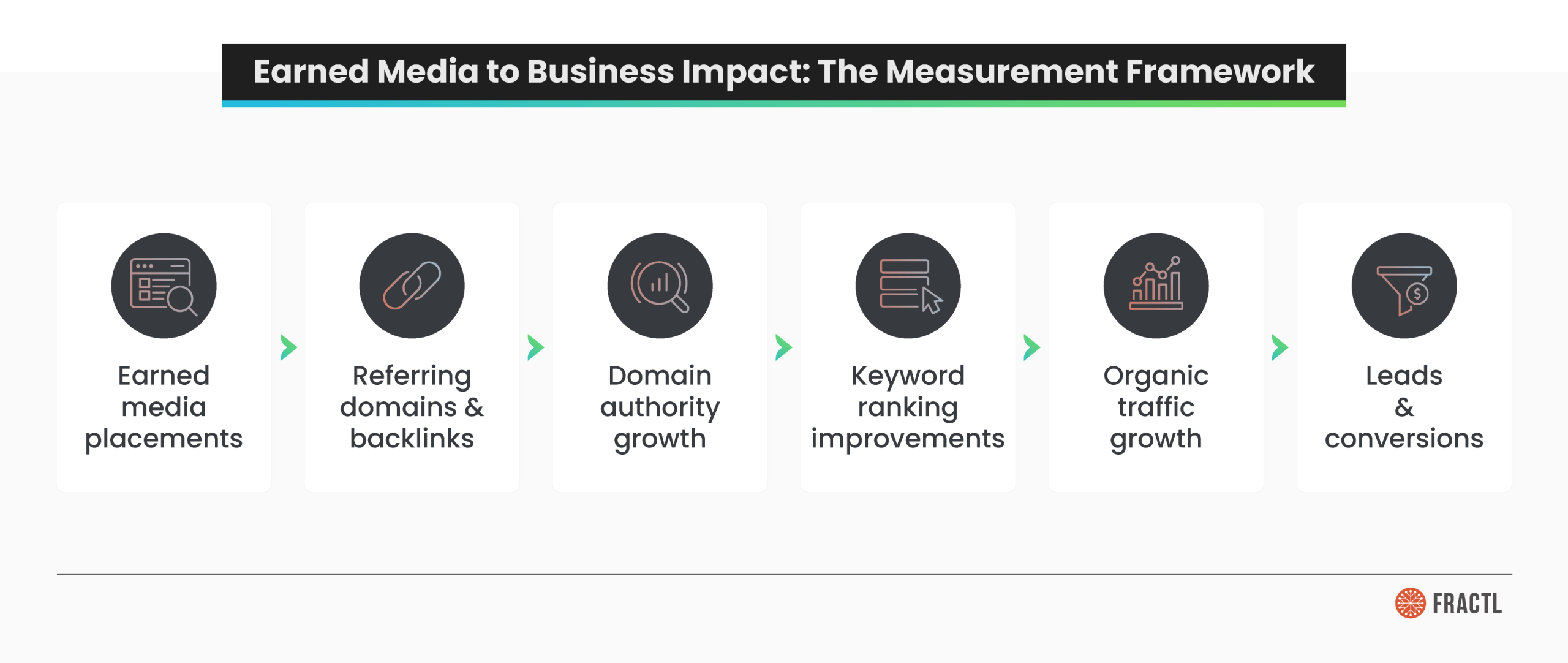
The framework we use at Fractl ties earned media directly to an SEO-driven business impact: increased domain authority → improved keyword rankings → more qualified organic traffic → more leads and conversions.
Every campaign is measured against this chain, which is what allows us to demonstrate ROI rather than just reporting coverage counts.
For a look at what this optimization process looks like in practice, including pricing for different types of earned media services, see our SEO pricing guide.
Your Brand Strategy Is Your Earned Media Strategy

The brands that consistently earn media coverage don’t treat pitching as a separate function from brand strategy. They treat it as a direct extension. Your brand identity defines which stories you can tell. Your brand positioning determines which journalists you’re relevant to. Your content creation choices dictate whether publishers want what you’re offering. And your outreach approach determines whether they actually see it.
We’ve spent 13 years building the dataset to prove this. Across surveys of 2,000+ publishers, the message is remarkably consistent: Be relevant, be original, be credible, and respect the people you’re pitching. That’s an effective brand strategy for earned media, and it’s one that produces a positive impact whether you’re a new brand building brand recognition or an established company looking to build brand loyalty with a broader customer base.
The data is here. The framework is here. Now it’s about execution. If you’re ready to put it to work, get in touch with Fractl to build an earned media strategy around your brand.
FAQ
What is earned media?
Earned media is publicity you don’t pay for: press coverage, social media mentions, product reviews, word-of-mouth recommendations, endorsements, and organic social media shares. It’s one of three types of media in digital marketing, distinct from paid media (advertising, sponsored social media posts) and owned media (your website, blog, social media accounts). Earned media is generally considered the most credible form of brand exposure because it comes from independent third parties rather than the brand itself.
What is brand storytelling?
Brand storytelling is the practice of using narrative to communicate your brand’s values, mission, and impact in a way that creates an emotional connection with your target audience. In the context of earned media, your brand story isn’t just marketing copy; it’s the foundation for every pitch you send. A strong brand story gives journalists a reason to care about your data, your perspective, and your expertise. It’s what transforms a brand strategy from an internal document into a tool for earning media coverage.
How do you create a brand strategy that supports earned media?
Start with three elements of a brand strategy: a clear brand positioning (what you’re an authority on), defined brand values and a target audience with detailed personas (whose problems you solve), and a differentiated brand voice (how you communicate). From there, identify the intersections between your brand’s expertise, your audience’s pain points, and the topics journalists in your industry are covering. Those intersections are your pitchable angles. A successful brand strategy for earned media isn’t created in isolation; it’s built around the stories your brand is credibly positioned to tell. Your brand promise to customers should align with what you’re offering to publishers.
What content types earn the most media coverage?
Based on our surveys of 2,000+ publishers, the content types that consistently earn the most coverage are original research with exclusive data, data journalism campaigns with visual assets, and reactive PR tied to breaking news. Publishers told us they most want to see more data visualizations, interactive graphics, infographics, and long-form content. Press releases and listicles rank near the bottom of what they wish they received.
For more examples of content marketing formats that earn press, see our guide to innovative content formats.
How do you measure earned media success?
Track referring domains, domain authority growth, organic traffic value, keyword ranking movement, and conversions driven by earned media placements. The most effective measurement framework connects earned media activity to SEO outcomes and business results rather than just counting press mentions or social media shares. Placement quality (measured by the linking site’s domain authority and relevance) matters more than placement quantity. This approach to optimization turns earned media from a brand awareness play into a measurable marketing strategy with clear ROI.