




Table of Contents
- Digital PR Pricing Models Explained
- What Digital PR Costs in 2026
- What You're Really Paying For: Campaign Types and What They Entail
- In-House vs. Agency: A Cost Comparison
- How To Get the Most Value From Your Digital PR Budget
- Invest in PR That Compounds
- FAQs
Key Takeaways
- Digital PR pricing ranges from $5,000 to $75,000+/mo depending on company size, campaign type, and agency experience.
- Monthly retainers are the most common pricing model (~90% of agencies), with a typical minimum commitment of six months.
- What you’re paying for varies by campaign type: data journalism campaigns require the most resources (and deliver the highest ROI), while proactive PR and expert quotes offer a lower per-campaign entry point.
- The lowest price isn’t the best value. Compare agency cost to the traffic value and backlink quality the campaigns deliver, not just the monthly fee.
Digital PR pricing is one of the least transparent areas in marketing. Ask five agencies what they charge, and you’ll get five different answers, five different scopes, and five different definitions of what “digital PR” even means. Some agencies bundle content creation, outreach, and reporting into one retainer. Others bill each piece separately. Some guarantee links; others (rightly) don’t.
This guide cuts through the ambiguity. I’ll cover the pricing models agencies use, what digital PR actually costs in 2026 by company size, and what you’re paying for at each tier, broken down by campaign type. If you’re evaluating digital PR investments for the first time (or reconsidering your current ones), this is the resource you need.
Digital PR Pricing Models Explained
How an agency structures its pricing affects what you pay, what’s included, and how the relationship works day to day.
Monthly Retainer
A fixed monthly fee for ongoing digital PR services. This is the most common model; most agencies use it because digital PR campaigns compound over time. A single month rarely shows the full impact.
Retainers typically include a set number of campaigns per quarter, ongoing media outreach, proactive and reactive PR, reporting, and strategy. Monthly costs are predictable, and both sides commit to a sustained relationship. Most agencies require a minimum commitment of six months, which aligns with how long it takes for digital PR to produce measurable SEO results.
Project-Based Pricing
A flat fee for a specific campaign or deliverable. Best for one-off needs: a product launch campaign, a single data journalism study, or a short-term engagement to test an agency before committing to a retainer. Project-based fees give you cost certainty but less flexibility. Once the scope is set, changes cost extra.
Performance-Based Pricing
Fees tied to results (placements earned, links acquired, coverage volume). This sounds appealing on paper, but it comes with real risks. Agencies optimizing for volume may pursue low-authority placements to hit targets, avoid ambitious campaigns with higher failure risk, or count syndicated pickups and nofollow links as “wins.” I’d be cautious with pure performance models. They incentivize the wrong behavior.
Hourly Rates
Less common in digital PR but used by some freelancers, consultants, and boutique agencies for strategy work, media training, or crisis communications. You get flexibility but less cost predictability. Hourly works better for advisory engagements than for ongoing campaign execution.
What Digital PR Costs in 2026
Pricing varies by company size, scope, and agency experience. These ranges reflect what most brands pay for full-service digital PR (strategy, content development, outreach, and reporting):
| Campaign size | Typical monthly range |
|---|---|
| Lower-scope / opportunistic campaigns | $5,000 – $10,000/mo |
| Mid-range campaigns | $10,000 – $35,000/mo |
| Full-service / high-competition campaigns | $50,000+/mo |
The broad industry range runs from $5,000 to $50,000+ per month. One-off project-based campaigns fall outside these monthly ranges and are scoped individually.
What you get at each tier varies significantly. At the lower end, expect targeted outreach with limited content production (the agency pitches your existing stories). In the mid-range, you’re paying for original content creation, data-driven campaigns, and broader outreach. At the enterprise level, you’re getting a full-service organic growth strategy with multiple campaign types running simultaneously, dedicated strategists, and integrated SEO alignment.
Don’t confuse up-front cost with long-term value. The backlinks you earn in month three still drive rankings in month 12.
For campaign-level cost details, see How Much Does a Digital PR Campaign Cost?
What You’re Really Paying For: Campaign Types and What They Entail
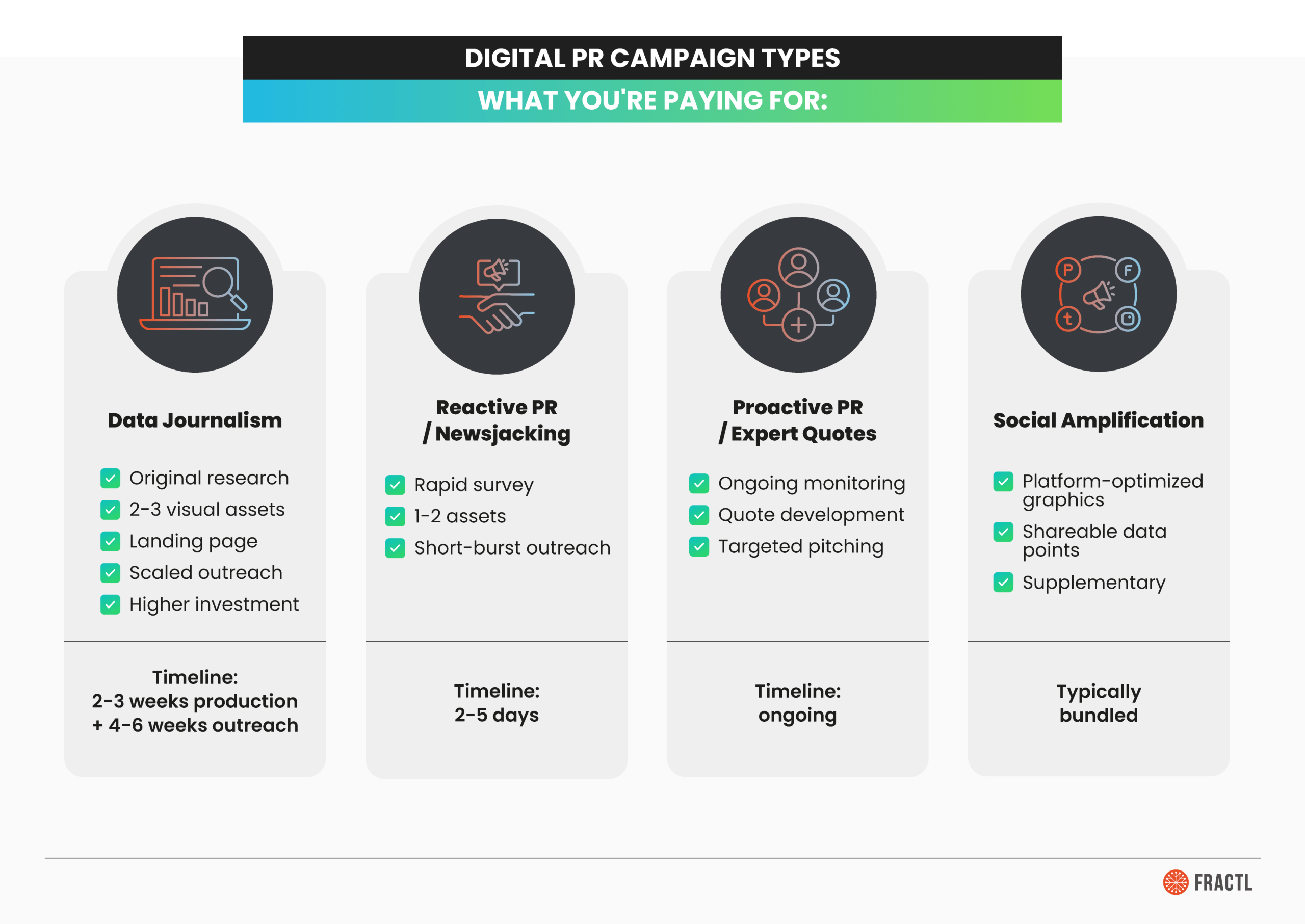
The biggest gap in most digital PR pricing conversations is what you’re actually getting for your money. Retainer fees don’t tell you much without understanding the campaigns behind them. Here’s what different digital PR campaign types involve and where they fall on the investment spectrum.
Data Journalism Campaigns: High Investment, High ROI
Data journalism is original research (surveys, data analyses, public data studies) turned into newsworthy stories with visual assets that journalists can embed and publishers want to cover. It’s the most resource-intensive form of digital PR, and the most effective at earning high-authority backlinks at scale.
It comes with:
- Research and production. Survey design, data collection (often 1,000+ respondents), analysis, and editorial. Allow two to three weeks for production.
- Visual assets. Custom infographics, interactive data visualizations, or shareable graphics (typically two to three per campaign).
- Landing page. A hosted page on your site that tells the story and houses the assets.
- Outreach. Scaled pitching to top-tier publishers with the largest syndication networks. Budget four to six weeks for publisher outreach.
Here’s a snapshot of what that kind of work delivers:
 Fractl’s data journalism campaigns for Payless Power secured 1,208 press mentions (450 from DA 60+ publishers) and drove a 25% increase in organic traffic over 16 months. |  Nine campaigns for Adobe earned 390 new referring domains and 56,000 new monthly visits. |
Reactive PR / Newsjacking (Mid-Range Investment, Speed-Dependent)
Reactive PR capitalizes on breaking news. When a trending story intersects with your brand’s expertise, your PR team produces rapid-turnaround content (surveys, data snapshots, expert commentary) that adds value to the news cycle.
It usually involves:
- Ideation approval within 24 hours.
- Production in 24-48 hours (rapid survey, one to two assets).
- Short-burst outreach to high-authority and niche-relevant sites over several days.
For instance…
When NYC public schools banned ChatGPT, Fractl quickly surveyed students and professors for Study.com. The campaign earned coverage in The Wall Street Journal, Business Insider, USA Today, and Forbes.
Reactive PR costs less per campaign than data journalism because the production timeline is compressed. But it requires an agency that can move fast, which means having the team and media contacts ready to go at all times.
Proactive PR and Expert Quotes: Lower Per-Campaign Investment, Ongoing
Proactive PR is planned against the news calendar and your brand strategy. Your PR team monitors platforms where journalists seek expert sources, develops commentary on behalf of your leadership team, and pitches to relevant beats. It builds thought leadership and earns highly relevant placements over time.
This includes:
- Ongoing monitoring of journalist query platforms and industry news.
- Quote development on behalf of your executives.
- Targeted pitching to relevant beats and publications.
Fractl’s proactive PR work has earned expert quotes in outlets like Newsweek, GoBankingRates, and Yahoo. Per-campaign investment is lower, but the value compounds: consistent media mentions build brand awareness, drive branded search volume, and position your brand as a trusted source for future coverage.
Social Amplification (Supplementary, Usually Bundled)
Social assets (platform-optimized graphics, short-form video, shareable data points) extend the reach of your digital PR campaigns across social media channels. These are typically bundled with larger campaigns rather than priced separately. They help your content reach your target audience beyond earned media and can drive additional referral traffic and brand mentions.
See real-world examples of what each campaign type delivers in Digital PR Pricing Examples: Real Campaign Scenarios & Outcomes.
In-House vs. Agency: A Cost Comparison
Building an in-house digital PR team requires hiring strategists, content creators, designers, data analysts, and outreach specialists — plus covering tools like media databases, SEO platforms, and project management software. Fully loaded, that can cost two to three times more than an agency retainer once you factor in salaries, benefits, recruitment, training, and overhead.
| In-House vs. Agency Costs | ||
|---|---|---|
| Factor | In-house team | Agency |
| Control | Direct oversight of strategy and execution | Less direct control; dependent on account team |
| Brand knowledge | Deepens over time | Requires onboarding and ongoing communication |
| Media relationships | Built from scratch; takes years | Established from day one |
| Scalability | Requires hiring or layoffs to adjust | Scale up or down without staffing changes |
| Cost | Higher fully loaded cost | More predictable retainer model |
Most midsized companies find the agency model more cost-effective for digital PR, specifically because results depend heavily on media relationships that take years to build.
For a deeper comparison of outsourced vs. in-house content marketing costs, see our analysis of content marketing agency economics.
How To Get the Most Value From Your Digital PR Budget
- Define your KPIs before you start. Placements? Backlinks above a DA threshold? Organic traffic growth? Branded search lift? Knowing what success looks like prevents scope creep and misaligned expectations.
- Commit to at least six months. Digital PR compounds. A three-month engagement rarely shows full ROI. Budget for sustained effort.
- Ask what’s included in the retainer. Content creation, outreach, reporting, strategy, and revisions should all be spelled out. Vague scope = vague results.
- Evaluate agencies on results, not promises. Case studies with specific numbers (links earned, traffic impact, publication quality) matter more than pitch decks.
- Align digital PR with your SEO strategy. The backlinks PR earns should feed your SEO goals. If your PR and SEO teams aren’t talking, you’re leaving value on the table.
Use our Digital PR Buyer’s Evaluation Checklist to compare agencies.

Invest in PR That Compounds
Digital PR pricing reflects real differences in scope, expertise, and output quality. The variation between agencies isn’t random; it reflects what you’re actually getting.
The brands that get the most from their investment are the ones that treat digital PR as a long-term marketing strategy (not a one-off experiment), align it with their SEO and content goals, and evaluate agencies on measurable results rather than monthly price tags.
We’ve spent over a decade at Fractl building digital PR and content strategies that deliver measurable organic growth. If you’re evaluating your options, we’d welcome the conversation.
FAQs
How much does digital PR cost?
Digital PR typically costs between $5,000 and $75,000+ per month, depending on scope, campaign type, and agency experience. Lower-scope campaigns typically run $5,000–$10,000/mo, mid-range engagements $10,000–$35,000/mo, and full-service high-competition programs $50,000+/mo.
What does digital PR include?
Digital PR includes any online public relations effort aimed at earning media coverage, backlinks, and brand mentions from digital publications. Common digital PR services include data journalism campaigns, press releases, reactive and proactive media outreach, content creation and content marketing, thought leadership placements, link building, and social amplification. Some agencies also offer crisis communications, influencer outreach, and podcast placements.
Is digital PR worth the investment?
For brands that depend on organic search visibility, yes. Digital PR earns the high-authority backlinks that drive search engine rankings, the media coverage that builds brand awareness, and the brand mentions that influence how AI platforms reference your brand. Fractl’s campaigns have driven measurable results, like 25% organic traffic increases, hundreds of high-authority placements, and millions in monthly traffic value. The key is choosing the right agency and aligning PR with your broader digital marketing strategy.