




Table of Contents
- What Drives Digital PR Campaign Costs
- How Campaign Types Compare
- Pricing Models and Pricing Strategies for Digital PR Campaigns
- What Measurable Results To Expect
- The Real Question: Is It Worth the Investment?
- FAQs
Key Takeaways
- Digital PR costs $5,000–$50,000+/mo. Small brands: $5K–$10K/mo. Midsized: $10K–$35K/mo. Enterprise: $50K+/mo.
- Cost is driven by campaign type, content complexity, publication targets, outreach volume, and agency experience.
- Digital PR is one of the few marketing channels that compounds: backlinks and media coverage keep delivering results long after the campaign ends, unlike paid media.
Those price ranges are a starting point, not a complete answer. What you actually pay depends on the type of campaign you’re running, the content creation involved, where you want placements, and who’s doing the work. Plus, this pricing is based on monthly campaign volume, not per-campaign cost.
I’ll break down the cost drivers, compare digital PR campaign types, and show what measurable results you should expect at different investment levels.
What Drives Digital PR Campaign Costs
Five factors determine where your digital PR cost falls in the range:
- Campaign type and methodology. A reactive PR piece that capitalizes on breaking news costs less than a data-driven PR campaign with original surveys, data analysis, and multiple visual assets. The research methodology, data set complexity, and production effort vary dramatically between campaign types.
- Content complexity and deliverables. A single press release is a different product than a multi-asset campaign with custom infographics, interactive tools, and a dedicated landing page. More assets = more content creation resources = higher marketing costs.
- Publication targets and media relations. Earning placements in top-tier national media outlets requires deeper research, stronger content, and more experienced outreach than targeting niche trade publications. If your business goals include high-quality backlinks for SEO, you need a PR agency that targets publications with strong domain authority.
- Outreach volume and media contacts. Pitching 50 journalists costs less than pitching 500. PR campaigns designed for maximum media coverage at scale require larger PR teams, established media relations, and more sustained outreach to your target audience across multiple marketing channels.
- Agency experience and track record. Established digital PR agencies with proven case studies from recognizable brands and existing media contacts charge more. PR professionals at these agencies bring relationships and methodology that took years to build. Freelancers and smaller agencies may offer lower agency fees, but with less predictability.
How Campaign Types Compare
Not all digital PR campaigns require the same investment. Here’s how Fractl’s core campaign types compare on relative cost, timeline, and what they deliver. Understanding these differences is essential for decision-making about your marketing budget and PR strategy.
| Campaign type | Relative investment | Timeline | What it delivers |
|---|---|---|---|
| Data journalism | Higher | 1–3 weeks production + 4–6 weeks outreach | High-authority backlinks at scale, earned media coverage, organic traffic growth, brand mentions, thought leadership positioning |
| Reactive PR / newsjacking | Mid-range | Days, not weeks | Rapid media coverage in real-time, brand mentions, timely backlinks from newsworthy angles, brand awareness spikes |
| Proactive PR / expert quotes | Lower per placement | Ongoing | Consistent thought leadership in media outlets, brand awareness, niche-relevant placements, influencer-level visibility for executives on LinkedIn and podcasts |
| Evergreen link magnets | Mid-to-higher | 6–8 weeks + ongoing organic link earning | Long-term SEO assets, featured snippets, sustained referral traffic, link building that compounds |
| Social amplification | Supplementary (usually bundled) | Aligned with campaign launches | Extended reach on social media, additional brand mentions, social media marketing visibility |
Large-scale or original research campaigns (complex survey design, customer data collection, sentiment analysis across demographics, segmentation of findings) should be planned on a three- to four-month timeline from kickoff to coverage. Moderate-scope digital PR campaigns typically run six to eight weeks total: two to four weeks for ideation and production, plus four to six weeks for outreach. Reactive PR and newsjacking campaigns move in days, not weeks.
The campaigns that cost more (data journalism, full-service engagements) are also the ones that produce the strongest measurable results. Data-driven pricing reflects the reality that original research, professional content creation, infographics, and scaled media outreach require specialized PR professionals, not just messaging templates and automation.
See real-world examples of what each campaign type delivers in Digital PR Pricing Examples: Real Campaign Scenarios & Outcomes.
Pricing Models and Pricing Strategies for Digital PR Campaigns

How you pay depends on the engagement structure. Different pricing models serve different marketing strategies:
- Monthly retainer. A fixed monthly fee covering ongoing PR campaigns, outreach, reporting, and strategy. Most common for brands running multiple campaign types as part of a full-service digital PR services engagement. Retainers typically require a six-month minimum to see compounding results.
- Project-based pricing. A flat fee for a single campaign. Best for one-off needs like a product launch, a single data set study, or testing a PR agency before committing long-term. Project-based digital PR cost is scoped individually based on deliverables.
- Performance-based pricing. Agency fees tied to results (links earned, placements secured). Carries risks: agencies may prioritize quantity over optimization of quality or chase low-authority placements to hit benchmarks. Performance models work better as a component of retainers than as standalone pricing strategies.
- Hourly rates. Used by some freelancers and boutique agencies for strategy consulting, media training, or crisis communications. Less predictable for full campaign execution, but useful for specific consulting needs.
Most full-service digital PR agencies and content marketing agencies work on a monthly retainer because PR campaigns compound. The backlinks, brand mentions, and media relationships you build don’t expire when the invoice does.
Unlike PPC, Google Ads, email marketing, or social media marketing, where results stop when ad spend stops, earned media keeps delivering.
For small businesses and startups evaluating providers, an in-house PR team is another option, but the total marketing costs (salaries, tools, management, training) add up quickly, and it takes years to build the media contacts and benchmarking data that an experienced agency already has.
What Measurable Results To Expect
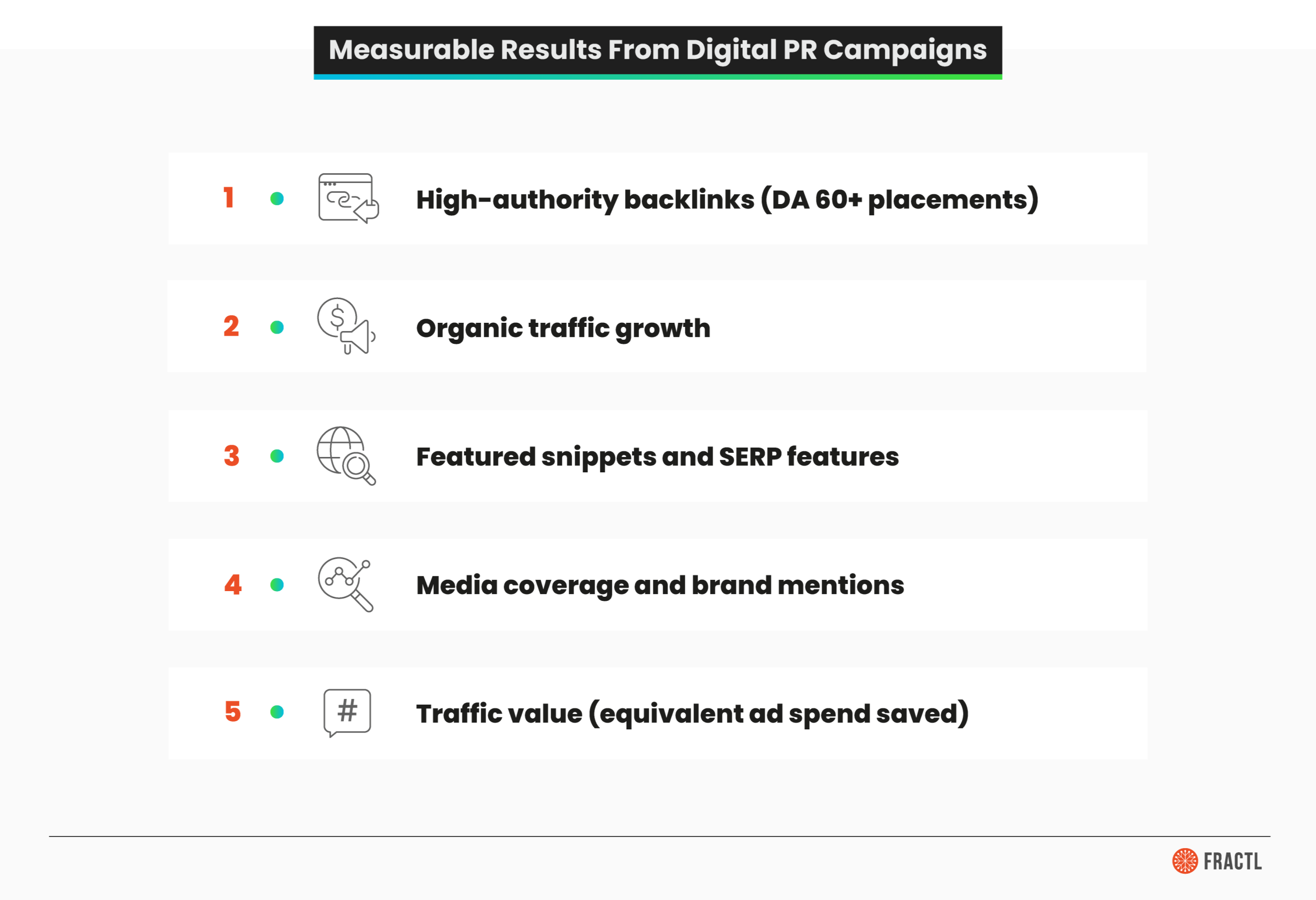
Digital PR isn’t a brand awareness play you hope works. Done well, it’s a data-driven marketing strategy with measurable results tied to search engine optimization and AI search performance, rankings, and business goals. Here’s what successful PR campaigns deliver, with benchmarking from a couple of Fractl’s own case studies:
 High-quality backlinks Links from publications with DA 60+ that improve search engine rankings and AI visibility. Fractl’s full-service engagement for Payless Power earned 450 backlinks from DA 60+ publishers. |  Organic traffic growth More backlinks and higher rankings = more organic traffic. McAfee saw a 12% increase in organic traffic in 4 months from Fractl-produced content, with 1,186,193 new monthly visitors. |
 Traffic value The dollar equivalent of what you’d pay in ad spend for the same organic traffic. Fractl’s work for McAfee generated over $1.29 million in monthly traffic value. This metric is one of the clearest benchmarks for ROI: compare your digital PR pricing to the PPC equivalent and the math usually favors PR. |  Media coverage and brand mentions Placements in publications your target audience reads. Fractl’s campaigns for Payless Power got 1,208 press mentions in outlets like Yahoo, USA Today, and MSN. Earned media coverage builds brand awareness, drives referral traffic, and signals authority to both search engine algorithms and AI-powered platforms like ChatGPT. |
 Featured snippets and SERP features Content built for digital PR campaigns can capture featured snippets. Fractl earned 586 featured snippets for McAfee and elevated 32 pages to the #1 position. |
These metrics should inform your KPIs when evaluating any PR agency or content marketing agency. Ask stakeholders what outcomes matter most and align your PR strategy accordingly. If an agency can’t show you case studies with specific results tied to these metrics, that’s a red flag.
The Real Question: Is It Worth the Investment?
Compare the digital PR campaign cost to your alternatives:
Paid media and ad spend PPC and Google Ads deliver immediate traffic but stop the moment your budget runs out. Email marketing and social media marketing require ongoing spend for ongoing results. Digital PR earns assets (backlinks, media coverage, brand mentions) that continue driving results long after the up-front investment, making it one of the most efficient marketing channels for long-term growth. |  Building an in-house PR team Salaries for PR professionals, tools, recruitment, and training add up fast. And it takes years to build the media contacts, methodology, and partnerships an experienced agency already has. In-house works better when you pair it with agency execution for specific campaign types. |  Doing nothing Your competitors are investing in digital PR. Every month without it is a month they’re earning the backlinks, media mentions, Ai visibility, and search engine rankings you’re not. This is especially true in competitive verticals like SaaS, e-commerce, and health care where digital marketing services are table stakes. |
Digital PR isn’t the cheapest marketing strategy, but it’s one of the few that compounds. The brands getting the strongest returns are the ones investing consistently over six to 12 months with an organic growth strategy that aligns PR, content marketing, and SEO into one system. That kind of decision-making (treating PR as an investment rather than an expense) separates the brands that scale from the ones that stall.
We’ve spent over a decade at Fractl building PR campaigns that deliver measurable organic growth for Fortune 500 brands, funded startups, and SMBs. If you’re evaluating what the right investment looks like for your brand, let’s talk.
FAQs
What is a digital PR campaign?
A digital PR campaign is a structured public relations effort designed to earn media coverage, high-authority backlinks, and brand mentions from online publications. Campaign types include data journalism (original research pitched to journalists), reactive PR and newsjacking (rapid-response content tied to breaking news), proactive PR (expert commentary and thought leadership), and evergreen resource guides. Unlike traditional PR, digital PR campaigns are directly tied to SEO and AI search outcomes: the backlinks and earned media they generate improve your search rankings, organic traffic, and visibility across both traditional search and artificial intelligence platforms.
How much should I budget for digital PR?
Budget depends on your business goals and company size. Small businesses and startups should plan for $5,000–$10,000/mo for targeted digital PR services. Midsized companies typically invest $10,000–$35,000/mo for multi-campaign marketing strategies across several marketing channels. Enterprise brands with aggressive growth targets often spend $50,000/mo on full-service engagements. For one-off campaigns, the budget varies widely depending on scope. Commit retainers for at least six months: digital PR results compound over time, and a short-term trial rarely shows the full picture. Our SEO pricing guide covers marketing budget planning in more detail.
What’s the difference between digital PR and traditional PR costs?
Traditional PR focuses on offline media (TV, print, radio) and typically involves higher up-front production costs (video, print ads, event sponsorships). Digital PR focuses on online publications and is more measurable: you can track links earned, referral traffic driven, rankings improved, and traffic value generated against specific KPIs. Digital PR pricing ranges from $5,000–$75,000+/mo depending on the scope of work. The key difference is accountability: digital PR delivers trackable metrics tied directly to search engine/AI search performance and digital marketing outcomes, while traditional PR’s impact on brand awareness is harder to quantify through concrete benchmarking.