




Table of Contents
- Traditional vs. Digital PR: What Sets Them Apart?
- What Is Traditional PR?
- Why It’s Hard To Tell Who’s Listening To Traditional PR
- Digital PR: A Measurable Evolution of Traditional PR
- Consumer Engagement You Can Measure With Digital PR
- Go Beyond Telling a Story and Create a Conversation
“What’s our public relations strategy?”
It’s a question that a lot of executives might brush to the side, especially in the early stages of building their company. And back in the days of traditional PR, a lot of brands would simply fall back on talking about themselves. “Enough about us,” you’d hear, “Let’s talk about you; what do you think of us?”
This type of one-way communication isn’t what your audience is looking for, particularly in today’s world, where few aspects of our day-to-day haven’t been profoundly changed by the rise of social networks and digital connections. For communication teams, it isn’t really a question of whether to embrace this new reality, but one of how to make the most of its incredible power to expand the reach of your brand’s key messages.
Public relations is strategic storytelling, and both traditional and digital PR function in this way. Key differentiators, though, lie in their objectives and the channels in which key relationships are built to reach target audiences, along with which one is more measurable.
Traditional vs. Digital PR: What Sets Them Apart?
While traditional PR and digital PR share the same core goal, strengthening brand reputation, they operate in very different ways. Traditional PR focuses on earning exposure through legacy media outlets, while digital PR prioritizes online visibility, search performance, and measurable engagement.
The table below breaks down the key differences across channels, targeting, content formats, measurement, and business impact so you can quickly see how each approach supports modern brand growth.
| Traditional vs. Digital PR | ||
|---|---|---|
| Category | Traditional PR | Digital PR |
| Primary focus | Brand awareness and reputation through mass media exposure | Brand visibility, authority, and engagement across online channels |
| Core channels | Newspapers, magazines, radio, and television | Online publications, blogs, social media, and search engines |
| Communication style | One-way messaging from brand to audience | Two-way interaction that encourages engagement and feedback |
| Audience targeting | Broad, general audiences | Specific, data-informed audience segments |
| Content format | Press releases, media briefings, and events | Data-driven stories, thought leadership, visual assets, and shareable content |
| Relationship building | Long-term relationships with journalists and editors | Scaled relationships with journalists, bloggers, influencers, and creators |
| Speed and flexibility | Longer lead times and fixed publication schedules | Real-time publishing and rapid campaign adjustments |
| Measurement approach | Estimated reach, circulation, and sentiment | Trackable metrics tied to behavior and performance |
| Key success metrics | Media mentions, impressions, and tone | Backlinks, organic traffic, referral traffic, and engagement |
| Attribution clarity | Limited visibility into audience actions | Clear attribution to traffic, conversions, and SEO impact |
| Feedback and insights | Minimal audience insight | Detailed analytics and performance data |
| Business impact | Difficult to connect coverage to outcomes | Directly tied to awareness, trust, and revenue goals |
What Is Traditional PR?
A traditional outreach strategy focuses on distributing press releases to as many media outlets as possible, including newspapers, magazines, and radio and television stations.
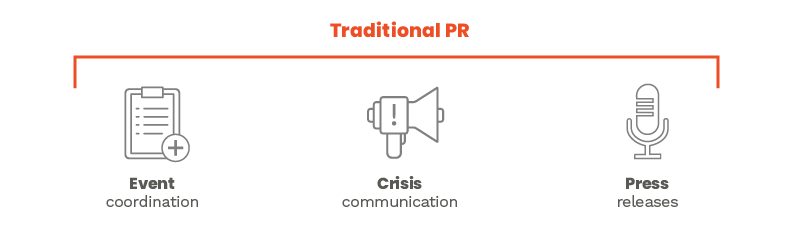
Traditional publicity has been falling by the wayside for a number of years, in large part because its tactics are a bit dated and success can be difficult to track. Event coordination, crisis communication, and press releases all fall under the umbrella of traditional PR, with press releases being one of the most used tactics. Some of the major characteristics of traditional PR include:
- One-way communication. Brands share messages with the public but receive little direct feedback from audiences.
- Broad audience reach. Messaging is distributed to large, general audiences rather than specific segments.
- Relationship-driven outreach. Success depends heavily on media relations and long-term connections with journalists and editors.
- Limited performance data. Measurement often relies on circulation numbers, estimated reach, and sentiment rather than concrete user behavior.
Traditional public relations can still play a role in building brand awareness, especially for reputation management and credibility. However, understanding who actually engaged with the message (and how that exposure influenced behavior) remains difficult.
Why It’s Hard To Tell Who’s Listening To Traditional PR
One of the biggest challenges with traditional media coverage is attribution. While a feature placement may look impressive, it’s rarely clear how audiences responded.
Here are some of the challenges of measuring the outcome of traditional PR methods:
- Estimated reach, not actual engagement. Circulation and viewership numbers show potential exposure, not confirmed readership.
- Long lead times. Print and broadcast placements often require months of planning before publication.
- Minimal audience insight. There’s little visibility into demographics, actions taken, or downstream impact.
- Surface-level success metrics. Coverage is often evaluated by brand mentions or tone rather than outcomes tied to business goals.
These pain points make it difficult for PR teams and stakeholders to connect traditional media placements to traffic, conversions, or shifts in public opinion.
Digital PR: A Measurable Evolution of Traditional PR
Digital public relations does, in fact, borrow from the same playbook as traditional public relations in that it hinges on strategic relationship building and visibility. The key difference is that it focuses on content marketing that talks subtly about your brand instead of blatant promotion.
But beyond avoiding shameless self-promotion, digital PR distinguishes itself as the preferred method of communication through the following three areas:
- Multiple channels. Compared to traditional PR, a digital PR strategy utilizes more avenues to get your brand’s message in front of your target audience. Digital strategists leverage websites, blogs, and social media placements to deliver real-time results across an increasingly sophisticated and connected digital community.
- Audience interaction. Traditional PR relies solely on one-way communication; it places key messages in front of an audience without any means of feedback. Digital PR, on the other hand, opens the door for a two-way dialogue between a brand and its core audiences, generating new opportunities for positive consumer interaction and engagement.
- Measurable objectives and goals. What really sets digital public relations apart from its traditional counterpart is the ability to clearly track and measure success. With tools like Google Analytics, it is now easier than ever to track exactly how many links your content is earning, how many people are sharing your content, and which publishers are driving the most traffic to your site.
In all three areas, success lies in your ability to create quality content that influencers want to share. Remember that it took influencers years to build their audience, and they don’t want to lose followers by promoting something that their audience will not find valuable. Make the most of these relationships and their respective channels; don’t waste them with unappealing content.
Thought Leadership as a Digital PR Method
Thought leadership has become a cornerstone of modern digital PR campaigns. Rather than promoting products directly, brands build authority by contributing expertise. Some examples of thought leadership in digital PR include:
- Original research reports and data studies
- Expert commentary published in media outlets
- LinkedIn articles and executive bylines
- Industry trend analysis shared across digital channels
Building Relationships That Scale Across Digital Channels
While tools and metrics have evolved, building relationships remains central to public relations. The difference is scale. Digital PR allows brands to build and maintain relationships not only with journalists but also with bloggers, influencers, and content creators across multiple media channels.
Effective relationship-building in digital PR includes:
- Data-backed content. Providing high-quality research, statistics, and insights that journalists and bloggers can confidently reference.
- Expert commentary. Supporting publishers with timely quotes, original analysis, and subject-matter expertise.
- Consistent outreach. Maintaining regular, thoughtful communication across digital channels and online platforms.
- Long-term value. Focusing on ongoing media relationships rather than one-off placements or transactional pitches.
Consumer Engagement You Can Measure With Digital PR

Digital PR makes it easier to connect media coverage to outcomes by focusing on metrics tied to visibility and trust. Brands measure the SEO impact of their PR campaigns by tracking these common metrics:
- Backlinks. Earned links from high-quality media placements support SEO and search rankings.
- Organic traffic. Media coverage can drive sustained traffic from search engines.
- Social engagement. Shares, comments, and discussions signal audience interest.
- Referral performance. Analytics tools show which media channels send traffic that converts.
These measurable outcomes help teams show the impact of digital PR on brand awareness, building trust, online presence, and business goals in ways that traditional PR metrics could not.
Go Beyond Telling a Story and Create a Conversation
No one just wants to read what you post anymore; you need a more dynamic plan. Traditional PR has its place, but your brand needs digital PR to remain competitive in the ever-expanding white noise that is the internet. A major benefit of digital PR is that it transforms what your brands have to say into a conversation that speaks directly to your target audience because it focuses on reaching them where they are most actively engaging: online.
Brands must understand that external communication is more than just a one-way street. Adapting a traditional press release to a much more visually attractive format, for instance, can be the difference between success and failure. Brands that actively engage in digital PR tactics are more likely to connect their most important audiences with their most important messages and achieve the kind of business results that create long-term success.