




Table of Contents
- How To Use Ahrefs Backlink Checker: A Step-by-Step Walkthrough
- Key Backlink Metrics and What They Mean
- Why Backlinks Are Still One of the Strongest Ranking Factors
- Types of Backlinks You Should Know
- How To Turn Backlink Data Into Link Building Strategy
- How Backlinks Build Brand Authority
- Use Competitor Backlinks To Lead Your Content and Outreach Strategy
- Better Links Start With Better Data
- FAQ
Even with the rise of AI Overviews and zero-click search, backlinks are still among the most powerful ranking factors in search engine optimization. Understanding what makes backlinks important is the first step toward a stronger online presence, but knowing you need them isn’t enough; you need to know which ones matter, where the gaps are, and what to do next. That’s where a backlink checker like this one comes in.
Ahrefs Backlink Checker is one of the most widely used SEO tools for analyzing a site’s backlink profile, monitoring referring domains, and spotting link-building opportunities. At Fractl, we use it daily to inform our digital marketing and digital PR strategies for clients across industries.
I’ll explain how to use this tool, the metrics that matter most, and how to turn raw backlink data into a link-building strategy that improves both your search engine rankings and your brand authority. I’ll also cover how backlinks connect to keyword research, internal links, technical SEO, and the broader content creation process.
How To Use Ahrefs Backlink Checker: A Step-by-Step Walkthrough
Ahrefs crawls over 490 billion web pages and maintains an index of more than 35 trillion external backlinks, making it one of the largest backlink databases available. Its crawlers process roughly 5 million pages per minute, so the data refreshes frequently.
Here’s how to use the tool to analyze any website’s backlink profile.
Access the Free Backlink Checker
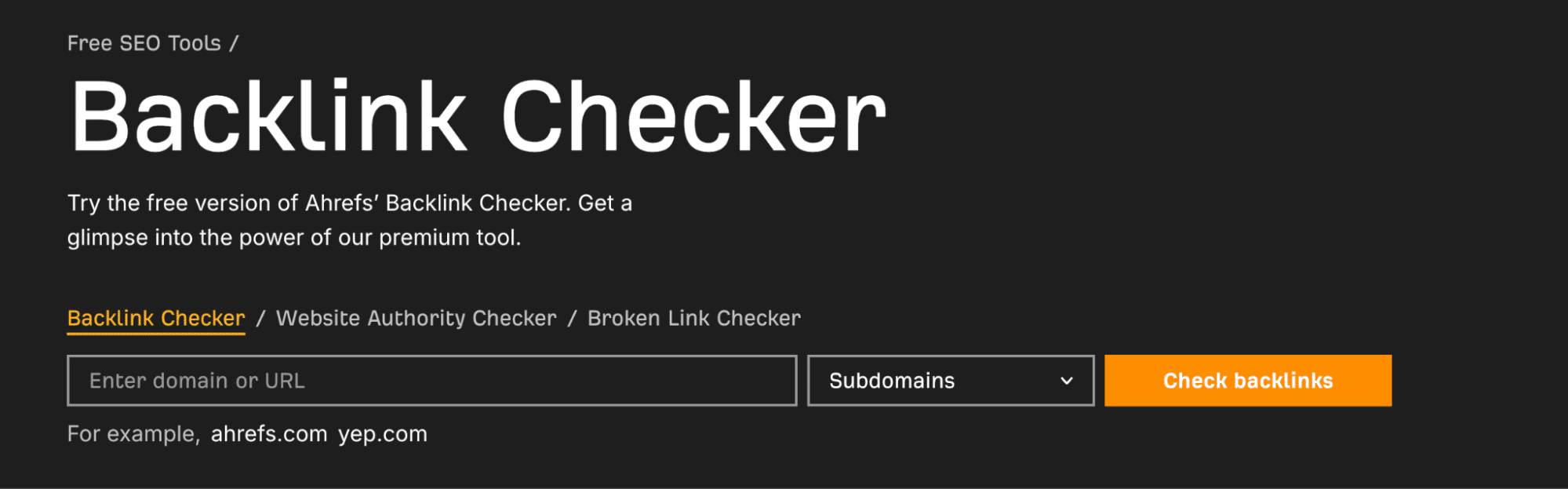
Go to Ahrefs’ free Backlink Checker page. You don’t need a paid account to get started. Enter a domain, subdomain, or specific URL into the search bar and click “Check backlinks.” The free version shows a limited snapshot; the full Site Explorer tool (paid) gives you access to complete data.
Review Your Top Backlinks and Referring Domains
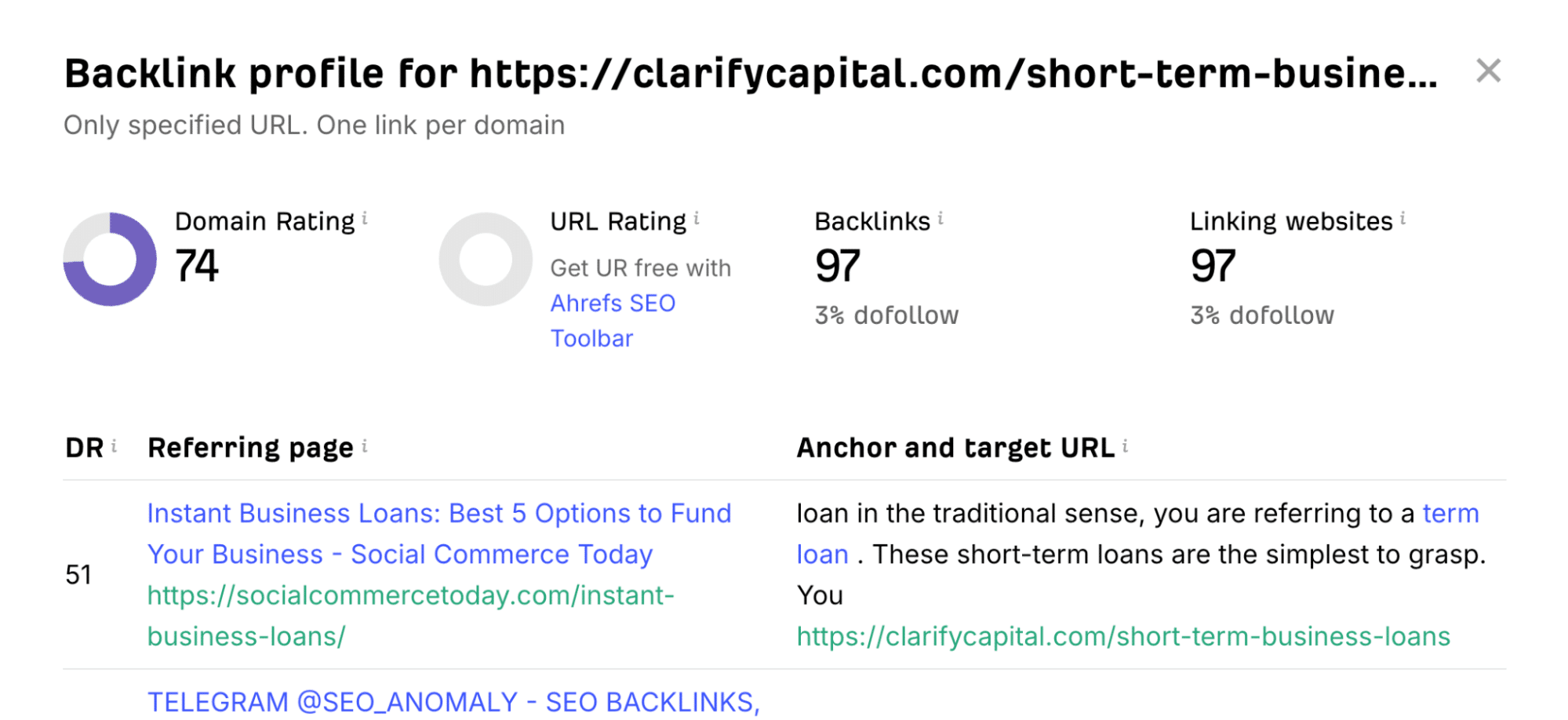
The free checker displays your top 100 backlinks along with the referring domain for each one. Scan through to see which sites are linking to you and note their Domain Rating scores. If you spot clusters of links from low-quality or irrelevant sites, those could be hurting more than helping.
Look for patterns. Are most of your links from a handful of domains? Are they from relevant sites in your industry, or random directories and forums? A strong backlink profile has diversity across high-authority, topically relevant referring domains. The free tool also shows your total referring domain count and a chart of how that number has changed over time.
Check Your Anchor Text Distribution
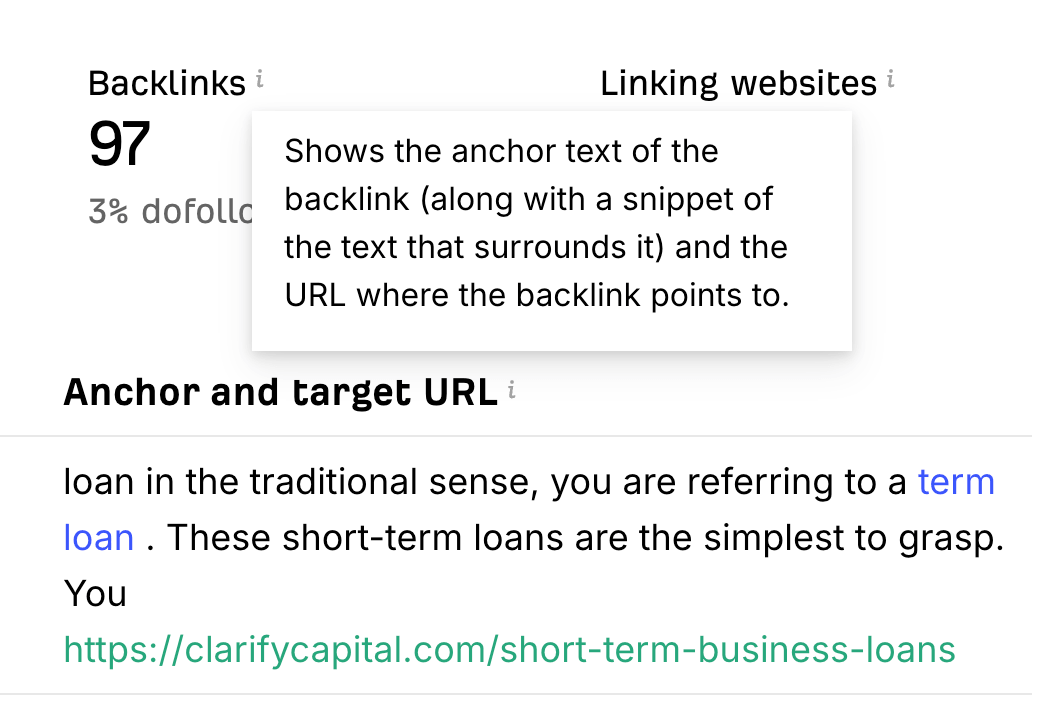
The anchor text report shows the clickable text other sites use when linking to you. A natural distribution includes a mix of branded terms (your company name), naked URLs, generic phrases (“click here”), and topical keywords. If your profile is heavily weighted toward one exact-match keyword, that’s a red flag for Google. Webmasters and site owners who spot overoptimized anchor text across their backlink profiles should diversify their link-building approach.
Key Backlink Metrics and What They Mean
Whether you’re using Ahrefs’ free tool or a paid plan, you’ll encounter a handful of metrics that shape how SEOs evaluate backlink profiles. Here’s a quick reference.
| Ahrefs Backlink Metrics | |
|---|---|
| Metric | What it measures |
| Domain Rating (DR) | The relative strength of a website’s backlink profile on a scale from 0 to 100. Higher DR generally correlates with stronger rankings. |
| URL Rating (UR) | The strength of a specific page’s backlink profile, also on a 0 to 100 scale. |
| Ahrefs Rank | A global ranking of all websites by the strength of their backlink profiles. Lower number = stronger profile. |
| Referring domains | The number of unique websites linking to a target. More important than raw backlink count because one domain with 500 links still counts as one referring domain. |
| Organic traffic | Estimated monthly search visits from Google based on current rankings and search volume data. |
| Organic traffic value | The estimated dollar value of organic traffic if it were purchased through Google Ads. A useful proxy for the ROI of your SEO strategy. |
| Authority score | A composite metric (used by some SEO tools, including Semrush) that factors in backlink data, organic traffic, and other signals to estimate domain authority. Ahrefs uses DR instead, but the concept is similar. Moz’s version is called Domain Authority (DA). |
A quick note on PageRank: Google’s original algorithm used PageRank to measure page importance based on link quantity and quality. Google no longer makes PageRank scores public, but the underlying principle still shapes how search engines evaluate links. Ahrefs’ DR and UR are modern approximations of the same idea.
Why Backlinks Are Still One of the Strongest Ranking Factors
Backlinks still matter for reasons that go beyond search rankings. Here’s why they remain one of the strongest signals in SEO, and increasingly, in AI-driven search as well:
- Votes of confidence from other sites. Search engines treat backlinks as endorsements. When a reputable site links to your content, it signals to Google that your page is trustworthy, relevant, and worth surfacing in results.
- Brand authority that compounds over time. High-quality links from recognized publications build name recognition before a potential customer ever clicks a search result, something paid advertising alone can’t replicate.
- Visibility in AI-generated results. Sites with consistent, high-quality inbound links are more likely to be cited in AI overviews, featured snippets, and knowledge panels. As Kelsey Libert writes in Search Engine Land, brand visibility now spans traditional search, social media, and generative AI platforms.
- Connective tissue across channels. Backlinks don’t just support one signal; they reinforce authority everywhere your brand appears online.
Types of Backlinks You Should Know
Not all backlinks carry the same weight. Here are the main categories you’ll encounter when reviewing a backlink profile.
- Dofollow links. These pass link equity (sometimes called “link juice”) from the linking page to your site and directly influence your search engine rankings. Most links on the web are dofollow by default.
- Nofollow links. These include a rel=”nofollow” attribute that tells crawlers not to pass ranking signals. Google treats nofollow tags as hints rather than hard rules, so they may still carry some indirect value. Social media profile links, blog comments, and some directory listings are typically nofollow. They won’t move the needle on rankings alone, but they contribute to a natural-looking backlink profile.
- Editorial links. Earned naturally when bloggers, journalists, or website owners reference your content because it’s genuinely useful. These are the gold standard of backlinks and the hardest to get.
- Guest posting links. Placed through guest blogging on relevant sites. The value depends entirely on the quality and relevance of the host site. A guest post on a high-authority industry publication is worth far more than one on a generic content farm.
- Self-created links. Added by you in forums, directories, blog comments, or profile pages. These carry the least weight and can look spammy if overdone. Use them sparingly and only on legitimate, relevant platforms.
A single high-quality link from a relevant, high-authority site can outperform hundreds of low-quality ones. The markers of quality: the linking site is topically relevant, has strong domain-level metrics (high DR or DA), uses natural anchor text, places the link within editorial content (not sidebars or footers), and isn’t associated with link farms or paid link schemes.
If your Ahrefs audit reveals a pattern of suspicious links from irrelevant or spammy sites, consider using Google’s disavow tool to distance your site from them.
How To Turn Backlink Data Into Link Building Strategy
Analyzing your backlink profile is the research phase. The real value comes from using those insights to earn better links. Here are the link-building strategies we rely on most at Fractl, each informed by what the data tells us about a site’s authority and competition:
 Broken link building Use Ahrefs to find broken outbound links on high-authority sites in your niche. If you have (or can create) content that fits, reach out to the webmaster and suggest your page as a replacement. It’s a win for both sides: They fix a dead link, you earn a new backlink. |  Guest posting on relevant sites Use Ahrefs’ competitor backlink analysis to find sites that link to your competitors but not to you. If those sites accept guest contributions, pitch a topic that fills a gap in their existing content. Focus on relevance and audience overlap, not just domain authority. |
 Content marketing and digital PR At Fractl, our earned media campaigns have driven hundreds of high-quality backlinks from high-authority publishers — including 390 referring domains from nine Adobe campaigns. Create content worth linking to, then promote it. |  Resource pages and niche directories Use Ahrefs to find resource pages that already link to competitors, then pitch your own relevant content. For local SEO, submit to legitimate local directories and industry-specific citation sources. |
 Social media and podcasts While most social media links are nofollow, building your brand’s presence on platforms like LinkedIn and through podcast appearances generates brand mentions and referral traffic that often lead to organic editorial links down the line. |  Outreach emails that get responses Personalize every message. Reference the recipient’s recent content, explain why your resource fits their audience, and keep it short. The best outreach treats link building as relationship-building, not a template blast. |
How Backlinks Build Brand Authority
It’s a flywheel (self-reinforcing cycle) that works like this:
Links improve rankings ➡️ rankings increase visibility ➡️ visibility builds brand recognition ➡️ a recognized brand earns links more easily. Over time, your reputation and your search presence reinforce each other.
For a deeper look at evaluating site credibility, see our guide on how to determine the authority of a website.
We’ve seen this play out in client work. Fractl’s campaign for Payless Power earned over 1,200 press mentions (including 450 from publishers with a domain authority above 60) and increased their referring domains by 55% in 16 months. The result was a measurable shift in brand strength and organic traffic value.
You can track your own progress in Ahrefs by monitoring your Domain Rating trend, the quality of new referring domains, and organic traffic growth. Moz’s Domain Authority and Semrush’s Authority Score offer additional benchmarks.
Use Competitor Backlinks To Lead Your Content and Outreach Strategy
Analyzing your own backlink profile is only half the picture. When you pull a competitor’s backlinks in Ahrefs Site Explorer, you’re not just looking for link gaps; you’re building the foundation for smarter campaigns, sharper outreach, and more strategic content.
Here’s what competitor backlink data can tell you:
- Who’s covering your competitors (and would cover you). Every referring domain in a competitor’s backlink profile represents a journalist, editor, or site owner who’s already interested in your topic. Export those referring domains, filter by DR, and you’ve got a warm outreach list for your next digital PR campaign.
- What data and topics resonate with publishers. The specific stats, angles, and subject matter that earned your competitor links tell you what the market rewards. Create new content with fresher data on those same topics, and you’re positioned to compete for those same placements in the next cycle.
- Which content formats perform best. Was the linked content a survey? A data visualization? An interactive tool? Knowing the format helps you choose the right content type for your own campaigns. If surveys dominate the backlinks in your niche, that’s a signal.
- Where the content gaps are. A full competitor backlink audit reveals which topics have earned coverage across your niche and where no one has produced something definitive yet. Fill those gaps with stronger, more comprehensive content, and you have a clear path to earning links your competitors missed.
Think of it as a bird’s-eye view of what’s working in your space: the where, when, and why behind your competitors’ link-building wins. Ahrefs makes this accessible in a few clicks. Pull a competitor’s referring domains, sort by DR, and start mapping your next campaign.
Better Links Start With Better Data

Ahrefs Backlink Checker gives you the data to understand your link profile, spot weaknesses, and find the opportunities your competitors are capitalizing on. But data alone doesn’t build backlinks or strengthen your brand. The value comes from acting on what you find: fixing broken links, creating content worth referencing, reaching out to the right sites, mining competitor backlinks to guide content creation and outreach, and building a brand strategy that earns editorial links over time.
Whether you’re a beginner running your first backlink audit or a seasoned digital marketing professional refining your SEO strategies, the fundamentals are the same. Focus on earning links from relevant, high-authority sites. Track your progress with keyword research and backlink monitoring. And invest in the kind of high-quality content and content strategy that makes people want to link to you.
If you’re looking for a team that turns backlink data into measurable results, learn more about our digital PR services and how we’ve helped brands build stronger link profiles and grow organic traffic.
FAQ
How do you use Ahrefs for backlinks?
Go to the Ahrefs Free Backlink Checker (or Site Explorer if you have a paid plan), enter a URL, and click “Check backlinks.” From there, review the overview dashboard, analyze referring domains, check anchor text distribution, monitor new and lost backlinks, and run competitor comparisons. The step-by-step walkthrough above covers each stage in detail.
Which backlink checker is most accurate?
Accuracy depends on how frequently a tool crawls the web and the size of its database. Ahrefs is widely considered one of the most comprehensive, with over 35 trillion external links indexed. Moz Link Explorer offers a strong free option with its own Domain Authority scoring system. Semrush Backlink Analytics is another popular choice, especially for users already in the Semrush ecosystem. Google Search Console is free and shows the links Google has actually discovered for your site, making it a useful complement to third-party SEO tools.
Is 500 backlinks good?
The number of backlinks alone doesn’t tell you much. Fifty links from high-authority, topically relevant sites will outperform 5,000 links from low-quality sources every time. What matters is the quality and diversity of your referring domains, not the raw number of links. Use Ahrefs to evaluate the strength and relevance of the sites linking to you rather than chasing a specific count.
How do beginners get backlinks?
Start with the foundations:
- Create great content that answers real questions in your industry.
- Submit your site to relevant niche directories and local business listings.
- Write guest posts for reputable sites in your space.
- Participate in industry forums and communities where you can share expertise (not just drop links).
- Build a social media presence that drives brand mentions and referral traffic.
- Use Ahrefs to find broken link opportunities and competitor gaps.
- For startups, consider crowdfunding campaigns and industry events as ways to generate early media mentions and inbound links.
The key for beginners is consistency. Build backlinks gradually through legitimate link-building tactics rather than trying to shortcut the process with spammy or black-hat methods. Quality always wins over time.