




Table of Contents
- Why Holidays Create Unique Thought Leadership Opportunities
- Digital PR vs. Traditional PR for Holiday Campaigns
- Campaign Types That Build Holiday Thought Leadership
- How To Plan a Holiday Thought Leadership Strategy
- Measuring the Impact of Holiday Thought Leadership
- Earned Media vs. Paid Media vs. Owned Media: Why Earned Wins for Thought Leadership
- Extending Your Holiday Thought Leadership Across Channels
- Start Building Your Holiday Digital PR Engine
- FAQ
We all know the holidays drive consumer spending, but did you know that means it also drives media demand? Journalists need expert sources for seasonal stories, and the brands that show up with ready-to-publish quotes, original research, and timely commentary are the ones that earn coverage, backlinks, and long-term brand visibility.
At Fractl, we’ve spent years building digital PR campaigns that position our clients as thought leaders during holidays throughout the year, from Valentine’s Day and Mother’s Day to Black Friday, Thanksgiving, and the December gift-giving season. Our approach works because it meets journalists where they are: looking for credible expert sources on topics their audiences care about right now.
These are the proven campaign types, planning strategies, and real examples we use to turn holiday moments into lasting earned media coverage and thought leadership for our clients.
Why Holidays Create Unique Thought Leadership Opportunities
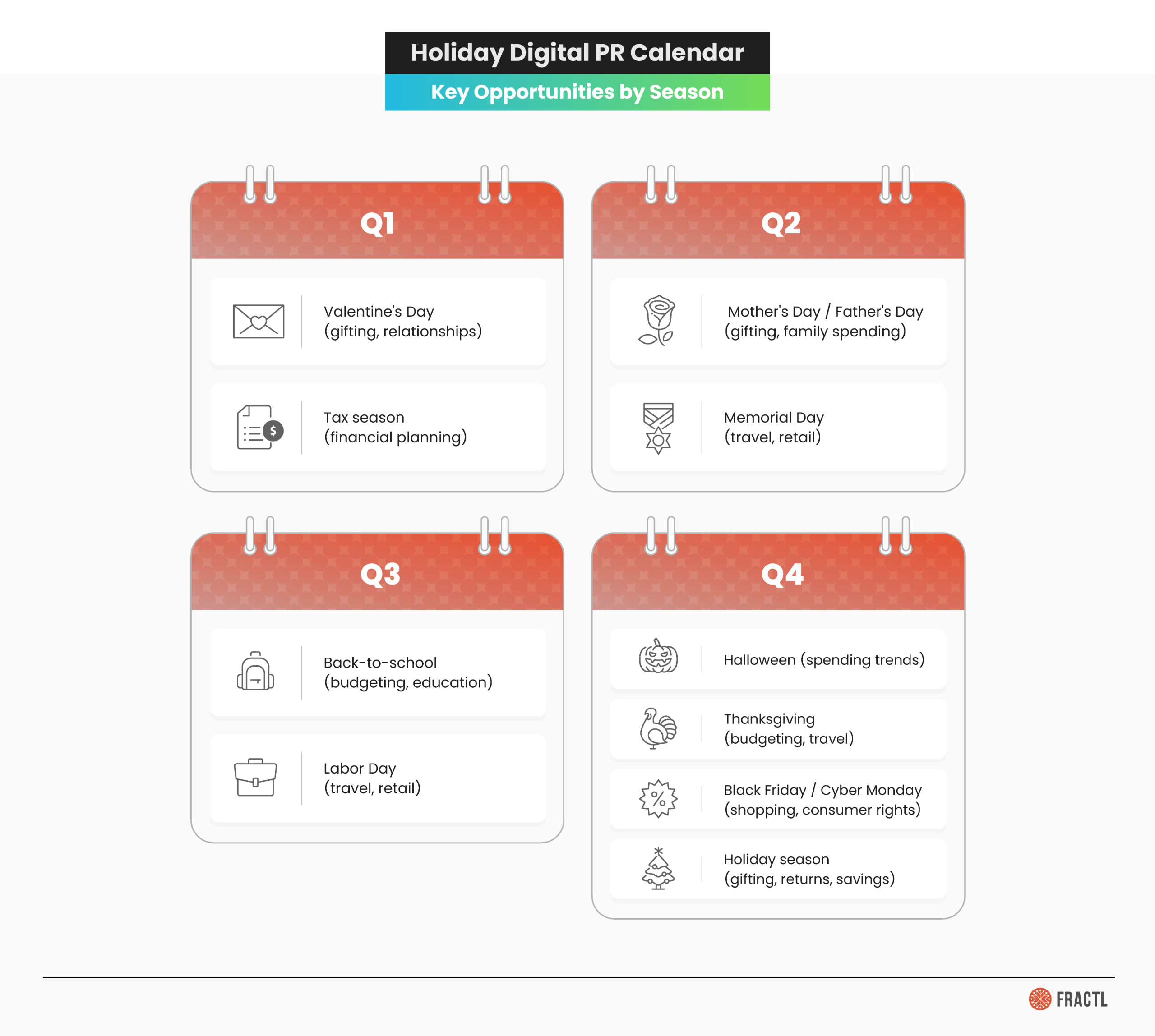
Every holiday on the calendar creates a predictable spike in media interest around specific consumer topics:
- Thanksgiving triggers stories about budgeting and travel.
- Black Friday brings coverage of shopping tactics and consumer rights.
- The December holiday season generates pieces on gifting, returns, and personal finance.
Valentine’s Day, Mother’s Day, back-to-school, and even daylight saving time each create their own clusters of media demand, too. What makes these windows so valuable for thought leadership is that journalists are actively seeking expert sources on these topics. They’re writing stories on tight deadlines and need credible quotes from subject matter experts who can provide unique insights on seasonal topics.
Brands that have quotes ready, data prepared, and a point of view worth sharing earn more than media coverage; they earn positioning as a trusted source that reporters return to year after year.
The holidays also span enough of the calendar that you’re not limited to a single window. A well-planned digital PR strategy can target multiple holidays across the year, building a compounding pattern of earned media coverage that strengthens your brand’s reputation and domain authority with each placement.
Digital PR vs. Traditional PR for Holiday Campaigns
Both approaches aim to earn media coverage, but they produce different outcomes during holiday campaigns:
| Traditional PR | Digital PR | |
|---|---|---|
| Primary tactics | Press releases, broadcast placements, media events | Data-driven content, journalist outreach, expert quotes |
| SEO impact | Minimal; coverage rarely includes backlinks | High-quality backlinks and brand mentions that strengthen domain authority |
| Shelf life | Short; a brief spike that fades | Long; placements drive traffic and rankings for months or years |
| Measurability | Impressions, ad equivalency (hard to tie to revenue) | Referral traffic, backlinks, search rankings, domain authority |
| Thought leadership value | Builds brand awareness with broadcast audiences | Builds credibility with search engines and online audiences simultaneously |
For thought leadership specifically, digital PR is the stronger play. A quote placed in a high-authority news article doesn’t just build credibility with that publication’s audience; it signals trust to search engines and improves your visibility across search engine results for months or years after the initial coverage runs.
We’ve seen this compound effect firsthand. When Fractl produced nine link-building campaigns for Adobe over a six-month engagement, the work drove 56,000 new monthly visits and 390 new referring domains. That kind of lasting SEO impact is what separates a successful digital PR campaign from a traditional press release.
Campaign Types That Build Holiday Thought Leadership
Not every holiday moment calls for the same approach. We use several different campaign types depending on the news cycle, the client’s area of expertise, and the type of media coverage we’re targeting.
Here’s how each one works and when it’s most effective.
For a deeper look at how we build these campaigns, see our guide to driving thought leadership through guest posting.
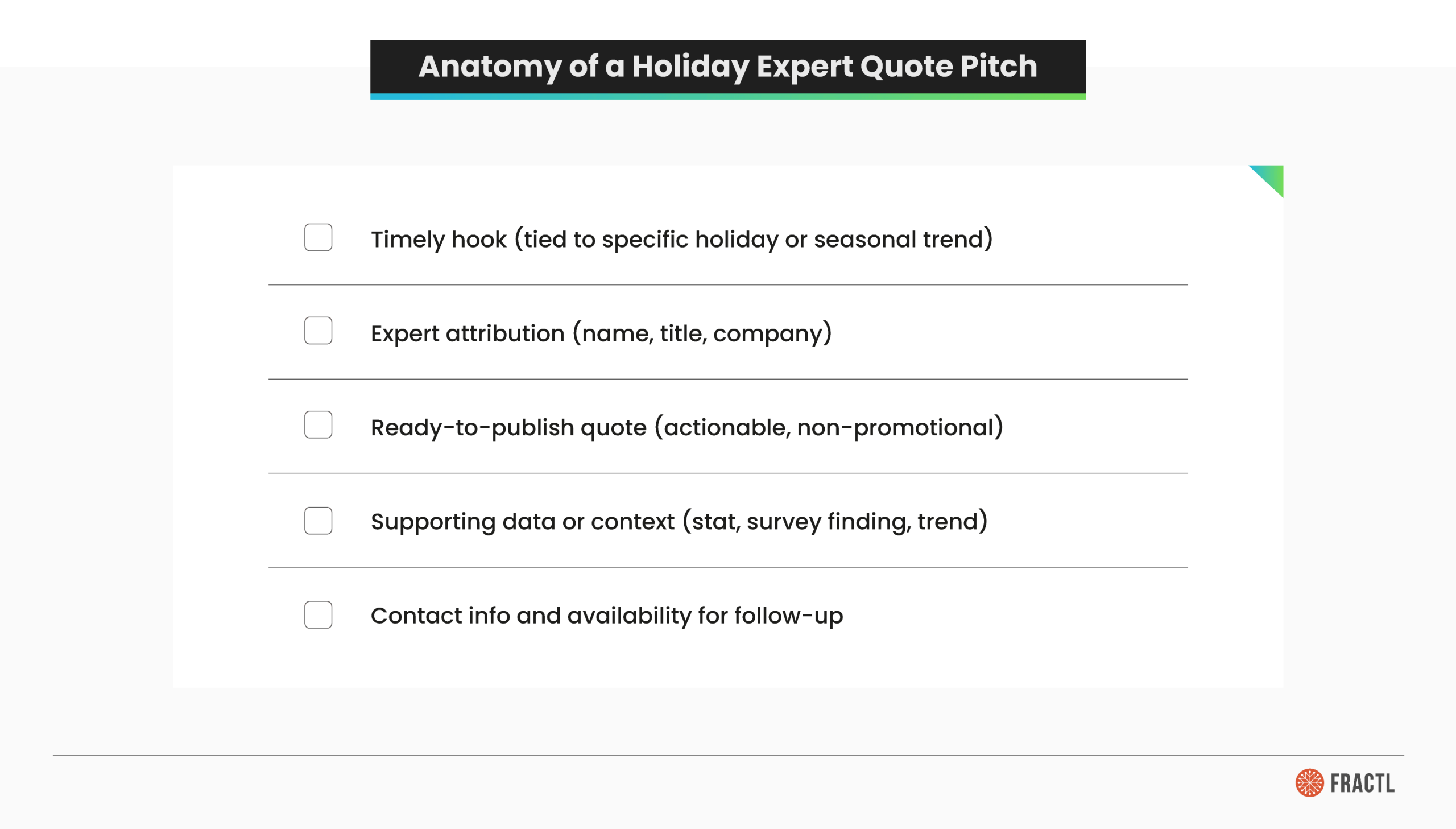
Expert Quotes and Proactive PR
This is the most direct path to thought leadership during the holidays. Proactive PR works by monitoring platforms where journalists seek industry experts for commentary on seasonal topics, then developing quotes on behalf of our client’s leadership team and pitching them to relevant media outlets.
The key is crafting quotes that genuinely help the reader and build trust, not promote the brand.
When a journalist covering Thanksgiving dinner costs needs a financial expert, they want actionable advice that their audience can use immediately. They don’t want a sales pitch. Our job is to make the client’s spokesperson the most useful, quotable source the journalist receives.
For instance, we positioned one of our clients’ Senior Trends Analysts as a go-to expert across eight different seasonal angles in a single season. Each pitch targeted a different publication and topic, building his visibility as a trusted consumer savings voice.
For The Independent, we developed quotes on managing post-holiday returns:
“The best way to track returns is to have all the info in the same place. An app for notes, a spreadsheet program, or a designated email folder will help the consumer keep track of the dates and times for returns, as well as the tracking numbers and refund notices.”
For Scripps News, he advised on keeping holiday meal costs down:
“You just have to be thoughtful about, ‘Am I actually going to use this or not?'”
The full list of placements from this single spokesperson includes:
- Better Homes & Gardens (secondhand gifting)
- The Sun (Black Friday deals)
- Scary Mommy (discount store deals)
- BizJournals (holiday parties)
- GoBankingRates (Amazon gifts)
- U.S. News (holiday savings)
- Scripps News (grocery budgeting)
The beauty of this approach is its scalability. One spokesperson can be pitched across dozens of holiday-related stories throughout the season, and multiple clients can run expert quote campaigns simultaneously. Each placement reinforces their position as an industry expert, and the cumulative effect on brand visibility and referral traffic compounds over time.
Data Journalism Campaigns
Data journalism campaigns involve original research (like surveys, data analysis, public data sets) packaged as newsworthy content. They need more lead time than expert quotes, but they produce some of the strongest thought leadership results because your brand owns the data. Some are proactive (planned months ahead), while others are reactive, built fast around trending topics or seasonal moments. Either way, the brand that collected the data gets credited as the source.
The in-depth research behind these campaigns is what makes them so effective for thought leadership.
When your brand is the one that collected the data, ran the survey, and produced the original findings, you’re not just commenting on the news; you’re creating it. As I wrote in my Search Engine Land column on reactive PR, the brands that respond fastest with the most useful data win the coverage.
The Most Popular Pet Halloween Trends in 2025
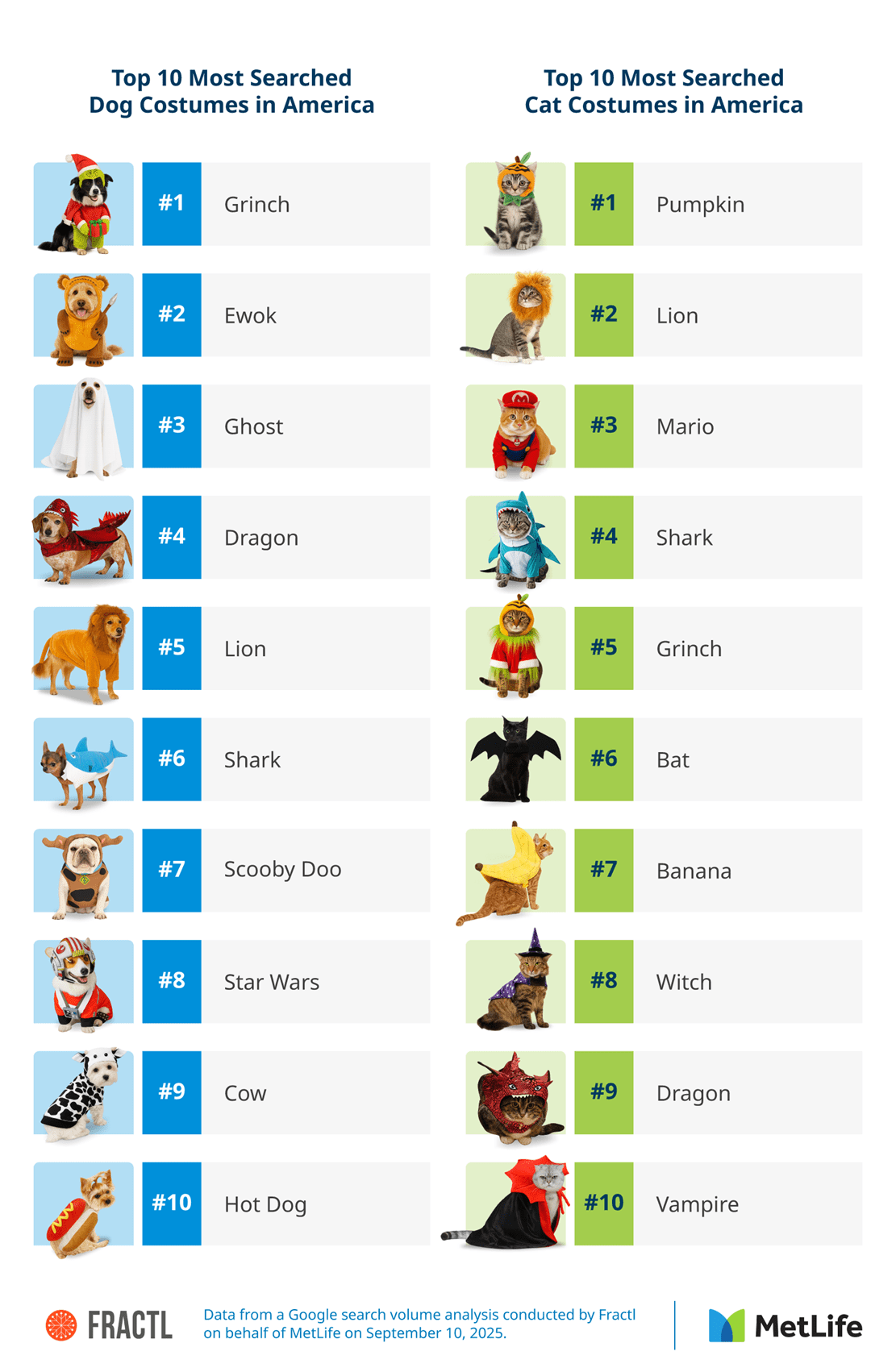
We surveyed pet owners on Halloween costume spending, safety concerns, and trending costumes for dogs and cats. The campaign earned a placement in the New York Post, positioning our client as a go-to source on pet culture and seasonal consumer behavior. That’s a high-authority link from a DA 90+ publisher, earned because we had the original data nobody else did.
Here’s the graphic from the campaign, ranking the top 10 most searched dog and cat costumes in America based on Google search volume data we collected for MetLife Pet Insurance:
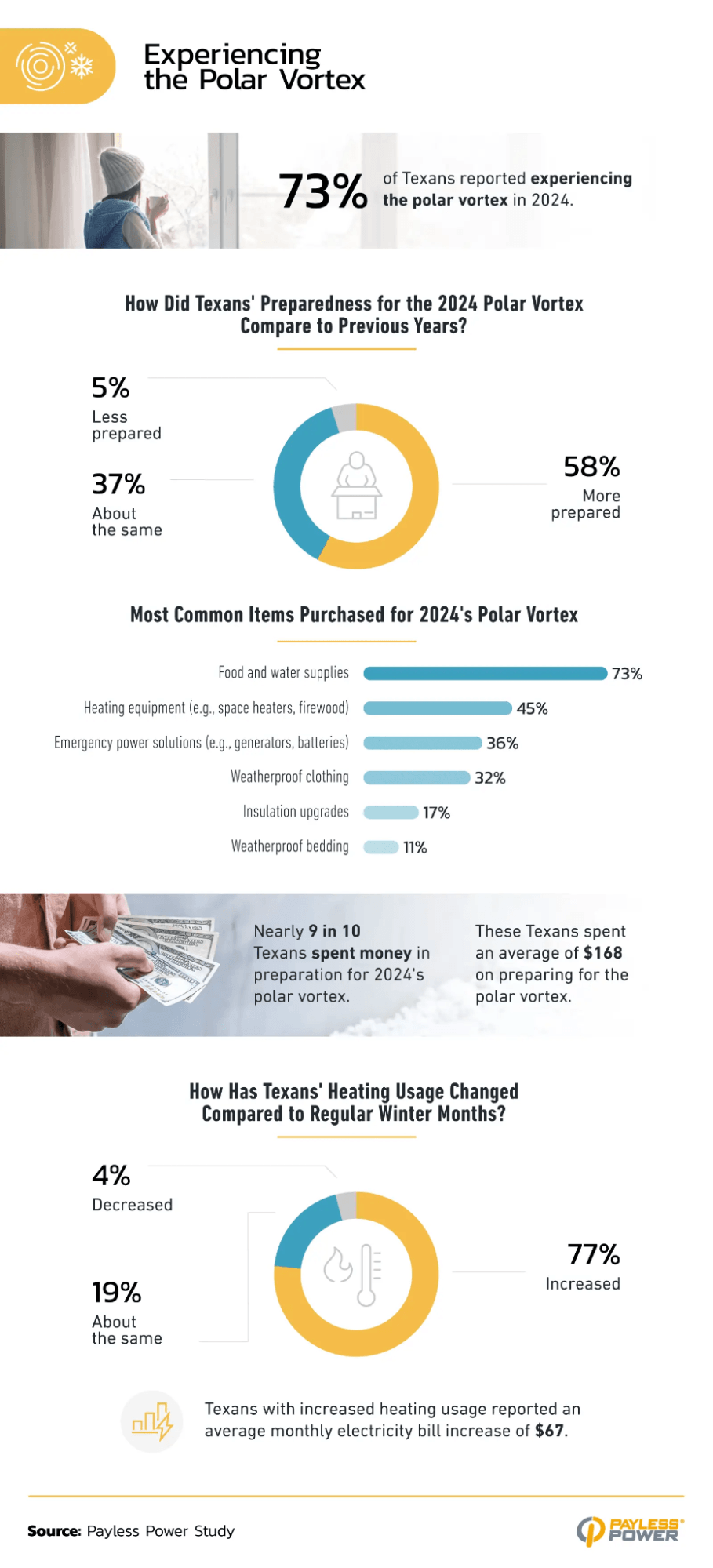
Texans’ Response to the Polar Vortex
When extreme cold weather hits, energy costs and safety concerns dominate local news. We produced a data campaign analyzing the financial impact of polar vortex events, earning regional coverage in the San Antonio Express and other Texas media outlets. Seasonal weather events aren’t holidays, but they follow the same playbook: predictable timing, high public interest, and media outlets actively looking for data to support their reporting.
Here’s an infographic from the campaign:
How Americans Really Feel About Daylight Saving Time
Twice a year, the daylight saving time debate floods newsrooms. We surveyed Americans on whether they want to end the clock change permanently, and the data earned placements in Consumer Affairs and Psychreg. This is a textbook reactive PR play: a predictable news cycle paired with original survey data that gives journalists something fresh to write about.
Here’s a graphic from this campaign, which we produced for Payless Power:
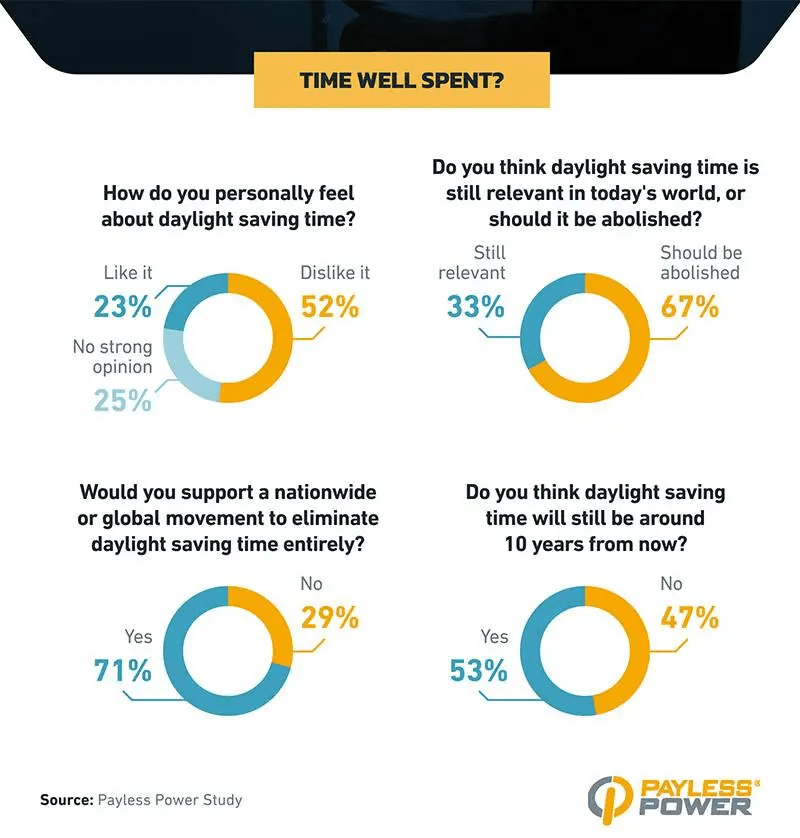
We’ve run variations of this campaign multiple times (Daylight Saving Sentiments, How Texans Feel About Daylight Saving, Getting Rid of Daylight Saving), showing how a strong seasonal concept can be refreshed and re-pitched year after year.
How To Plan a Holiday Thought Leadership Strategy
Executing thought leadership campaigns during the holidays requires planning that starts well before the season you’re targeting. Here’s how we approach it.
Map Your Campaigns to the Holiday Calendar
Every holiday presents different content marketing opportunities. Start by identifying which holidays align with your client’s area of expertise and target audience, then map specific campaign types to each one:
- Proactive PR and expert quotes. These work for nearly every holiday because journalists always need expert sources. Plan quotes and talking points for your client’s spokesperson four to six weeks before each holiday window.
- Reactive PR. You can’t predict exactly what will break, but you can anticipate the types of stories that emerge around each holiday (inflation data around Thanksgiving, consumer rights issues around Black Friday, etc.). Pre-approve topics and have your client’s spokesperson briefed so you can move within 24–72 hours.
- Data journalism. These require up to three weeks for production (depending on the scope of methodology), then publisher outreach typically takes four to six weeks. Map your campaigns to Q4 holidays by starting production in late summer or early fall.
The goal is a thought leadership strategy that keeps your client visible across multiple holiday windows, not just one. Consistency builds recognition with journalists and their audiences, and the KPIs compound: more placements, more backlinks, more brand mentions, stronger domain authority.
Position Your Clients as the Expert Source
The difference between a quote that gets used and one that gets ignored comes down to how useful it is. Journalists want a credible expert who can explain something their audience cares about in clear, quotable terms.
Here’s what we’ve found works when developing quotes for potential clients and existing clients alike:
- Choose the right spokesperson. Match the person to the topic. A CEO works for business strategy commentary. A senior analyst or trends expert works for consumer-facing advice. The title matters because it signals credibility to both the journalist and their decision-makers.
- Lead with actionable advice. The best-performing quotes give the reader something they can do, not just something to think about. When we positioned Clay Cary as an expert on holiday returns, the quotes covered specific tactics: organizing by retailer deadline, keeping original packaging, and using tracked shipping.
- Skip the brand plug. Quotes that mention the client’s product or service get cut. Quotes that provide genuinely valuable insights get published. The thought leadership comes from the attribution line, not from working the brand name into the advice.
Pitch Precisely and Persistently
Holiday pitching is competitive. Media outlets are fielding more pitches than usual while also managing heavier ad inventory and editorial calendars. Your outreach needs to cut through the noise:
- Target tier-1 outlets with the largest syndication networks first, because a single placement can cascade into dozens of pickups.
- Personalize every pitch to the specific journalist and their beat.
- Provide ready-to-publish quotes that save the reporter time (this is why we develop full Q&A responses for our clients, not just talking points).
- Follow up strategically. A well-timed follow-up to a journalist on deadline can be the difference between getting included and getting overlooked.
We build relationships with reporters and bloggers over time, so as a holiday gets closer, our pitches land with people who already know the quality of commentary our clients provide. Partnerships between brands and media contacts aren’t built overnight, which is why consistency across the full holiday calendar matters.
Measuring the Impact of Holiday Thought Leadership
Thought leadership is harder to measure than a direct-response campaign, but the right metrics tell a clear story. We track both immediate and long-term indicators to evaluate whether our PR efforts are building the positioning we’re after.
Immediate Metrics
- Placements and media mentions. How many publications featured the client’s expert? Which media outlets ran the story? Brand mentions and media mentions across news sites and social media platforms give you the full picture.
- Referral traffic. How much website traffic did the placements drive? This tells you whether the coverage reached an engaged new audience.
- Social media mentions and organic mentions. Coverage that gets shared on LinkedIn, TikTok, and other social media channels extends its reach beyond the original placement.
Long-Term Metrics
- Domain authority and search rankings. Each high-quality backlink from a placement strengthens your domain authority, improving rankings across your entire site.
- Repeat coverage. When journalists come back to your client as a source without being pitched, that’s the clearest signal that thought leadership is working.
- Lead generation and conversions. Over time, stronger brand visibility and search engine optimization drive more potential customers to your site. The return on investment from thought leadership is cumulative, not immediate.
When we ran a full-service engagement for Payless Power over 16 months, the results showed this compound effect: 1,208 press mentions (450 from high-authority publishers), a 25% increase in organic traffic, and a $57,351 monthly increase in traffic value. Those numbers don’t come from a single campaign. They come from sustained PR tactics applied across multiple news cycles and holidays.
Earned Media vs. Paid Media vs. Owned Media: Why Earned Wins for Thought Leadership
Understanding where digital PR fits in the broader marketing strategy means understanding the three types of media and why they aren’t equally effective for building trust.
 Owned media Content you create and control: your blog, social media accounts, podcasts, webinars, LinkedIn posts, and social media posts. You have full control but limited credibility with new audiences. |  Paid media Paid advertising, sponsored content, and endorsements. You control the placement and message, but audiences know it’s paid, which limits its trust-building value. |  Earned media Press coverage, media mentions, positive reviews, customer reviews, testimonials, word-of-mouth referrals, user-generated content, and social media mentions that you didn’t pay for. This is the most credible form of earned media because a third party chose to feature your brand based on merit. |
For thought leadership, earned media is the clear winner. When a reporter at Newsweek quotes your client as an expert on Thanksgiving dinner costs, that carries more weight than any paid advertising placement could. The journalist’s editorial judgment acts as an endorsement, and readers trust it accordingly. Product reviews on Yelp, positive reviews from customers, and organic mentions on social media platforms create similar trust signals at different scales.
Earned media is also more cost-effective over time. A single data journalism campaign can earn dozens of placements that continue driving referral traffic and backlinks for months. Paid media stops the moment you stop paying. That’s why we consider digital PR the bridge that turns owned media (your research, your expertise, your data) into earned media coverage that builds lasting authority.
Extending Your Holiday Thought Leadership Across Channels
A single earned media placement shouldn’t live and die in the publication where it first appeared. The brands that get the most out of their digital PR amplify each placement across every digital channel available to them:
- LinkedIn. Share the placement with commentary from the spokesperson. Tag the journalist. This is where decision-makers and potential clients see your thought leadership content in action, and it’s one of the strongest social media platforms for B2B visibility.
- Social media. Repurpose the placement as social media posts across your social media channels. Pull the best quote, pair it with a visual, and share it on LinkedIn, TikTok, and other platforms where your target audience spends time.
- Podcasts and webinars. Turn the data or insights behind your campaigns into podcast episodes, webinar presentations, or speaking engagements. The original research gives you content formats that work across in-person and digital channels.
- Influencer amplification. When influencers in your space share or reference your earned media, it reaches a new audience that trusts their recommendation. Influencer marketing and earned media work as natural complements.
- Content repurposing. A data journalism campaign can become blog posts, infographics for social media, email newsletter content, and even a new product landing page or content hub. One piece of content creation fuels multiple content formats.
This cross-channel approach is something I’ve written about extensively: the brands that understand how to extend the life of a single piece of content across online channels are the ones that see compounding returns. Your holiday earned media doesn’t have to be seasonal if you repurpose it intelligently. That’s how you turn seasonal media efforts into year-round digital marketing impact.
Start Building Your Holiday Digital PR Engine
Holiday thought leadership through digital PR isn’t something you turn on in November and hope for the best. It’s a year-round earned media strategy that maps campaign types to the holiday calendar, positions your spokespeople as the expert sources journalists need, and measures results over time rather than placement by placement. Business leaders and entrepreneurs across industries can use this approach, whether you’re running a content marketing strategy in-house or working with a digital PR agency.
The hard work is in the preparation: developing quotable spokespeople, building relationships with journalists, and having your content strategy ready before each holiday window opens. But when you do that work consistently, the results speak for themselves.
If you’re looking to build a thought leadership strategy powered by digital PR, explore our case studies to see the results we’ve driven for brands like Adobe, Payless Power, and Study.com, or reach out to our team at Fractl and we’ll start planning your next campaign.
FAQ
How is digital PR different from traditional PR?
Digital PR focuses on earning high-quality backlinks, search engine visibility, and online brand mentions through data-driven content and journalist outreach. Traditional PR emphasizes press releases and broadcast media coverage without the same focus on search engine optimization benefits. Both build brand awareness, but digital PR produces lasting improvements in domain authority, search rankings, and website traffic that traditional public relations typically doesn’t.
What are examples of thought leadership content?
Examples of thought leadership include expert quotes placed in industry publications (like the examples in this article), original research and data journalism campaigns, long-form resource guides, webinar presentations, podcast appearances, speaking engagements at industry events, and in-depth analysis of industry trends. The common thread is that each piece of content positions the author or brand as an industry expert with unique perspectives worth paying attention to.
What is earned media, and why does it matter?
Earned media is any coverage or mention your brand receives without paying for it, including press coverage, social media mentions, product reviews, customer reviews, testimonials, and word-of-mouth referrals. It matters for thought leadership because it carries third-party credibility. When a journalist or reviewer independently chooses to feature your brand, that endorsement is more trustworthy to audiences than any paid media placement. Types of earned media range from a Newsweek quote to a Yelp review, and the benefits of earned media include improved search rankings, referral traffic, and brand visibility.
How far in advance should you plan holiday digital PR campaigns?
Data journalism campaigns need two to three months of lead time for research, production, and outreach. Proactive PR and expert quote campaigns should have spokesperson talking points prepared four to six weeks before each holiday window. Reactive PR campaigns are inherently fast (24–48 hours from concept to pitch), but they benefit from pre-planning: identifying likely topics, briefing spokespeople, and having your marketing efforts and approval process streamlined so you can move quickly when a news story breaks.