




Table of Contents
- Establishing Content Marketing KPIs
- A List of Content Marketing KPIs
- Is Your Content Marketing Getting a Return on Investment?
- Turning Metrics Into Action
- Connecting Content Metrics to Business Results
Measuring content marketing success comes down to tracking the right metrics, which are performance indicators that connect content marketing efforts to real business goals.
Without properly measuring results, you can’t know if your content marketing strategy is working. You can’t see your mistakes, and you can’t identify your opportunities. You can’t refine your approach based on what’s working and what isn’t.
This guide breaks down the most important metrics to track across on-site and off-site content, how to measure content marketing success effectively, and how to turn performance data into smarter decisions.
Establishing Content Marketing KPIs
Assigning key performance indicators (KPIs) gives you a clear way to measure whether your content marketing efforts are actually supporting business goals. They help teams focus on the right metrics, evaluate performance consistently, and make informed decisions about what to improve or prioritize next.
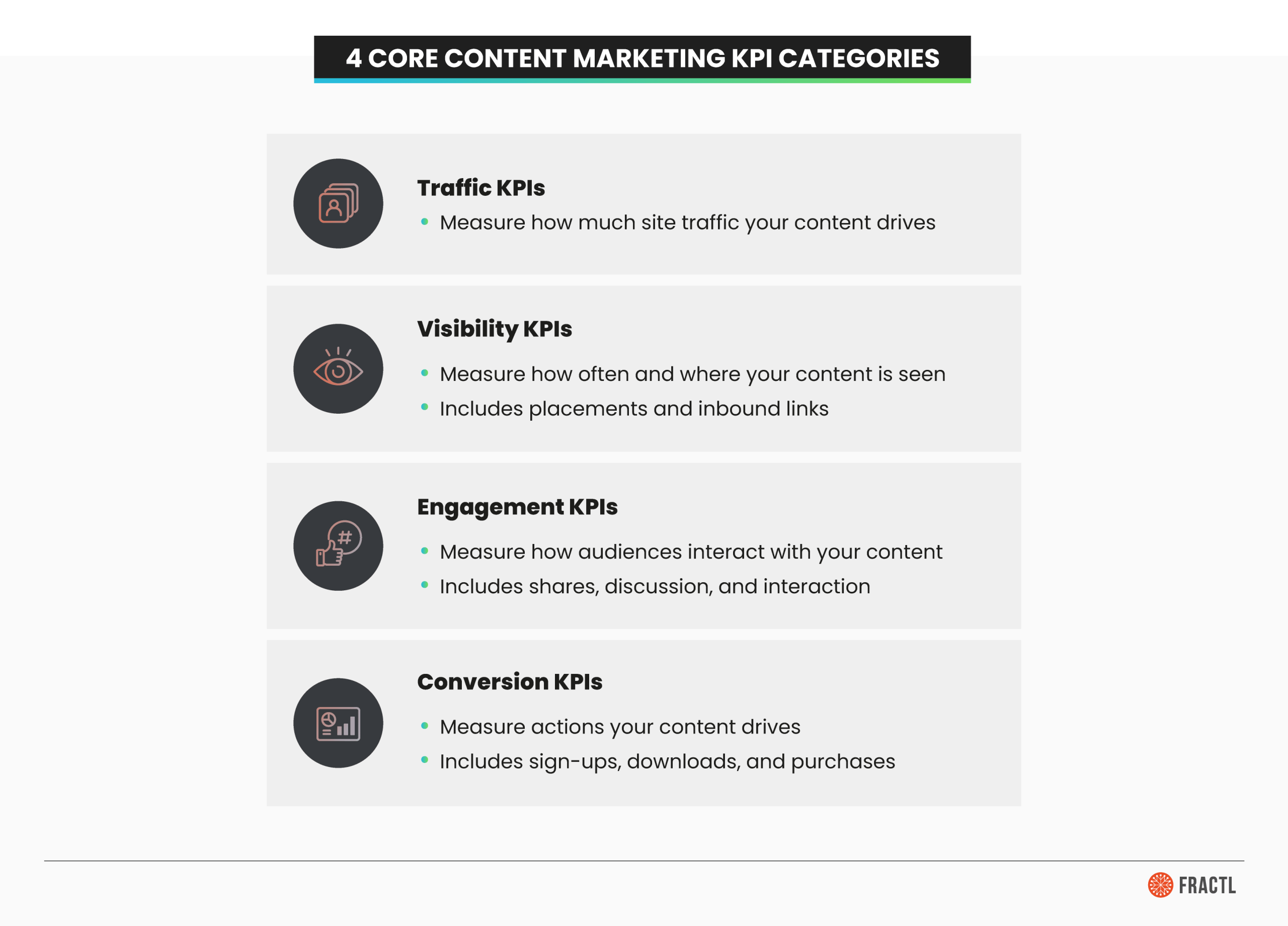
There are many KPIs you can measure, but as you begin your goal-setting, think about content marketing KPIs in four categories:
- Traffic KPIs relate to the amount of site traffic being driven by your content.
- Visibility KPIs relate to how many people are seeing your content, such as where it is featured and the inbound links that point back to your site.
- Engagement KPIs relate to the reception of your content, including social shares and discussion around it.
- Conversion KPIs relate to the behaviors your content drives, such as email sign-ups, coupon downloads, or product purchases.
Categorize these KPIs even further by thinking about them regarding small and big picture results:
- Campaign-specific KPIs relate to metrics that result from a single initiative, such as an email marketing blast or a large-scale content marketing campaign.
- Long-term KPIs relate to metrics that occur over time as a result of your overall content marketing efforts, with results that steadily grow and compound.
Here are the steps to take when establishing KPIs:
- Define goals before content creation. KPIs should guide your content marketing strategy from the start rather than being assigned after content is published.
- Align metrics with business goals. Choose key performance indicators that support outcomes like brand awareness, retention, lead generation, or sales funnel movement.
- Avoid vanity metrics. Page views or social shares alone don’t show content performance unless they tie back to a desired action or conversion.
- Match KPIs to content type. Blog posts, landing pages, webinars, and email newsletters all support different content marketing goals and require different metrics.
As an example, if your main goal is driving traffic to your site, then you will want to keep a close eye on traffic metrics. But if you mostly want content to help grow your email subscriptions, then you can be less concerned with traffic metrics and instead focus on a conversion KPI (like new email subscribers).
A List of Content Marketing KPIs
By measuring the right KPIs for on- and off-site content, you will be able to more effectively set your goals and expectations and see your content marketing results.
Measuring On-Site Content Marketing Success
On-site content refers to anything published on your website, such as blog posts, e-books, guides, white papers, infographics, and videos. This content is typically designed to engage the users on your website and potentially get them to take action. Use the following metrics to evaluate how your on-site content is performing.
Is Your On-Site Content Being Seen?
Use these metrics to evaluate your content’s visibility:
- Page views. Track how often content pieces are viewed, separating organic traffic from paid sources in Google Analytics. Organic page views come from natural traffic sources, such as organic search, social media, and referrals. Paid page views come from paid traffic sources, such as paid search or social media advertising.
- Number of visits. This is called sessions in Google Analytics, and it measures the total number of visits to your website.
- Unique visits. This metric is called users in Google Analytics, and it measures the number of individuals who visit your website.
Is Your On-Site Content Engaging?
Consider tracking these metrics to see how others interact with your content:
- Average time on page. Indicates how long users spend consuming a piece of content and whether it holds attention.
- Bounce rate. Shows how often users leave after viewing one page, which can signal content relevance or misalignment with intent.
- Return visits. Reflects retention and whether the content encourages users to come back.
- Engagement signals. Blog comments and on-page interactions can reveal how users respond to content beyond clicks.
Does Your On-Site Content Convert Visitors?
These metrics tell you whether your on-site content is encouraging users to take meaningful action:
- Conversion rate. Measures how often users complete a desired action, such as signing up or downloading a resource.
- Landing page performance. Tracks how effectively a specific landing page moves users toward a call-to-action.
- Qualified leads. Shows whether content marketing campaigns are attracting the right target audience.
- Email subscribers. Indicates growth driven by content tied to email marketing and newsletters.
Measuring Off-Site Content Marketing Success
Off-site content campaigns relate to distributing, publishing, and promoting your content on other websites. These campaigns can increase awareness about your brand and draw traffic back to your website.
Is Your Off-Site Content Engaging?
These metrics help you understand how audiences interact with your content across external platforms and channels:
- Press mentions. This metric tracks how many times your content has been mentioned by media publications. This may include mentions that are through both online media and traditional media, such as television coverage.
- Social shares. Measures how often content is shared across social media platforms like LinkedIn, Facebook, and X.
- Impressions. Tracks how frequently content appears in front of users.
Is Your Off-Site Content Driving Traffic?
Consider the following metrics to show whether off-site content is successfully directing users back to your website:
- Social media traffic. Measures visits driven by social media engagement.
- Referral traffic. Tracks visits coming from backlinks and external websites.
- Click-through rate (CTR). Shows how often users click content links from external sources.
Is Your Off-Site Content Improving SEO?
Use these metrics to indicate whether off-site content is contributing to stronger search visibility and organic growth over time:
- Domain authority. This is a unique metric from Moz that measures a site’s authority. You want websites that link to your site or mention your content and brand to have a high domain authority.
- Inbound links. Measures backlinks that strengthen domain authority and SEO performance.
- Search rankings. Track keyword rankings to measure visibility in search engines.
Is Your Content Marketing Getting a Return on Investment?
At the end of the day, you want to see a bottom-line impact from your content marketing efforts. How do you know if you’re getting as much (or more) value out of your content as you’re putting into it?
Let’s look at some metrics for measuring how content affects sales, SEO, and your brand perception, all of which can contribute to increased revenue.
Sales Impact
The most obvious thing to look at regarding content ROI is sales growth. If sales are spiking in conjunction with your publication dates, it’s a good sign your content is contributing to this spike.
But in most cases, content’s impact on sales isn’t linear. Many times there isn’t always a clear path from content to sale. Consider how it may take months of visiting a blog or receiving targeted email communication before someone becomes a customer. Sometimes it’s the sum of all of your content marketing efforts that leads someone to buy, but sometimes it takes just one piece of content to make it happen.
To better understand how content supports sales, teams can review the following data using tools like Google Analytics and marketing automation platforms:
- Sales trends over time. Compare sales performance against content publication timelines to identify patterns or correlations.
- Assisted conversions. Review how content contributes to the sales funnel, even when it isn’t the final touchpoint.
- Content interaction paths. Analyze which content pieces users engage with before completing a conversion.
- Attribution insights. Use analytics and automation tools to trace sales and conversion events back to specific content interactions.
SEO Impact
Tracking your search rankings and organic traffic growth will tell you if your content is improving your position in search results. This is important to measure because the higher you rank in search, the more traffic your site will get. More site traffic increases the potential for more conversions and sales.
Track these metrics to assess whether content is improving search performance and delivering long-term SEO value:
- Organic traffic growth. Indicates whether content marketing efforts improve discoverability.
- Search visibility. Higher rankings increase click-through opportunities and conversions.
- Evergreen performance. Long-term content performance shows sustained value beyond launch.
Brand Authority and Loyalty Impact
Content marketing can position your brand as an industry leader and make people like your brand more. Furthermore, content marketing can make your current customers more loyal and encourage some to refer new business to you.
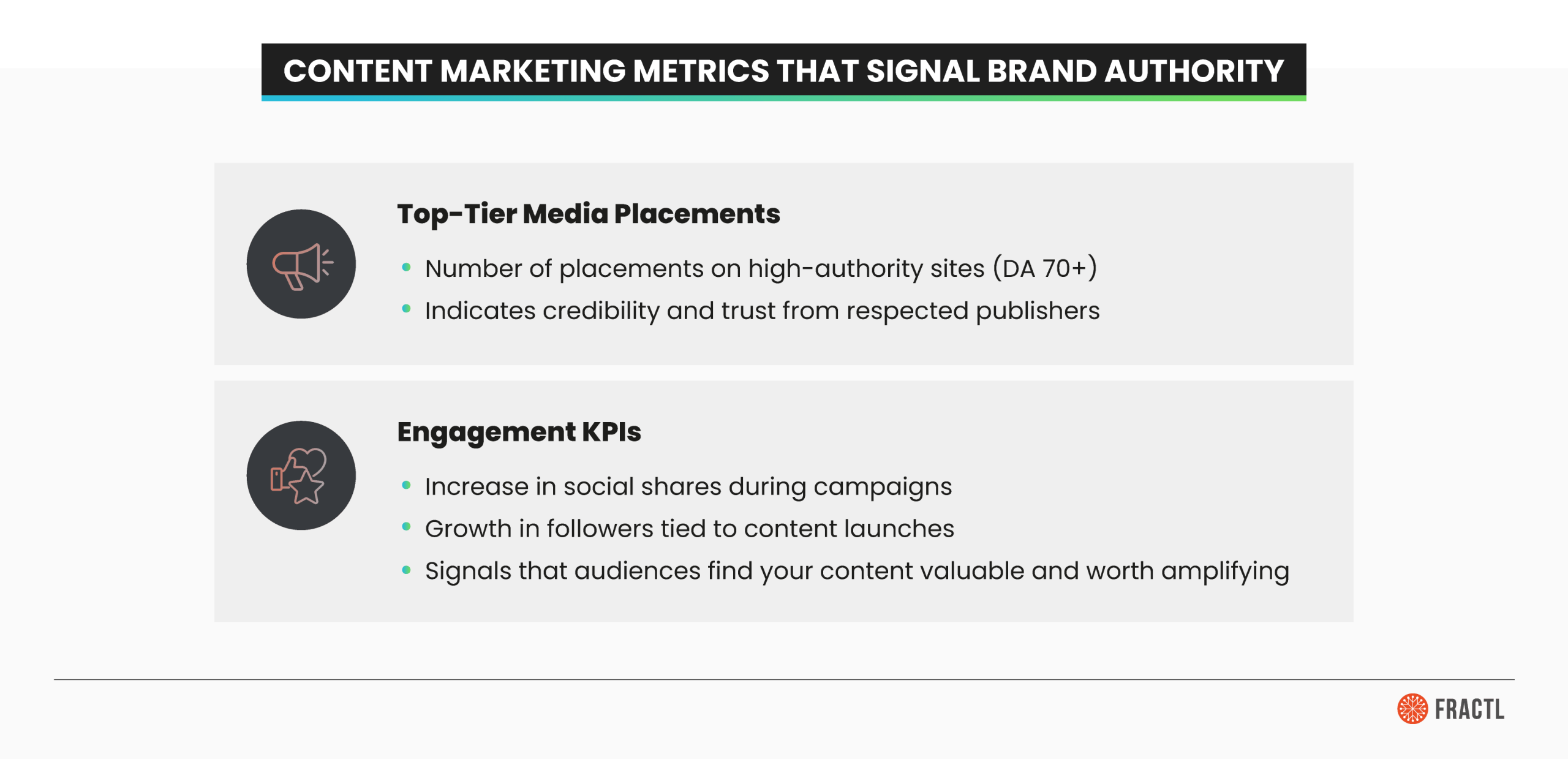
While these things may seem harder to track, they no doubt play a role in increased sales. Look for increases in repeat customers, referrals, press mentions, and social mentions to judge if your content is having a positive influence on brand authority and loyalty.
Here are some examples of what you can consider, particularly for assessing brand authority:
Also, in the future, you can set up any lead generation materials to ask how these potential customers found out about your brand. This can help identify if content campaigns have been effective in this effort.
Turning Metrics Into Action
Metrics only matter if they inform action. Use your data to identify patterns, refine content creation, and improve future content marketing campaigns in the following ways:
- Optimize underperforming content. Update headlines, CTAs, or formatting based on engagement data.
- Double down on successful content. Repurpose high-performing content pieces into webinars, email newsletters, or social posts.
- Align metrics with goals. Focus on the right metrics that reflect content marketing success, not just visibility.
- Support testing and iteration. Performance data can inform A/B testing for headlines, CTAs, and landing pages, helping teams make incremental improvements based on evidence.
Connecting Content Metrics to Business Results
Creating effective content marketing campaigns requires you to use metrics to measure the results. You need to:
- Use KPIs and set them early on
- Match your KPIs to your campaign goals
- Understand which KPIs matter most
- Review your results.
- Determine the ROI of your efforts
Once you measure content marketing metrics in this way, you’ll be able to find the value of your work, get the most out of your campaigns, and accurately evaluate and revise your content marketing strategies to get the best results.
Want to see how we have used clear KPIs to lead successful content campaigns for our clients? Check out our full library of client work and case studies.