




Table of Contents
- What Impacts Digital PR Pricing?
- Digital PR Pricing Ranges: What To Expect
- A Buyer's Evaluation Checklist for Choosing a Digital PR Agency
- How To Find the Right PR Partner for Your Brand
- FAQs
Digital PR means any online public relations effort aimed at earning media coverage, high-authority backlinks, and brand mentions from digital publications. It includes data journalism campaigns, press releases, proactive and reactive media outreach, content creation, thought leadership placements, and link building. Unlike traditional PR (which focuses on TV, print, and radio), digital PR is directly tied to SEO, AI search visibility, search engine rankings, and measurable digital marketing outcomes.
The problem for buyers is that pricing is opaque; agencies can quote wildly different numbers for what sounds like the same thing. Scope descriptions vary, and it’s hard to know whether you’re comparing apples to apples or apples to oranges.
I’ll break down the factors that actually drive digital PR costs, provide pricing benchmarks, and give you a practical checklist for evaluating agencies before you sign anything.
What Impacts Digital PR Pricing?
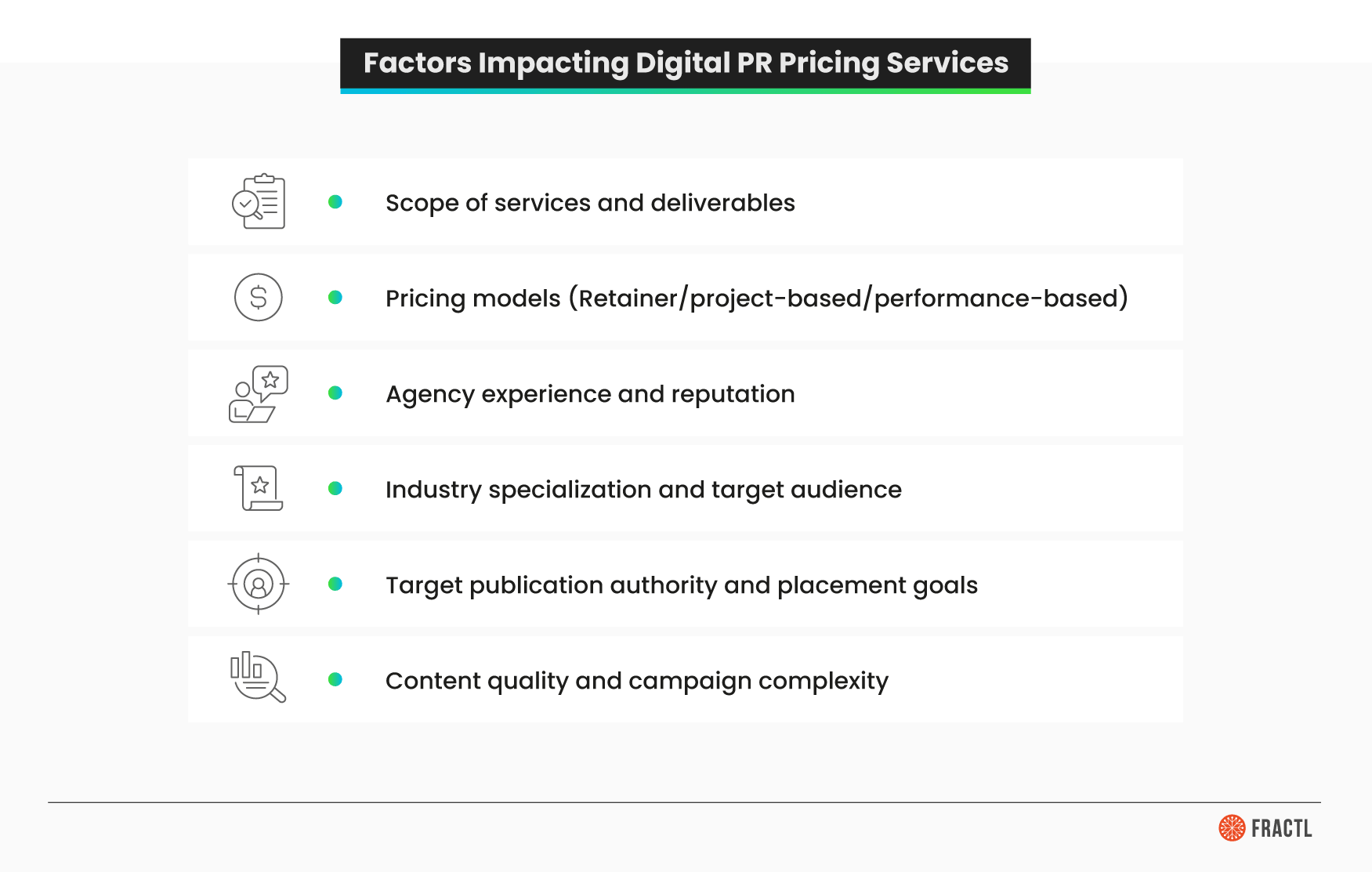
These six factors determine what you’ll pay.
Scope of Services and Deliverables
The single biggest pricing variable is what’s included. A narrow engagement (one press release with targeted outreach) costs a fraction of a full-service digital PR campaign with original research, custom infographics, interactive assets, and scaled outreach to hundreds of publishers.
Common deliverables that affect cost include:
 Data journalism campaigns Original surveys, data analyses, and visual storytelling designed to earn media coverage and backlinks simultaneously. These are the most resource-intensive (and highest-ROI) digital PR deliverables. |  Press releases and media outreach Writing, distributing, and pitching stories to journalists and publishers. |
 Content creation Articles, infographics, interactive tools, and landing pages that give PR campaigns a home on your site. |  Thought leadership placements Expert commentary, bylined articles, and proactive pitching that position your executives as industry leaders. |
 Link building through earned media Targeted outreach designed to earn backlinks from high-authority publications. |  Crisis communications Rapid-response PR to manage reputation issues. Usually scoped separately. |
Some agencies bundle content creation and outreach into one fee. Others bill them separately. Ask what’s in scope before you compare proposals.
Pricing Models: Retainer, Project-Based, and Performance-Based
How an agency charges matters as much as how much they charge.
- Monthly retainer. A fixed monthly fee for ongoing PR services. This is the most common model for full-service digital PR agencies because it allows for sustained campaign momentum, proactive/reactive PR, and regular reporting. Monthly costs are predictable, and both sides commit to a long-term relationship.
- Project-based pricing. A flat fee for a specific campaign or deliverable. Best for one-off needs like a product launch campaign, a single data study, or a short-term engagement. Project-based fees give you cost certainty but less flexibility.
- Performance-based pricing. Fees tied to results (placements earned, links acquired, coverage volume). This sounds appealing, but it comes with real risks: agencies may chase quantity over quality, pursue low-authority placements to hit targets, or avoid ambitious campaigns that could fail. I’d be cautious with pure performance models.
- Hourly rates. Less common in digital PR but used by some freelancers and boutique agencies. You get flexibility but less cost predictability.
Most established agencies work on retainer because digital PR campaigns compound over time. A single month of work rarely shows the full impact.
Agency Experience and Reputation
Established agencies with a proven track record charge more.
That’s not arbitrary: They’ve built media relationships, refined their methodology, invested in proprietary tools like AI-powered agents, and can show case studies with real results from recognizable brands.
Newer or smaller agencies may offer lower rates, but with less predictability.
The question isn’t whether you can find someone cheaper. It’s whether cheaper delivers the results your business actually needs.
Reviewing an agency’s past work and client testimonials is one of the most reliable ways to gauge whether their pricing reflects real value. We publish our own case studies because we think every agency should.
Industry Specialization and Target Audience
Agencies with deep expertise in specific verticals charge more because they can move faster. If a digital PR agency already has media contacts in your industry, understands the editorial landscape, and knows which angles resonate with publishers in your space, they’re not starting from scratch. That expertise has real value.
This matters especially for niche verticals. SaaS companies, e-commerce brands, health care organizations, and startups all have different media ecosystems, different target audiences, and different publication targets.
Whether you’re a startup trying to break through or an enterprise brand defending market share, the more specialized your needs, the fewer agencies can serve them.
Pricing reflects that scarcity.
Target Publication Authority and Placement Goals
Where you want to be featured directly impacts cost. Earning coverage in top-tier national outlets requires deeper research, stronger content, and more experienced outreach than landing in local or niche trade publications.
If your business goals include high-quality backlinks for SEO, you need an agency that targets publications with strong domain authority. That means pitching editors who receive hundreds of emails a day, which takes a different level of skill and persistence than targeting smaller outlets.
More ambitious placement goals require more resources.
Your agency’s pricing should reflect the caliber of media coverage you’re buying.
Content Quality and Campaign Complexity
A text-based press release costs a fraction of a data-driven campaign with original surveys, custom infographics, interactive tools, and a multi-asset landing page.
The depth of research, the number of assets produced, and the level of data analysis all affect what you’ll pay.
More complex campaigns also require larger teams and longer timelines. A campaign that involves surveying 1,000+ respondents, cleaning and analyzing the data, producing three standalone visual assets, building an interactive landing page, and running outreach to 500+ journalists is a different product than a single-asset press release. Price accordingly.
Digital PR Pricing Ranges: What To Expect
Pricing varies widely, but these ranges reflect what most brands pay for digital PR based on campaign scope and competitiveness:
| Campaign scope | Typical monthly range |
|---|---|
| Lower-scope / opportunistic campaigns (existing brand stories, limited content creation, targeted outreach) | $5,000 – $10,000/mo |
| Mid-range campaigns (multiple campaign types, consistent outreach, moderate content development) | $10,000 – $35,000/mo |
| Full-service / high-competition campaigns (original research, multi-channel execution, ongoing campaign production) | $50,000+/mo |
One-off project-based campaigns fall outside these monthly ranges and are typically scoped individually based on research depth, asset production, and outreach volume.
The lowest price isn’t always the best value.
What matters is the return on your investment. A $5,000/mo engagement that earns three low-authority placements delivers less than a $15,000/mo engagement that earns coverage in publications with DA 60+ and drives measurable organic traffic growth.
Fractl’s detailed breakdown of SEO and digital PR pricing covers this in more depth.
Don’t confuse up-front cost with long-term value. Digital PR compounds: The backlinks you earn in month three still drive rankings in month 12. Comparing agency fees purely on monthly cost ignores the difference between hiring a team in-house (salaries, benefits, tools, management overhead) and outsourcing to an agency that’s already built the infrastructure.
A Buyer’s Evaluation Checklist for Choosing a Digital PR Agency
The pricing factors above tell you what drives cost. This checklist tells you how to evaluate whether an agency is worth it. Download the full checklist as a PDF to use during your agency evaluation process:
Buyer’s Evaluation Checklist for Choosing a Digital PR Agency
Define Your Business Goals and KPIs Before You Talk to Agencies
You need to know what success looks like before you can evaluate whether an agency can deliver it. Answer these questions internally first:
- Are you primarily trying to build brand awareness, earn backlinks for SEO, drive website traffic, generate leads, or support a product launch?
- What metrics will you use to measure success (placements earned, DA of linking sites, organic traffic growth, branded search volume, conversions)?
- What’s your marketing budget and timeline?
- Do you need a full-service marketing partner or help with a specific marketing campaign?
Clear answers to these questions make every agency conversation more productive. You’ll compare proposals on equal terms instead of getting distracted by slick pitch decks. A digital marketing strategy starts with knowing what you’re trying to accomplish.
Evaluate Their Case Studies, Not Just Their Client List
Any marketing agency can list impressive logos. What matters is whether they can show specific, measurable results from campaigns similar to what you need.
Ask for case studies with actual numbers: links earned, domain authority of placements, organic traffic impact, and media coverage volume. At Fractl, we share results like these because we think every good agency should:
 Payless Power Payless Power1,208 press mentions (450 from DA 60+ publishers), 25% organic traffic increase in 16 months |  Adobe Adobe390 new referring domains from 9 data journalism campaigns |  McAfee 586 featured snippets captured, 32 pages elevated to the #1 position, $1.29 million monthly traffic value increase |
A good agency should be eager to share this kind of data. Hesitance to show campaign performance with specific numbers is a red flag.
Ask About Their Pricing Structure and What’s Included
Get specific about what’s in (and out of) scope. Questions to ask:
- Is content creation included in the retainer or billed separately?
- How many campaign assets are produced per month?
- What’s your outreach process, and how many journalists/publishers do you target per campaign?
- Do you charge for revisions or additional assets?
- What reporting do you provide and how often?
- Is there a minimum commitment period?
- Are there any up-front costs beyond the monthly fee?
Understanding the full pricing structure prevents surprises. It also helps you compare digital PR agencies on an apples-to-apples basis, which is impossible when scope descriptions are vague.
Assess Communication Style, Reporting, and Transparency
You’ll work closely with your PR partner for months or years. Communication fit matters more than most buyers realize.
Ask how often you’ll get status updates, who your day-to-day contact will be, and what reporting looks like. A good PR team provides regular reporting tied to the KPIs you agreed on, not vanity metrics. Ask if they share raw data or just polished summaries. Look for agencies that are transparent about what’s working and what isn’t. A marketing partner that only shares wins is hiding problems.
Also, ask about their media relations process. Do they have established relationships with journalists in your space, or are they starting cold? Experienced PR professionals with existing media contacts can move faster and earn better placements. Client referrals are another strong signal: Ask if you can speak with current or past clients about their experience.
Check for Red Flags
Not every agency that talks a good game can deliver. Watch for these warning signs before committing your budget:
| 🚩 No case studies or vague results If they can’t show specific numbers from past work, question why. Any credible agency tracks and shares campaign outcomes. | 🚩 Guaranteed placements in specific outlets No PR agency can guarantee coverage. Journalists make their own editorial decisions. Agencies that promise specific outlets are either misleading you or paying for advertorials. |
| 🚩 Pricing significantly below market rates If it sounds too cheap, they’re likely cutting corners on content quality, outreach volume, or both. You’ll spend more fixing the damage than you saved. | 🚩 One-size-fits-all proposals Your campaign should be scoped to your specific industry, goals, and target audience. A generic proposal suggests a generic approach that won’t deliver specific results. |
| 🚩 No clear scope of work If they can’t articulate exactly what you’re getting for your money, you’ll end up paying for ambiguity. Deliverables, timelines, and reporting should be spelled out before you sign. | 🚩 Resistance to sharing their outreach process Transparency about methodology is a baseline expectation. If they won’t explain how they earn placements, they may be using tactics that could hurt your brand. |
Run a Short-Term Test Before a Long-Term Commitment
If you’re unsure, start with a single project-based campaign before signing a six or 12-month retainer. This gives you a clear picture of the agency’s communication, content quality, and results without a long-term commitment.
Evaluate the test on: Did they deliver what they promised? Were placements relevant and high-authority? Was communication smooth? Did they hit the KPIs you agreed on? A short-term pilot is the most reliable way to validate that an agency is the right PR partner for your specific needs before you commit your marketing budget long-term.
How To Find the Right PR Partner for Your Brand
Digital PR pricing is driven by real factors: scope, expertise, publication targets, and campaign complexity. The variation between agencies isn’t random; it reflects genuine differences in what you’re getting.
The buyers who get the most value aren’t the ones who find the cheapest agency. They’re the ones who know exactly what they need, evaluate agencies on proven results rather than promises, and align pricing to business outcomes. Your online presence and brand awareness depend on the quality of your public relations investment, not just the quantity.
We’ve spent over a decade at Fractl helping brands build digital PR and content marketing strategies that earn measurable results across traditional search, social, and GenAI platforms. If you’re evaluating agencies, we’d welcome the conversation.
FAQs
How much does digital PR cost?
Digital PR typically costs between $5,000 and $50,000+ per month, depending on campaign scope, competitiveness, and agency experience. Lower-scope engagements with targeted outreach run $5,000–$10,000/mo; mid-range campaigns with multiple campaign types and consistent outreach fall between $10,000–$35,000/mo; and full-service programs with original research and multi-channel execution start at $50,000+/mo. One-off project-based campaigns are scoped individually based on research depth and asset production. Agency fees reflect the range of services included, not just outreach volume.
What does digital PR include?
Digital PR includes any online public relations activity aimed at earning media coverage, backlinks, and brand mentions from digital publications. Common digital PR services include data journalism campaigns, press releases, proactive and reactive media outreach, content creation and content marketing, thought leadership placements, and link building. Some agencies also offer social media strategy, influencer outreach, podcast placement, and crisis communications as part of their service offering.
What’s the difference between digital PR and traditional PR?
Traditional PR focuses on offline media (TV, print, radio) and brand perception. Digital PR focuses on online publications, earning backlinks that improve search engine optimization and rankings, and building brand visibility across search, social media, LinkedIn, and AI platforms. Digital PR is more measurable: You can track links earned, website traffic driven, and ranking improvements directly. Many digital marketing agencies now offer PR services alongside SEO and AI search optimization because the disciplines reinforce each other.