



Table of Contents
- What Is AI Overview Optimization?
- Where These Patterns Come From
- 1. Google Rankings Still Feed AI Overview Citations
- 2. Most AI Citations Come From Pages Outside Google's Top 10
- 3. How-To Guides and Answer-First Pages Get Cited Most
- 4. Brand Product and Service Pages Earn a Fifth of Citations
- 5. YouTube and Reddit Are Cited in Nearly Every Industry
- 6. Original Research Earns the Authority Behind Citations
- 7. Coverage on Trusted Sites Gets Your Brand Named
- 8. AI Overviews Name Fewer Brands Than Other AI Engines
- 9. Wording Changes the Answer, So Track Many Prompts
- AI Overview Optimization Checklist
- Earn AI Overview Citations With Research and Coverage
- FAQ
Key Takeaways
- Rankings still feed AI Overviews. Domains that rank first on Google get cited by AI 93% of the time, so SEO best practices remain the starting point.
- Most citations come from beyond page one. Ranking first makes a citation likely, but only 26% of all AI citations in our research came from page-one domains. Earn coverage on the sites AI cites.
- Formats that answer questions get cited most. How-to guides, brand product pages, and listicles took about 75% of AI citations on marketing and SEO queries.
- AI Overviews name fewer brands than other AI engines. They named 3.5 brands per answer on average, compared with 5.8 for Google AI Mode.
- One check isn’t enough. Rewording a question changed about half the recommended brands, so track a set of prompts on a schedule.
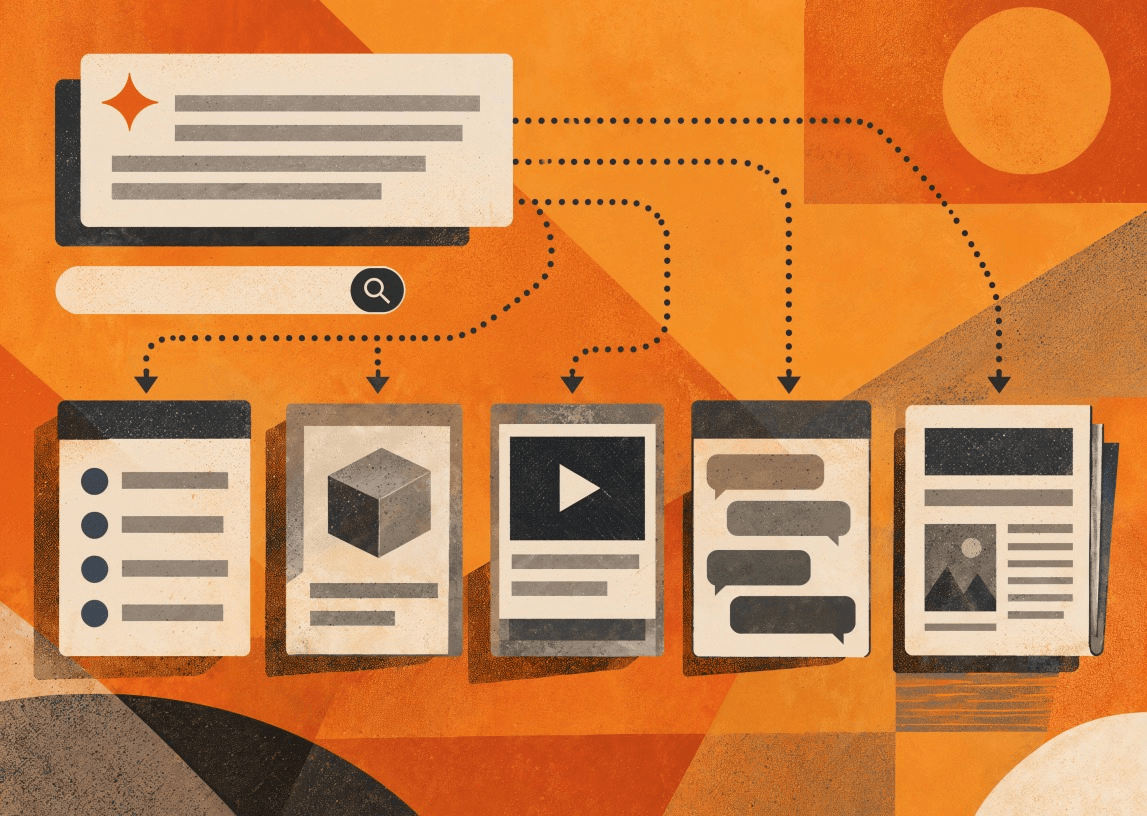
AI Overview optimization is the work of getting your pages cited as sources in Google AI Overviews, the AI-generated summaries at the top of the search engine results page. Google says there’s no special trick to it, but we’ve found which pages it cites most.
We combined two Fractl studies with our own citation tracking and client results. Together, the two studies cover more than 21,000 AI answers. Each of the nine patterns that held up comes with an example and a step to take.
The nine patterns split between work on your site and coverage you earn elsewhere:
| Pattern | What to do |
|---|---|
| Rankings feed citations | Keep pages crawlable, indexed, and ranking |
| Most citations come from outside Google’s top 10 | Get mentioned on the cited sites your rankings can’t reach, like Reddit and review sites |
| How-to guides lead | Open with a short summary, then walk through the steps |
| Brand pages get cited | Make product and service pages clear and specific |
| YouTube and Reddit are cited everywhere | Publish video and join relevant Reddit threads |
| Research earns the authority | Publish original data reporters will cite |
| Coverage gets brands named | Pitch the publications AI reads in your category |
| AI Overviews name few brands | Pick the questions you most need to win, since each answer names only three or four brands |
| Wording changes the answer | Track many prompts across engines, repeatedly |
What Is AI Overview Optimization?
AI Overview optimization, a form of AI SEO, means getting Google to understand your pages well enough and trust them enough to cite them in an AI Overview. It overlaps with generative engine optimization (GEO), which targets AI search engines like ChatGPT and Perplexity, and with answer engine optimization.
According to Google Search Central, there are no additional requirements or special optimizations necessary to appear in AI Overviews or AI Mode. A page only needs to be indexed and eligible to show in Search with a snippet. Google adds that AI Overviews appear only when its systems decide they add something to classic results, so many queries never trigger one.
Unlike the organic results under it, an AI Overview (AIO) is written by large language models (LLMs) that summarize several sources and link to them. It’s one of several SERP features Google can show for a query. Google also explains how it builds an answer. AI Overviews and AI Mode may use “query fan-out,” which runs several related searches across subtopics to assemble a response. That’s why a page can be cited for a question it never targeted.
Where These Patterns Come From
Each pattern traces back to one of four Fractl sources:
| AI platform citation patterns Our analysis of 10,108 AI answers and 67,951 citations on marketing and SEO queries, using Ahrefs Brand Radar data. | AI brand recommendations Our study of 11,573 answers to buyer questions across 15 industries and six AI engines, collected in July 2026. |
| Our citation tracking A fixed panel of brand-relevant queries we track for our own content across Google and other AI engines. | Client campaigns Results from AI Overview programs we run for clients in energy, finance, software, and dating. |
Two of these sources cover several AI engines, not just Google. Where we have a number specific to AI Overviews, we use it.
1. Google Rankings Still Feed AI Overview Citations
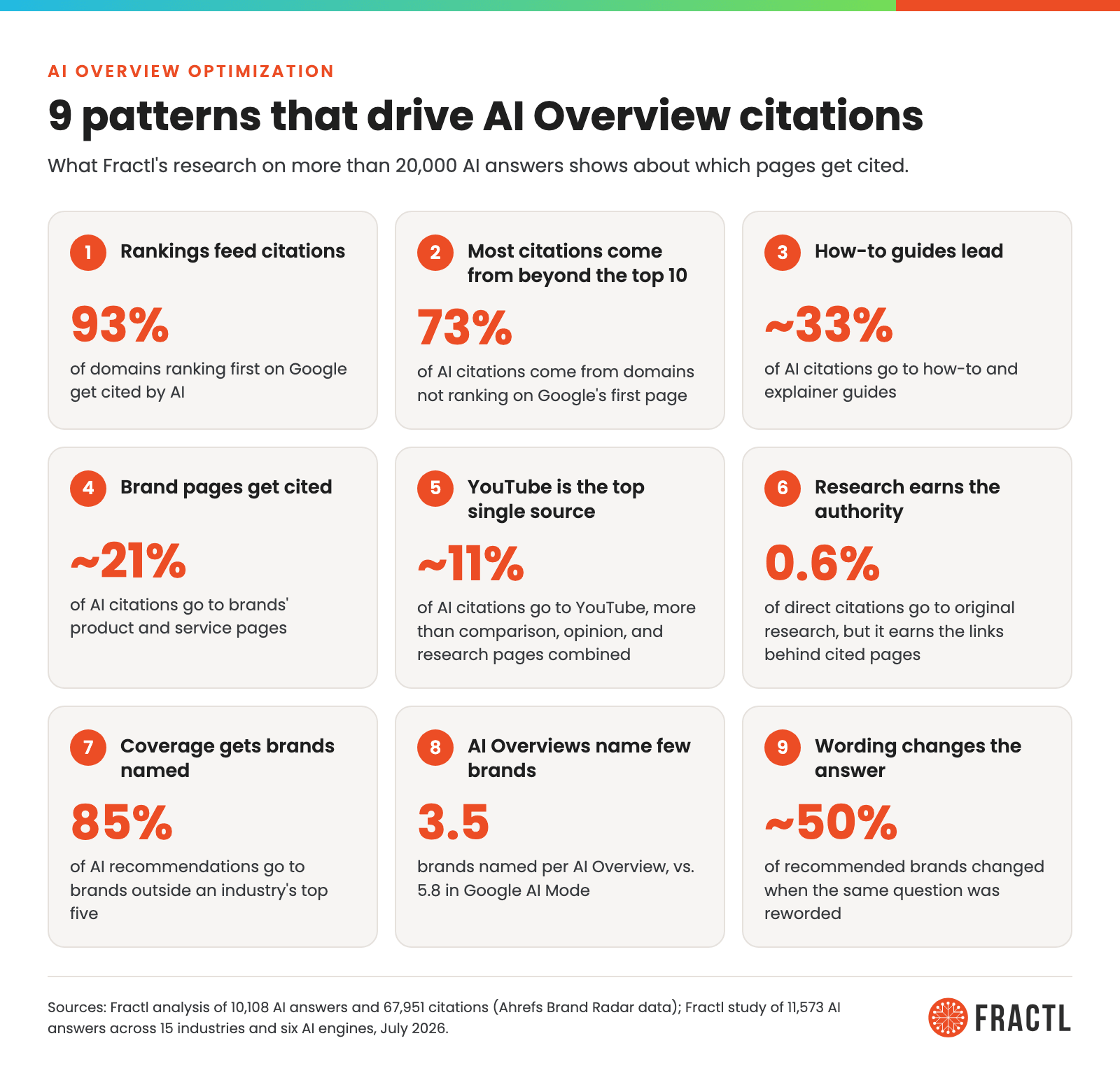
AI Overviews pull sources from Google’s own index, so ranking well still raises your odds. In our study of 11,573 AI answers, domains that ranked first on Google were cited by AI 93% of the time. That shows overlap, not cause, since authoritative sites tend to both rank and get cited.
For example, a student loan provider we work with grew its AI Overview citations from 3,600 to 11,200 in six months. Over the same period, its top-three keyword rankings climbed from 4,800 to 11,800, and organic traffic doubled.
Start with the technical SEO checks Google lists for AI features:
- Allow crawling in robots.txt and in any CDN or hosting settings.
- Put important content in text, not only in images or video.
- Link to key pages internally so Google can find them.
- Confirm pages are indexed and eligible for a snippet in Google Search Console.
If Google can’t crawl a page, it can’t index it or cite it in an AI Overview, so fix crawlability before anything else. If you’re weighing new AI files, our take on llms.txt vs. robots.txt covers what each one controls.
2. Most AI Citations Come From Pages Outside Google’s Top 10
Ranking helps, but it covers a minority of citations. Only 26% of AI citations in our research came from a domain on Google’s first page, and 73% came from outside the top 10 entirely. Software was higher still, at 76%.
Those citations went to Reddit threads, YouTube videos, review sites, and niche publications. In software answers, 77% of the review-platform pages AI cited didn’t rank on page one for that query.
For example, our research mapped which cited sites mention ClickUp in software answers. ClickUp appeared on Reddit, TechRadar, and Zapier, but not on PCMag, NerdWallet, Forbes, or G2. Each gap is a publication to pitch, since AI already cites it for that category.
To find your own gaps, run your top buyer questions through Google and note every site the AI Overview cites. The sites that mention competitors and not you become your outreach list. Keyword research tools report keyword difficulty for classic rankings, but they won’t show these citation gaps.
3. How-To Guides and Answer-First Pages Get Cited Most
How-to and explainer guides took about 33% of AI citations in our analysis of 10,108 AI answers, more than any other format. Listicles took about 20%.
For example, Payless Power started with zero AI Overview placements. We built answer-first, definitional content with structured data around the questions Texas shoppers ask about prepaid electricity. Paired with digital PR, that content helped Payless Power earn 488 AI Overview placements and become a top-three-cited brand in its category.
Four formatting habits make a passage easy for an AI Overview to quote:
 Lead with a summary Open each section with a short summary of the answer, then give the steps or detail. |  Phrase headings as questions Match the informational queries and long-tail keywords people type. |
 Keep paragraphs short Give each paragraph one idea so a passage makes sense on its own. |  Use lists and tables Steps and comparisons are easier to extract than long prose. |
The same format helps you win featured snippets, which still earn an 8.6% CTR when they appear. Schema markup can help Google read a page, but it isn’t required. Google says “there’s also no special schema.org structured data that you need to add.” If you use structured data, Google asks that it match the visible text on the page.
4. Brand Product and Service Pages Earn a Fifth of Citations
Brands’ own product and service pages took about 21% of AI citations in our citation research, behind only how-to guides.
That share depends on the engine. In software answers, review platforms made up only 14% of AI Overview citations, compared with 28% for ChatGPT.
To make your own pages citable, state what you offer, who it’s for, and what it costs, if you publish pricing. Google’s AI features guidance also asks businesses to keep Merchant Center and Business Profile details up to date.
5. YouTube and Reddit Are Cited in Nearly Every Industry
YouTube was the single most-cited source in our citation research, at about 11% of citations. That’s more than comparison, opinion, and original research pages combined.
Reddit and YouTube also sat at the top of the cited-source list in nearly every industry we studied. In software answers alone, AI cited YouTube 348 times and Reddit 279 times, more than any review platform.
Publish video that answers the same questions your articles do, and add transcripts so the text is crawlable. On Reddit, build a presence through genuine participation in threads where your expertise fits, not promotional posts.
6. Original Research Earns the Authority Behind Citations
Original research made up just 0.6% of direct AI citations in our analysis. Its bigger effect comes before the citation: research earns the backlinks, brand mentions, and rankings that get your other pages cited.
For example, a crypto payments app we worked with grew its AI Overview citations about tenfold in six months, to 545. We ran surveys and data studies on crypto payroll, wallet adoption, and trust in crypto. The coverage earned links from 714 websites, and its Domain Rating rose from 45 to 59.
A creative software brand saw the same effect with one study. We analyzed 21,000 TikToks to find the best times to post, and the page captured the AI Overview for those queries. It now ranks for 596 keywords and draws 20,000 monthly organic visits.
Research also supports E-E-A-T (Experience, Expertise, Authoritativeness, and Trustworthiness). Google’s helpful content guidance asks whether content provides “original information, reporting, research, or analysis.” It also asks whether pages “carry a byline, where one might be expected,” and whether bylines lead to background on the author. Our guide to author bios that build E-E-A-T covers what to include.
7. Coverage on Trusted Sites Gets Your Brand Named
Our study of AI recommendations found that AI recommends the brands it reads about on the sites it cites. In that study, 85% of AI recommendations went to brands outside their industry’s top five, and even category leaders captured only 2% to 8%. A smaller brand with the right coverage can be named alongside the giants.
Each industry has a short list of sites AI leans on. Financial services answers cite NerdWallet, Bankrate, CNBC, and Forbes. Software answers cite TechRadar, Zapier, G2, and PCMag.
For example, Tawkify paired answer-first content with a sustained digital PR program over 12 months. It became the most-cited matchmaking brand across AI Overviews, AI Mode, and ChatGPT, with 1,223 AI citations and 200 brand mentions.
Pitch the publications AI cites in your category, and aim for the roundups and reviews on them. A link-building program built on brand mentions and links feeds Google’s rankings, and AI answers at the same time.
8. AI Overviews Name Fewer Brands Than Other AI Engines
AI Overviews named fewer brands per answer than any other engine in our study of 11,573 answers:
| AI engine | Brands per answer | Sources per answer | Answers that name a brand |
|---|---|---|---|
 Google AI Overviews | 3.5 | 10 | 71% |
 Google AI Mode | 5.8 | 25 | 91% |
 ChatGPT | 4.9 | 13 | 90% |
 Perplexity | 5.0 | 10 | 89% |
Google says AI Mode and AI Overviews “may use different models and techniques,” so the sources each shows will vary. Winning one doesn’t guarantee the other.
A challenger can still take one of those slots. Payless Power became a top-three cited brand for Texas prepaid electricity, ahead of larger providers like TXU, Gexa, and Champion. With so few slots, focus your content and coverage on the questions you most need to be named for, such as the ones people ask when comparing options.
9. Wording Changes the Answer, So Track Many Prompts
In a controlled test, we asked the same buyer question several ways and held the meaning constant. Rewording it changed roughly half the recommended brands. Query fan-out adds to the variation, since each version can trigger different related searches.
Engines also differ from each other. In our own tracking panel, Google’s AI surfaces cited Fractl in 76% of responses (244 of 322). Every other engine combined cited us in 8.5% (seven of 82). Combining every engine into one overall rate would have made our AI visibility look strong everywhere, when it came almost entirely from Google.
To measure progress, build a prompt set grouped by search intent and user intent. Include long-tail and conversational versions of each question, not just your head keyword. Then:
| Check Google Search Console Google counts AI feature traffic in the Performance report under the Web search type, mixed in with other results. | Use a tracking tool Tools like Semrush and Ahrefs Brand Radar sample AI answers for citations and brand mentions. |
| Watch clicks and impressions Rising impressions with flat click-through rates can signal zero-click searches. | Re-run on a schedule Answers shift with each update, so compare the same prompts month over month. |
Google says clicks from results pages with AI Overviews are “higher quality,” meaning visitors spend more time on the site. Measure time on site and conversions alongside organic traffic.
AI Overview Optimization Checklist
Use this nine-point self-audit to check a page or site against each pattern:
| Rankings and access Is the page indexed, crawlable, and ranking for its core query? | Coverage gaps Which sites cite competitors for this topic but not you? | Answer-first copy Does each section open with a short summary before the detail? |
| Service pages Do your product pages say what you offer, for whom, and at what price? | Video and forums Have you published video or joined Reddit threads on your core questions? | Original research Have you published data in the past year that earns links? |
| Earned coverage Are you mentioned on the publications AI cites in your category? | Brand slots Are you one of the few brands named for your top buying questions? | Tracking Do you check a fixed prompt set across engines every month? |
Each “no” points to the pattern to work on first.
Earn AI Overview Citations With Research and Coverage
AI Overviews reward the same things good content marketing always has: pages that answer questions clearly, rank well, and get written about on trusted sites. Since most citations come from beyond page one, the coverage you earn elsewhere does as much work as your own pages. Fractl builds that coverage with original data, then pairs it with answer-first content AI Overviews can quote.
Reach out to see where your brand stands in AI Overviews and what it would take to get cited.
FAQ
What is AI search optimization called?
It goes by several names, including generative engine optimization (GEO), answer engine optimization (AEO), and AI SEO. Fractl’s guide to GEO terms explains how each one differs.
Is SEO dead now that AI Overviews exist?
No. Google says SEO best practices still apply to AI features, and our research found that domains ranking first are cited by AI 93% of the time. Fractl runs SEO and digital PR together so pages rank and get cited.
Do you need schema markup to appear in AI Overviews?
No. Google says no special structured data is required, though any markup should match the visible text. Fractl pairs structured data with answer-first content, as in our Payless Power campaign.
How do you track AI Overview citations?
Check Google Search Console’s Performance report, then use a tool like Semrush or Ahrefs Brand Radar to sample answers. Fractl tracks a fixed set of prompts for clients on a schedule to show where citations move.
Can you keep content out of AI Overviews?
Yes. Google says the nosnippet, data-nosnippet, max-snippet, and noindex controls limit what it shows from your pages. Fractl’s technical SEO work confirms these controls aren’t blocking pages a client wants cited.
How long does AI Overview optimization take?
It depends on your starting authority and how competitive your category is. In Fractl’s client work, a crypto payments app grew its AI Overview citations tenfold in six months.