


AI recommends the brands that are written about on the sites it cites. Getting featured on those sites — earned media and digital PR — is now the highest-leverage way to win AI recommendations.
- 73% of what AI cites doesn’t rank on Google’s page one. SEO alone won’t get you named.
- New brands can win now — on current visibility, not fame. Incumbency isn’t a moat.
- Every engine is different, and each gives a different answer every time you ask. A single “AI visibility check” is noise.
- How a buyer words the question changes half the answer. Phrasing is a real lever.
- It’s a broad field — 85% of recommendations go outside an industry’s top five.
Whoever the AI names, wins
Search is splitting in two. Alongside Google’s blue links, ChatGPT, Perplexity, Gemini, Copilot and Google’s own AI answers now hand people a short list of brands and a few cited sources. Whoever the AI names makes the buying shortlist — and almost everything the marketing world “knows” about how that list gets made is folklore.
So we measured it. We took ~1,000 real commercial buyer questions across 15 industries and ran each through six engines, capturing which brands got recommended, which sources got cited, and the full page behind every citation. Then we did the one thing no visibility tool does: we joined it to what’s actually inside the AI’s training data — so we could tell whether a brand is recommended because the model learned it long ago, or because it’s being read about right now.
11,573 answers · 15 industries · 6 engines · 8,784 brands · 18,422 domains cited · 36,413 pages read. Every query was run twice on each engine; the collection was stress-tested by five independent reviews before we spent a dollar; every headline number survived a check that it wasn’t a quirk of measurement.
The sites AI trusts — and they’re not who you’d guess
Two sources sit at the top of nearly every industry: Reddit and YouTube. Then each industry has its own short list of authority sites.
A brand’s own website rarely wins a citation. You get cited by being written about elsewhere — on user forums, video reviews, and the specific outlets AI leans on for your sector.
| Industry | The sites AI actually cites |
|---|---|
| Automotive | Car and Driver · MotorTrend · Edmunds |
| Financial services | NerdWallet · Bankrate · CNBC · Forbes |
| Software | TechRadar · Zapier · G2 · PCMag |
| Consumer electronics | RTINGS · Tom’s Guide · TechRadar · CNET |
| Beauty | Allure · Byrdie · Glamour |
| Home & kitchen | Food Network · Serious Eats · Good Housekeeping |
| Apparel & footwear | OutdoorGearLab · RunRepeat |
| Smart home | CNET · Security.org |
| Online education | Coursera · Class Central · Udemy |
The engines even prefer different kinds of sites. ChatGPT and Perplexity lean on independent reviews and comparison sites; Google’s AI Overviews and AI Mode lean far more on brand- and vendor-owned pages. Reddit/YouTube-style content is a quarter of Google AI Overviews’ citations but almost none of Copilot’s.
AI cites who wrote about you, not you.
Which sites are you missing from?
Because we captured the full text of every cited page, we can do the thing that actually matters: for any brand, show the cited sites its competitors appear on and it does not — a ranked “get featured here” list. Here’s a real one for ClickUp in software:
| Site AI cites | AI cites | Durability | ClickUp on it? |
|---|---|---|---|
| reddit.com | 279 | durable | ✓ present |
| techradar.com | 211 | moderate | ✓ present |
| zapier.com | 161 | niche | ✓ present |
| pcmag.com | 121 | moderate | GAP · pitch here |
| nerdwallet.com | 105 | moderate | GAP · pitch here |
| forbes.com | 103 | durable | GAP · pitch here |
| g2.com | 89 | niche | GAP · pitch here |
That output is the earned-media plan: the exact authority sites to get ClickUp featured on so AI starts recommending it — ranked, and tagged by whether the placement is durable (deep in the training data, lasting) or retrieval-dependent.
Winning search rankings isn’t enough
Nearly three-quarters of what AI cites doesn’t rank on Google’s first page.
We captured the ordinary Google results for every query alongside the AI answer. Only 26% of AI citations come from a domain on Google’s first page; 73% come from outside the top ten entirely — Reddit threads, YouTube videos, niche sites that don’t rank but do get cited.
You can’t just win search rankings and expect AI to cite you.
There’s a flip side worth naming honestly: domains that do rank #1 on Google also get cited by AI 93% of the time. That’s a strong overlap — though it’s mostly because authoritative sites tend to both rank and get cited, not proof that ranking causes the citation. Either way, chasing rankings alone leaves most of the AI-citation pool untouched.
There’s no “optimizing for AI.” There are six different jobs.
The engines agree only a third of the time — and each gives a different answer every time you ask.
| Engine | Brands | Sources | Answers w/ brands | Same twice? |
|---|---|---|---|---|
| Google AI Overviews | 3.5 | 10 | 71% | 84% |
| Google AI Mode | 5.8 | 25 | 91% | 62% |
| Gemini | 4.9 | 10 | 86% | 54% |
| ChatGPT | 4.9 | 13 | 90% | 54% |
| Perplexity | 5.0 | 10 | 89% | 53% |
| Copilot | 4.6 | 5 | 93% | 49% |
Two things jump out. First, there’s no single number to plan around: the source count runs from 5 (Copilot) to 25 (Google AI Mode) — it’s an engine-by-engine question. Second, and bigger: ask the chat engines the identical question twice and roughly half the recommended brands change. AI recommendation isn’t a fixed ranking; it’s more like a lottery you can improve your odds in. For anyone tracking their “AI visibility,” a single check is meaningless.
One check is noise. Measure across engines, multiple times.
Baked-in vs. borrowed brands
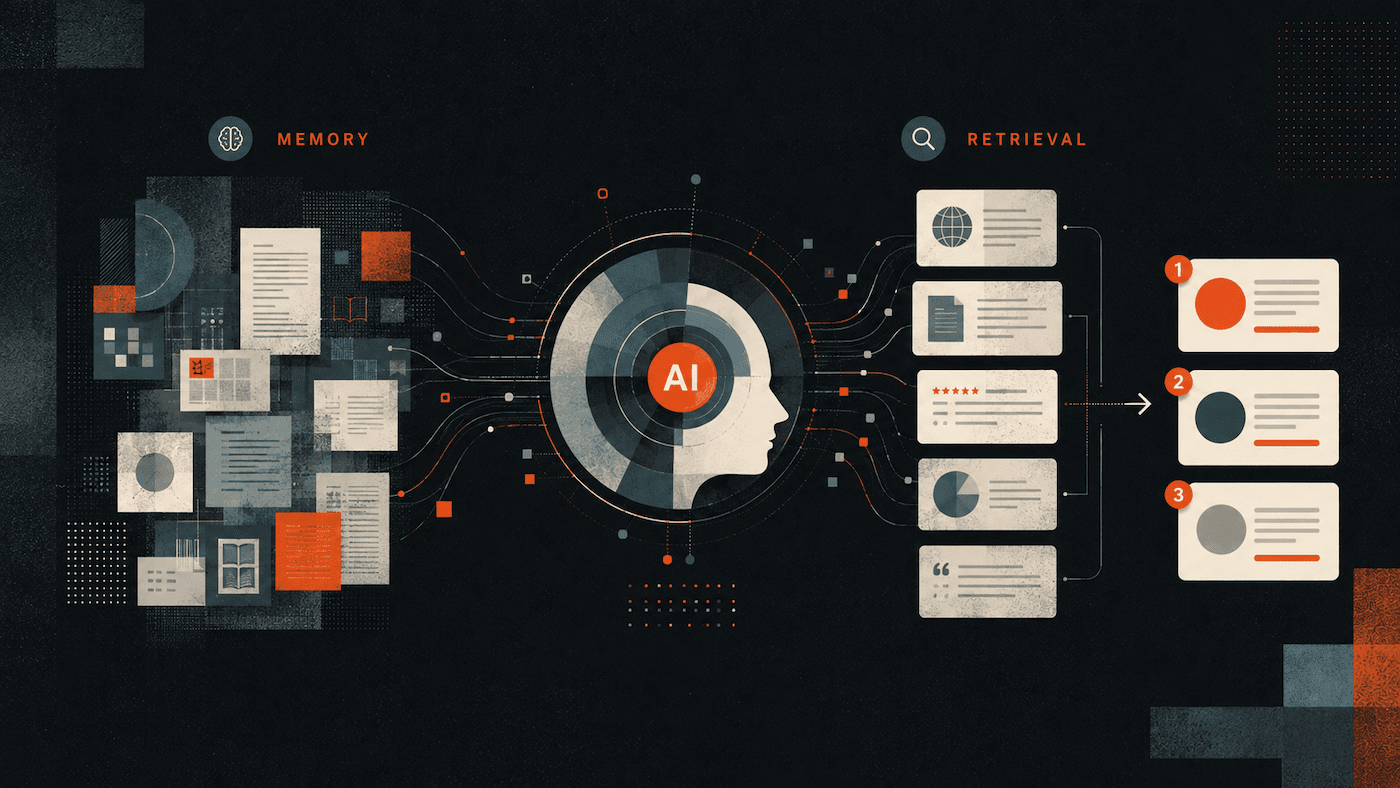
By joining recommendations to the AI’s training data, we can split every brand in two: recommended and deeply present in the training data — an incumbent the model knows cold — or recommended despite being nearly absent from it, winning purely on what the engine is reading right now.
| Baked in — model knows them | Borrowed — winning on live visibility |
|---|---|
| Bose · Bosch · ADP · Glossier · WordPress | TP-Link Tapo · SE Ranking · Petlibro · Omnisend · Orthofeet |
A brand-new company can win AI recommendations today — on visibility, not fame.
These “borrowed” brands are recommended heavily while almost absent from the training data — a sign that current visibility, not incumbency, is driving the wins. It’s the same story the industry-level finding tells, where 85% of recommendations already go to brands outside the top five.
To test that head-on, we did something only an open model allows. We took OLMo 2 — the one capable AI whose exact training data is public — and asked it the same buyer questions with its web access switched off, so it could answer only from memory. It recommended the corpus-heavy incumbents 4.6× more often than the borrowed brands, and it named none of the five borrowed brands above — not SE Ranking, TP-Link Tapo, Omnisend, Petlibro or Orthofeet — a single time from memory. They win inside the live engines while a model trained on the open web doesn’t know them from memory at all. That’s the cleanest evidence we have that the borrowed wins come from what the engines are reading right now, not from fame.
Honest note
The OLMo test is a clean behavioral check on one open 7-billion-parameter model — it shows the mechanism, but OLMo isn’t ChatGPT or Gemini, so it can’t prove what those specific closed models “knew.” (Even for incumbents a small model’s memory is partial — OLMo named about 39% of the baked brands from memory, not all of them; the borrowed rate was 9%.) For the underlying memory-vs-retrieval mechanics measured directly across nine models, see our sister study, Where AI recommendations come from. The pattern holds either way.
Reword the question, change half the answer
Phrasing isn’t a rounding error. It’s a lever you control.
We ran a controlled test: take the same buyer intent, ask it several ways (a question vs. a keyword, formal vs. casual, synonyms), hold the meaning constant, and watch what changes. Rewording the same question changed roughly half the recommended brands. So the content and coverage you earn should target the specific ways your buyers actually ask — not one tidy keyword.
Being useful beats being famous
85% of AI recommendations go to brands outside their industry’s top five.
A common fear is that AI just names the same two or three giants. It mostly doesn’t — even the category leader captures only 2–8% of recommendations, and it takes 17 to 76 brands to make up half. The same holds for the sites AI cites: a sharp specialist like RTINGS gets cited far more than its fame would predict. The door is open for challengers — brands and publishers — in a way the “AI favors incumbents” narrative misses.
The playbook
The one sentence: AI recommends the brands written about on the sites it cites — so getting featured on those sites (earned media, digital PR) is the highest-leverage AI marketing move there is. How to execute:
- Pull your category’s citation short list. Every industry has ~4–6 sites AI leans on. That’s your target media list.
- Get into the roundups and reviews on those sites. AI reads “best X” listicles and comparison pages. Being in the roundup on NerdWallet or TechRadar beats a page on your own site.
- Build a real Reddit and YouTube presence — through genuine participation and creator relationships, not spam.
- Chase specialist coverage, and weigh durability. Placements on big platforms (Reddit, YouTube, Forbes) are the most durable; niche-specialist placements win now but are more retrieval-dependent — a portfolio, not a single bet.
- Measure across engines, repeatedly. Any single reading is noise.
- If you’re a challenger, move now. 85% of recommendations already go outside the top five.
Earned media just became AI distribution
For a decade, “get covered on the sites your customers trust” was a brand and traffic play. Now it’s how you get recommended by the AI that’s making the buying shortlist. The brands moving first are getting baked into AI answers while their competitors are still optimizing for page one.
Two things we can do with this instrument:
- Map your category. The exact sites AI cites for your industry, the competitors beating you into the answers, and where you’re missing — your earned-media target list, built from data.
- Get you onto them. Earning that coverage is Fractl’s core work. The AI shift just made it the highest-leverage channel there is.
First step, today: ask ChatGPT, Perplexity and Google AI Mode the top buyer question in your category. Note who they recommend and which sites they cite. If you’re not on those sites, that’s your roadmap.
See it applied: the AI visibility webinar
Fractl cofounder Kelsey Libert walks through how to act on these findings — where AI visibility is heading, which GEO tactics build real moats, and how to monitor your brand’s presence across a splintering search landscape. The session draws on this study and its companion, Where AI Recommendations Actually Come From, which traces whether an AI’s answer comes from memory or from what it’s reading right now.
Software topline — how the vertical differs from the study average
76%
of software citations come from outside Google’s top ten (vs 73% all-industry) — software is more detached from SEO than average
85.1%
of software recommendations go outside the top-five brands — the leader holds just 4.7%
526
distinct brands recommended across 780 software answers; it takes 39 brands to make up half of all recommendations
17%
of software recommendations had the brand’s own site among the cited sources — 83% of wins happen without your website in the room
- The most-recommended software brand is Zoho (4.7% of recommendations), ahead of QuickBooks — not Salesforce, not Microsoft’s flagships.
- Software answers are stickier than average. Run the identical query twice and the recommended-brand overlap in software is 63–73% on the chat engines, vs 49–62% all-industry. Takeaway for a SaaS audience: slots are harder to luck into and worth more once held.
- Engine field guide, software only: Google AI Mode reads widest (23 sources/answer, 8.9 brands); Copilot reads narrowest (4.5 sources — being in its small retrieved set is everything); Google AI Overviews names brands in only 69% of software answers.
AI heavily relies on niche review sites and “best X” listicles and comparison pages
- 74% of AI answers to software buying questions cite at least one review/comparison platform (G2, PCMag, Capterra, TechnologyAdvice, Gartner, Software Finder–class sites).
- When AI cites a third party — anyone other than a software vendor — 45% of the time it’s a review/comparison site. (Review platforms are 21% of all software citations; vendors’ own pages are the rest of the pool.)
- The chat engines lean on them hardest: review platforms are 39% of Copilot’s software citations, 28% of ChatGPT’s, 27% of Perplexity’s — vs 14% for Google AI Overviews and 12% for AI Mode. The engines people use conversationally are the most review-site-driven.
- AI reads review sites beyond their SEO reach: 77% of the review-platform pages AI cited did not rank on Google’s page one for that query. A review site’s influence on AI answers is bigger than its search rankings suggest.
- The mechanism (companion study, 9 models, 6,000+ controlled runs): models build answers almost entirely from the retrieved set — and a page carrying real evaluative evidence (ratings, review counts, an explicit verdict) climbs +3–4 ranks over its retrieval position on the strongest models. The review page is the salesperson in the room when the answer gets written.
The software review-platform leaderboard (citations in software answers, subdomains merged)
| Site | Citations | Site | Citations |
|---|---|---|---|
| G2 | 160 | Business.com | 47 |
| PCMag | 150 | TechRepublic | 47 |
| NerdWallet | 105 | Capterra | 47 |
| Tech.co | 80 | TechnologyAdvice | 43 |
| FitSmallBusiness | 65 | Gartner | 43 |
| Security.org | 53 | Forbes (advisor-style) | 50 |
The Software Finder moment
In the July 2026 collection, Copilot cited softwarefinder.com in both runs of “best payroll software for small businesses” (answers recommending Gusto, OnPay, QuickBooks Payroll, Square Payroll/Rippling), and Google AI Mode cited their payroll resource page on “best HR software for startups under 50 employees.”
SaaS-specific “borrowed brands”
The published piece names SE Ranking and Omnisend. The dataset has more software names winning heavy recommendation while nearly absent from the training corpus (OLMo memory column = times OLMo 2 named them answering from memory alone):
| Brand | Recs (software) | Corpus mentions | OLMo memory |
|---|---|---|---|
| SE Ranking | 49 | 313 | 0 |
| TouchBistro | 38 | 135 | 5 |
| AgencyAnalytics | 32 | 45 | 0 |
| BambooHR | 29 | 383 | 1 |
| HoneyBook | 19 | 411 | 0 |
| FlutterFlow | 17 | 77 | 0 |
| NordPass | 48 | 785 | — |
And in the adjacent AI-tools vertical (777 answers, also in the study): NotebookLM (34 recs), ElevenLabs (29), SciSpace (24), Paperpal (22), HeyGen (13) — all heavily recommended with near-zero training-corpus presence. Several are young brands that partly post-date the corpus snapshot — which is exactly the point: they’re winning on what engines read today, months after launch, not on years of accumulated fame.
Bonus AI-tools stat: Zapier alone is 3% of ALL citations in the AI-tools vertical (227 citations, the #2 domain behind YouTube) — a software vendor acting as a review publisher and getting treated like one by the engines.
Caveats
- Association, not causation — “Brands cited on review sites get recommended” is an observed pattern plus a controlled mechanism result, not a proven causal chain in the live engines.
- July 2026 snapshot; engines change monthly.
- “Same twice” convention: the software stability numbers here are brand-set overlap between two identical runs, counting only pairs where at least one run named brands. The published table’s AI Overviews 84% counts its frequent no-brand answers as “same”.
All numbers computed 2026-08-14 from the raw wave dataset (atlas_v1) with the study’s own definitions; the all-industry versions of each metric reproduce the published figures.
Method & limits
Scale: ~1,000 buyer queries across 15 industries × 6 engines (ChatGPT, Google AI Overviews, Google AI Mode, Gemini, Perplexity, Copilot) × 2 runs = 11,573 answers, collected July 2026; engines change monthly, so treat it as a dated snapshot. The training-data join is an association, not proof of cause — we use the open-web data that open models (OLMo-class) trained on as a stand-in for the closed engines’ undisclosed data, so the baked-in/borrowed split is a strong proprietary signal, not a claim about what any specific model “knew.” As a separate behavioral check we also queried OLMo 2 (whose training data is fully public) with retrieval off — see Finding 04 — which confirmed the borrowed brands aren’t recommended from memory; that check is on one open 7B model, not the closed engines.
Measurement care: brands and recommendations were extracted by a language model and can contain edge errors; brand names that double as common words can’t be reliably counted in the training data, and we detected and removed those before finalizing any number; the smallest baked-in/borrowed examples ride on modest counts and should be read as illustrative.
Sample: the 15 industries lean consumer and commerce; heavy-B2B, healthcare and local-services behavior may differ. Cross-industry claims are directional — 15 industries is a designed sample, not a census.
Disclosure: Fractl is a marketing agency, and this research supports client-facing tools and services we build and sell. Weigh the piece knowing the interest exists; the method is open and the numbers are checkable.