




Table of Contents
- What AI Platform Citation Patterns Are
- What AI Actually Cites
- Why Original Research Still Wins (Even at 0.6%)
- How To Earn AI Citations
- Win the Search, Win the Citation
- Frequently Asked Questions
Key Takeaways
- Three formats dominate. How-to guides, brand product and service pages, and listicles take roughly 75% of AI citations on marketing and SEO queries.
- YouTube leads all sources. Video is the single most-cited source at about 11%, more than comparison, opinion, and research combined.
- Original research is rarely the cited link. It accounts for just 0.6% of direct citations.
- Citations follow rankings. AI answers pull sources from live search, so winning the search result is how you get pulled into the answer.
- Research still drives visibility. It earns the rankings, authority, and human-quality signals that get your other pages cited.
AI platform citation patterns describe which sources AI answers actually cite when they respond to a query. Getting named in those answers is the new version of ranking, and the rules aren’t what most marketers assume. To see which sources AI answers actually cite, we analyzed Ahrefs Brand Radar data covering 10,108 AI answers and nearly 68,000 citations across ChatGPT, Gemini, Perplexity, Copilot, and Google’s AI Overviews, all on marketing and SEO queries. AI overwhelmingly cites practical utility pages, and original research is almost never the cited link, but research still drives AI visibility indirectly, and the data shows how.
What AI Platform Citation Patterns Are
When you ask an AI search engine like ChatGPT, Perplexity, Gemini, or Claude a question, the AI-generated answer often names its sources, and those citations decide which brands get seen. Google does the same through AI Overviews and Google AI Mode, and the broader practice of getting your content into these answers is called generative engine optimization (GEO). Three measures matter: citation rate, how often a source gets cited at all; citation frequency, how many times it appears across answers; and citation positioning, whether it leads the answer or trails as a footnote. Traditional search spreads ten blue links across a page, but AI-generated answers may cite only a handful of sources, so the competition for each search engine results page (SERP) slot is fierce.
What AI Actually Cites
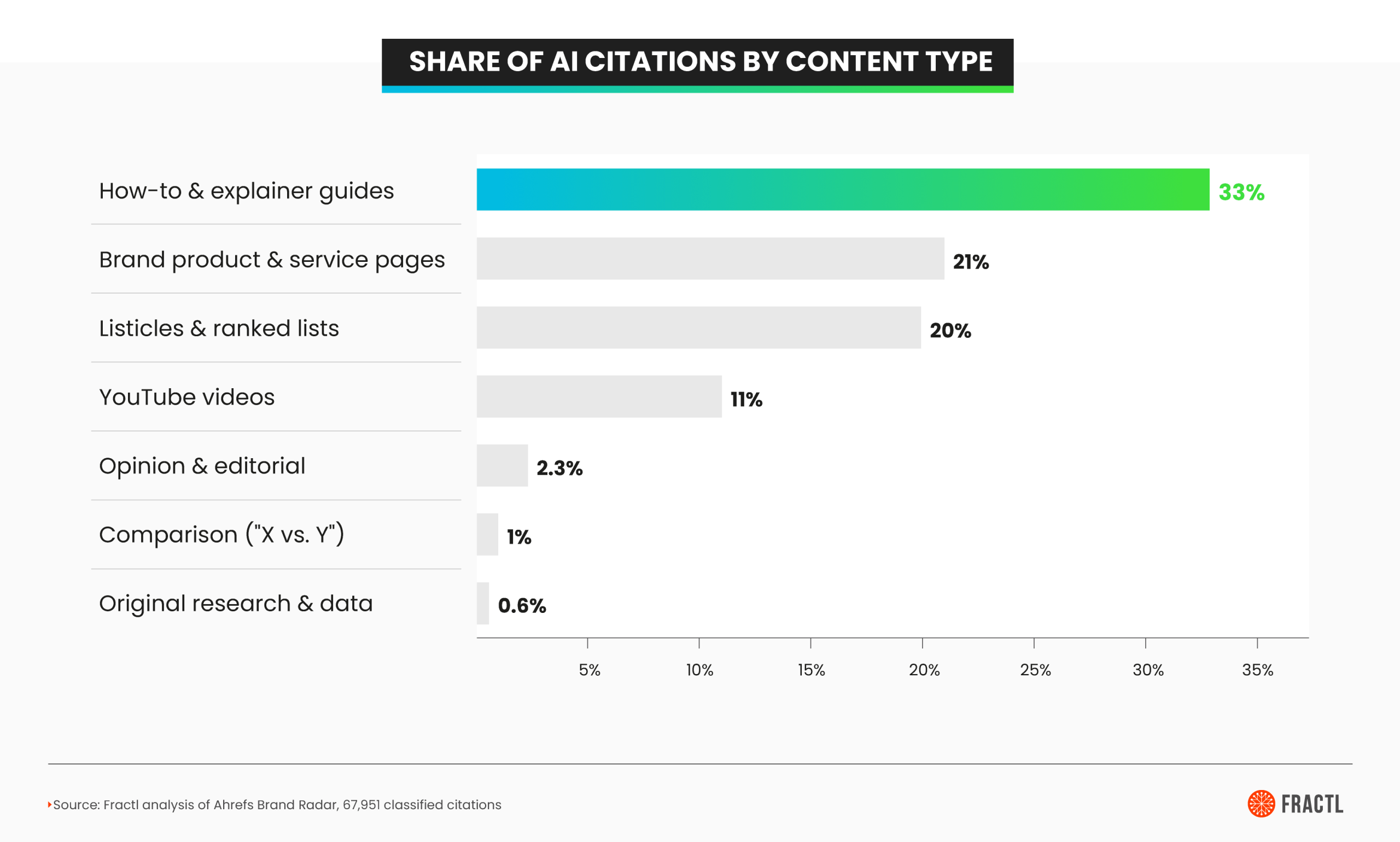
Across nearly 68,000 citations that Ahrefs Brand Radar classified, three content types took roughly 75% of them. The breakdown below is of all classified citations on marketing and SEO queries.
| What AI cites | Share of citations |
|---|---|
| How-to and explainer guides | ~33% |
| Brand product and service pages | ~21% |
| Listicles and ranked lists | ~20% |
| YouTube videos | ~11% |
| Opinion and editorial | ~2.3% |
| Comparison (“X vs. Y”) | ~1% |
| Original research and data | ~0.6% |
Fractl’s analysis of Ahrefs Brand Radar data: 10,108 AI answers and 67,951 classified citations across ChatGPT, Gemini, Perplexity, Copilot, Grok, and Google AI Overviews / AI Mode, on marketing and SEO queries.
YouTube is the single most-cited source at about 11%*. That’s more than comparison, opinion, and original research combined — and brands’ own product and service pages are cited about as often as listicles, so AI leans on vendor pages, not only editorial coverage.
The sources behind those citations skew toward authority and firsthand experience. High-authority publishers like Forbes, Business Insider, Reuters, and TechRadar appear often, alongside analyst and reference sources like Gartner and Wikipedia. Review sites like Yelp and Tripadvisor feed local and product answers, and user-generated content (UGC) from Reddit, Quora, and LinkedIn gets cited heavily because it reads as lived experience. SEO tools like Semrush even get cited when the query is technical.
*How-to guides, product pages, and listicles are content-type categories that pool citations across thousands of domains, while YouTube is a single platform, which is why it leads all individual sources even though how-to guides lead by format at about 33%.
Why Original Research Still Wins (Even at 0.6%)
Original research accounts for just 0.6% of citations, but that number understates its role, because it works in two indirect ways.
| It signals quality to search engines Google’s guidance asks whether content offers original information, reporting, research, or analysis, and proprietary data is one of the clearest ways to clear that bar and build the domain authority that thin, templated pages can’t. | It feeds AI citations through rankings The AI answers that cite sources pull them from live search, so winning the result is how you get pulled into the answer. Ahrefs found that 38% of pages cited in AI Overviews also rank in the top 10, a strong link between ranking and AI search visibility. Research also seeds the training data models learn from and authority signals like a knowledge panel that these systems lean on. |
Original research is one of the most reliable ways to earn the links, brand mentions, and rankings that feed citations, even when the page AI names is a how-to or product page rather than the study itself.
How To Earn AI Citations
Work with the patterns rather than against them:
- Publish the formats AI cites. Build genuinely useful how-to guides, clear product and service pages, and well-researched listicles, plus video where it fits.
- Win the search result first. Because citations track rankings, strong SEO is the foundation of AI search visibility.
- Earn brand mentions on trusted sources. Coverage on high-authority publishers and review sites gives AI more reasons to name you.
- Back it with original research. Original data earns the links, rankings, and authority that pull your other pages into answers.
- Make your content machine-readable. Add schema markup so AI systems can parse what your page is and who it serves.
Win the Search, Win the Citation
AI hasn’t rewritten the rules so much as it’s raised the stakes on the ones that already mattered: useful content, high-authority coverage, and search rankings that now feed AI answers as well as clicks. The brands that get cited are the ones doing the fundamentals well, backed by original research that earns trust from both search engines and the models pulling from them. If you want a partner that produces that kind of research-driven content, reach out and partner with Fractl.
Frequently Asked Questions
What are AI platform citation patterns?
They’re the patterns in which sources AI answers cite, such as which content types and websites ChatGPT, Gemini, and Perplexity name most often when they respond to a query.
What content does AI cite most often?
How-to guides, brand product and service pages, and listicles account for about 75% of citations on marketing and SEO queries, and YouTube is the single most-cited source.
Does original research help with AI visibility?
Yes, mostly indirectly. Research is rarely the cited page itself, but it builds the rankings, links, and authority that get your other pages pulled into AI answers.
What is generative engine optimization (GEO)?
GEO is the practice of optimizing your content and brand presence so AI search engines cite you in their answers.
How do you get cited by ChatGPT and Perplexity?
Publish useful, well-structured content, earn brand mentions on trusted sites, rank well in search, and add schema markup so the systems can parse your pages.