




Table of Contents
- How To Spot Content Decay
- When Content Peaks and How Fast It Fades
- Decay Curves by Content Type
- What To Do About a Decaying Page
- Content Decay in the Age of AI Search
- Plan for Decay Before It Starts
- Methodology
- Frequently Asked Questions
Key Takeaways
- Content peaks fast. The typical piece hits its traffic peak a median of four months after publishing, then declines.
- The drop is steep. The typical piece loses about 76% of its peak traffic within three months of peaking.
- Research and data content is the spikiest. It peaks in a median of one month and sheds 89% of its traffic within three months.
- How-to content lasts longest. It retains roughly 30% of peak traffic a full year later, more than any other format.
- Decay is manageable. Refreshing outdated pages tends to help them rebound, and pruning the rest concentrates authority where it counts.
Content decay is the slow loss of organic traffic, rankings, and impressions a page suffers as it ages. A post that once pulled hundreds of visitors a month steadily slides down the SERPs until it barely registers. It happens to almost everything you publish, and it’s one of the most under-measured problems in content marketing. We wanted hard numbers, so we analyzed 719 editorial pieces across three client portfolios in business finance, energy, and home security, tracking monthly Google Analytics views over two years. Across those two years, content peaks faster and fades harder than most teams assume.
A page can decay for several reasons:
 Outdated information The stats, prices, or dates on the page no longer match reality. |  Algorithm updates A search engine algorithm update reshuffles the rankings. |  New competition Fresher, deeper pages outrank you for the target keyword. |
 Search intent shift What people want from the query has changed. |  AI Overviews AI-generated answers absorb the click before it reaches your page. |  Keyword cannibalization Two of your own pages compete for the same query. |
How To Spot Content Decay
Decay often starts when user intent shifts and your page no longer answers the question behind the query, so a quick SEO audit each quarter catches it before it compounds.
Watch for a declining page in Google Search Console: falling impressions, slipping click-through rates (CTR), and lower average position in the search engine results pages. Cross-check traffic in Google Analytics and rankings in a tool like Ahrefs or Semrush, and keep an eye on downstream signals like conversions and a rising bounce rate.
When Content Peaks and How Fast It Fades
Averaged across all 719 pieces, content took a median of four months to reach peak traffic (mean 6.5). The drop after the peak is sharp: the typical piece lost about 76% of its peak traffic within three months of peaking.
| How Fast Is Traffic Lost After Content Peaks? | |||
|---|---|---|---|
| Content type | Pieces studied | Median time to peak | % of traffic lost by month three |
| Research / data | 107 | 1 month | 89% |
| How-to | 309 | 5 months | 61% |
| Listicle | 303 | 5 months | 82% |
| All | 719 | 4 months | 76% |
Median values. The “% lost by month 3” figures are measured on the 590 pieces old enough to have three months of post-peak data. Source: Fractl’s analysis of 719 pieces across three client portfolios, GA4 views, March 2024 to June 2026.
Research and data pieces peak almost instantly, in a median of one month, then shed 89% of their traffic within three months. How-to content is the slow burn: it takes about five months to peak and holds on to more of its traffic than anything else. Listicles peak around the same time as how-to content but decay far harder.
Decay Curves by Content Type
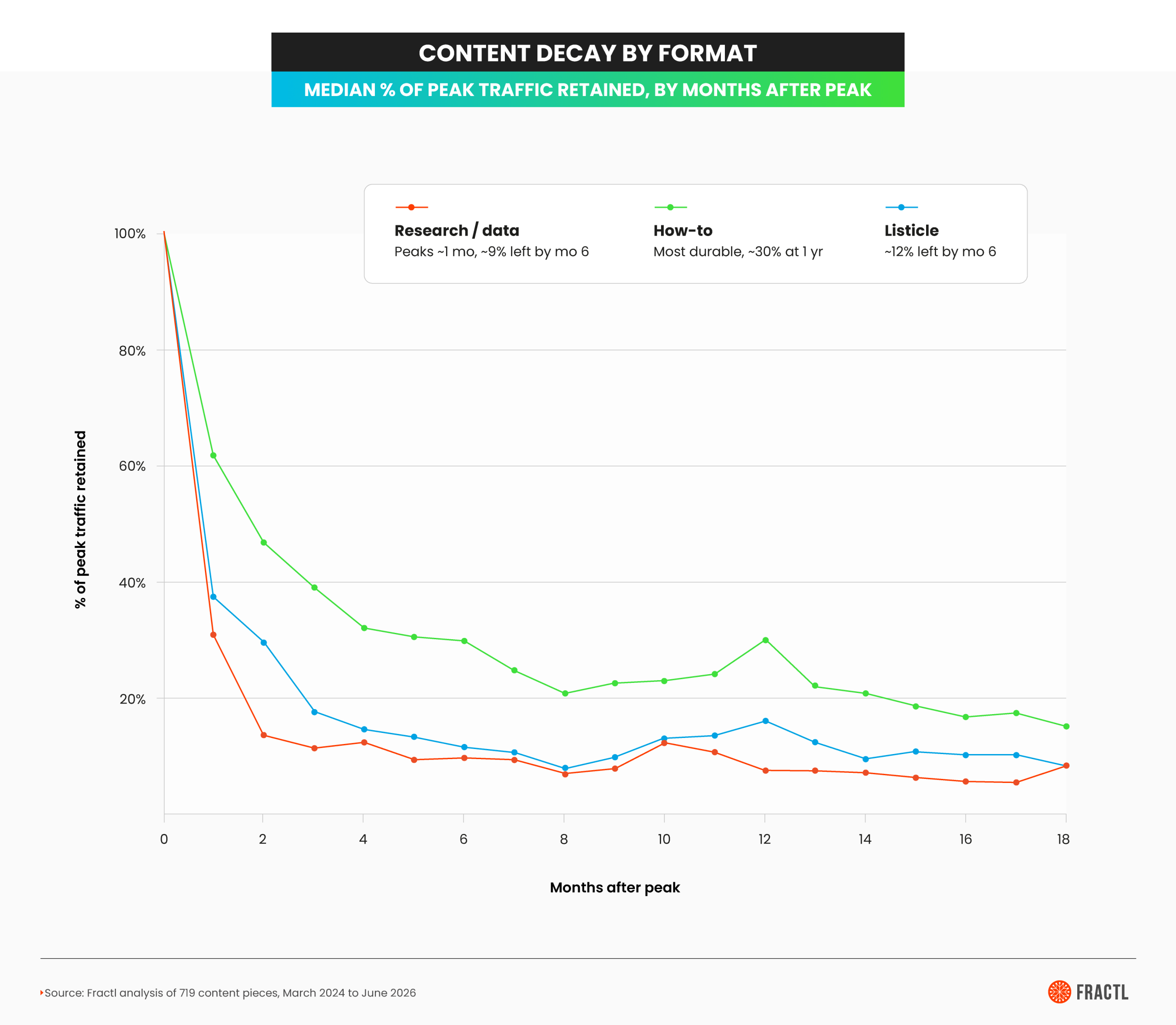
Research and data content spikes and crashes, keeping only about 31% of its peak traffic one month out and under 10% within half a year. How-to content is the most durable, retaining roughly 30% of peak a full year later as it keeps answering an ongoing question. Listicles fall between the two, holding about 12% six months out. Topical authority and freshness signals help the durable formats hold their ground, and featured snippets can prop up a strong how-to long after its peak.
What To Do About a Decaying Page
Decay is normal, but you can slow it and often reverse it by updating underperforming content before it flatlines, which protects both search rankings and seo performance. Start by deciding whether a page is worth saving, then act:
- Refresh outdated information. Update stats, examples, and dates, and add anything fresh keyword research says the query now expects. Refreshing tends to help pages rebound.
- Consolidate or redirect. Merge thin or overlapping pages and point the weaker URL to the stronger one with a 301 redirect to fix keyword cannibalization.
- Rebuild internal links. Add links from strong pages so link equity and existing backlinks flow to the piece you’re reviving, protecting its backlink profile.
- Refresh the metadata. Rewrite the title tag and meta description to match current search intent, and keep the rest of the metadata accurate.
- Shore up structure. Add or update structured data for rich results, plus a table of contents, so the page stays easy to crawl and skim.
- Prune what can’t be saved. Content pruning, removing or redirecting dead pages, concentrates authority on the content that still performs.
Content Decay in the Age of AI Search
Decay is accelerating because search itself is changing. AI Overviews and other AI-generated answers now answer many user queries on the SERP (search engine results page), so a page can hold its organic SERP ranking and still lose clicks. Tools like ChatGPT pull people out of traditional search entirely for some questions.
As search engine algorithms and AI answers keep shifting, the pages that survive AI search are the ones that answer a need better than the summary can, with original data, clear structure, and expertise the models cite.
Plan for Decay Before It Starts
Every page you publish is on a clock: fast peaks, faster drops, and a long tail only the most useful content holds. Build refreshes into your calendar the way you build new posts, prune what’s beyond saving, and treat your best pages as assets worth maintaining.
If you want a team that produces durable content and keeps it performing, reach out and partner with Fractl.
Methodology
We built this analysis from 719 editorial pieces across three client portfolios in business finance, energy, and home security. Using GA4 monthly views from March 2024 through June 2026 (28 months), we kept only pieces that reached a clear peak of at least 20 views in a month, identified each piece’s peak month, and measured the traffic it retained afterward. Time-to-peak and traffic-lost figures are medians. The percent-lost-by-month-3 figures cover the 590 pieces old enough to have three months of post-peak data.
Frequently Asked Questions
What is content decay?
Content decay is the gradual loss of organic traffic, rankings, and impressions a page experiences as it ages, usually because the information, competition, or search intent around it has shifted.
How do you identify content decay?
Track each page’s traffic, impressions, and click-through rate in Google Search Console and Google Analytics, and flag any declining page that has trended down over several months.
How often should you refresh content?
Review high-value pages at least twice a year. Research and data pieces decay fastest, so they may need attention within a month or two of publishing.
What’s the difference between content decay and content pruning?
Content decay is the problem: the loss of traffic over time. Content pruning is one fix, removing or redirecting pages that can’t be revived so authority concentrates on the rest.
Does content decay affect AI search visibility?
Yes. Outdated or thin pages are less likely to be cited in AI Overviews and AI-generated answers, so decay can cost you visibility in AI search as well as in traditional rankings.