




Table of Contents
- What Causes Content Decay?
- How To Identify Decaying Content
- To Refresh, Consolidate, or Redirect?
- How To Refresh Underperforming Content
- Building a Content Refresh Program Into Your Marketing Strategy
- Your Content Doesn't Expire, It Evolves
Content decay is the gradual decline in a page’s organic traffic, keyword rankings, and search visibility over time. It doesn’t happen overnight. It’s the slow slide where a blog post that once drove hundreds of visits per month quietly drops to a trickle.
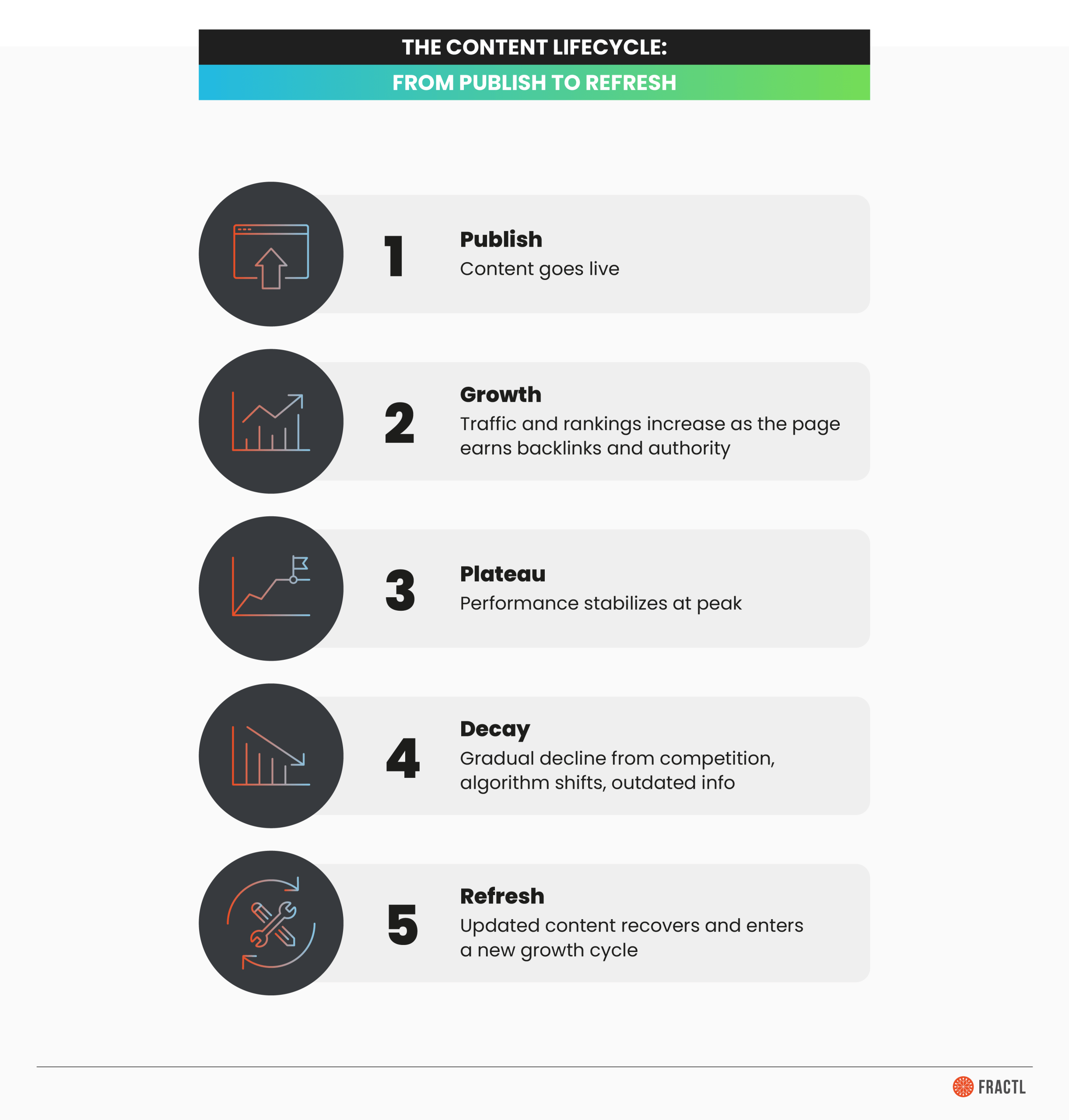
Every piece of content has a lifecycle. Publish it, watch it grow, and eventually, it plateaus and declines. That’s normal; what separates strong content marketing programs from stagnant ones isn’t avoiding decay, it’s having a system to catch it and act on it.
I’ve worked on content refreshes across industries at Fractl, and the pattern is consistent: teams invest heavily in creating new content but rarely revisit what’s already been published. The result is a growing library of underperforming pages dragging down the site’s overall SEO health.
Here, I’ll walk you through how to identify decaying content, decide whether to refresh, consolidate, redirect, or remove it, and execute a content refresh that recovers organic traffic and keyword rankings.
What Causes Content Decay?
Content decay rarely has a single cause. Usually, it’s a combination of factors that compound over months. Understanding what’s driving the decline is the first step toward fixing it, because the cause determines the solution.
Algorithm Updates and Shifting Search Signals
Google ran four core algorithm updates in 2024 and three in 2025. Each one can reshuffle rankings for thousands of queries, and pages that ranked well under one set of signals might not under the next.
Google’s algorithm increasingly rewards content that demonstrates experience, expertise, authoritativeness, and trustworthiness (what Google calls E-E-A-T). If your content hasn’t been updated to reflect those evolving standards, it’s vulnerable.
There’s also the AI layer. AI tools like ChatGPT and Gemini are changing how people search, and AI Overviews now appear for a growing number of Google search queries.
Organic CTR for informational queries with AI Overviews fell 61% between June 2024 and September 2025, according to a Seer Interactive study of 25.1 million impressions. Even pages that maintain their rankings can see reduced traffic as AI-generated answers capture clicks directly on the SERP.
As Kelsey Libert wrote in her column on adapting content strategy for AI-powered SERPs, visibility now means optimizing for more than traditional rankings.
For a deeper look at how this shift affects SEO, see our guide to generative engine optimization.
Competitor Velocity
Your content doesn’t have to get worse for it to decay; competitors just have to publish something better.
When a competitor publishes a more comprehensive, better-sourced, or more visually engaging page on the same topic, it can push your existing content down in the SERPs. This is especially common in fast-moving industries like SaaS, digital marketing, and finance, where content cycles are measured in months, not years.
Beyond updating what you have, the fix here involves understanding what competitors are doing differently and closing the gap.
Shifting Search Intent
User intent behind a keyword can evolve. A query that once demanded a definition article might now require a comparison guide or a how-to walkthrough. Google adjusts what it ranks based on what users actually click on and engage with, so the SERP itself is your best signal.
If your page was written to answer one version of the intent and the intent has shifted, your rankings will follow. Reviewing the current top-ranking results for your target keywords reveals whether this has happened.
Outdated Information and Stale Data
Content that references specific statistics, pricing, regulations, or trend data has a built-in expiration date. When those numbers become inaccurate, readers notice, and so do search engines. Outdated information doesn’t just hurt rankings. It erodes trust with your target audience and can damage brand credibility. The good news? This is one of the easiest forms of content decay to fix, which makes it a strong starting point for any content refresh effort. Even evergreen content needs periodic updates to maintain its value.
How To Identify Decaying Content
Identifying content decay requires looking at specific metrics over time, not a single snapshot. A structured content audit using the right performance metrics surfaces pages that need attention before the decline becomes irreversible.
Key Metrics That Signal Decay
These are the signals that should trigger a closer look at any page:
- Declining organic traffic over three to six months. A sustained drop (not a one-time dip from seasonality or a site issue) is the most reliable indicator of content decay.
- Dropping keyword rankings. If a page is slipping from positions one through five to six through 10 or beyond, it’s losing competitive ground. Even small position drops matter: position one captures 39.8% of clicks compared to 18.7% for position two, according to First Page Sage.
- Decreasing impressions and click-through rates. Falling impressions mean Google is showing the page to fewer searchers. Falling CTR means the listing itself is less compelling relative to competitors.
- Rising bounce rate. If the bounce rate is climbing, the content may no longer match what users expect when they click through from organic search.
- Loss of backlinks. Declining referring domains means the page is losing the authority signals that helped it rank in the first place.
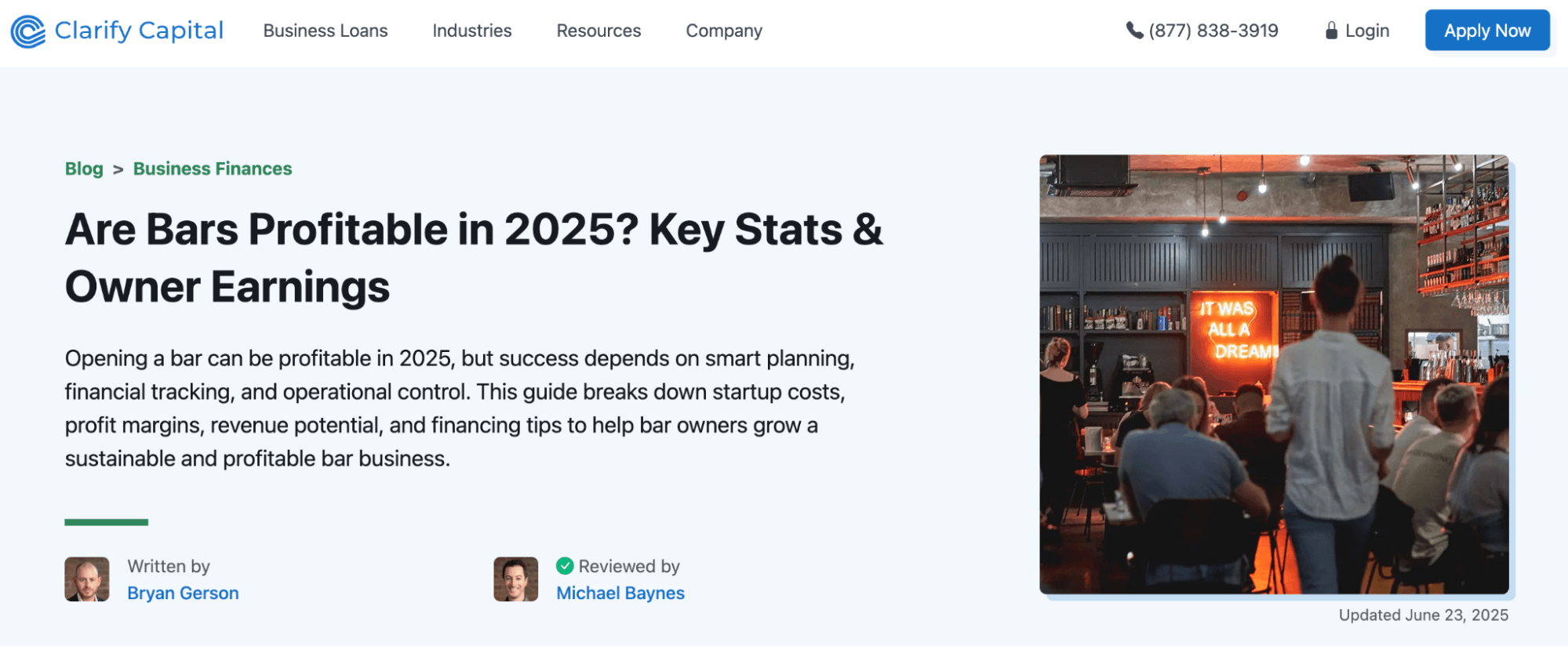
For example, this Clarify Capital article, “Are Bars Profitable in 2025? Key Stats & Owner Earnings,” was published in the summer of 2025. It’s time to update the facts throughout this piece, and (critically) change the year in the title to 2026:
Using Google Search Console and Google Analytics
Google Search Console and Google Analytics are the best free starting points for identifying decay.
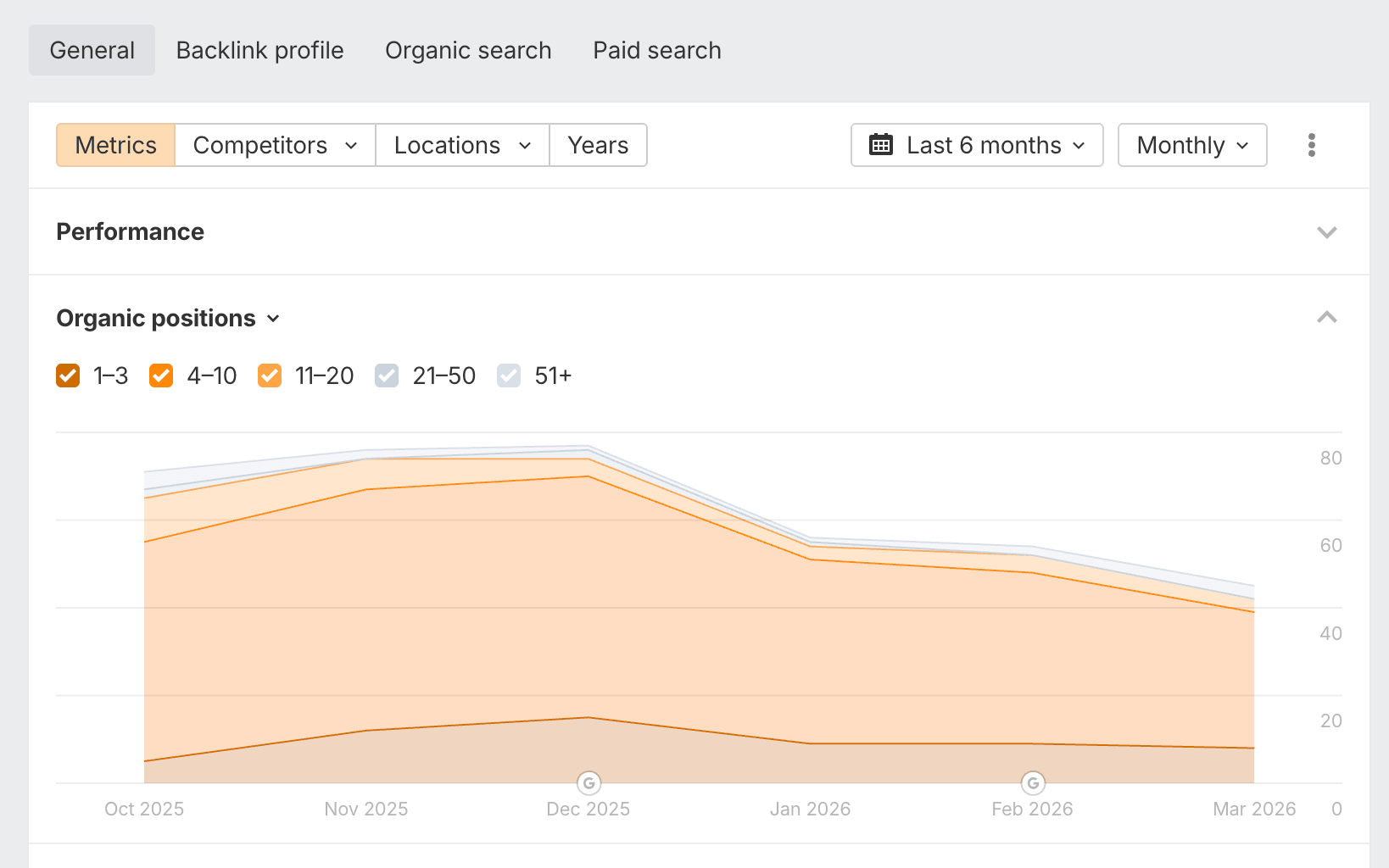
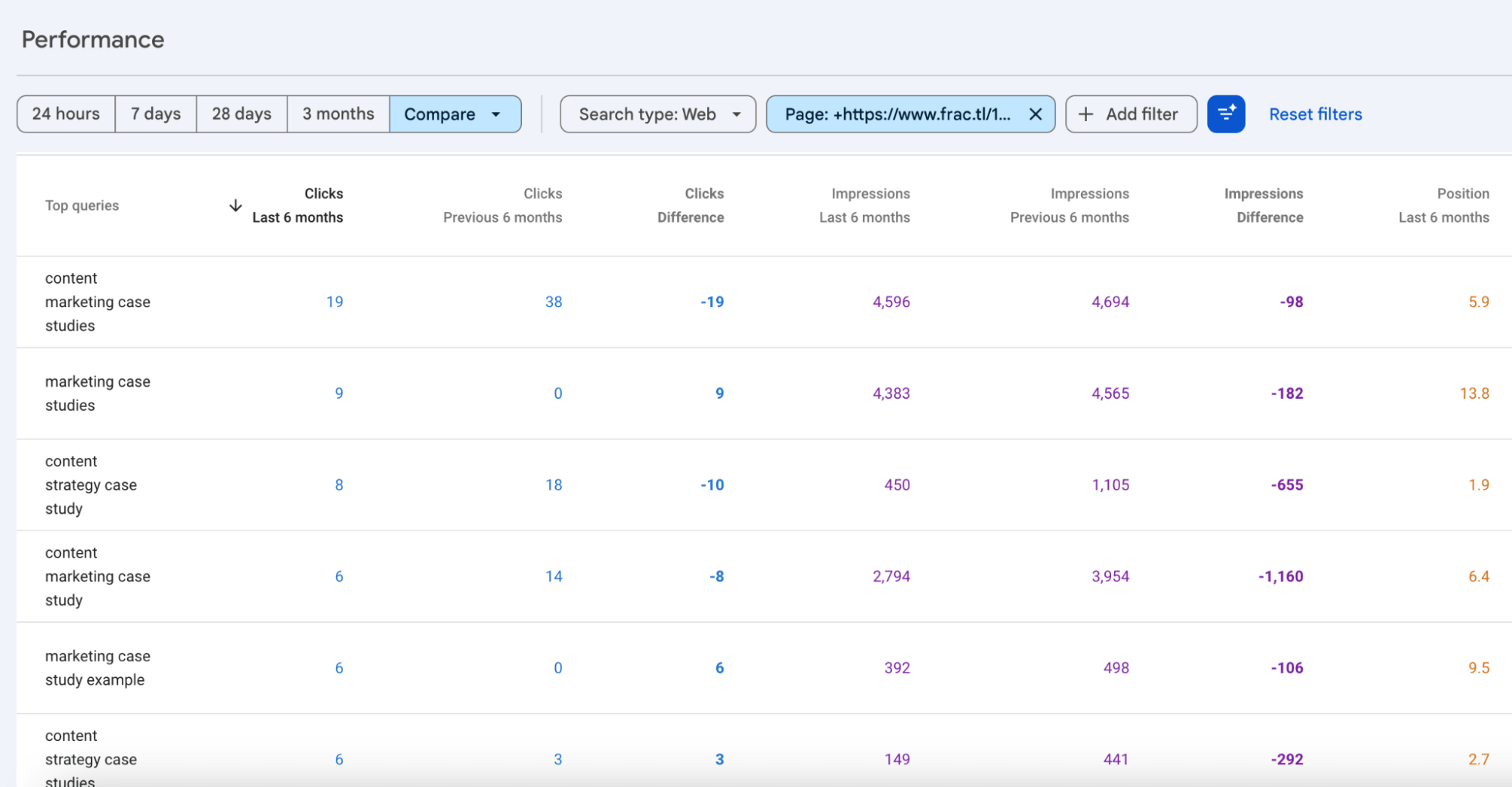
In GSC, pull the Performance report and filter by page. Compare the last six months to the previous six months, looking for pages where clicks, impressions, and average position are all trending down. Pages with declining impressions are especially worth flagging since that means Google is showing your content less, which typically precedes traffic drops.
Here’s a look at the performance of one of our blog posts, “10 Case Studies That Show the Real Impact of Content Marketing“:
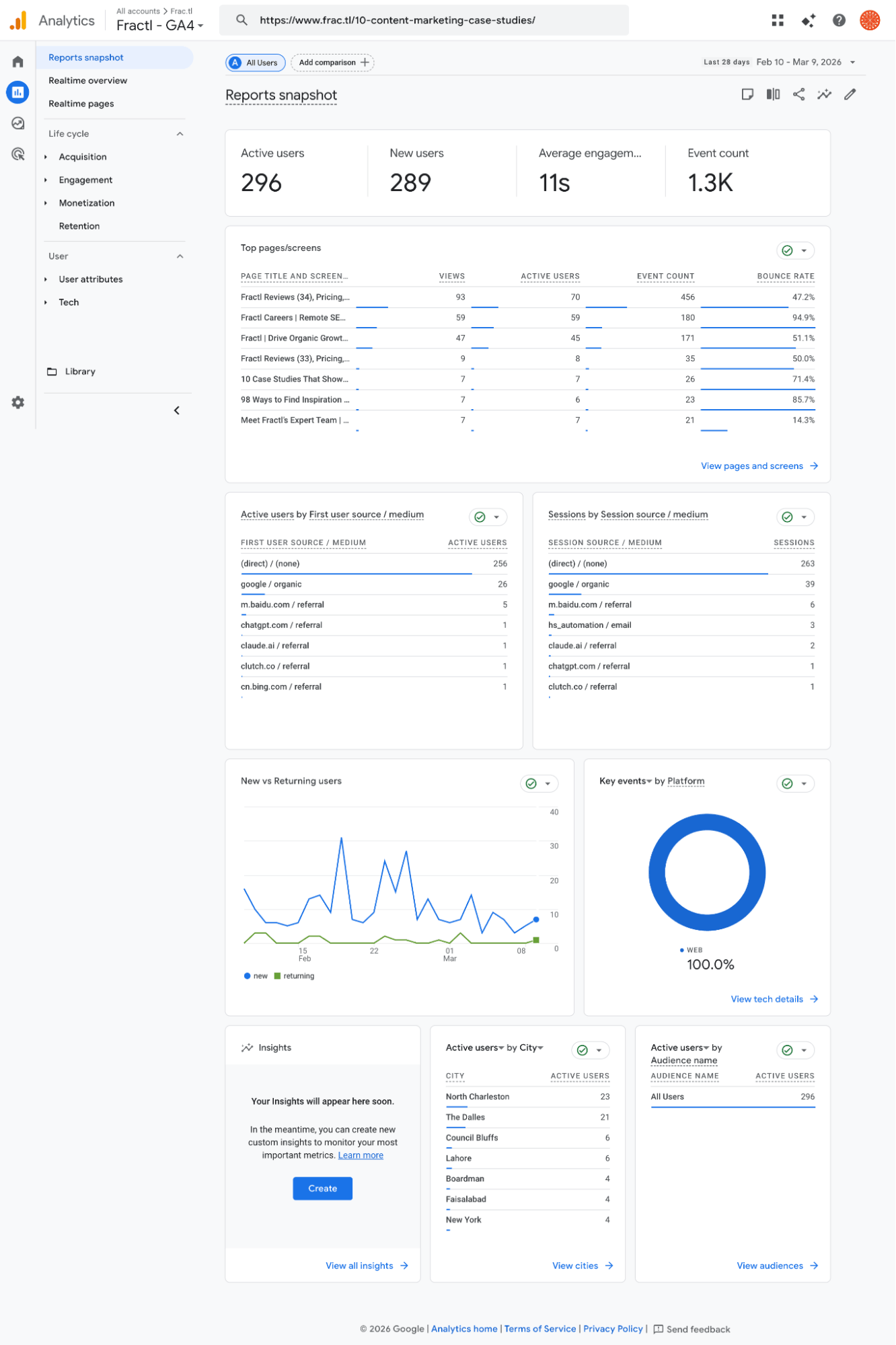
In GA4, use the landing page report to compare engagement metrics across date ranges. Look for pages where sessions, engagement rate, and average engagement time are declining simultaneously. A page where traffic and engagement are both dropping is almost certainly decaying.
Here’s the current GA4 snapshot for our homepage, Frac.tl:
SEO Tools for Deeper Analysis
Free tools get you started, but dedicated SEO platforms offer more granular tracking:
- Semrush. Position Tracking lets you monitor keyword rankings over time for specific pages. The Organic Research report shows traffic trend lines by URL, making it straightforward to spot declining pages.
- Ahrefs. Site Explorer tracks backlink trends and organic traffic estimates per page. The Content Gap tool shows where competitors are outranking you, which helps prioritize which older pages to refresh first.
- Content optimization platforms. Tools like Clearscope score your content against the current top-ranking pages for a keyword, identifying gaps in topic coverage, keyword usage, and content depth that may be contributing to decay.
Each tool approaches the problem differently. GSC and GA4 tell you what’s happening, then Semrush and Ahrefs help you understand why. Content optimization platforms tell you how to fix it.
To Refresh, Consolidate, or Redirect?
Not every decaying page should be refreshed. Some should be consolidated, redirected, or removed entirely. The right decision depends on the page’s current authority, its relevance to your business goals, and the effort required to fix it.
Assessing your content needs before acting prevents wasted time on pieces of content that don’t warrant the investment. Here’s a quick framework to help you decide:
| The Content Refresh Decision Framework | ||||
|---|---|---|---|---|
| Factor | Refresh | Consolidate | Redirect | Remove |
| Backlinks | Has meaningful backlinks | Multiple thin pages share backlinks | Few or no backlinks, but a better page exists | No backlinks |
| Topic relevance | Still aligned with business goals | Related pages overlap or cannibalize | Topic no longer relevant, but a related page exists | Topic completely irrelevant |
| Traffic trend | Declining but still has some traffic | Individual pages have minimal traffic | Zero or near-zero traffic | Zero traffic |
| Effort level | Moderate (update content) | Moderate (merge + redirect) | Low (set up redirect) | Low (remove or 410) |
When To Refresh and Update
A page is a strong refresh candidate when it still has meaningful backlinks, the topic aligns with current business goals and search intent, and the content primarily needs updated data, improved formatting, or better optimization.
Typical refresh candidates include:
- Pages that peaked 12 or more months ago with a steady decline
- Pages ranking in positions six through 15 that could move to page one with better optimization
- Pages with strong backlink profiles but outdated information
Refreshing existing content is often more efficient than creating something new because you’re building on the page’s existing search equity rather than starting from zero.
When To Consolidate or Merge
Consolidation is the right call when multiple thin or overlapping pages compete for the same keyword. This is keyword cannibalization, and it splits your authority across pages instead of concentrating it:
Identify pages targeting similar keywords with overlapping content, then merge them into one comprehensive resource. Use 301 redirects from the retired URLs to the consolidated page to preserve link equity.
This approach is particularly effective when you have several old posts covering similar subtopics that individually underperform but could form a strong single resource if combined.
When To Redirect or Remove
Pruning is the right call for older pages with zero backlinks, no meaningful traffic, and topics that no longer align with your business strategy.
Set up 301 redirects to the most relevant remaining page to preserve any residual link equity. For content that’s truly irrelevant with no logical redirect target, a 410 (gone) status tells search engines the page has been intentionally removed.
Removing thin or irrelevant content can actually improve site-wide SEO health by focusing crawl budget on your strongest, most relevant content.
How To Refresh Underperforming Content
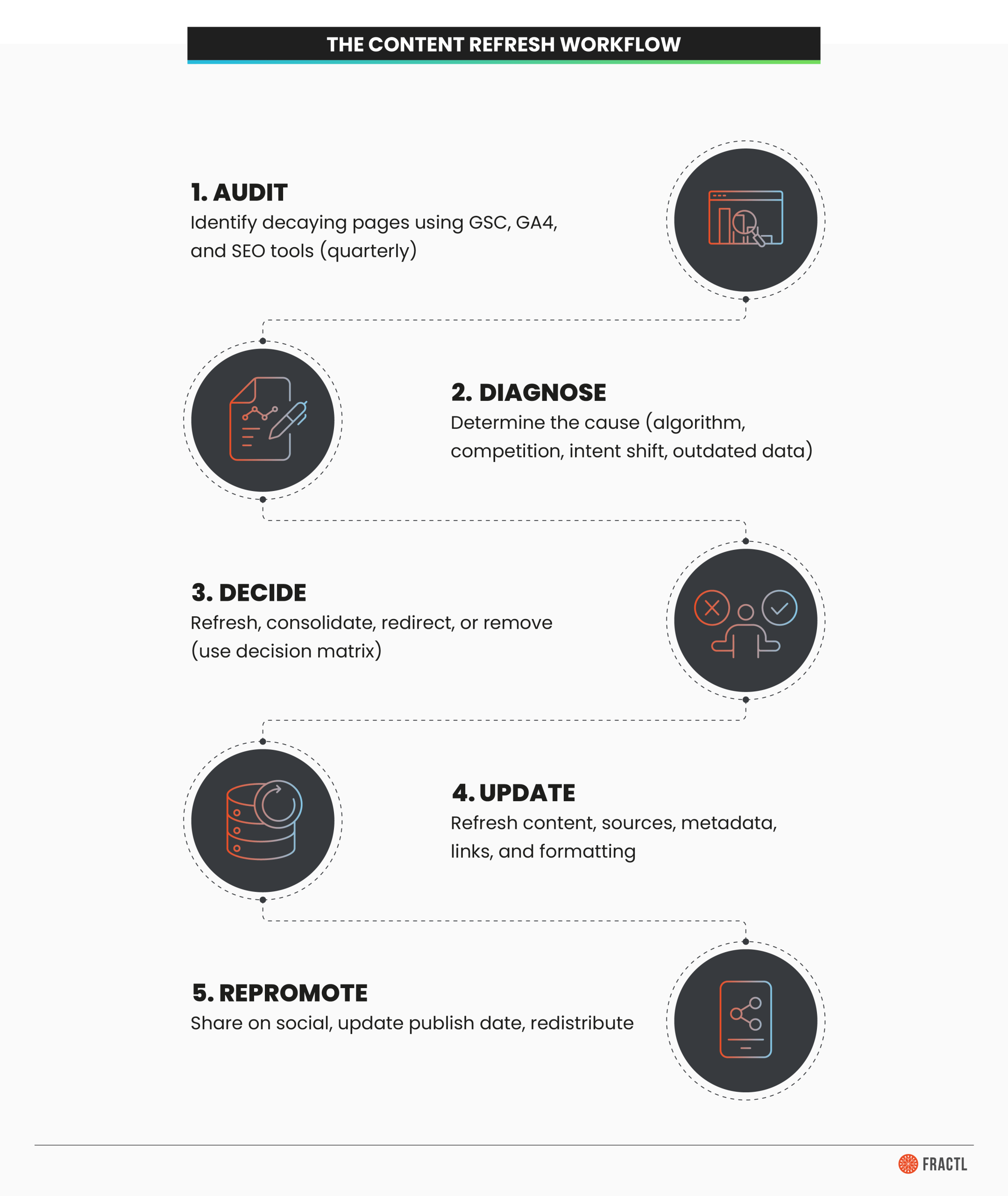
A content refresh isn’t just changing a publish date and hoping for the best. You’ll need to update the data, re-optimize for current search intent, and improve the page’s overall quality and user experience. Here’s how:
Update Statistics, Sources, and Examples
Keeping your statistics and sources current is one of the most important steps in a content refresh. To do it well:
- Audit every factual claim, statistic, and example in the content. Replace outdated data with current figures from credible sources.
- Remove dead links and broken sources, and verify that all remaining claims are still accurate.
- Add recent case studies or examples where they strengthen the content.
- Review your sources in depth. What felt current a year ago may now read as stale.
Here’s another example from the “Are Bars Profitable in 2025? Key Stats & Owner Earnings” article I mentioned earlier:
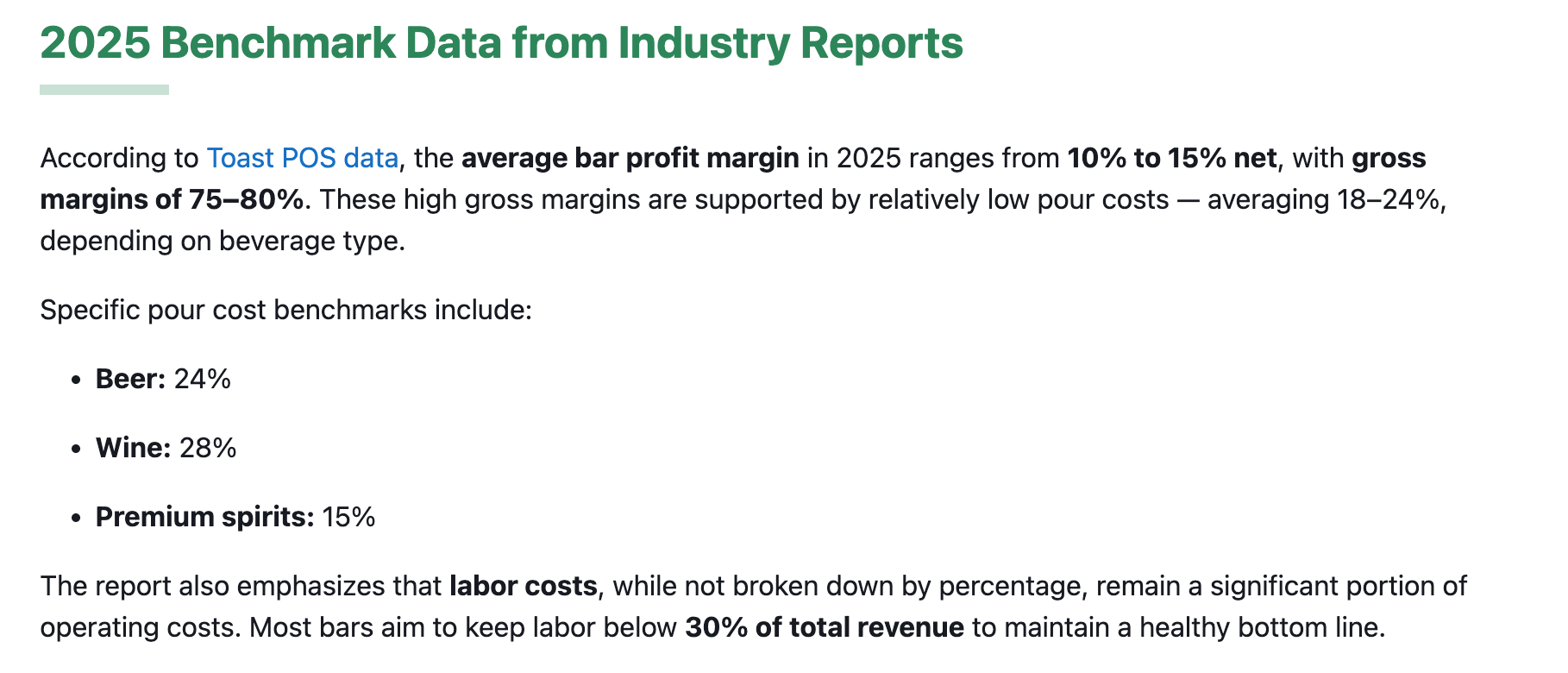
It would be a good idea to see if there are any newer sources for this information that we can update with here. Even if this Toast data is still the most recent and authoritative, it would help to change the “2025” to a “2026” in the section heading to note that it’s the most recent as of the current year.
Re-Optimize for Current Search Intent
Search intent can shift significantly over time, so it’s worth revisiting how your content aligns with what’s ranking now:
- Google the target keyword and compare the format, angle, and depth of the top results against your page. If the SERP has shifted from listicles to in-depth guides (or vice versa), your content needs to match.
- Conduct fresh keyword research to find relevant keywords based on current search data.
Search intent shifts are one of the most common causes of content decay, and they’re also one of the most fixable.
Improve Formatting, Readability, and UX
User experience directly affects engagement metrics, which influence how search engines evaluate your page. Make these updates part of every refresh:
- Break up dense paragraphs. Use clear headings and subheadings to create a scannable structure.
- Add lists and tables. Bulleted and numbered lists improve readability and increase the chance of earning featured snippets.
- Improve readability. Shorter sentences, simpler language, and clear transitions make content accessible to a wider audience.
- Update image alt text. Descriptive alt text improves accessibility and gives search engines additional context about your visuals.
- Add visual elements. Infographics, charts, or screenshots clarify complex information and break up text-heavy sections.
- Check mobile formatting. Ensure headings, images, and tables display correctly on smaller screens.
- Evaluate word count and depth. If competing pages are significantly more comprehensive, your page may need expanded coverage to keep up.
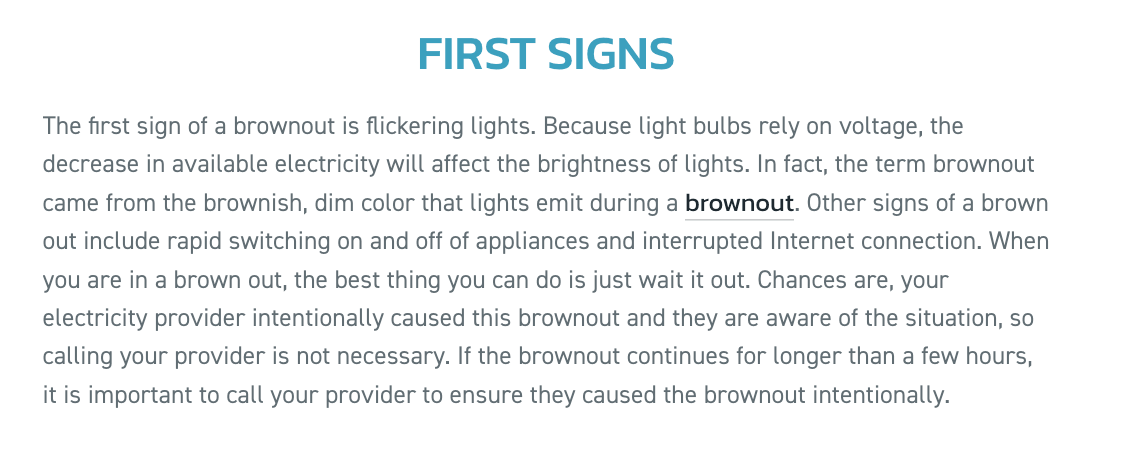
Here’s an example of an issue I run into all the time. I’m getting ready to refresh the “What Is a Brownout?” page for Payless Power. A quick, easy fix that will make this section skimmable (and more useful to the reader) is to turn this section into a bulleted list of “signs” instead of a wall of text listing them:
Update Metadata and Schema
Metadata updates are high-impact, low-effort changes that can improve click-through rates significantly:
- Rewrite title tags to be more compelling and keyword-optimized.
- Refresh meta descriptions (keeping them under 150 characters) to accurately reflect the updated content and include the primary keyword.
- Add or update schema markup (FAQ schema, how-to schema, article schema) to earn rich snippets in search results.
A page with a rich snippet stands out visually in the SERP, which can offset some of the CTR pressure from AI Overviews.
Back to the Payless Power page I referenced above about brownouts, it doesn’t currently have an FAQ section at the end. It’s super easy to add one that will satisfy the current search intent. Just take a look at the “people also ask” questions listed in the Google SERP that show up when you search for the article’s primary keyword, “brownout / what is a brownout.”
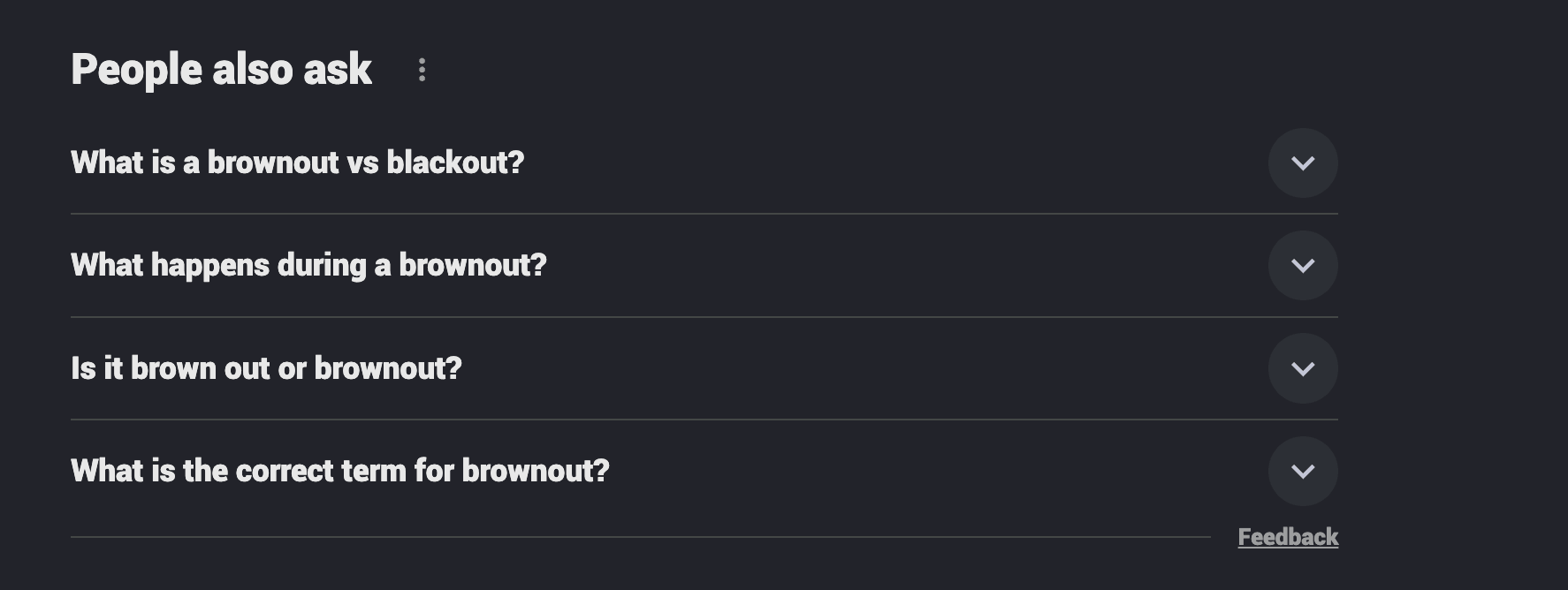
These would make great additions to a new FAQ section, complete with short answers that might even show up as a featured snippet on this SERP page, or earn a citation in the AI overview for other keywords like “What happens during a brownout?”
Strengthen Internal and External Links
Strong internal and external links are a key part of any content refresh. Here’s what to audit:
- Update the page’s internal linking structure by adding new links pointing to and from the refreshed content.
- Remove links to deleted or irrelevant pages, and fix any broken links you find during the audit.
- Audit external source links to ensure they’re still live, credible, and reasonably recent.
- Replace sources that have gone stale or been taken down, and add new high-authority citations where they strengthen the content.
Learn more about how earning high-authority backlinks supports this process.
Repromote and Redistribute
A refresh isn’t complete until you repromote the content. Here’s how to get it back in front of your audience:
- Update the publish date (only after you’ve made substantive changes).
- Share it on social media channels like LinkedIn, and include it in email newsletters.
- Repurpose the refreshed content into other formats: pull key data points into infographics for social, create a short video summary, or adapt sections into a LinkedIn post.
Keep in mind that re-promotion signals freshness to search engines and helps drive traffic back to the page through channels beyond organic search alone.
Building a Content Refresh Program Into Your Marketing Strategy
A one-off refresh helps individual pages, but the real value comes from building content refreshes into your ongoing marketing strategy. Treat it as a program, not a project. Here’s what that looks like in practice:
- Audit content performance quarterly for high-value, competitive keywords and semi-annually for evergreen topics. This catches decay early, before it compounds into significant traffic loss.
- Balance new content creation with refreshing what already exists. Refreshing a page with existing backlinks and authority is almost always more efficient than starting from scratch.
- Allocate at least 20% of your content budget to refreshes. Teams that do this often see disproportionate returns because they’re compounding existing equity rather than building it from zero.
- Assign clear ownership. Someone should own the refresh calendar, track which pages have been updated, and monitor performance after each refresh — otherwise, refresh cycles consistently lose out to new projects.
- Use your SEO data to inform prioritization. This is where SEO and content marketing working together becomes critical: your data should directly inform which pieces get refreshed and when.
- Track refresh performance over time to prove ROI. Compare organic traffic, keyword rankings, and engagement metrics before and after updates.
Keep in mind that content marketing results take time to build, and letting older content decay undermines the investment you’ve already made.
As Google’s own Search Relations team discussed in their Search Off the Record episode on content decay, this concept isn’t new, but it’s becoming more pressing. With AI Overviews reshaping SERPs, Ahrefs research showing AI search platforms prefer to cite content that’s 25.7% fresher than what traditional organic results surface, and algorithm updates becoming more frequent, maintaining content freshness isn’t optional. It’s a competitive requirement across digital marketing.
Your Content Doesn’t Expire, It Evolves
Content decay is natural, but it’s not a death sentence. Every decaying page is an opportunity to recapture traffic, improve your site’s authority, and deliver more value to the readers who find you through organic search.
The most effective content marketing strategies don’t just create new content. They maintain and improve what already exists. A systematic content refresh program, built on clear metrics, a solid decision framework, and consistent execution, turns your content library from a depreciating asset into one that compounds over time.
Start with a content audit of your highest-value pages. Identify what’s declining, diagnose why, and apply the framework in this guide to decide your next move. The pages that once drove your best results can do it again.
If you’re looking for a team that builds content programs designed to grow and sustain organic traffic, explore how Fractl approaches content marketing.
Frequently Asked Questions
What is content decay in SEO?
Content decay is the gradual decline in a page’s organic traffic, keyword rankings, and search visibility over time. Common causes include Google algorithm updates, increased competition, shifting search intent, and outdated information. It typically affects individual pages rather than entire sites.
How often should you refresh existing content?
Audit content performance quarterly for high-value, competitive keywords and semi-annually for evergreen content. Prioritize pages showing three or more months of consistent decline. High-traffic pages in fast-changing industries may need more frequent updates.
What’s the difference between a content refresh and creating new content?
A content refresh updates an existing page, preserving its URL, backlinks, and accumulated authority signals. New content starts from zero. Refreshing is often more efficient because you’re building on the page’s existing search equity rather than earning authority from scratch.
What tools can help identify content decay?
Google Search Console (free) and Google Analytics (free) are the best starting points. GSC’s Performance report filtered by page is particularly useful for spotting declining clicks and impressions. For deeper analysis, Semrush and Ahrefs offer keyword tracking, backlink monitoring, and traffic trend data at the page level.