




Table of Contents
- When AI Work Needs More Review Than Expected
- The Cleanup Adds Up Across People
- The Trust Cost Extends Beyond the Fix
- Who Sends It, and Who Handles the Cleanup?
- What Employers Measure, and What Reaches Customers
- Count Correction Time Alongside AI Savings
- Methodology
- About Fractl
- Fair Use Statement
Key Takeaways
- Cleanup took a median of 45 person-minutes. That counts everyone’s time on the latest incident, including the sender’s, and 43% still said AI saved time overall.
- Employers count AI savings more often than corrections. Of all workers, 22% said their employer tracks time AI saves, while 14% said it tracks time spent correcting AI-assisted work.
- Trust dropped after the incident. Afterward, 66% trusted the sender’s work less, and 67% relied less on it without double-checking.
- Senders rarely cleaned up their own work. The sender did most of the cleanup in 22% of incidents, though 58% said senders are usually held accountable.
- Some flawed AI work reached customers. Among workers whose jobs involve customers, 23% said their company sent AI-assisted work to customers in the past year that later needed correction.
Generative artificial intelligence (AI) is now routine at work. Eight in 10 workers surveyed used it on the job, and 51% of those users estimated it saved them an hour or more in a typical week. But AI-assisted work rarely stays with the person who made it. Reports, emails, slide decks, code, and analysis get passed to colleagues who are expected to build on them, approve them, or send them to customers.
We surveyed 1,001 employed Americans about the AI-assisted work they receive from others. Workers who said that work needed more review than expected then described their most recent incident: how long the cleanup took, who sent the work, who fixed it, and how the experience changed their view of the sender.
The survey called this kind of incident an AI slop grenade: an unread, unedited piece of generative AI content, such as an email, code pull request, report, or slide deck, that lands on someone else to handle. Here, generative AI means tools that create or substantially rewrite text, images, code, presentations, reports, or summaries, such as ChatGPT, Microsoft Copilot, Google Gemini, or Claude. Ordinary spellcheck and basic autocomplete don’t count.
When AI Work Needs More Review Than Expected
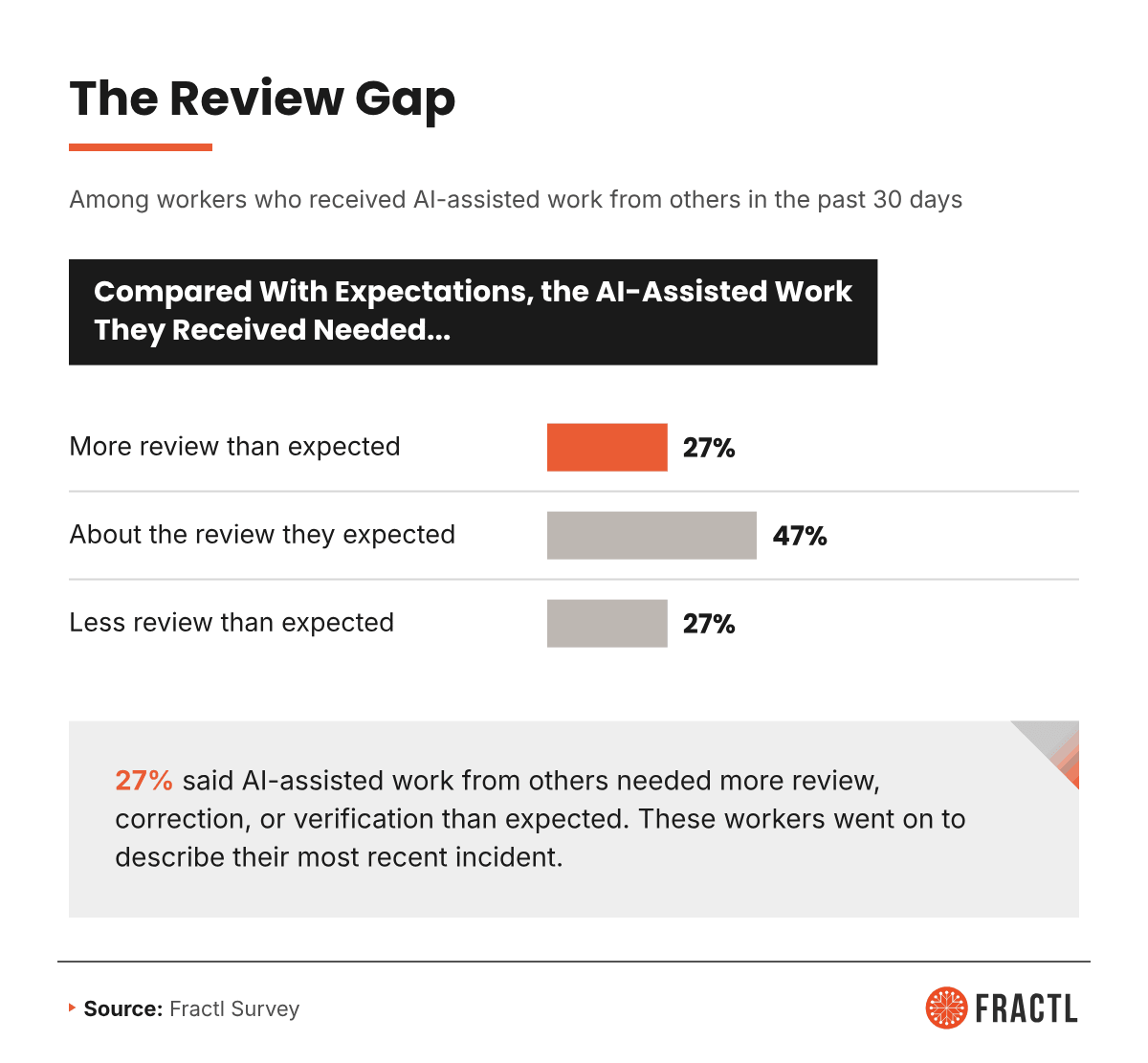
Most AI-assisted work that changes hands doesn’t arrive as a problem. Among workers who received AI-assisted work from others in the past 30 days, 47% said it needed about the review they expected, and 27% said it needed less.
Another 27% said it needed somewhat or much more review, correction, or verification than expected. Those workers went on to describe their most recent incident, and the rest of this study follows them.
The Cleanup Adds Up Across People
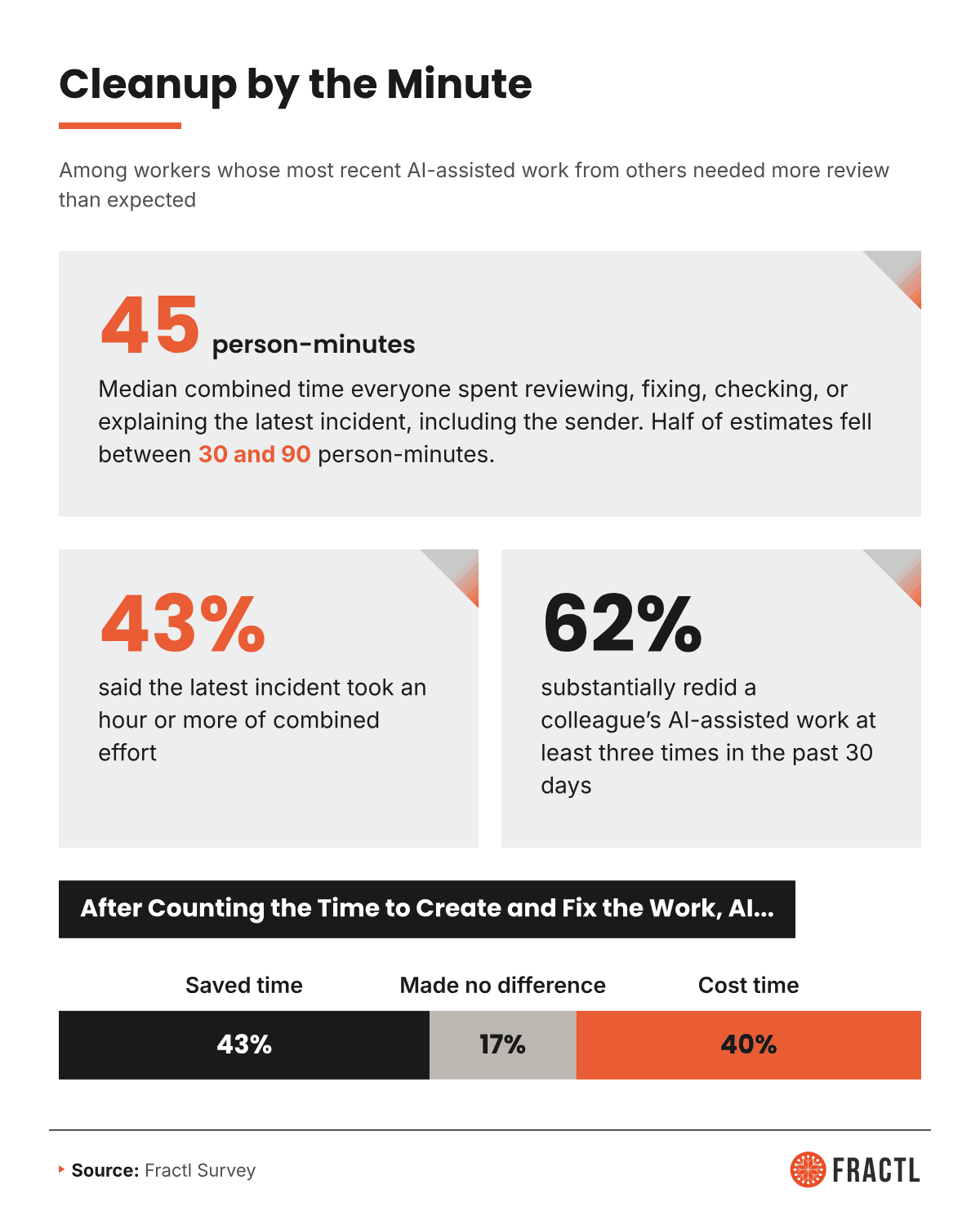
Workers estimated the total time everyone spent reviewing, fixing, checking, or explaining their most recent incident. The question counts person-time rather than clock time: if three people each spend 20 minutes on it, the total is 60 person-minutes. The sender’s own time counts too.
The typical incident took a median of 45 person-minutes, and half of all estimates fell between 30 and 90. In 43% of incidents, the combined effort reached an hour or more.
The latest incident was rarely the only one. Of those workers, 62% said they had to substantially redo or correct a colleague’s AI-assisted work at least three times in the past 30 days, meaning changes to facts, calculations, content, or essential parts rather than routine proofreading.
Even so, the verdict on AI was split. After weighing the time spent creating and fixing the work, 43% said AI still saved time overall on that incident, 40% said it cost time, and 17% said it made no difference.
The Trust Cost Extends Beyond the Fix
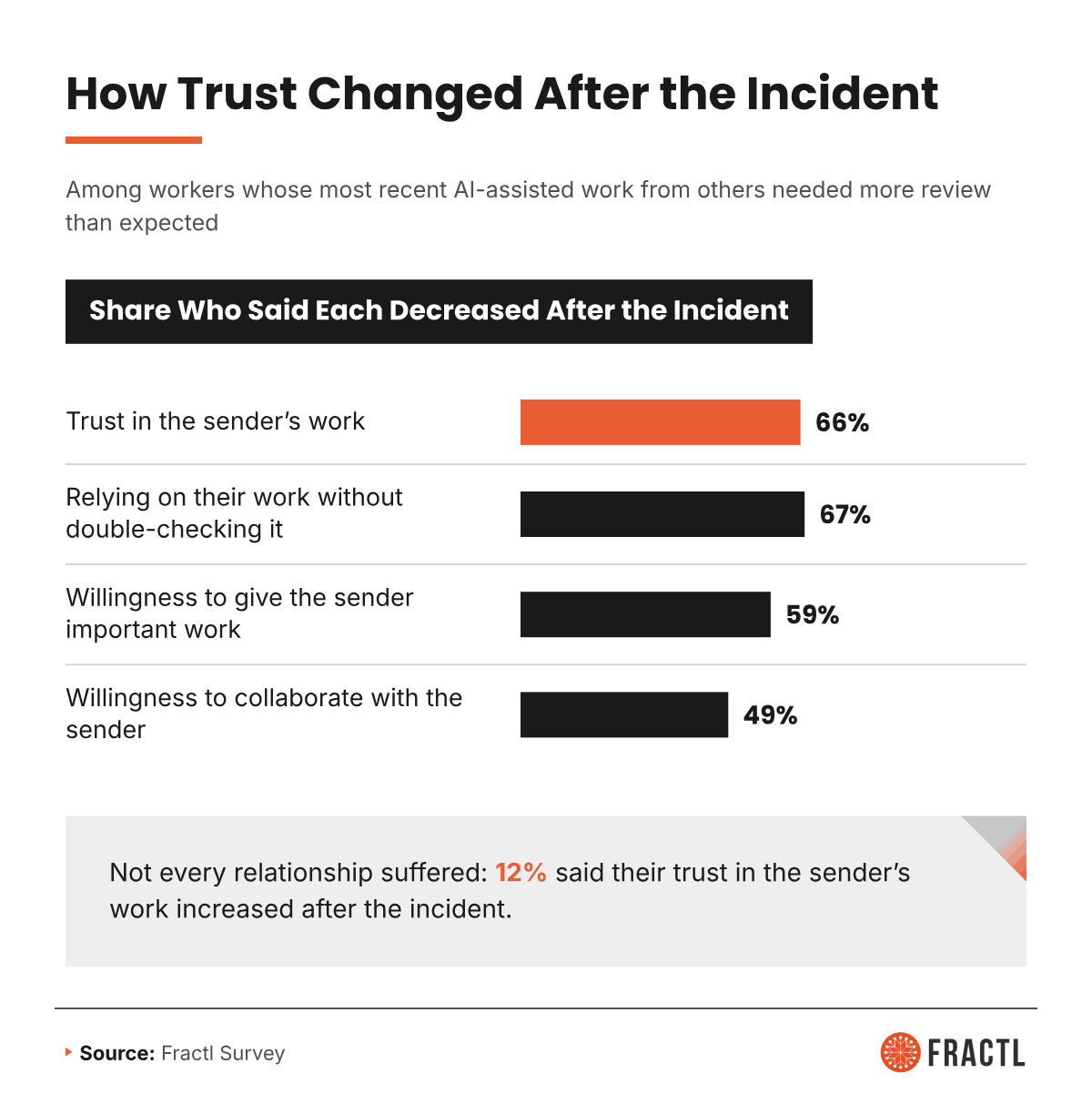
Fixing the work didn’t end the incident. Afterward, 66% said their trust in the sender’s work had decreased, and 67% said they now rely less on that person’s work without double-checking it. The effects reached delegation and teamwork too: 59% were less willing to give the sender important work, and 49% were less willing to collaborate with them.
Not every relationship suffered. For 12%, trust in the sender’s work increased, and 22% reported no change. Those shifts point to a cost no time estimate captures: the sender’s next piece of work may arrive under more scrutiny, or may not be handed over at all.
Who Sends It, and Who Handles the Cleanup?
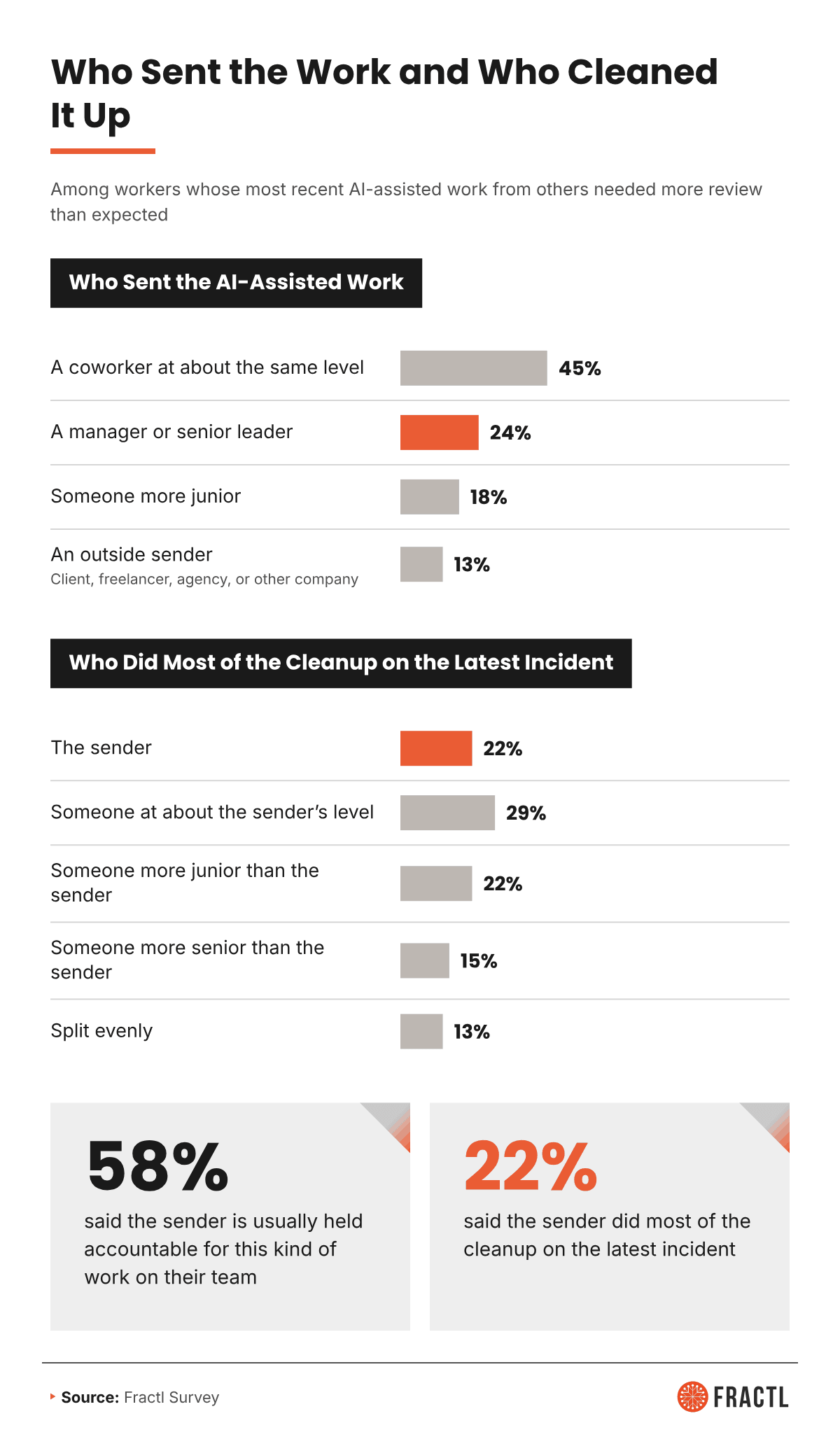
Coworkers at about the same level sent the work most often (45%). Managers or senior leaders sent it in 24% of incidents: 10% came from a direct manager, and 14% from a senior leader or executive. Junior colleagues accounted for 18%, and outside senders such as clients, freelancers, and agencies accounted for 13%. Cleanup estimates were similar regardless of who sent the work, so the data doesn’t show that leaders’ work took longer to fix.
The sender did most of the cleanup in only 22% of incidents. Otherwise, it fell to someone at about the sender’s level (29%), someone more junior than the sender (22%), or someone more senior (15%), and 13% said the work was split evenly. Cleanup spread across levels rather than consistently flowing up or down.
Asked separately how their team usually handles this kind of work, 58% said the sender is usually held accountable, and 40% said the sender is usually expected to fix it. Set against what happened in the latest incident, those norms point to a gap between who is expected to own AI-assisted work and who ends up cleaning it up.
What Employers Measure, and What Reaches Customers
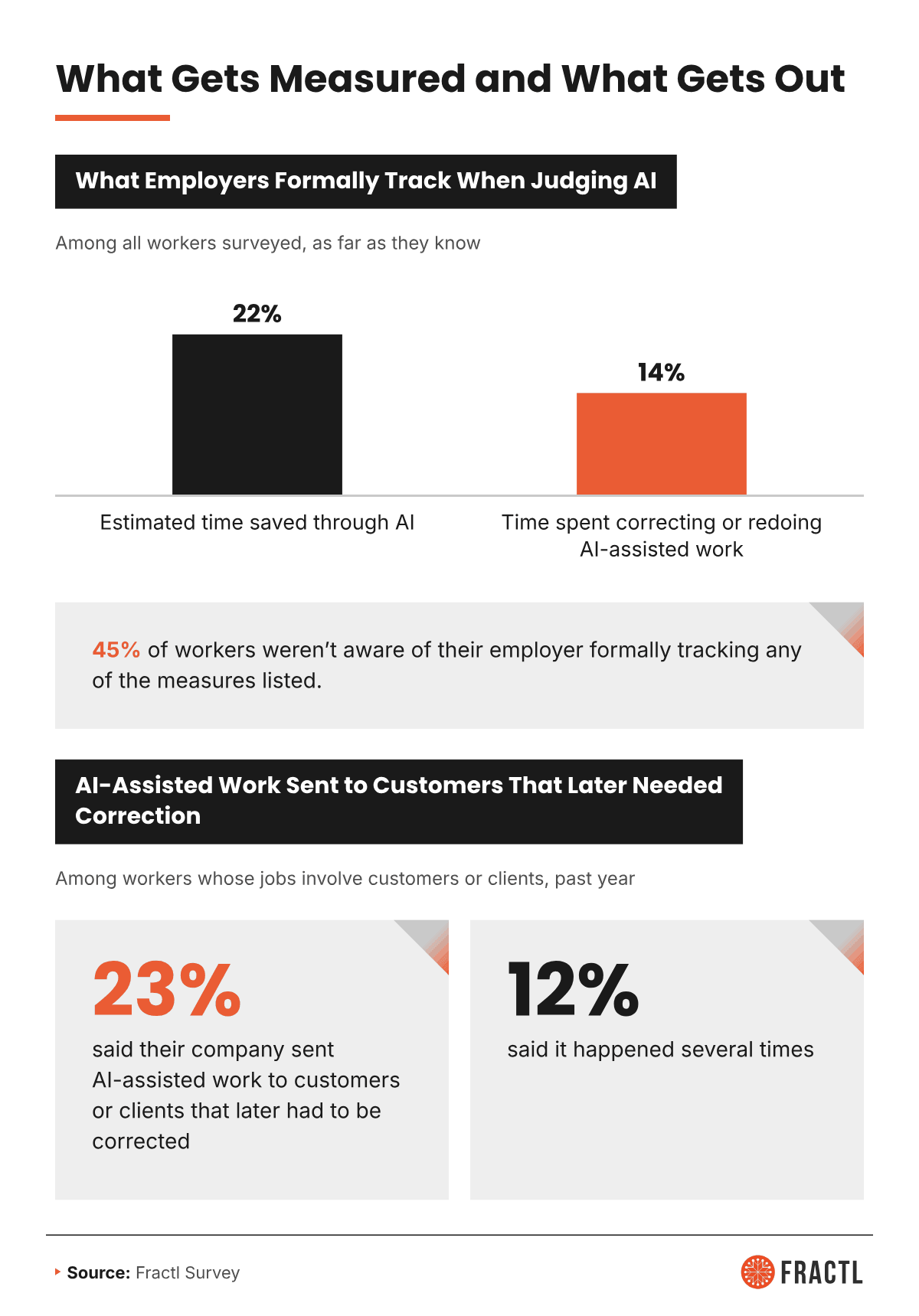
Across all workers surveyed, 22% said their employer formally tracks estimated time saved through AI, while 14% said it tracks time spent correcting or redoing AI-assisted work. Another 45% weren’t aware of their employer tracking any of the measures listed. Where savings are counted more often than corrections, the cleanup time workers described may be missing from the numbers leaders see.
Some AI-assisted work also leaves the building. Among workers whose jobs involve customers or clients, 23% said their company had sent AI-assisted work to customers in the past year that later had to be corrected, and 12% said it happened several times.
Count Correction Time Alongside AI Savings
Many workers, including those who had just dealt with a problem, still said AI saved them time. But when AI-assisted work needs more review than expected, the cost spreads: across colleagues, into working relationships, and, for some companies, all the way to customers.
The survey didn’t test solutions, but the findings point to where teams can start:
- Review before sending, because a check by the person who used the tool can keep a problem from becoming several colleagues’ cleanup.
- Make ownership explicit, so that the person usually held accountable for the work is also the first to fix it.
- Count correction time alongside savings, because measuring only the time AI saves leaves part of its cost out of the picture.
Want to turn original research like this into earned media coverage, links, and AI search visibility? Talk to the Fractl team about a data-driven campaign for your brand.
Methodology
We surveyed 1,001 employed Americans through Connect powered by CloudResearch. Responses were collected Oct. 21 to 22, 2026. All respondents passed an attention check, and none were excluded from the analysis.
Detailed incident questions went only to workers who said AI-assisted work from others needed somewhat or much more review than expected in the past 30 days. Incident findings describe that group and their most recent incident, not all workers or all AI-assisted work. Cleanup time is a self-reported estimate of combined person-minutes across everyone involved, including the sender, and is reported as a median. The survey didn’t ask how much time AI saved the sender. Employer tracking reflects what respondents know about their employer’s practices, and customer corrections cover workers whose jobs involve customers, over the past year. Because several respondents may work for the same company, these figures describe workers’ experiences, not a count of companies.
Findings are self-reported and unweighted, and they don’t establish causation or national representativeness.
The demographic breakdowns were as follows:
- Generative AI use at work: 20% use it throughout every workday, 25% most workdays, 35% a few times a week or less, 8% tried it but no longer use it, and 12% have never used it for work
- Gender: 53% women, 45% men, 1% non-binary, 1% preferred not to answer
- Age: 10% 18 to 24, 27% 25 to 34, 33% 35 to 44, 20% 45 to 54, 8% 55 to 64, 2% 65 or older
- Position: 58% individual contributors, 19% supervisors or team leads, 16% managers or directors, 5% owners or founders, 2% vice presidents or senior executives
- Industry: 14% healthcare or pharmaceuticals, 14% education, 12% technology or software, 11% retail or e-commerce, 8% finance, banking, or insurance, 6% manufacturing, 5% government or public sector, 5% media, publishing, or entertainment, and the remainder in other industries
Some numbers don’t total 100 due to rounding.
About Fractl
Fractl is a data-driven earned media and SEO agency that builds brand authority to win both Google rankings and AI search visibility. With more than 14 years of industry research, Fractl specializes in earned media, SEO, content development, and digital PR that grow organic traffic and AI visibility.
Fair Use Statement
Fractl encourages journalists and publishers to share findings from this study with proper attribution. Please link back to this page when referencing the research so readers can access the full context behind the findings.