




Table of Contents
- 8 Tips for Integrating Your SEO and Digital PR Agencies
- The Brands That Win Treat SEO and PR as One System
- FAQs
Brand authority is your brand’s reputation and credibility as a trusted source in your industry, measured by search visibility, media mentions, and customer trust. It’s not the same as domain authority (a Moz metric that scores your backlink profile on a 1-100 scale). Domain authority is one input; brand authority is the full picture.
Most enterprise brands invest in both SEO and digital PR as part of their broader digital marketing strategy. The problem is these teams (or agencies) usually operate in silos with separate goals, separate reporting, and no shared strategy. Your SEO agency optimizes for rankings and organic traffic. Your PR agency pitches journalists and tracks placements. Neither sees how their work compounds the other’s.
That disconnect is expensive, especially now. Half of consumers intentionally seek out AI-powered search engines for buying decisions, and a brand’s own website accounts for only 5-10% of the sources AI references. The rest comes from publishers, media coverage, and third-party content. Scaling brand authority in 2026 requires SEO and digital PR working as one system, not two line items.
Here’s how to make that happen.
8 Tips for Integrating Your SEO and Digital PR Agencies
Most brands don’t fail at SEO or PR individually; they fail at connecting the two. These eight tips are drawn from Fractl’s work across hundreds of integrated campaigns, and they’re designed to close the gap between what your SEO agency tracks and what your PR agency earns.
1. Run a Joint Brand Authority Audit Before You Start
You can’t scale what you haven’t measured. Before your SEO and digital PR agencies launch a single campaign together, both teams need to baseline where your brand stands across its full online presence.
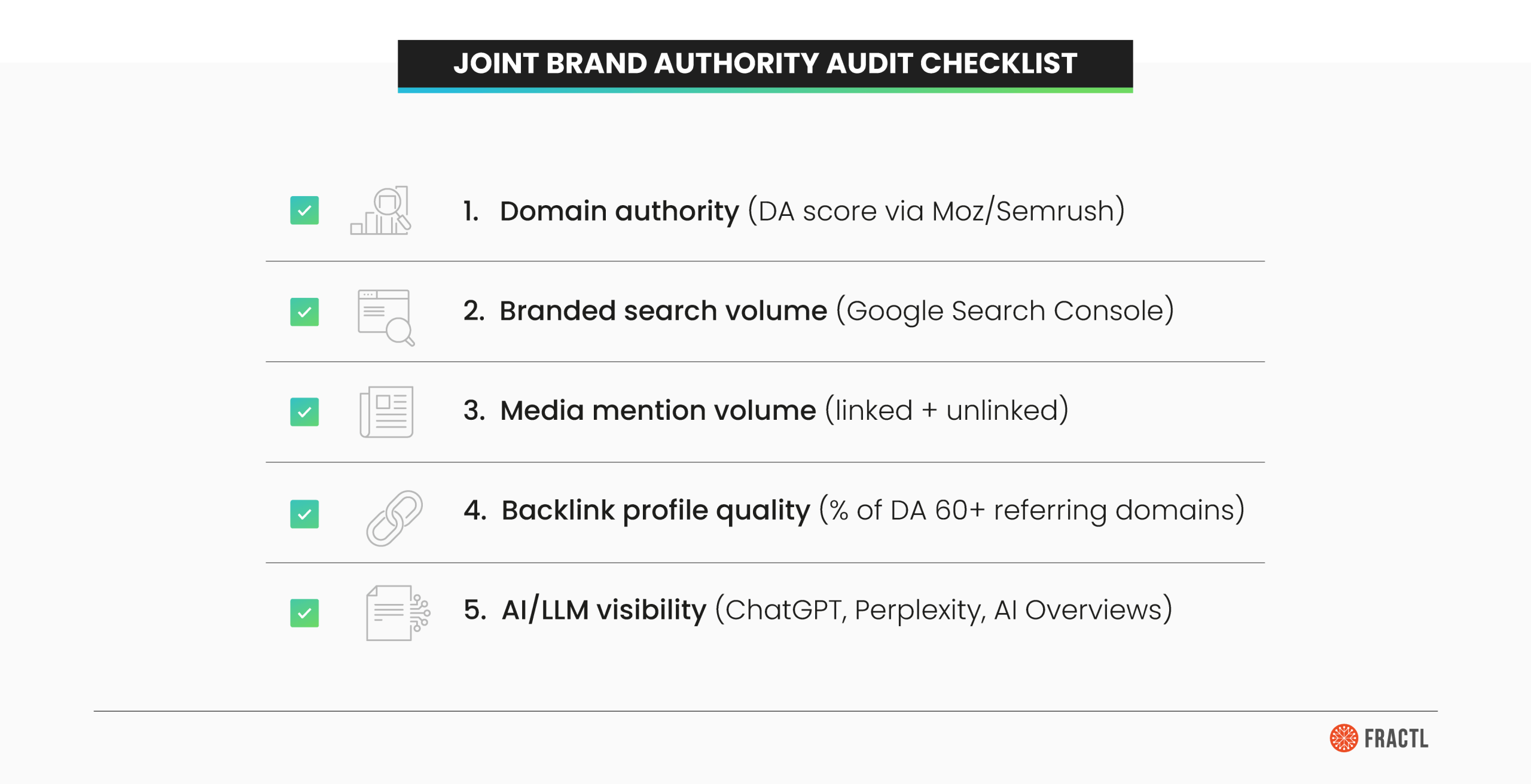
A joint audit should cover:
- Domain authority. Check your current DA score using Moz or Semrush. This is your backlink profile’s starting point.
- Branded search volume. How often do people search your brand name in Google search? Branded search is one of the strongest signals of brand strength, and it’s a metric both SEO and PR can influence.
- Media mention volume. How frequently does your brand appear in news coverage, industry publications, and social media? Track both linked and unlinked mentions.
- Backlink profile quality. Not all backlinks are equal. Audit the authority of your referring domains: How many are DA 60+? How many come from top-tier publishers versus directories and low-quality sites?
- AI and LLM visibility. Search your brand name in ChatGPT, Perplexity, and Google’s AI Overviews. Are you being referenced? Accurately? Only 16% of brands systematically track AI search performance, which means getting ahead here is still a competitive advantage.
This audit gives both agencies a shared starting point and prevents duplicated efforts. At Fractl, our organic growth strategy begins with exactly this kind of cross-disciplinary baseline, so every campaign decision is grounded in data.
2. Align on Shared KPIs That Bridge Both Disciplines
When your SEO agency reports on keyword rankings and your PR agency reports on media placements, nobody sees the compounding effect.
Both teams should co-own these KPIs:
- Domain authority growth over time. PR earns the high-authority backlinks; SEO tracks the DA impact. Both need to see this number monthly.
- Branded search volume trends. Media coverage drives branded searches. SEO benefits from those signals. This is the connective tissue between both disciplines.
- High-authority backlink acquisition (DA 60+). PR earns these through placements; SEO values them for rankings. Set a shared monthly target.
- Brand mention volume. Tracked across media outlets, social platforms, and AI-generated content. Earned media creates brand mentions that influence how algorithms and AI models perceive your brand’s value.
- Organic traffic to PR-supported content. When PR earns links to a landing page, SEO should track the organic traffic lift to that page and its surrounding content hub.
When I’ve seen these shared dashboards work at Fractl, the shift is immediate: Both teams start optimizing for the same outcomes instead of their own metrics in isolation.
3. Build a Unified Content Strategy That Serves Both SEO and PR
Content is where SEO and digital PR share the most overlap, and where misalignment causes the most waste. Your SEO team identifies high-value keyword gaps. Your PR team knows what stories journalists will cover. A unified content strategy combines both inputs so every piece of content works harder.
Content types that serve both disciplines:
- Data journalism campaigns. Original research (surveys, data analyses, visual storytelling) that earns media coverage from high-authority publishers and ranks for target keywords. This is the highest-impact content format for scaling brand authority because it generates backlinks, brand mentions, and organic traffic simultaneously.
- Thought leadership articles. Expert commentary and POV pieces that position your executives as industry leaders. These build brand influence, earn social proof on platforms like LinkedIn, and can rank for informational queries.
- Content hubs and pillar pages. Comprehensive resource centers that build topical authority around your core expertise. These give PR-earned backlinks a home that compounds SEO value over time.
- Interactive tools. Calculators, assessments, and data explorers that attract links and engagement naturally. They also earn media coverage when they’re genuinely useful.
Fractl’s content development approach builds every asset with both SEO rankings and media coverage in mind from the start, so no content is left serving only one channel.
4. Use Data-Driven Campaigns To Earn Links and Media Coverage at Scale
Generic blog posts don’t earn media coverage. Journalists want original data, surprising findings, and visual assets they can embed. Data-driven campaigns give both your SEO and PR agencies exactly what they need: newsworthy stories that generate high-quality backlinks at scale.
This is where the integration pays off most directly. We’ve seen it across hundreds of digital PR campaigns at Fractl:
- A full-service engagement for Payless Power secured 1,208 press mentions (450 from publishers with DA 60+), increased referring domains by 55%, and drove a 25% increase in organic traffic over 16 months.
- Nine data journalism campaigns for Adobe earned 390 new referring domains and drove 56,000 new monthly visits.
- Fractl-produced content for McAfee captured 586 featured snippets, elevated 32 pages to the #1 position in search engine results, and boosted organic traffic value by over $1.29 million monthly.
The pattern is the same:
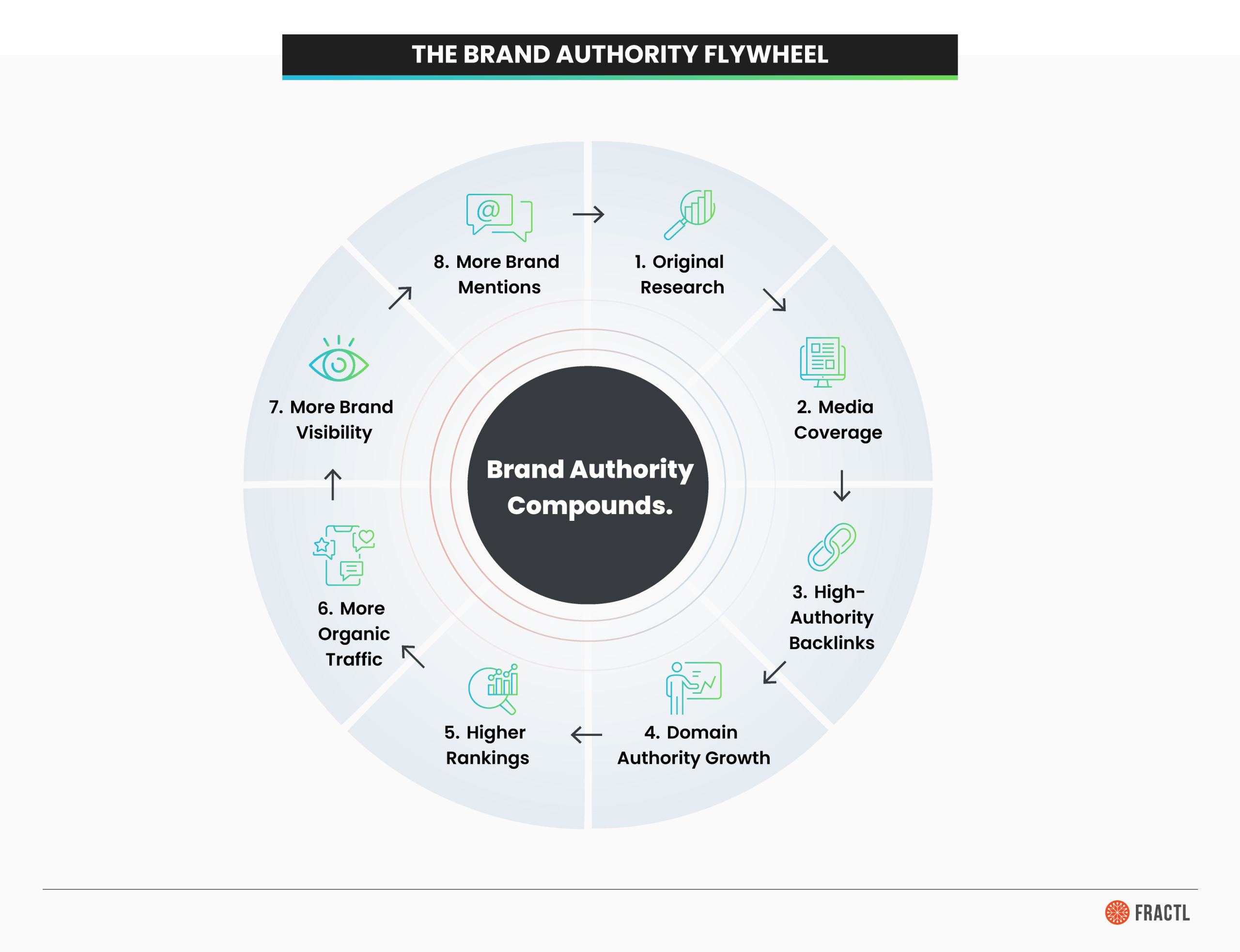
Original research + scaled PR outreach = high-authority backlinks + brand mentions + organic traffic growth.
Your SEO agency benefits from the link equity. Your PR agency benefits from the placement volume. And your brand authority grows across every channel your potential customers use.
5. Coordinate Technical SEO With Your PR Link-Building Strategy
Earning a backlink from The Wall Street Journal doesn’t help much if the page it links to is deindexed, slow to load, or buried three levels deep in your site architecture. Technical SEO ensures the links your PR team earns actually translate into ranking improvements.
Alignment points both teams should coordinate:
- Indexation and crawlability. Every landing page targeted by a PR campaign should be indexed, crawlable, and free of technical issues before outreach begins.
- Internal linking. When PR earns a high-authority backlink to one page, your SEO team should distribute that link equity across related pages through strategic internal links. This is how a single earned placement lifts an entire content hub.
- Page speed and mobile optimization. Journalists and their readers will click through to your site. A slow, clunky mobile experience wastes the attention PR earned.
- Structured data. Implement schema markup on PR-targeted pages to maximize your chances of earning SERP features (featured snippets, knowledge panels, FAQ rich results) from the ranking boost those backlinks provide.
- Anchor text coordination. SEO and PR teams should align on preferred anchor text so earned backlinks reinforce target keywords without over-optimization.
These can make the difference between a backlink that moves rankings and one that sits there doing nothing.
6. Use Proactive and Reactive PR To Build Consistent Brand Mentions
Brand mentions, even without a hyperlink, influence brand authority. They affect how Google’s algorithm evaluates your brand, how AI models reference you, and how potential customers perceive your trustworthiness. Consistent media coverage builds the kind of brand awareness that compounds over time.
Two approaches work in tandem:
Proactive PR is planned in line with the news calendar and your brand strategy. Your PR team monitors platforms where journalists seek expert sources, develops commentary on behalf of your leadership team, and pitches to relevant beats. This builds thought leadership and earns placements in publications your target audience already reads. Fractl’s proactive PR work has earned expert quotes in outlets like Newsweek, GoBankingRates, and Yahoo.
Reactive PR (newsjacking) capitalizes on breaking news. When a trending story intersects with your brand’s expertise, your PR team can produce rapid-turnaround content (surveys, data analyses, expert commentary) that adds value to the news cycle. Speed is the differentiator: ideation approval within 24 hours, production in 24-48 hours, and outreach while the story is still hot.
Here’s a Fractl example: When NYC public schools banned ChatGPT in early 2023, Fractl quickly surveyed students and professors on AI usage and policies. The resulting campaign for Study.com earned coverage in The Wall Street Journal, Business Insider, USA Today, and Forbes.
The SEO benefit was that more brand mentions lead to more branded searches, which signal brand strength to search engines. It’s a flywheel that authoritative brands use to widen their lead over competitors.
7. Extend Your Brand Visibility Into AI and LLM Platforms
Brand authority doesn’t live exclusively in Google search anymore. AI platforms like ChatGPT, Perplexity, and Google’s AI Overviews now recommend brands based on the information available about them across the web. And that information comes overwhelmingly from third-party sources: a brand’s own site accounts for only 5-10% of what AI search references.
This means earned media is now a direct input to AI visibility. SEO strategies that ignore this shift risk losing ground to competitors who’ve already adapted. Here’s how to optimize:
- Earn coverage from publications included in LLM training data. High-authority news outlets, industry publications, and .edu/.gov sites carry the most weight. This is exactly what digital PR campaigns already target.
- Build consistent brand messaging across channels. AI models synthesize information from multiple sources. If your messaging is inconsistent across your website, media coverage, social media, and LinkedIn, AI will reflect that confusion back to users.
- Create content that AI can easily parse and cite. Clear, factual, declarative language with context-rich statements helps AI systems generate accurate answers about your brand. Structured content with definitions, comparisons, and data points gets referenced more often.
- Monitor your brand’s presence in AI-generated answers. Search your brand and core topics in ChatGPT and Perplexity quarterly. Note inaccuracies and work to correct them by publishing authoritative content that addresses gaps.
My research on AI-powered cross-channel brand visibility covers this shift in depth. The brands winning in AI search are the ones investing in earned media and digital PR that supports SEO, not just traditional search engine optimization.
8. Measure Brand Authority Holistically Across Search, Social, and AI
Brand authority can’t be captured by a single metric. Moz’s Brand Authority score (a 1-100 metric based on search behavior, mentions, and engagement) is a useful benchmark, but it’s one piece of a broader measurement framework.
Track these together for a complete picture:
- Branded search volume. Monitor through Google Search Console. Growth here reflects the combined impact of SEO visibility and PR-driven brand awareness.
- Domain authority trends. Track monthly via Moz or Semrush. This reflects your backlink profile’s health and your PR team’s link-earning performance.
- Media mention volume and sentiment. Both the quantity and tone of coverage matter. Positive reviews and a strong reputation in media build customer trust; negative or inaccurate coverage erodes it.
- Social proof signals. Testimonials, case studies, word-of-mouth referrals, and positive online reviews all contribute to how potential customers evaluate your brand’s reputation. Track these alongside your SEO and PR metrics.
- AI visibility audits. Quarterly checks of how your brand appears in ChatGPT, Perplexity, and AI Overviews. Are you being recommended? Accurately? For the right queries?
- Business outcomes. Connect brand authority metrics to customer loyalty, loyal customer retention, and revenue. The goal isn’t a higher score; it’s measurable business growth tied to your business goals.
The brands that scale brand authority successfully build trustworthiness across every platform their customers use, from Google search to social media to AI-powered recommendations.

The Brands That Win Treat SEO and PR as One System
SEO and digital PR are complementary ones that compound each other’s results when they share data, coordinate campaigns, and measure outcomes together.
The brands building the strongest authority right now are the ones that stopped treating these as separate line items. Your SEO agency needs your PR team’s media coverage to earn the backlinks that drive rankings. Your PR agency needs your SEO team’s keyword data to create content journalists actually want to cover. And both need to optimize for AI platforms that are reshaping how potential customers discover and evaluate brands.
We’ve spent over a decade at Fractl building content strategies that integrate digital PR, content development, and technical SEO into one system. The results speak for themselves: high-authority earned media, qualified organic traffic, and brand authority that compounds over time.
Your brand’s reputation is too important to leave to siloed agencies. Start integrating.
FAQs
What is brand authority, and how is it different from domain authority?
Brand authority measures your brand’s overall reputation, influence, and trustworthiness across search, social, media, and AI platforms. Domain authority is a Moz-developed metric (scored 1-100) that specifically measures your website’s backlink profile strength. You can have high domain authority without strong brand authority (and vice versa). Scaling brand authority requires both the technical SEO signals that domain authority reflects and the broader perception signals (media coverage, brand mentions, social proof) that come from digital PR.
How long does it take to scale brand authority?
Most enterprise brands see measurable gains within six to 12 months of integrated SEO and digital PR efforts. Early indicators include increased branded search volume and media mention growth. Compounding results (ranking improvements, AI visibility, stronger customer trust) typically accelerate in months nine through 18 as earned media builds on itself. The timeline depends on your starting point, industry competitiveness, and campaign volume.
Can small businesses and startups scale brand authority, too?
The principles apply at any scale, but the tactics differ. Small businesses and startups can build brand authority through niche thought leadership, guest posting on relevant industry publications, local media coverage, webinars, podcasts, and consistent high-quality content that positions them as an authoritative voice in their space. An e-commerce brand might focus on product reviews and influencer mentions; a SaaS company might prioritize data-driven thought leadership. The integration of SEO and PR is valuable regardless of company size.