




Table of Contents
- What Are Brand Mentions and Why Do They Matter?
- How Brand Mentions and Links Drive SEO Visibility
- How Brand Mentions and Links Drive GEO Visibility
- When You Need Links, When Mentions Are Enough, and When You Need Both
- How To Earn Brand Mentions and Links Through Digital PR
- Measuring Brand Mention Impact
- Brand Mentions and Links Are Stronger Together
- FAQs
Google isn’t the only place people discover brands anymore. ChatGPT now has over 900 million weekly active users, and Gartner predicts traditional search engine volume will drop 25% by the end of 2026 as consumers shift toward AI-powered platforms. That means your brand needs to show up in search engine results and in AI-generated answers to maintain online visibility.
Brand mentions and links are the connective tissue between these two channels. In traditional SEO, backlinks and brand citations build domain authority and signal relevance to search engines. In generative engine optimization (GEO), those same signals help large language models recognize your brand as a trusted source worth citing.
Each touchpoint reinforces visibility across channels: when a journalist quotes your research, when a publisher links to your data, when an AI platform references your brand by name, etc.
I’ll break down the fundamentals of what you need to learn about SEO and GEO and how brand mentions and links function in both (for beginners and experienced marketers alike), where they overlap, and how to earn them through digital PR strategies that serve both channels at once.
What Are Brand Mentions and Why Do They Matter?
Brand mentions matter more than ever, having evolved beyond simple name drops on a webpage. They now span traditional search, social media, and AI-generated responses, and each type carries a different weight depending on the platform processing it.
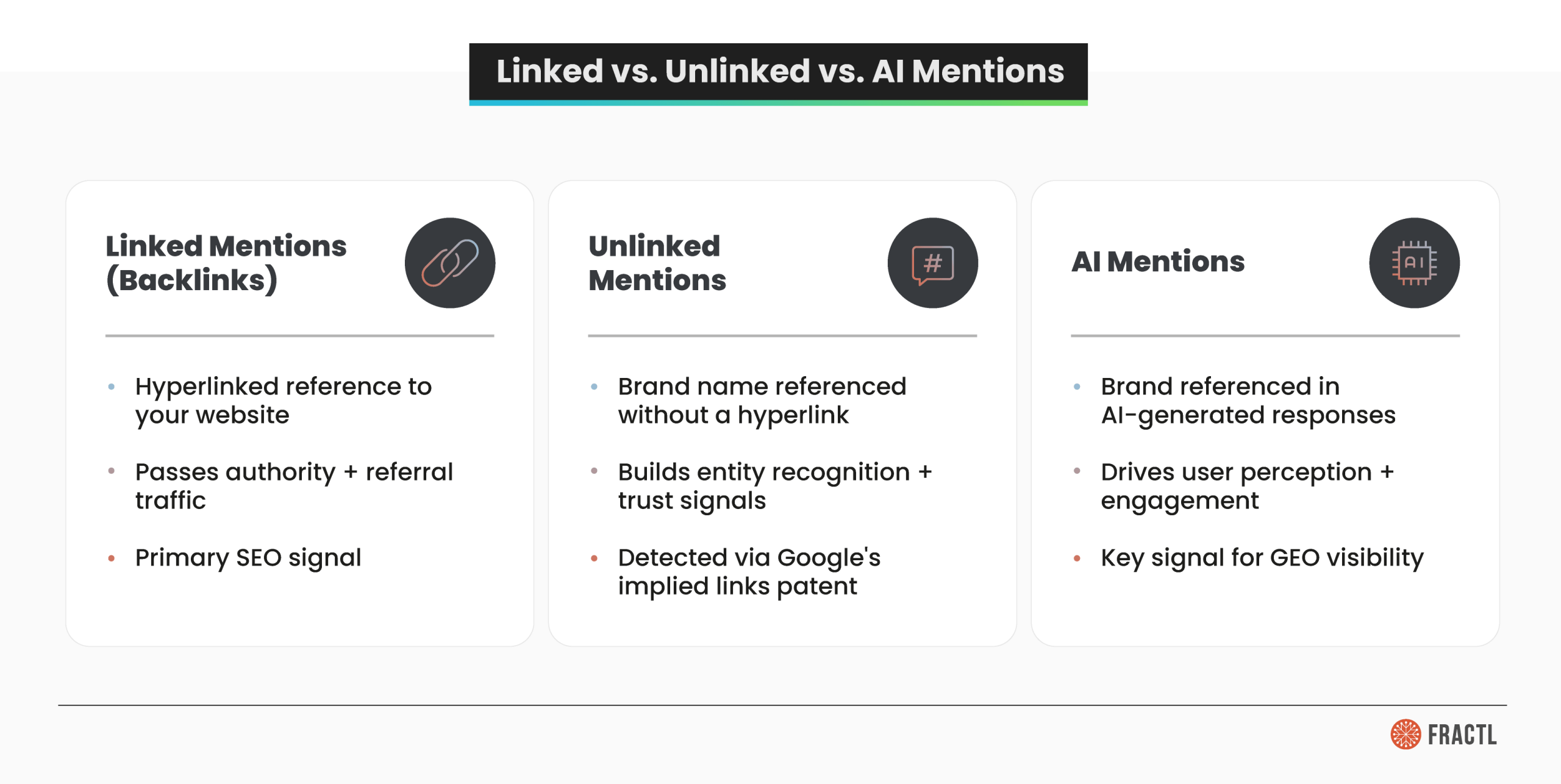
Linked vs. Unlinked vs. AI Mentions
Not all brand mentions function the same way. Understanding the distinctions helps you build a content strategy that targets the right mix.
Linked mentions (backlinks) are the traditional SEO currency. When a publisher links to your site, that hyperlink passes authority and referral traffic. The page ranking first in Google has 3.8 times more backlinks than pages in positions two through 10, according to Backlinko’s ranking factors analysis.
Unlinked mentions are references to your brand name without a hyperlink. Google has long signaled it can detect these. The company’s “implied links” patent, which resurfaced in August 2024, describes how search engines and their crawlers can treat brand references as trust signals even without a traditional link. These mentions still contribute to your brand’s entity profile and overall brand equity in Google’s eyes.
AI mentions are the newest category. When ChatGPT, Perplexity, or Google’s AI Overviews reference your brand in a generated response, that’s an AI mention. These don’t pass link equity in the traditional sense, but they influence user perception and drive click-through behavior. Research from Search Engine Land found that organic click-through rates dropped 61% when AI Overviews appeared, but brands cited within those overviews saw 35% higher engagement than uncited competitors.
Why Brand Mentions Are a Ranking Factor
Google’s Gary Illyes said in April 2024 that the search engine needs “very few links” to rank pages. That raised eyebrows, but the subtext matters: Google has gotten better at evaluating brand authority through signals beyond backlinks alone.
Entity recognition is central here. When Google identifies your brand as an entity (a distinct, recognizable thing in the Knowledge Graph), it connects mentions across the web to build a comprehensive picture of your authority. A brand mentioned frequently in credible contexts, whether through website content, news coverage, industry publications, review sites, forums, Quora, or directories, whether linked or not, signals relevance and trustworthiness.
This is why a strong digital PR strategy produces outsized results. Every press mention, expert quote, and data citation contributes to your brand’s entity profile, building the kind of brand reputation that both search engines and AI platforms reward.
How Brand Mentions and Links Drive SEO Visibility
Search engine optimization still runs on authority signals, but the way those signals work has become more nuanced. Links remain powerful, and they’re most effective when they’re part of a broader brand visibility strategy.
Entity Authority and the Knowledge Graph
Google’s Knowledge Graph connects brands, people, topics, and relationships into a structured understanding of the web. When your brand appears consistently across authoritative sources, Google strengthens its entity association for your brand, connecting it to the topics and industries you want to rank for.
This matters because search engine rankings increasingly depend on topical authority, not just page-level content optimization.
A brand that publishes original research, earns media coverage, and gets cited by industry experts builds entity authority and brand image across its entire domain.
That rising tide lifts every page on the site.
Two pages with similar content and similar backlink profiles can rank very differently if one belongs to a recognized entity with strong brand signals and the other doesn’t. Entity authority is the multiplier that makes all your other SEO work more effective. Structuring your content to reinforce entity signals through clear topic hierarchies amplifies that effect.
How Backlinks Still Drive Rankings
Despite the evolving algorithm, backlinks aren’t going anywhere. Semrush’s 2024 ranking factors study found that eight of the 20 factors most strongly correlated with high rankings are backlink-related.
What’s changed is the quality threshold. A handful of links from high-authority publishers (think domain authority 70 and above) now outweigh hundreds of low-quality or spammy links. This is where earned media becomes a competitive advantage: A single placement in a major news outlet can deliver the kind of authority signal that months of manual link building can’t replicate.
Google’s algorithm has also gotten better at evaluating context. A backlink from a relevant, topically related article carries more weight than one from an unrelated page, regardless of the linking domain’s authority score. The anchor text around the link matters too, as it helps search engines work out the relationship between the linking page and your content.
Ready to build high-authority links through earned media? Fractl’s digital PR campaigns earn placements in outlets like CNN, Business Insider, and USA Today, driving the kind of link equity that moves rankings. See how our earned media strategies and pricing can work for you →
On-Page SEO Signals That Amplify Brand Mention Value
Your off-page SEO brand mentions become more powerful when your site reinforces the same authority signals on-page. These elements help search engines connect your content to your broader entity profile:
- Structured data markup. Schema markup (Organization, Article, Author) helps search engines match your content to your brand entity and can improve your presence in search engine results pages.
- Author pages with credentials. Linking content to real authors with verifiable expertise strengthens EEAT signals (expertise, experience, authoritativeness, trustworthiness).
- Consistent brand information. Your brand name, title tags, address, and contact details should match across your site and external profiles, which is especially important for local SEO.
- Technical foundations. Proper HTML headings, clean robots.txt configuration, fast page load times (Core Web Vitals), and correct redirects help crawlers index your content.
- Topical depth. Content hubs covering a subject comprehensively signal that your brand is an authority on that topic, not just a one-off publisher.
- Internal linking and user experience. Connecting related content through strategic internal links reinforces topical clusters and helps search engines understand your site structure and architecture.
How Brand Mentions and Links Drive GEO Visibility
Generative engine optimization is still a developing discipline, but the core principle is already clear: AI platforms cite brands they recognize as authoritative. The signals that drive those citations overlap significantly with SEO, with important differences in how they’re processed.
How LLMs Use Brand Mentions as Signals
Large language models don’t crawl the web in real time the way search engines do (with some exceptions for retrieval-augmented generation). Instead, they learn brand associations during training by processing massive text datasets. If your brand appears frequently in high-quality sources during that training window, the model develops a stronger association between your brand and relevant topics.
This creates a compounding effect. Brands with sustained media presence across authoritative publications build deeper LLM familiarity. When a user enters a search query or search terms on ChatGPT or Perplexity about a topic your brand is known for, that training-data familiarity makes it more likely the model will surface your brand in its response.
For retrieval-augmented generation (RAG) systems, the dynamic shifts. These platforms pull from indexed web content to generate answers, which means your current online presence and content freshness matter more.
A well-structured page with optimized content, clear factual claims, and strong brand signals is more likely to be retrieved and cited.
Why AI Platforms Cite Some Brands and Not Others
AI citation selection isn’t random, and it isn’t purely based on popularity. Based on what we’ve observed across our campaigns and emerging industry research, several factors influence whether an AI platform names your brand:
- Source authority. Content from recognized, high-authority domains gets weighted more heavily in both training and retrieval.
- Frequency and consistency. Brands mentioned across multiple credible sources, like news articles and industry publications, for the same topics build stronger associations.
- Recency. For RAG-based systems, recent content gets prioritized. Outdated pages are less likely to be retrieved.
- Specificity. AI platforms favor content with clear, specific claims over vague generalizations. Data, statistics, and named methodologies give models something concrete to reference.
- Sentiment. Broadly positive or neutral brand sentiment across mentions helps. Brands with predominantly negative coverage may be referenced differently or avoided entirely.
Kelsey Libert’s analysis of SEO thought leaders’ perspectives on GEO shows how the industry is converging around brand authority as the shared denominator between traditional and AI-powered search.
The Overlap Between SEO and GEO Signals
SEO and GEO aren’t separate disciplines operating in parallel. They share a common foundation of brand authority signals, with key differences in how those signals get processed.
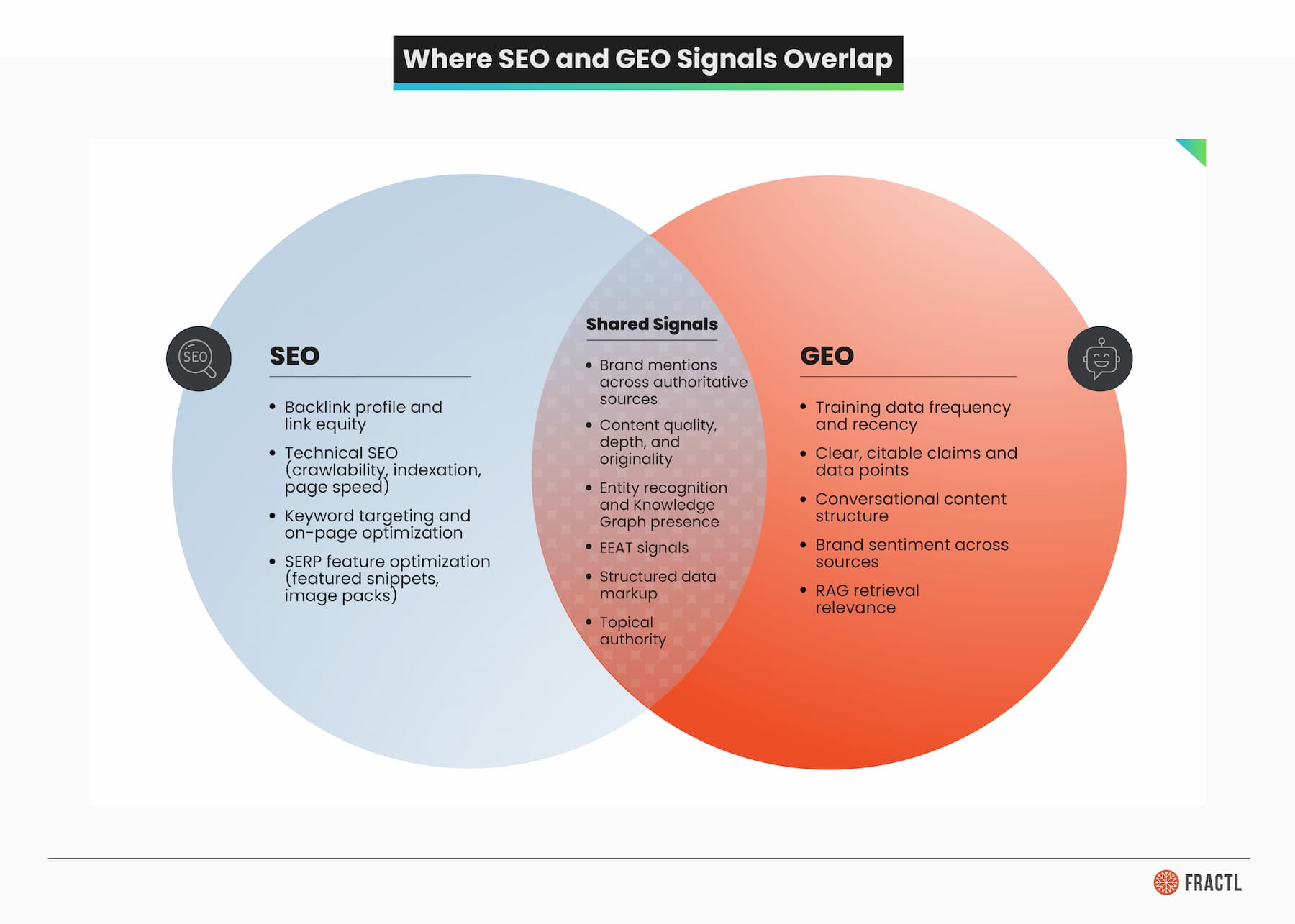
The overlap in the center is where your highest-leverage work happens. Strategies that build brand authority, earn media coverage, and produce original data serve both channels simultaneously.
This is why content marketing through digital PR has become the connective tissue between SEO and GEO visibility. Kelsey Libert has explored this in her research on the new era of brand visibility across SEO, GEO, and ASO, and we’ve analyzed it in Fractl’s work on AI media partnerships.
When You Need Links, When Mentions Are Enough, and When You Need Both
The right strategy depends on your goals. I created this at-a-glance comparison to break down when each signal type matters most and where combining them creates the strongest brand visibility impact:
| Links, Mentions, or Both? | |||
|---|---|---|---|
| Goal | Links | Mentions (unlinked) | Both |
| Improve domain authority | Essential; backlinks from high-DA sites directly increase domain authority | Helpful but insufficient on their own | Ideal; links build authority while mentions reinforce brand signals |
| Rank for competitive keywords | Critical; top-ranking pages consistently have stronger backlink profiles | Supportive; mentions contribute to entity authority | Strongest approach for competitive terms |
| Appear in AI-generated answers | Less direct; links aren’t processed the same way by LLMs | Very important; LLMs rely on brand mentions in training data | Best for visibility across both search and AI |
| Build brand recognition | Secondary; links drive traffic but don’t always build awareness | Primary; unlinked mentions in media build recognition | Comprehensive brand-building strategy |
| Drive referral traffic | Essential; only linked mentions generate direct referral traffic | No direct traffic benefit | Links for traffic, mentions for authority |
| Earn featured snippets and AI Overviews | Important; backlinks help pages rank high enough to be selected | Supportive; brand entity signals influence selection | Combined signals increase selection likelihood |
How To Earn Brand Mentions and Links Through Digital PR
The most effective way to earn both brand mentions and links at scale is through digital PR. Rather than chasing individual links, this approach creates newsworthy content that journalists and publishers want to cover, generating both linked and unlinked mentions naturally across news sites, social networks, and social media channels like LinkedIn and TikTok, as well as other platforms.
Create Newsworthy, Data-Driven Content
Data journalism and original research give publishers a reason to mention your brand. When you produce a study, survey, or analysis that reveals something surprising or useful, media outlets cite your findings and link to your methodology. That single campaign can generate dozens of brand mentions across high-authority publications.
A strong example is the Winter Preparedness: Who’s at Risk? campaign we produced for Utilities Now. The campaign used original data to identify which populations face the greatest risk during winter weather events, creating content that was directly relevant to energy and public safety reporters. That kind of topical specificity, paired with original research, is what separates campaigns that earn broad media coverage from those that go unnoticed.
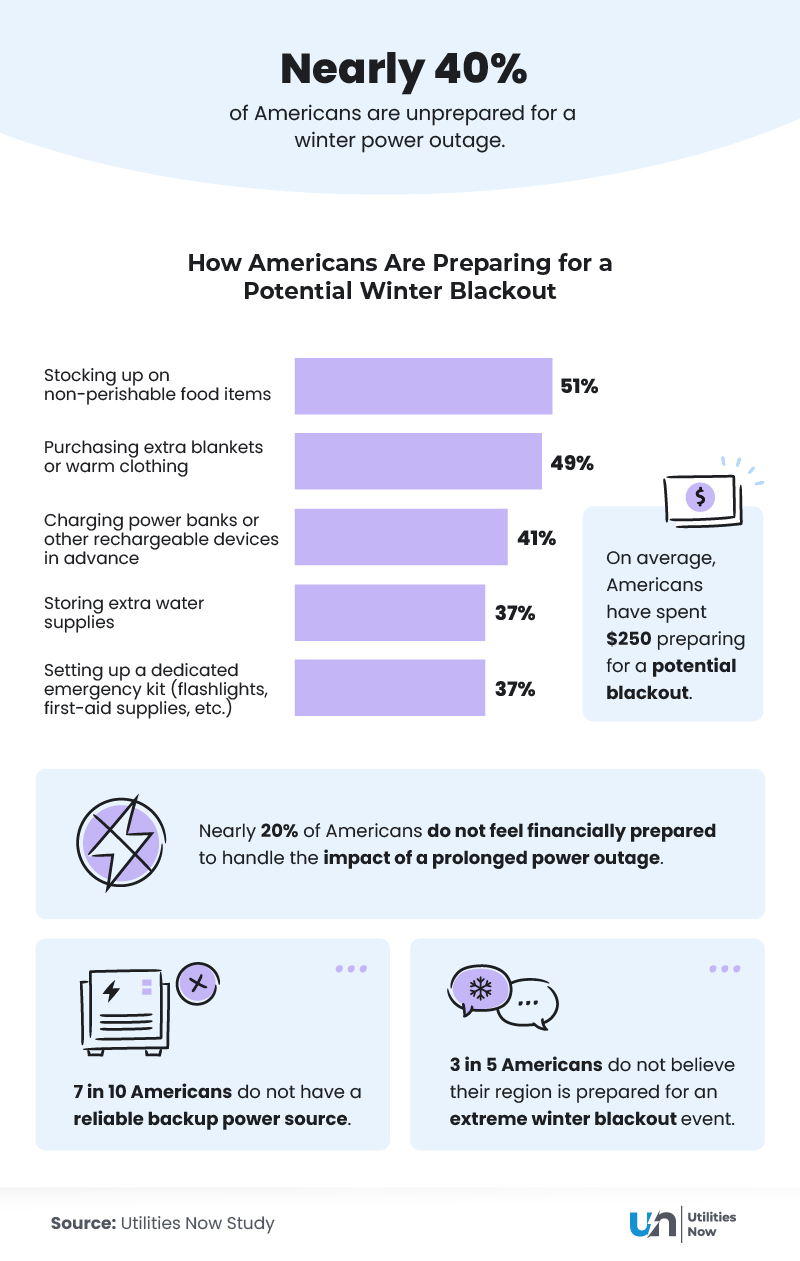
The key ingredients for data-driven content that earns mentions and links:
- Original data. Surveys, public data analysis, or proprietary datasets give journalists something they can’t get elsewhere.
- A clear narrative. Raw numbers don’t get covered; surprising findings do. The data needs to tell a story that connects to what readers care about and matches their search intent.
- Visual assets. Infographics and data visualizations with descriptive alt text (like the one above) make findings easier to reference and share, increasing the likelihood of both linked and unlinked mentions.
- Broad relevance. Content tied to trending topics or seasonal events tends to earn more coverage because it aligns with what publishers are already writing about.
Build Relationships With Journalists and Creators
Data-driven content creates the opportunity, but relationships determine whether it reaches the right publishers. In Fractl’s 10+ years of PR outreach, we’ve found that high-touch outreach to journalists who already cover your industry consistently outperforms mass distribution.
A personalized pitch to a reporter who’s written about your topic is worth more than 100 generic emails.
Expert commentary and collaborations with influencers are underutilized channels for building thought leadership. When your leadership team provides quotes on breaking news or emerging trends, or appears on podcasts and online conversations, those quotes become brand mentions in published articles and audio content.
Kelsey Libert has written about why PR is becoming essential for AI search visibility, explaining that the brands investing in media relationships now will have a structural advantage as AI platforms increasingly rely on media-sourced citations.
Proactive PR (monitoring journalist requests, distributing a press release with original data, offering expert commentary on trending topics) and reactive PR (responding quickly to breaking news with relevant data or analysis) both create mention opportunities that build brand authority over time. The key is consistency. One campaign builds awareness; a sustained program (whether through organic efforts or paid search engine marketing like pay-per-click (PPC) advertising) builds the kind of brand presence that search engines and LLMs recognize. User-generated content (UGC) like testimonials, customer feedback, and reviews amplifies this effect by creating authentic brand mentions.
Convert Unlinked Mentions Into Links
Not every brand mention will include a hyperlink, and that’s fine. Unlinked mentions still build entity authority. But converting them into linked mentions when possible gives you the best of both worlds.
The process is straightforward:
- Monitor mentions of your brand using media monitoring platforms and SEO tools that track new references to your brand across the web.
- Identify high-value opportunities. Prioritize mentions on high-authority sites (DA 60 and above) where adding a link would be natural and useful for readers.
- Reach out to the publisher. A short, polite email asking if they’d consider adding a link to the existing mention converts at a surprisingly high rate. You’re not asking for something new; you’re making an existing reference more useful for their audience.
This approach is especially valuable for brands with strong media presence. If you’ve earned dozens of mentions through digital PR campaigns, even a modest conversion rate translates into meaningful new backlinks with relevant anchor text.
Measuring Brand Mention Impact
Tracking brand mentions requires different tools and metrics depending on whether you’re measuring SEO impact, GEO visibility, or overall brand awareness.
Track these key metrics for brand mentions:
- Referring domains. The number of unique domains linking to your site. Growth in referring domains correlates with improved domain authority and rankings.
- Brand search volume. How often users search for your brand name directly. Increases in branded search volume indicate growing awareness and brand recognition.
- Share of voice. Your brand’s mention frequency relative to competitors across media coverage and search results. Regular competitor analysis helps you benchmark performance and reveals gaps in your mention strategy.
- AI citation frequency. How often AI platforms mention your brand in generated responses for relevant queries. This is a newer metric, but it’s becoming critical for your overall SEO strategy and GEO approach.
- Domain authority. While not a direct Google ranking factor, DA provides a useful proxy for your site’s overall backlink strength and authority signals.
- Sentiment analysis. The tone of brand mentions across media and social media platforms. Tracking sentiment is a core part of online reputation management. Consistently positive mentions strengthen both SEO entity signals and GEO citation likelihood, while negative mentions can undermine brand trust.
Brand Monitoring Tools for Tracking Brand Mentions
Different brand mention tools serve different parts of the monitoring process:
 Google Search Console shows which queries drive impressions and clicks, including branded searches. Google Alerts provides real-time alerts and notifications when your brand is mentioned on new pages, and Google Analytics tracks referral traffic from brand mentions and backlinks. |  Media monitoring platforms (like Meltwater or Cision) track brand mentions across news, social, and web sources in real time. |  Social listening tools (like Brandwatch and Sprout Social) add social media management capabilities, tracking hashtags, social media posts, and social mentions across social platforms and networks. |  SEO platforms (like Semrush and Ahrefs) provide backlink tracking, referring domain analysis, and competitor comparison data. |
AI monitoring is still emerging, but manually testing your brand’s presence in ChatGPT, Perplexity, and Google AI Overviews for relevant queries is currently the most reliable method. As Fractl has explored in our analysis of the new vocabulary of AI search, the tools and terminology for measuring GEO performance are evolving quickly.
The most valuable approach combines these data sources into a single dashboard or workflow. When you can see how digital PR or marketing campaigns generated media mentions, which mentions include backlinks, and whether your brand’s AI citation frequency changed afterward, you can measure the full impact of your marketing strategy across channels and extract valuable insights about what’s working.
Brand Mentions and Links Are Stronger Together
Brand visibility in digital marketing in 2026 doesn’t mean choosing between SEO and GEO, or between links and mentions. The brands winning across both channels are building authority signals that serve every platform simultaneously.
The throughline is: Create quality content worth referencing, earn coverage from credible sources, and build the kind of brand presence that search engines like Google and Bing, AI bots, and generative platforms all recognize. Links drive authority and search traffic. Mentions, including social mentions, build entity recognition and AI familiarity. Together, they create a visibility foundation that compounds over time.
At Fractl, we build generative engine optimization strategies and earned media campaigns designed to drive brand visibility across search, social, and AI platforms. If you’re ready to invest in a strategy that works across all three, let’s talk.
FAQs
What’s the difference between a brand mention and a backlink?
A backlink is a hyperlinked reference to your website that passes authority and referral traffic. A brand mention is any reference to your brand name, whether it includes a link or not. Both contribute to brand visibility, but through different mechanisms. Backlinks directly build domain authority and drive organic traffic, while unlinked mentions build entity recognition and influence how AI platforms associate your brand with relevant topics. Google’s implied links patent indicates the search engine can interpret unlinked brand mentions as trust signals similar to traditional backlinks.
Do brand mentions help with AI search visibility?
Yes. Large language models learn brand associations from the text they’re trained on, so brands mentioned frequently and positively across authoritative sources are more likely to be cited in AI-generated responses. For RAG-based systems (like Perplexity or Google’s AI Overviews), having well-structured, recently published content with clear brand signals increases retrieval likelihood. The more consistently your brand appears in high-quality sources, the stronger the association LLMs develop between your brand and the topics you want to be known for.
How do you earn brand mentions at scale?
Digital PR through data journalism is the most effective approach. Creating original research, surveys, and data-driven analysis gives publishers a reason to reference your brand. A single well-executed campaign can generate dozens of media mentions across high-authority publications, building both link equity and brand recognition simultaneously. Combining data journalism campaigns with proactive PR (expert commentary, thought leadership) and reactive PR (responding to breaking news with relevant data) creates a sustained pipeline of brand mentions.
What Is SEO, and Is GEO Replacing It?
No. If you want to learn SEO basics, the core hasn’t changed: GEO and SEO are complementary disciplines that share significant overlap in their core signals. Brands that invest in authority-building strategies (original content, media coverage, entity development) perform well in both traditional search and AI-powered platforms. As Kelsey Libert has noted in her research on the evolving landscape of brand visibility, the strongest strategies address both channels through a unified approach to brand authority rather than treating them as separate workstreams.