




Table of Contents
- Reach: How Many People Are Actually Seeing Your Brand?
- Relevancy: Are You Reaching the Right Target Audience?
- Brand Mentions: Where and How Your Brand Appears
- Sentiment: What People Are Saying About Your Brand
- Branded Search: Measuring Demand Through Search Behavior
- Social Engagement & Share of Voice
- Brand Recall Studies
- How Fractl Helps Brands Measure Awareness
Brand awareness campaigns are often judged too quickly (or with the wrong metrics altogether.) Unlike lead-generation or conversion-focused marketing campaigns, awareness measurement doesn’t always show immediate payoff in a dashboard. Still, that doesn’t mean it’s immeasurable.
When done correctly, measuring brand awareness connects early-stage marketing efforts to long-term outcomes like brand recognition, brand recall, and being top-of-mind with potential customers. The key is knowing which signals matter, where to track them, and how to benchmark progress over time.
This guide breaks down how to measure awareness campaigns using a mix of analytics tools, social listening, search data, and qualitative indicators so you can clearly understand what’s working for your brand and why.
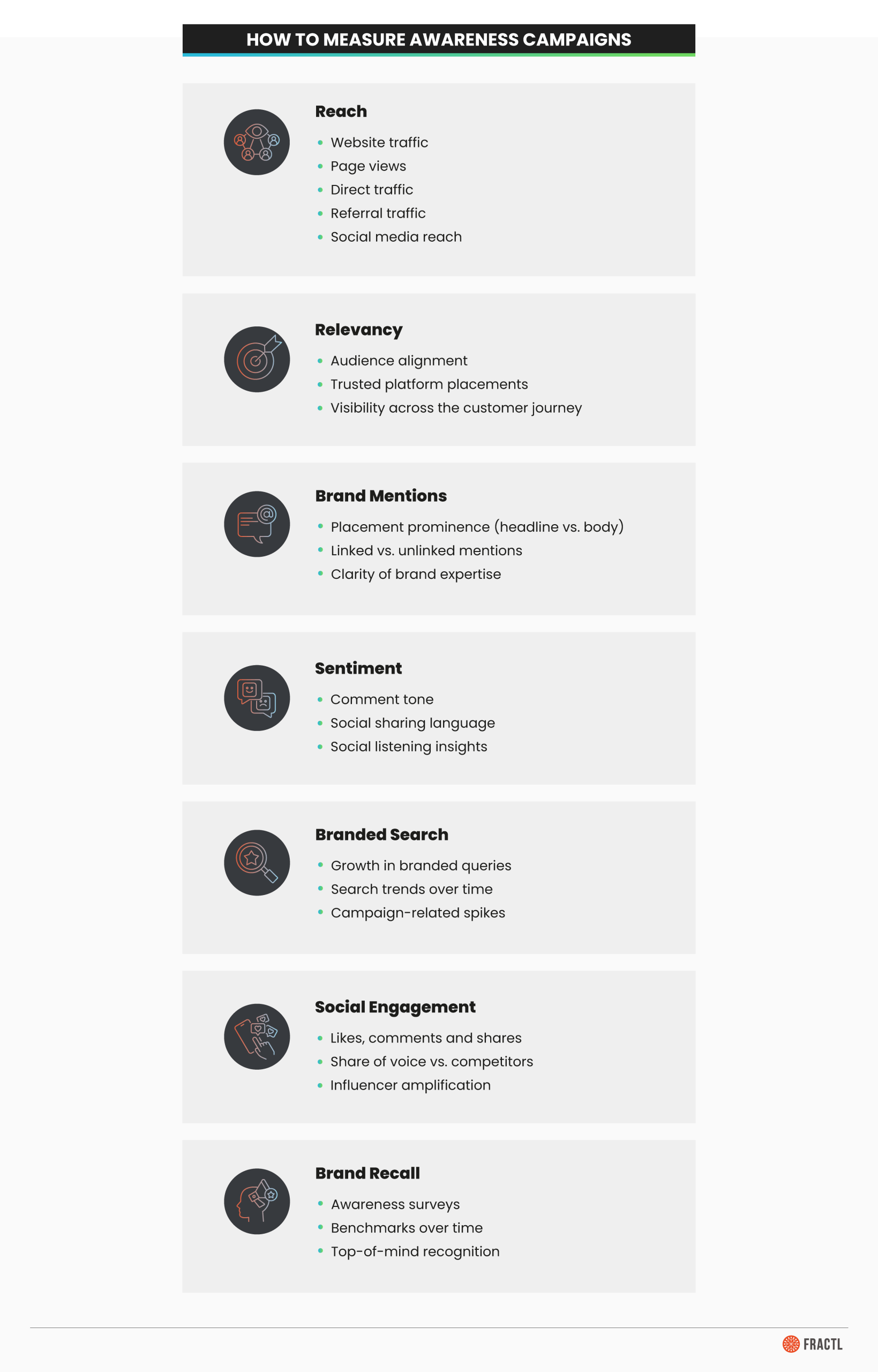
Reach: How Many People Are Actually Seeing Your Brand?
Reach answers this simple question: How many people were exposed to your brand name during a campaign? Here are some key indicators to review:
- Website traffic. Review overall traffic trends in Google Analytics during and after brand awareness campaigns.
- Page views. Analyze page views on campaign-related content to see which assets attracted the most attention.
- Direct traffic. Monitor increases in direct traffic, which often indicate growing brand recognition and familiarity.
- Referral traffic. Track referral traffic from media placements, backlinks, influencer partnerships, and other earned channels.
- Social media reach. Measure reach across social media platforms, including LinkedIn, to understand how widely your brand content circulated.
Tools like Google Analytics and Search Console help identify where traffic originates and how users enter your site. While reach alone doesn’t measure success, it establishes the baseline number of people who could recognize your brand later.
Relevancy: Are You Reaching the Right Target Audience?
High reach means little if your message misses the intended target audience. Relevancy focuses on who is seeing your brand and whether those people align with your demographic, industry, or buying stage. Take a look at some of the questions to ask:
- Does your coverage appear on platforms your audience already trusts?
- Are you visible across the right touchpoints in the customer journey?
- Do placements align with your marketing strategy and brand awareness goals?
A smaller but well-matched audience often delivers stronger brand perception and recall than broad, unfocused exposure. This is especially important when awareness campaigns support future SEO, content marketing, or B2B sales cycles.
Brand Mentions: Where and How Your Brand Appears
Not all brand mentions contribute equally to awareness. The context of the mention matters just as much as its existence.
You should evaluate:
- Where the brand name appears within the content (headline, intro, citation)
- Whether the mention includes a link or plain-text reference
- How clearly the brand’s role or expertise is described
Prominent mentions near the top of content tend to improve brand recognition, while detailed explanations help audiences remember what you actually do, which is a critical factor in long-term awareness measurement.
Sentiment: What People Are Saying About Your Brand
Sentiment measures how your brand is perceived, not just whether it’s visible. Look beyond neutral coverage and review:
- Comment tone. Analyze comments on articles and social media posts to understand how audiences emotionally respond to your brand.
- Social sharing language. Review the language people use when sharing your content to identify positive, negative, or skeptical sentiment.
- Social listening insights. Use social listening tools to uncover broader trends in brand perception across platforms.
IMPORTANT: If people read the content and think that the research your brand provided to the publisher doesn’t make sense for your brand to be discussing or dealing with, this can potentially lead to negative brand sentiment. Always make sure there is a logical, subject-matter connection between your brand and the content you’re creating if brand awareness is your priority.
Branded Search: Measuring Demand Through Search Behavior
One of the clearest indicators of awareness is branded search volume, which is a measure of how often people search for your brand in search engines.
Here are a few metrics to track:
- Increases in branded queries via Google Search and Search Console
- Trends over time using Google Trends
- Correlation between campaigns and spikes in branded interest
Rising branded searches suggest that awareness campaigns are pushing your brand closer to top-of-mind status, even if conversions happen later.
Social Engagement & Share of Voice
Social media is one of the primary ways people encounter and form opinions about brands. In fact, nearly 60% of consumers say they discover new businesses via social media, making social platforms a major channel for awareness and brand discovery. Key social media metrics to monitor include:
- Engagement rates. Measure likes, comments, shares, and overall social media engagement to understand how actively audiences interact with your brand.
- Share of voice. Compare your brand’s visibility to competitors to understand its relative presence in your industry.
- Influencer amplification. Review influencer-driven engagement to see how third-party voices contribute to awareness.
Brand Recall Studies
Some awareness insights can’t be pulled from analytics alone. Here are a few methods to strengthen awareness measurement:
- Awareness surveys. Use surveys to directly measure brand recall, brand recognition, and top-of-mind awareness.
- Benchmark comparisons. Compare current results to past performance benchmarks to identify meaningful improvement.
- Stakeholder alignment. Review results with internal stakeholders to confirm agreement on success metrics and KPIs.
- Case study analysis. Reference case studies to contextualize performance and identify repeatable brand awareness strategies.
How Fractl Helps Brands Measure Awareness
Brand awareness campaigns are most effective when measurement is part of the strategy from day one. At Fractl, we help brands design and evaluate awareness campaigns using a combination of performance data, audience insight, and earned visibility.
Fractl supports awareness measurement by focusing on:
- Campaign-specific KPIs. Define brand awareness metrics that match campaign goals rather than forcing conversion-based benchmarks onto upper-funnel efforts.
- Search and traffic analysis. Use Google Analytics, Search Console, and branded search volume data to understand how awareness impacts discovery and site behavior.
- Earned media evaluation. Assess the reach, relevancy, nature, and sentiment of brand mentions across publishers and platforms.
- Audience engagement signals. Measure social media engagement, referral traffic, and share of voice to evaluate how audiences interact with brand messaging.
- Clear reporting for stakeholders. Translate complex awareness data into insights that marketing teams and decision-makers can act on.
Ready to build brand awareness — and prove it’s paying off? Fractl helps teams track what matters and act on it. Contact us today to see how we can help.