




Table of Contents
- What Is Social Media Marketing?
- What Is Content Marketing?
- The Key Elements That Connect Content and Social
- What Happens to Earned Coverage on Social Media
- Create Content Worth Sharing
- Social Media Content Strategies by Platform in 2026
- How To Amplify Your Content With Social Media
- Build Social Media Content Strategies That Carry Every Story Further
- Methodology
- FAQ
Key Takeaways
- Most coverage never travels past the outlet on X. In Fractl’s analysis of news coverage from 30 campaigns, only 37% of the stories BuzzSumo tracked were shared on X by anyone with no connection to the story.
- Workplace, careers, and AI topics are the exception. Facebook out-shared X on every topic but this one.
- Threads is emerging and worth testing. It reached 500 million monthly users in June 2026, close to Pinterest’s 640 million, and replying to comments boosts engagement more on Threads than on any other platform.
- Run social and content as one plan. Both follow the same steps, from goals to reporting, so build one social media content calendar for both.
You’ve built a social media strategy. You know what you’re going to post, when you’re going to post it, and who you’re trying to reach. Your X, LinkedIn, Facebook, Instagram, and TikTok accounts are populated with posts and a calendar to help you schedule all your social media marketing campaigns well in advance.
You’ve also built your content strategy, with an editorial calendar for your blog. You know what topics you’ll cover, what content you’ll produce, and what goals you’re trying to achieve.
A social media content strategy connects those two: which pieces of content you’ll share, on which platforms, in what formats, and how you’ll measure what that sharing earns. So, how do you ensure content marketing and social media marketing work together?
What Is Social Media Marketing?
The part of digital marketing that creates and shares content tailored to each social platform to build brand awareness, start conversations with your target audience, and drive website traffic and sales. It covers organic posting, community management, social media advertising, and influencer marketing.
Posting a link to your product on X and calling it a day won’t get you far. Social media marketing is a strategic effort that has to be tailored to the people you want to reach, to each individual platform, and optimized to drive user engagement, shares, and traffic back to your site.
What Is Content Marketing?
A strategic approach built on creating and distributing valuable, relevant, and consistent content to attract and keep a clearly defined group of customers, and ultimately to drive profitable action.
Focus on the “distributing” part of that definition above. Distribution can be anything from digital PR outreach to email marketing, to yes, sharing on social media. In a digital marketing plan, social is the distribution channel you control.
The Key Elements That Connect Content and Social
Your social media strategy should support your content performance by amplifying content on social media, distributing it widely, and informing your editorial calendar with reports on what’s working and what isn’t.
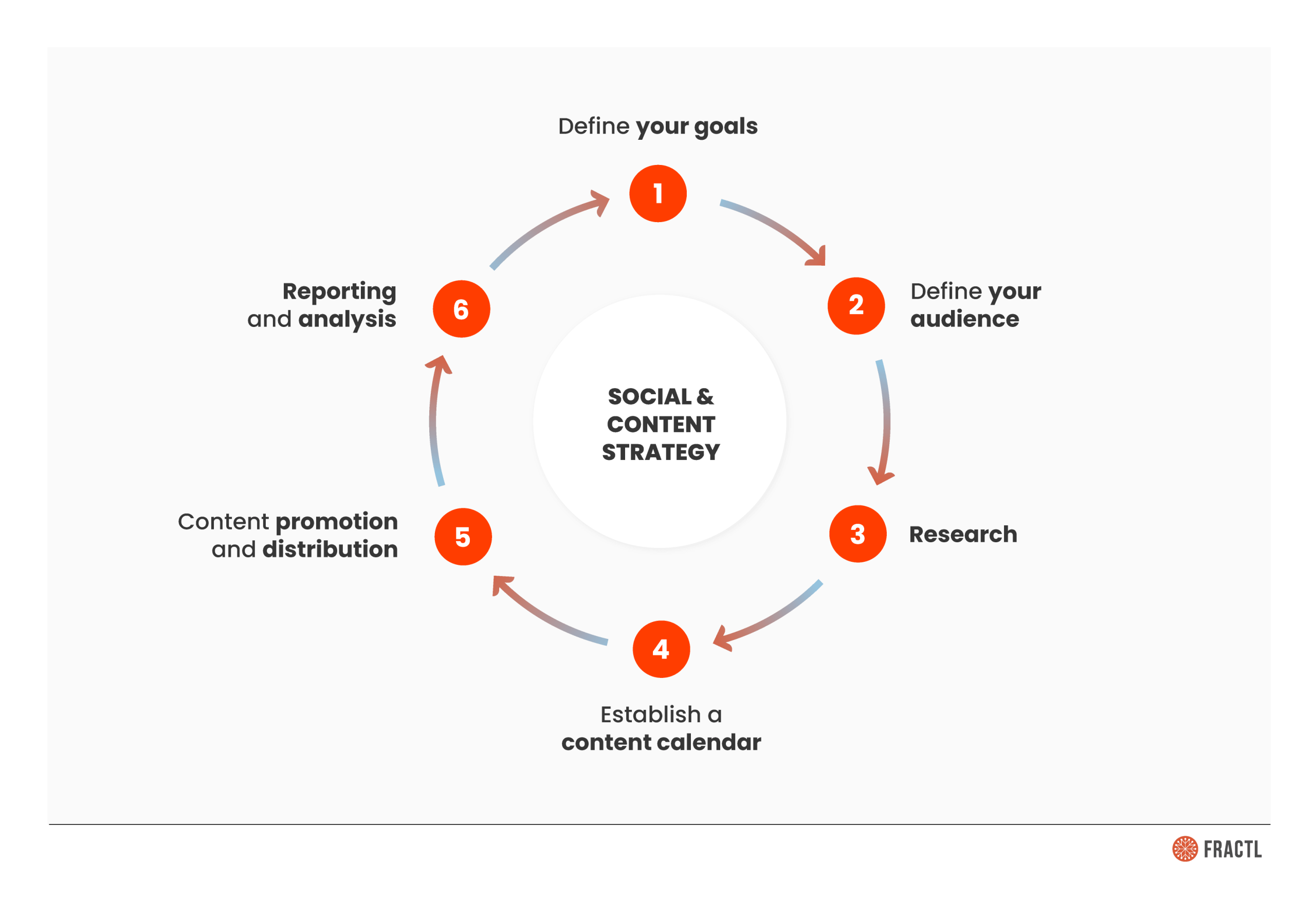
While social media marketing and content marketing differ in many ways, both content and social strategies have nearly the same structure. That makes it easy to align your objectives, target audience, and content calendar right from the get-go.
A fully fledged social media marketing strategy and a fully fledged content strategy will have several core components. Work to unite each of these components into one integrated social and content strategy.
1. Define Your Goals
The first step for a content or social media marketer is defining and aligning objectives. Write them as SMART goals (specific, measurable, achievable, relevant, and time-bound), so both teams know what success looks like before anything goes live.
Social
What are your goals with social media marketing? Do you want to increase brand awareness by earning more shares, likes, and follows? Do you want to drive traffic back to your website and use social media marketing to help sell a product or generate leads? Do you want to use it to communicate with your current customers?
Content
Like setting up your social media marketing strategy, your content marketing strategy should begin with the same question: What are your goals? Some possible goals may be to increase brand authority, be more visible, offer value to your community or industry, improve your website’s search ranking, or get more customers for your product or service.
2. Define Your Target Audience
Who do you hope to reach? Who benefits from your content, product, or service? Identify your customer base and any other potential audiences that could benefit from the content you create and put out into the world. Build buyer personas from that audience research, and meet people where they already are.
Social
In 2025, 84% of U.S. adults used YouTube and 71% used Facebook, while half used Instagram and 37% used TikTok. No matter how hard you try and how often you post, you’ll never be able to reach all of them. Which social channels is your niche audience using? What types of content are they engaging with?
Content
What types of content are your potential customers already consuming and sharing? Where are they engaging with content online? What publications publish content in your industry or niche often? Where are they most likely to go for recommendations for the product or service you’re offering?
3. Research
A content or social media strategy that isn’t informed by research isn’t a good one. Identify your competitors, optimize what’s working, scrap what isn’t, and make sure you show people what makes you different. What sets you apart? Highlight that in every post and every piece of content.
Social
Identify your competitors, analyze their social presence, and determine what direction you want to take your social media strategy from what you’ve learned. Use that competitive analysis for benchmarking: note each competitor’s posting frequency, content formats, engagement rate, and follower growth, then set your own targets against them.
Social listening belongs in this step, too. Tracking what people say about your brand, your competitors, and your topic tells you which questions to answer before you plan a single post.
Content
While you should never create content just for search engines, you still need to research the keywords your customers search for and try to rank for those keywords. You may also want to perform a keyword analysis on your competitors to get a sense of the direction to take for your own content strategy.
Keyword planning allows you to better understand your customers and communicate with them more effectively by providing content that answers and serves their search queries. Keyword research now extends past the search box: people also search inside TikTok, YouTube, and AI assistants, so an organic growth strategy should plan for visibility across search, social, and AI answers at once.
4. Establish a Content Calendar
A shared calendar ties every social post to something you’re publishing, so each piece has its promotion planned before it goes live.
Social
Just having a social media profile isn’t enough. You need to create, curate, and share posts and updates with your followers often. You’ll want to define a few topics that you’d like to focus on, and then produce, refine, and follow a social media content calendar.
Mix educational content, product reviews, user-generated content, and behind-the-scenes posts, and plan the format for each platform.
Short-form video and Reels are for Instagram and TikTok, text and carousels for LinkedIn, and conversation starters for X and Threads. Social media management tools such as Hootsuite and Buffer keep the calendar running once it’s built, and Fractl Agents can take on repeat tasks like turning a finished campaign into platform-specific posts.
In HubSpot’s 2026 survey of 1,500+ marketers, short-form video (48.6%) topped the list of formats that earned the biggest ROI, well ahead of long-form video (28.6%), so give it a regular slot in the calendar.
Content
The editorial calendar for your content plan should establish a publishing schedule and identify four key parts:
 Format Is this a blog post, a white paper, ebook, research campaign, video, infographic, or interactive asset? Will it be hosted on-site or off-site? |  Keyword(s) Identify the keyword(s) you’d like the content to rank for. Also, identify related keywords or long-tail keywords for this content. |
 Title and topic Give a title and description of the main topic, and write a title that reads clearly in search results and in a social feed. |  Goal Specify which stage of the path to purchase and the related goal this piece of content strives to achieve. |
5. Content Promotion and Distribution
The three channels that carry a piece of content after it’s published are:
 Social media |  |  Digital PR |
Social
Once you start integrating your content and social calendars, the fun begins. Your on-site and off-site content will provide endless opportunities to share on social, and your social media analytics will better inform content creators what types of content “win” with your followers.
Your social editorial calendar should coincide with your content calendar, and for every piece of content published, you should have planned unique and strategic messaging in advance. Keep a consistent brand voice across every platform, even when the format changes.
Content
Keyword research helps people find your content in search results and AI answers. Promotion puts it in front of readers who aren’t searching yet.
At Fractl, we specialize in digital PR outreach for most of our client campaigns.
Executing this type of outreach for your content can amplify your brand through brand mentions and links, and it builds trust from third-party publishers. Coverage is only the start, though, because most of it doesn’t spread on social unless someone shares it.
6. Reporting and Analysis
Report on both plans together, so what performs on social shapes what you create next.
Social
You need to track how your posts perform and compare them with your competitors’. Refine and optimize what’s working, scrap what isn’t, and listen actively to what your followers are saying. Did your follower count or likes, comments, and shares increase? Did you drive much referral traffic? Your social media analytics answer those questions post by post. Social media marketing isn’t something you can “set and forget,” no matter how easily you can schedule posts in advance.
Reply to your followers and participate in conversations.
Pick KPIs that match each goal: reach and follower growth for awareness, engagement rate for community, and click-through rate and conversions for traffic and leads. Tag every link with UTM parameters, so Google Analytics can attribute website traffic to the post that sent it, and use A/B testing on captions, images, and posting times before you scale a format. Match every KPI to one of your SMART goals, and revisit your benchmarking against competitors each quarter.
In HubSpot’s 2026 survey, measuring marketing ROI was the top challenge, cited by 33% of marketers.
Content
How did your content perform? How did readers receive it (read comments, social shares, third-party posts, etc.)? Did your conversion, visibility, traffic, or interactions improve? Google Analytics shows which posts sent readers to each piece. Remember that not all metrics can measure all goals and content formats.
What Happens to Earned Coverage on Social Media
To see how much social life earned media gets on its own, we pulled BuzzSumo data on the news coverage from 30 Fractl campaigns, one per client, with outreach that started between March 2025 and January 2026. Those campaigns earned 15,690 article placements, and 96% of them were syndicated copies of 618 original stories. For the originals BuzzSumo already tracked, we checked who shared each story on X and how many times it was shared on Facebook.
Social Sharing on News Coverage of Fractl Campaigns
For most stories, nobody outside the outlet, the client, or bots shared them on X:
| Measure | Result |
|---|---|
| Stories shared on X by anyone outside the outlet | 37% |
| Median Facebook shares per story* | 6 |
| Median X shares per story* | 2 |
| Share of all social interactions from the single most-shared story | 81% |
*Among stories shared at least once on that platform.
Facebook out-shared X on every topic we studied except for one:
 Stories about money, travel, and lifestyle drew up to five times more Facebook shares than X shares. |  Workplace, careers, and AI coverage was the one area where X shares outnumbered Facebook’s. |
Content vertical matters. If your coverage is aimed at shoppers and households, put more effort behind Facebook. If it’s professional, X or LinkedIn are where it’s more likely to travel.
One national news story produced 81% of all the social interactions in the sample, indicating viral coverage.
Create Content Worth Sharing
Coverage that travels on social starts with content people want to pass along:
- Start with original data. Surveys and original studies give reporters a finding they can’t get anywhere else, and that finding becomes the hook for every social post.
- Build around a strong emotion. When I retested our research on viral content on Reddit in 2024, the same emotions still drove the most popular images.
- Go deep on a narrow subtopic. A focused, in-depth piece gives each post one clear finding to lead with, instead of a broad overview no one remembers.
- Design it to be shared. Charts, maps, and interactive visuals let people pass along a finding without reading the full piece.
That’s the approach behind our content development work: fewer, better pieces built on original research, with designers and developers bringing each story to life.
Social Media Content Strategies by Platform in 2026
The mix of platforms worth your time has changed since X replaced Twitter. Meta’s Threads reported 500 million monthly active users in June 2026, and Bluesky says it has over 40 million users.
U.S. Adults Who Use Each Platform
| Platform | U.S. adults who use it | What it does best for content |
|---|---|---|
| YouTube | 84% | Long-form explainers and research walk-throughs that people search for later |
| 71% | Everyday stories about money, travel, and lifestyle that friends and groups pass along | |
| 50% | Reels, carousels, infographics, and visual data from your campaigns | |
| TikTok | 37% | Short-form video that turns one finding into a quick story |
| 26% | Community discussion, when you answer questions instead of promoting | |
| X | 21% | Reaching reporters and industry voices in real time |
| Threads | 8% | Conversation-style posts from brands already active on Instagram |
| Bluesky | 4% | Niche communities in tech, media, and research |
Source: Pew Research Center, Americans’ Social Media Use 2025, survey conducted Feb. 5 to June 18, 2025.
X
X still matters for news. According to Pew, 57% of X users get news there. Use X to put coverage in front of journalists and your industry:
Tag the outlet and reporter, quote the finding in the post, and reply to the people who engage.
Skip the stack of hashtags; one relevant tag is plenty. Our data showed workplace and AI coverage did better here than on Facebook.
Threads
Threads is Meta’s conversation app, and it’s a natural extension for brands that already post on Instagram. It had more than 400 million monthly users in August 2025, and Meta put it at 500 million by June 2026, close to Pinterest’s 640 million in the same quarter. It skews young: in Pew’s 2025 survey, 15% of U.S. adults ages 18 to 29 used Threads, compared with 3% of those 65 and older.
Keep your brand voice conversational, post the way you’d talk to a colleague, ask questions, and share the findings behind a campaign rather than the link alone.
Reply to the people who comment: in Buffer’s 2026 study of about 2 million posts, replying to comments lifted the engagement rate 42% on Threads, the largest lift of any platform in the study. Video and images also earned higher median engagement rates there than text or link posts, so pull a campaign’s finding into a visual instead of posting a bare link. Treat it as a test channel: with 8% of U.S. adults using it, it’s still a following you build, not one you inherit.
Bluesky
Bluesky’s registered users keep climbing, but TechCrunch reported in August 2026 that Bluesky’s active user base is shrinking.
It’s worth a presence if you’re trying to reach researchers, journalists, or tech professionals, but don’t move your whole calendar there.
LinkedIn has more than 1 billion members.
It’s the default for B2B brands that use content to generate leads.
In the Content Marketing Institute’s 2025 research, 85% of B2B marketers said LinkedIn delivers the best value of any social platform. Posts from your people extend your reach here: LinkedIn data shows employees’ combined networks are about 12 times larger than a company’s own following.
TikTok, Instagram, and YouTube
On TikTok, Instagram, and YouTube, turn each campaign into a short clip or a piece of educational content that leads with the most surprising finding, then use hashtags sparingly and only where people search them. Carousels and infographics work well on Instagram and LinkedIn.
Repurpose one video across Reels, TikTok, and YouTube Shorts, and adjust the caption for each.
How To Amplify Your Content With Social Media
The crowded content marketing space is why it’s more important than ever to use social media to amplify your content performance. Social media can help your content reach far more people than if you didn’t integrate it at all. It can help you rise above the noise and reach customers before your competitors do. Build these tactics into every content plan.
1. Use Paid Ads for Your Best Content
Social media advertising works best when you’re selective. When you’re paying to promote your posts, remember only to promote your best content, especially if you’re on a budget. You want to get the most out of your money by promoting content that moves people through the buying cycle.
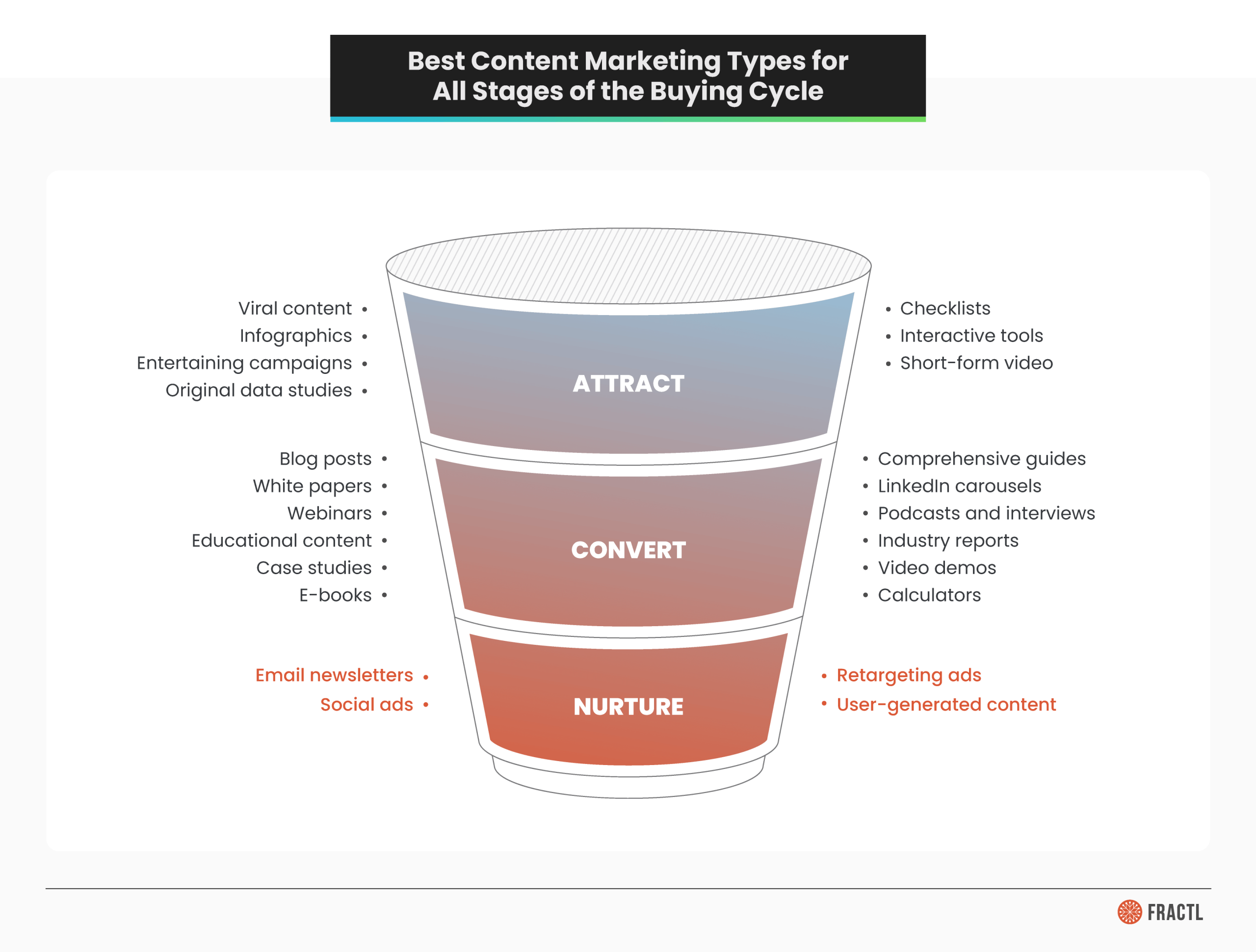
Be sure to create hyper-targeted buyer personas to target the ads to, to ensure that your content is reaching the people you know would find value in what you produced and who are possibly already weighing a purchase.
For paid amplification, you can use boosted posts on Facebook and Instagram, Thought Leader Ads and Sponsored Content on LinkedIn, and paid promotion on X and Pinterest. Watch click-through rate as well as reach, and A/B test two versions of each ad before you put the full budget behind one.
2. Choose Your Platforms Wisely
Consider the top social platforms (YouTube, Facebook, Instagram, TikTok, LinkedIn, X, Pinterest, and Threads), and see where the largest concentration of your target audience members is.
Every profile adds social media management work, so don’t frantically try to set up every social profile if it’s more than you can manage or doesn’t make sense for the people you’re trying to reach. If your target audience is retirees, for example, you don’t need a Snapchat presence. Be where your customers are, and remember, it’s better not to have a presence on a social channel than to post sporadically and inconsistently.
3. Share Every Placement Yourself
When a publisher covers your campaign, don’t wait for the story to spread. Our data showed most stories were never shared on X by anyone outside the outlet. Remember to:
 Share the original article rather than a syndicated copy. |  Tag the outlet and the reporter, and pull the most surprising finding into the post. |  Ask your team to share it from their own accounts to tap into their networks and expand reach. |
The work starts with pitching stories that earn coverage, and each placement keeps paying off as the brand mentions build your authority. When a publisher mentions you without a working link, broken link building can recover it.
4. Reach Out to Social Media Influencers When Appropriate
Are there any social media influencers in your niche you can partner with to amplify your content? Think bloggers in your niche or Instagram, TikTok, and YouTube creators. Why reach out and pay influencers for saying something you can say yourself? Well, ideally, the influencer has already built trust with their followers. Hopefully, those followers are people you’re trying to reach (if they’re not, don’t use that influencer!).
5. Put User-Generated Content to Work
In BrightLocal’s 2026 survey, 97% of consumers said they lean on reviews to guide their purchase decisions. Reshare product reviews, customer photos, and videos (with permission), and ask for UGC around campaign topics so customers have a reason to join the conversation.
6. Retargeting
Retargeting is a method used to show relevant ads to users related to a previous search they made or pages they visited. Using the information collected, a marketer can purchase ads on social networks that the person visits. Retargeting is a great way to build thought leadership in your niche using content marketing.
You can target users who have visited your site with content that shows the benefits of your service or product as well as your expertise on the topic.
7. Get Involved in Online Communities Related to Your Industry
There are social platforms that cater to your niche community online. The major one that comes to mind is Reddit, the front page of the internet.
Chances are there’s a Reddit thread (or two) that relates directly to the people you serve.
Other social platforms with communities related to each niche include Quora, Discord, and LinkedIn groups.
Build Social Media Content Strategies That Carry Every Story Further
Content marketing can be hugely beneficial to your bottom line by increasing brand awareness, demonstrating your trust and authority as a brand, increasing leads and sales, improving your search ranking, increasing organic traffic, earning industry recognition, demonstrating thought leadership, and the list goes on and on. The problem is if your content never sees the light of day and doesn’t reach anyone, it’s just you shouting into the void, and you never reap the benefits your hard work could earn. Our campaign data shows that holds even for coverage in major outlets: the story runs, the outlet posts it, and most of the sharing that follows is up to you.
Fractl builds campaigns that earn high-authority coverage and then puts them to work across search, social, and AI answers. If you want your content to reach further than the first post, reach out and partner with Fractl.
Methodology
We took each client’s most-covered campaign with outreach that started between March 1, 2025, and Jan. 31, 2026, and pulled up to 15 original stories per campaign that were published by Feb. 20, 2026. We stopped the window there because BuzzSumo’s Facebook counts for articles published after late February 2026 came back empty. We searched 266 stories in BuzzSumo’s Content Analyzer, and 81 already had share data from before this study, which is the base for the X sharer check and the Facebook share counts. We sorted every X account BuzzSumo showed as a sharer into the outlet or its author, the client, likely bots, or accounts with no tie to the story. On 24 of the 54 stories that had a list of X sharers, the only accounts that shared them were the outlet, the client, or bots. Because the sample takes each client’s best-covered campaign, it leans toward campaigns that earned wide coverage.
Platform user counts come from each company’s own reports. Threads’ 500 million monthly active users is from Meta’s June 16, 2026, announcement, and Pinterest’s 640 million monthly active users is from its results for the quarter that ended June 30, 2026, so both cover April through June 2026. Each company calculates monthly users under its own definition.
FAQ
What is a social media content strategy?
A social media content strategy is a plan for which content you’ll share on each social platform, in what formats and how often, tied to goals you can measure. It works best when it runs on the same calendar as your broader content marketing.
What is the 5-5-5 rule for social media?
The 5-5-5 rule is an informal routine for engaging on social, and sources define it differently. Hootsuite describes it as spending five minutes liking posts, five minutes commenting, and five minutes responding to comments or messages on your own content.
What is the 5-3-1 rule on social media?
In Hootsuite’s version, five of every nine posts are curated from other sources, three are original, and one is promotional. Other sources use the same name for a daily routine of liking and commenting, so check which version a team means.
What are the 7 C’s of social media strategy?
Hootsuite lists the 7 C’s as community, content, curation, creation, connection, conversation, and conversion. It’s a checklist rather than a standard, and other versions swap in terms like consistency and collaboration.