




Table of Contents
- How We Vetted These GEO Agencies
- The 12 Best GEO Agencies in 2027
- Partner With a GEO Agency That Earns Citations With Original Research
- FAQ
Key Takeaways
- Ask for citation proof, not promises. Every agency on this list has published an AI-visibility result, but only some count AI citations for a named client over a stated timeframe.
- Citations, mentions, and AI traffic are different metrics. Compare agencies on the same metric, or a large AI traffic lift can look stronger than a citation result that matters more.
- Rankings don’t guarantee citations. Our study of 11,573 AI answers found that only 26% of AI citations came from a domain on Google’s first page.
- Earned authority feeds AI answers. AI tends to recommend brands that third-party sites write about, so a GEO program needs coverage on those sites, not just changes to your own pages.
- Published prices vary widely. Digital Elevator’s AI visibility program starts at $3,000, while Omniscient Digital’s full-service programs start at $120,000 a year.
Generative engine optimization (GEO) means getting your brand cited and named in AI answers. That covers ChatGPT, Perplexity, Gemini, Claude, Google AI Overviews (AIO), and other tools built on large language models. You’ll also see it called answer engine optimization (AEO), LLM optimization (LLMO), or AI SEO. The best GEO agencies in 2027 start with Fractl for original-research-led AI citation building. Foundation leads for distribution-first content, Omniscient Digital for B2B software, Skale for tech and SaaS pipeline, and SearchTides for brands defending an AI lead. Seven more specialists follow below.
Every one of these generative engine optimization agencies has published an AI-citation or AI-visibility result for a named client. A citation count and an AI traffic lift measure different things, so check which one an agency reports before you compare it with another.
| Agency | Best for | Strongest published AI proof | Pricing model |
|---|---|---|---|
| Fractl | Original-research-led AI citation building | AI Overview citations and AI share of voice, named client, 10 months | Custom retainer |
| Foundation | Distribution-first content for B2B tech | AI citation share, named client, 12 months | Retainer or project roadmap |
| Omniscient Digital | B2B software brands | AI citation share and LLM visibility, named client, 60 days | Annual contract |
| Skale | Tech and SaaS teams that report to pipeline | AI brand mentions, named client, 90 days | Not published |
| SearchTides | Brands defending an existing AI lead | Citation share and AI-attributed sales, named client, 5 months | Fixed-fee sprint, then custom |
| Growth Marketing Pro | Fast-growing tech companies | AI share of voice, named client, 7 months | Not published |
| Digital Elevator | Lean teams that want fixed-scope sprints | AI Overview citations, named client, 1 year | Fixed-price sprints or retainer |
| Orbit Labs | Growth-stage B2B SaaS and AI companies | AI visibility rate, named clients, 90 days | Not published |
| Intero Digital | Product and industrial brands | AI Overview appearances, named client, year over year | Not published |
| Siege Media | Decision-stage GEO for SaaS, fintech, and e-commerce | ChatGPT sessions and AI Overview keywords, named client, 6 months | Not published |
| Directive | B2B pipeline-attributed GEO | Tracked-prompt presence, named client, 9 months | Not published |
| Single Grain | GEO run alongside paid media | AI citations, named clients, 30 days to 12 months | Not published |
How We Vetted These GEO Agencies
We vetted each agency’s GEO strategies against four bars:
- A published AI-visibility result. A case study on the agency’s own site that reports AI citations, AI Overview appearances, LLM mentions, or AI-referred traffic for a named client.
- A stated way to measure it. A named tracking tool, a prompt-tracking method, or a reporting cadence for AI share of voice.
- A GEO service you can buy. A dedicated GEO, AEO, or AI search optimization service, not a blog post about the trend.
- Its own AI visibility. ChatGPT, Gemini, Perplexity, Microsoft Copilot, Grok, or Google AI Overviews had to mention the agency, which we checked in Ahrefs Brand Radar.
The 12 Best GEO Agencies in 2027
All 12 agencies sell a dedicated GEO or AEO service for AI search visibility, and every result below comes from the agency’s own published case study.
1. Fractl
We founded Fractl in 2012 on original research, and that’s what our GEO work runs on. Our teams produce data studies and surveys, and our digital PR team earns coverage for them on high-authority publishers.
We pair that coverage with answer-first, structured content and schema markup that AI engines can quote. We also run query fan-out research to map the follow-up searches an AI engine runs behind a single prompt. The coverage builds the entity authority that gets a brand named, and the content gives the AI something specific to cite.
Our study of 11,573 AI answers found that AI tends to recommend brands that third-party sites write about, such as Reddit threads, YouTube reviews, and industry publications. A brand’s own website was rarely the page AI cited.
| Payless Power, a Texas prepaid electricity provider, had no AI Overview placements when we started. Within 10 months, it was a top-three cited brand in Google AI Overviews for its category. It earned 488 AI Overview placements and 1,051 total AI citations, and an AI share of voice ahead of TXU, Gexa, and Champion. | For a leading student loan provider, AI Overview citations grew from 3,600 to 11,200 in six months. Coverage we landed in The New York Times, CNBC, and Forbes helped drive that growth. |
Learn more about our client work and results from our case studies.
 Our teams use Fractl Agents, our AI platform, daily on client work, from research and pitches to briefs and prospect lists. Its GEO agents track which pages AI platforms cite and how often AI answers mention a brand. |  Fractl ranks No. 1 on Clutch’s Leaders Matrix for content marketing. Our clients span finance, energy, cybersecurity, health tech, and education, and we work on custom retainers. |
2. Foundation
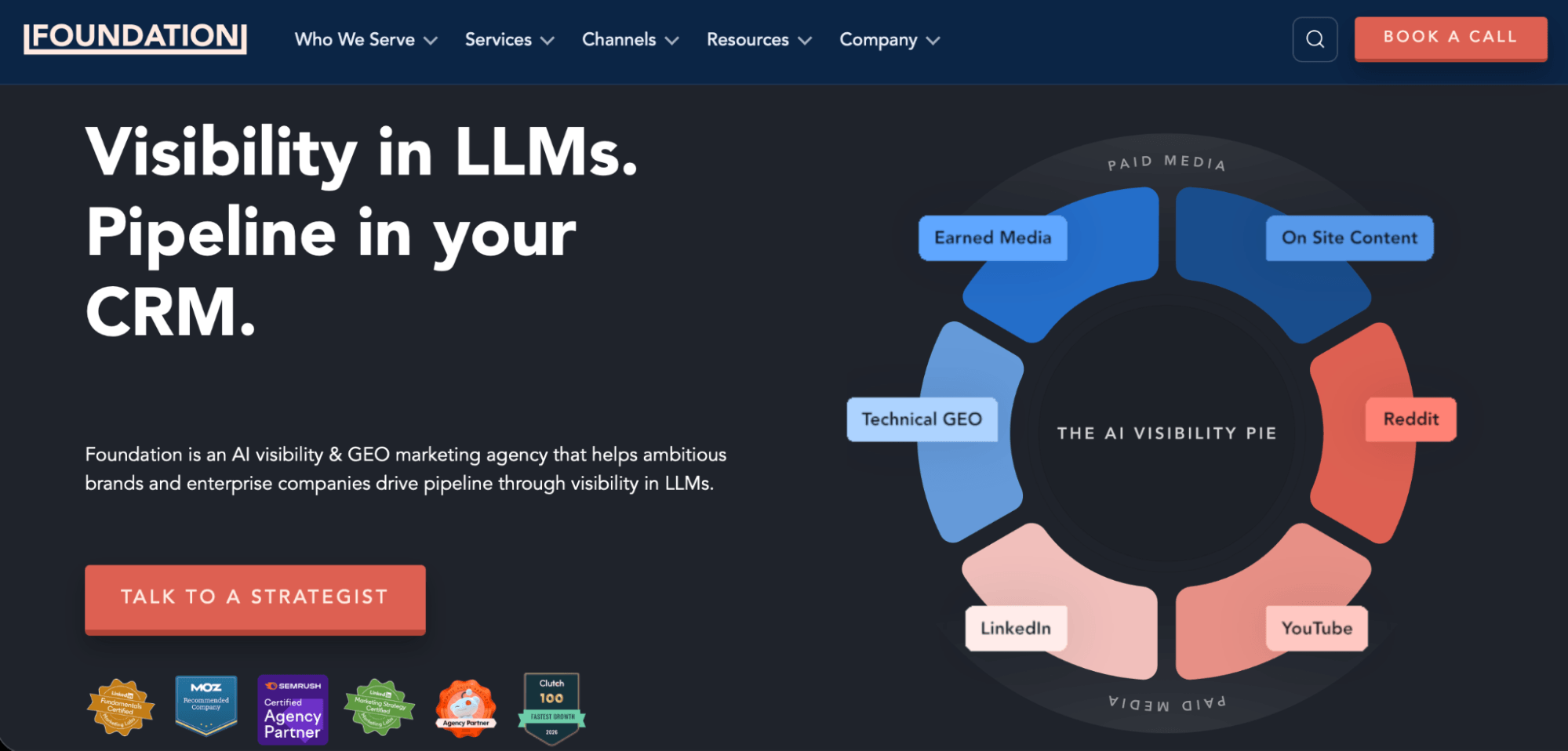
Foundation Marketing leads with distribution, and its operating model is named for it: D.R.E.A.M., or “Distribution Rules Everything Around Me”. Its GEO service covers content analysis, GEO content strategy, and AI-focused brand and content distribution. It also runs query fan-out research, which maps the follow-up searches an AI engine runs behind a single prompt.
For Bitly, Foundation reports that the brand’s citation share for link shorteners grew to 11.7% over 12 months, nearly double the next competitor’s. It focuses on B2B tech: SaaS, AI companies, martech, cybersecurity, and developer tools. Work runs as an ongoing AI visibility retainer or a channel-by-channel roadmap.
3. Omniscient Digital
Omniscient Digital is an organic growth agency for B2B software companies, and it sells GEO as answer engine optimization. Its AEO service aims to get a brand discovered, described accurately, cited, and recommended in AI conversations. In-house software pulls in customer and market data to guide the content. The same team also runs content production, digital PR, and technical SEO.
For Convert, an A/B testing platform, Omniscient reports 81% growth in LLM visibility and 140% growth in AI citation share in 60 days, tracked with Peec AI. Its client list includes Jasper, SAP, Loom, and Hotjar, and full-service programs are priced annually.
4. Skale
Skale calls itself an AI search-first organic growth agency for tech and SaaS brands. Its GEO service tracks leading and lagging indicators weekly, tying visibility in AI answers to revenue.
For deBridge, a DeFi bridge, Skale reports a 133% quarter-over-quarter rise in AI brand mentions from December 2025 to February 2026. Over those 90 days, deBridge’s gap to the category leader narrowed from 17 percentage points to six. Skale doesn’t publish pricing.
5. SearchTides
SearchTides, founded in 2013, now calls itself an AEO and AI visibility agency. Every client program starts with Profound data, and clients get weekly and monthly reports on visibility, competitors, and citations. New clients can start with a one-time sprint that maps how AI systems describe the brand.
The hat brand melin was already a top AI recommendation when it hired SearchTides in late 2025. In five months, SearchTides reports a 60% increase in citation share and a 315% increase in sales attributed to AI tools. Its typical clients include financial services, SaaS, marketplace, and e-commerce brands.
6. Growth Marketing Pro
Growth Marketing Pro works with fast-growing tech companies and runs SEO, GEO, Reddit, and paid media under one roof. Its GEO work starts with prompt research and tracks visibility in ChatGPT, Claude, and Google AI Overviews. Its case studies cite AthenaHQ for mention and citation tracking.
For Bonfire Ventures, a venture capital firm, Growth Marketing Pro reports AI share of voice growing from 0% to 16% within seven months. The base was small: AI platforms sent Bonfire about 20 visits a month at the start and more than 200 by the end. Pricing isn’t published.
7. Digital Elevator
Digital Elevator sells AI visibility as two fixed-scope, 90-day sprints built on three pillars: technical setup, content extractability, and off-site signals. The technical work covers schema implementation, a JSON-LD entity graph, an llms.txt file, and access for AI crawlers. The measurement work sets up GA4 tracking for AI-referred sessions. It also runs local SEO and CRO for the same lean in-house teams.
For BMG Labtech, a lab equipment maker, Digital Elevator reports 125 new citations in Google’s AI Overviews after one year. Its clients cluster in healthcare and life sciences, biotech, medtech, B2B SaaS, and ecommerce. Sprints carry a fixed price set by complexity, and managed AEO and SEO run as monthly retainers.
8. Orbit Labs
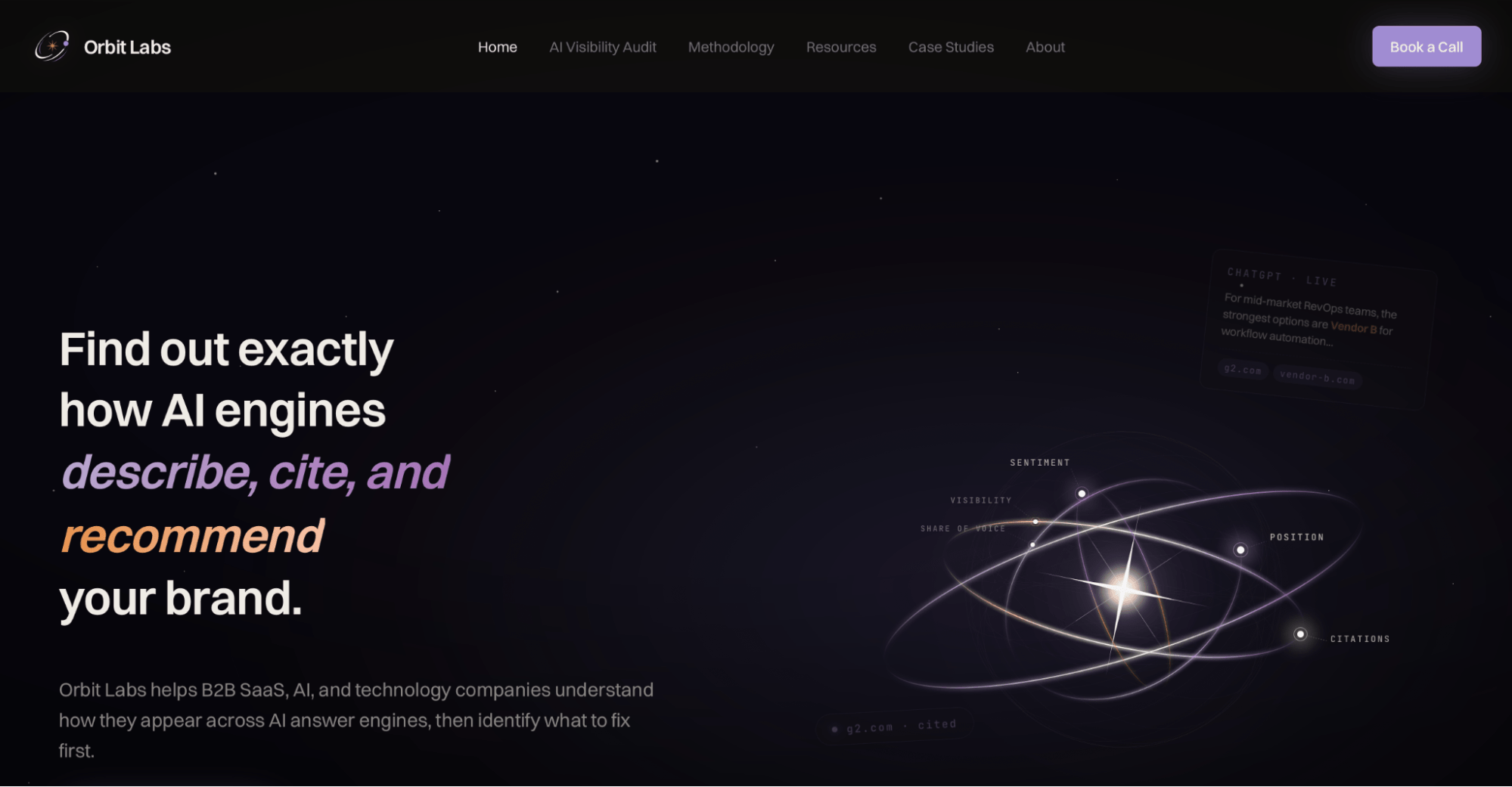
Orbit Labs is a young AI visibility and GEO agency for B2B SaaS and AI companies, founded in 2024. It tracks mention rate, citation rate, share of voice, sentiment, and average position weekly against a locked baseline. Its entry offer is an AI visibility audit with a 90-day roadmap.
For Grow Big Ventures, Orbit Labs reports AI visibility rising from 1% to 15% in 90 days. For Investor Signals, it rose from 2% to 24% in under four months. Orbit Labs doesn’t publish pricing.
9. Intero Digital
Intero Digital runs GEO through Intero GRO™, its Generative Response Optimization® framework. Every GEO program starts with a diagnostic of how AI platforms currently describe the brand. The work then covers entity optimization, structured data, digital PR, and citation monitoring through Profound. Its patented InteroBOT® crawler, which mimics the crawlers search engines use, supports the technical SEO side.
For Global Industrial, an industrial equipment distributor, Intero reports 1,200+ Google AI Overview appearances year over year, up from none. Organic revenue rose 24%. Intero is a full-service agency that also runs paid media, and it lists retail, manufacturing, home services, and e-commerce among a dozen GEO industries. It doesn’t publish GEO pricing and offers a free GEO audit to start.
10. Siege Media
Siege Media started in content marketing and now calls itself a full-service GEO agency. Its GEO service pairs proprietary research for publisher coverage with the comparison and pricing pages AI answers quote. Affiliate partnerships also place clients on the review sites AI leans on.
BlueprintIQ, an in-house tool, maps citations prompt by prompt and sets a baseline LLM share of voice, and DataFlywheel refreshes pages at least quarterly. Siege reports LLM share of voice monthly to every client, and its founder, Ross Hudgens, wrote a book on generative engine optimization for Wiley.
Its clearest published result is for Mentimeter, where ChatGPT accounted for 124,000 sessions over six months, and 555 keywords appeared in AI Overviews. Siege works mainly with SaaS, fintech, e-commerce, and health brands, and it doesn’t publish pricing.
11. Directive
Directive is a B2B marketing agency that’s been in business since 2013. Its GEO service structures content to be referenced in ChatGPT, Perplexity, and Google’s AI answers, and its DiscoverabilityOS framework targets the places B2B customers research and shortlist vendors. Stratos, Directive’s AI intelligence platform, reports performance across channels, which is why it suits teams that answer to a revenue number.
Case Status, which sells software to legal professionals, started with no presence in AI answers. Within nine months, Directive reports, it held a leading position across 39+ tracked prompts, and organic sessions rose 19% quarter over quarter. The same page reports demo bookings 20% above forecast, though it doesn’t say how much of that came from AI search. Directive doesn’t publish pricing, and new clients start with an audit.
12. Single Grain
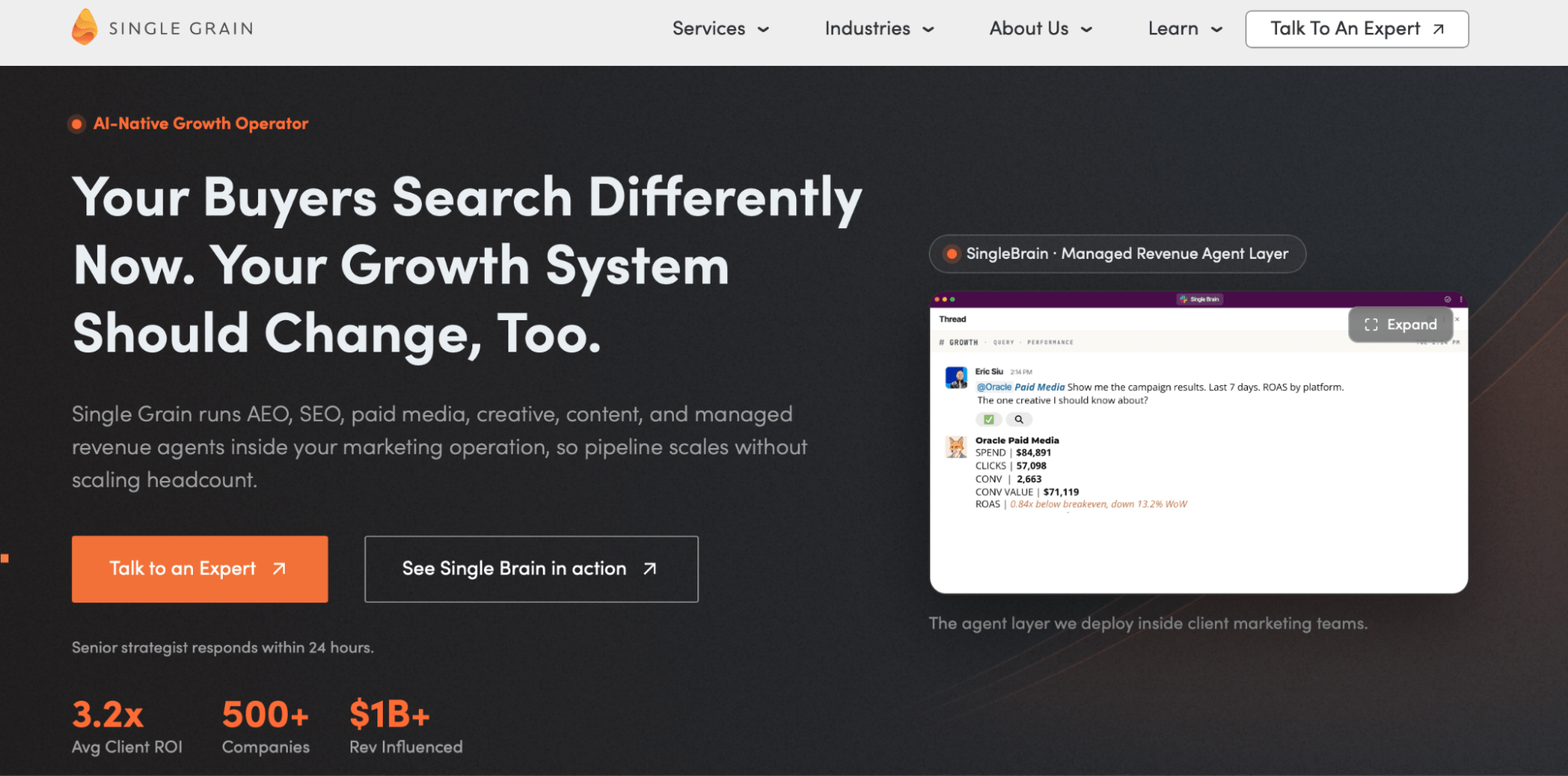
Single Grain bills itself as a B2B digital marketing agency for SaaS. It runs AEO, SEO, paid media, creative, and content under one team, and it also sells its own marketing software. Its GEO service tracks share of answer, citations, and brand mentions across AI platforms. Dashboards tie that visibility to traffic, leads, and revenue.
For SmartRent, a smart-home technology company, Single Grain reports 136 new AI citations within 30 days. For LS Building Products, it reports more than 400 new AI citations after 12 months. It doesn’t publish pricing.
Partner With a GEO Agency That Earns Citations With Original Research
Every agency on this list has a credible claim to a corner of GEO. The right one depends on whether you need research, distribution, technical depth, or tracking.
What separates them is the evidence. Pick the agency whose published results match the metric you care about, and hold it to the same measure once you sign. At Fractl, that measure is citations earned through original research and high-authority coverage, tracked across search, social, and AI answers.
Reach out to see how Fractl would build your brand’s AI visibility.
FAQ
How is GEO different from SEO?
SEO wins a position in a list of links. GEO wins a mention inside the answers that tools like ChatGPT and Google AI Overviews write. Each of those AI answers may cite only a handful of sources.
GEO and SEO share a foundation, since AI search engines pull many of their sources from live search. But our research on 11,573 AI answers shows that only 26% of AI citations come from a domain on Google’s first page. Most of the rest (73%) come from outside the top 10 entirely: Reddit threads, YouTube videos, and niche sites that get cited without ranking.
 SEO |  GEO | |
|---|---|---|
| Goal | Rank a page in search results | Get the brand cited or recommended in AI answers |
| Where it appears | Blue links, featured snippets, and knowledge panels | ChatGPT, Perplexity, Gemini, Claude, Google AI Overviews, and AI Mode |
| What earns it | Relevance, link building, and technical health | Brand mentions on the sites AI cites, topical authority, and a content structure AI can quote |
| How you measure it | Rankings, clicks, and organic traffic | Citations, AI mentions, AI share of voice, and AI-referred traffic |
How do you measure AI citation success?
Ask any GEO agency which of these its AI visibility tracking reports, because each one answers a different question:
| Metric | What it tells you | Watch out for |
|---|---|---|
| AI citations | How often an AI answer links your page as a source | An AI answer can cite your page and still recommend a competitor first |
| AI mentions | How often AI answers name your brand, with or without a link | Brands with common-word names pick up false matches |
| AI share of voice | Your share of mentions against competitors across a fixed set of prompts | The prompt set decides the result, so ask to see it |
| AI Overview appearances | How many Google AI Overviews include your brand or page | Counts move when Google changes how it extracts answers |
| AI-referred traffic | Visits that arrive from ChatGPT, Perplexity, and similar tools | Answers that name you without sending a click never show up in traffic |
A 315% rise in AI-attributed sales and 125 new AI Overview citations, both from agencies on this list, measure different steps between being seen and being chosen. Ask for the same metric across every agency you shortlist, measured on a fixed prompt set over a stated timeframe.
How much does a GEO agency cost?
Three agencies on this list publish starting prices for GEO work:
- Omniscient Digital. Full-service programs start at $120,000 a year.
- Digital Elevator. Its AI visibility program starts at $3,000, and managed AEO and SEO start at $3,500 a month.
- SearchTides. Its one-time AI Undercurrent Sprint costs $45,000.
At Fractl, generative engine optimization services run $5,000 to $50,000 or more a month. Budget depends on campaign scope and competitiveness, not company size:
| Program scope | Monthly budget | What it covers |
|---|---|---|
| Lower-scope or opportunistic | $5,000 to $10,000 | Existing brand stories, limited content creation, and targeted outreach |
| Mid-range | $10,000 to $35,000 | Multiple campaign types, consistent outreach, and moderate content development |
| Full-service or high-competition | $50,000 or more | Original research, multichannel execution, and ongoing campaign production |
The results we list from the agencies compared here took between 30 days and 12 months. At Fractl, a large original research campaign takes three to four months from kickoff to coverage, so budget for at least two quarters before judging a program.
What should you ask a GEO agency before you sign?
Put these questions to any generative engine optimization agency on your shortlist:
- Can you show me citation results for a named client? Ask for the client, the metric, the starting point, and the timeframe.
- What do you track, and with which tool? Get the prompt set and the platforms covered in writing.
- How do you earn brand mentions off our site? On-page fixes help AI read a page, and a strong backlink profile helps it rank, but mentions on trusted publishers decide whether AI names you.
- Which of this work does our SEO team already do? Some GEO work, like schema markup and AI crawler access, is technical SEO. Ask which tasks are new so you don’t pay an agency for work your team already handles.
What is generative engine optimization?
Generative engine optimization (GEO) means earning citations and mentions for your brand inside AI-generated answers from tools like ChatGPT, Perplexity, Gemini, and Google AI Overviews. It combines answer-first content, structured data, and earned authority from coverage on sites AI trusts.
What is the difference between GEO and AEO?
Very little in practice. Answer engine optimization (AEO) started with the featured snippet and voice answers, while GEO describes AI-generated answers. On this list, Omniscient Digital and SearchTides sell the service as AEO, and most of the others call it GEO. Some firms use a third label and call themselves an AI SEO agency.
How do you get cited in ChatGPT?
Get written about on the sites ChatGPT cites for your category, such as industry publications, review sites, and forums. Then publish clear pages that answer the questions your customers ask. ChatGPT leans on independent reviews and comparison sites more than brand-owned pages.
How long does GEO take to show results?
The published results on this list took between 30 days and 12 months. Plan for at least two quarters, since earned coverage takes time to build and AI platforms take time to pick it up.
Can your SEO team handle GEO in-house?
It can handle the technical side, like schema markup and AI crawler access. The harder part is earning brand mentions on the publishers AI trusts, which takes digital PR and original research on top of SEO.