




Table of Contents
- Consumers are using AI more, but trusting it less
- AI is accelerating marketing, but eroding quality and trust
- The 2026 playbook
- AI rewards brand equity. It doesn't create it.
A year ago, 82% of consumers said AI was more helpful than traditional search. Today, that number is 54%.
The same survey that captured the AI honeymoon in 2025 just captured the hangover. Consumer trust is fracturing, marketer pressure is hitting operational territory, and the playbook everyone built last year (chasing rankings, then chasing AI Overviews) is already showing its limits.
To understand where things actually stand, Fractl surveyed 1,008 U.S. consumers and 150 marketers in Q2 2026. The data isn’t a vibe check. It’s a year-over-year measurement against the same questions we asked in 2025, plus a deeper read on what consumers want labeled, what marketers are monitoring, and where brand visibility is actually growing.
Search isn’t a platform. It’s a behavior. And SEO isn’t dying; it’s expanding into surfaces most brands still aren’t optimizing for.
Here’s what 21 takeaways from the new research tell us about the year ahead.
Consumers are using AI more, but trusting it less
1. Adoption is not the problem.
70% of consumers say their AI use for search has increased over the past year. Only 4% have never used AI tools for search at all.
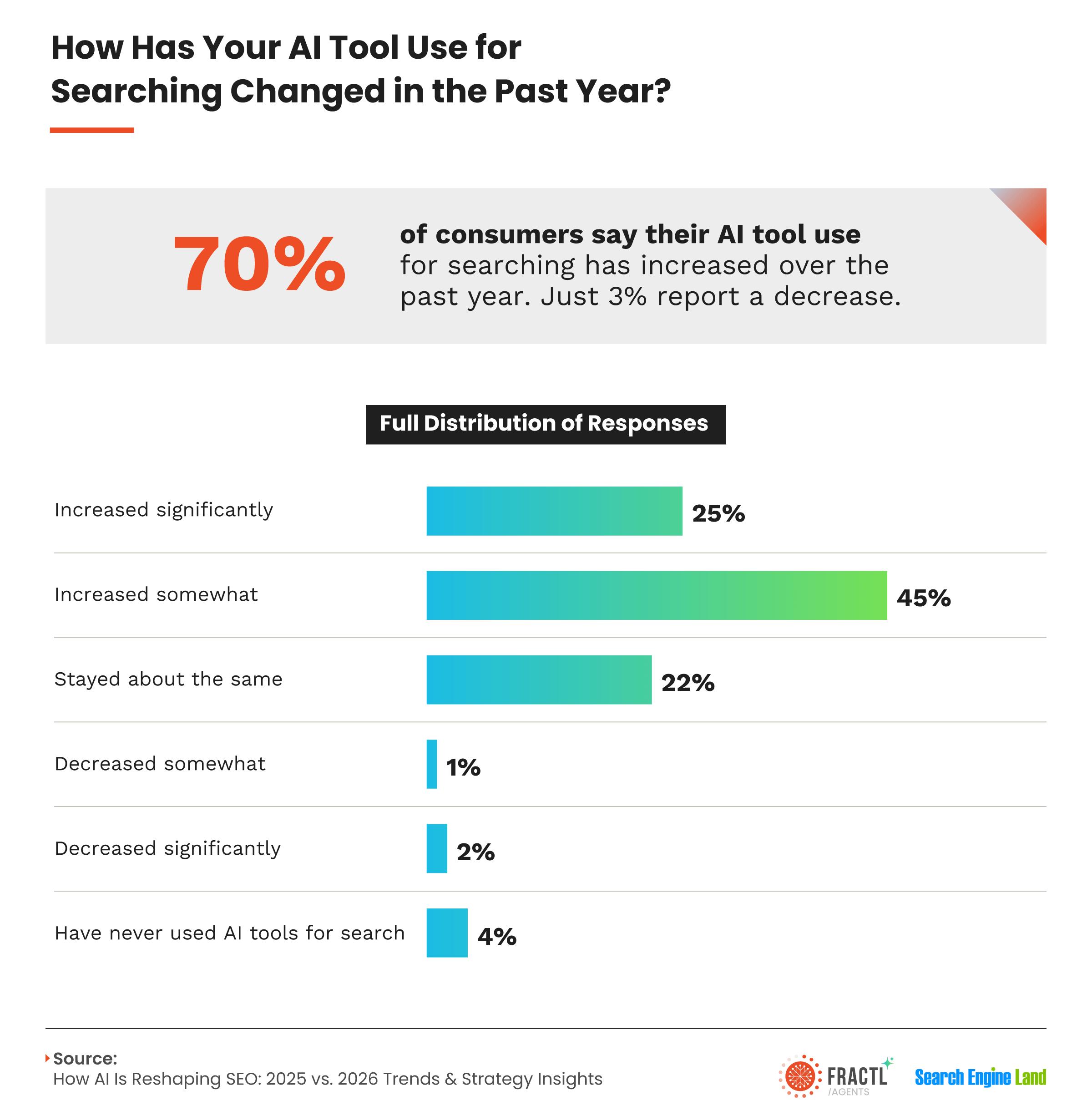
The adoption ceiling is gone. 25% report significantly more use, 45% somewhat more, and just 3% report a decrease. Whatever happens next in the search market, it’s happening on a saturated user base.
The interesting question isn’t whether consumers are using AI. It’s what they think when they do.
2. Consumer sentiment is eroding fast.
In 2025, 82% of consumers found AI more helpful than traditional search. In 2026, that number is 54%. A 28-point drop in twelve months.
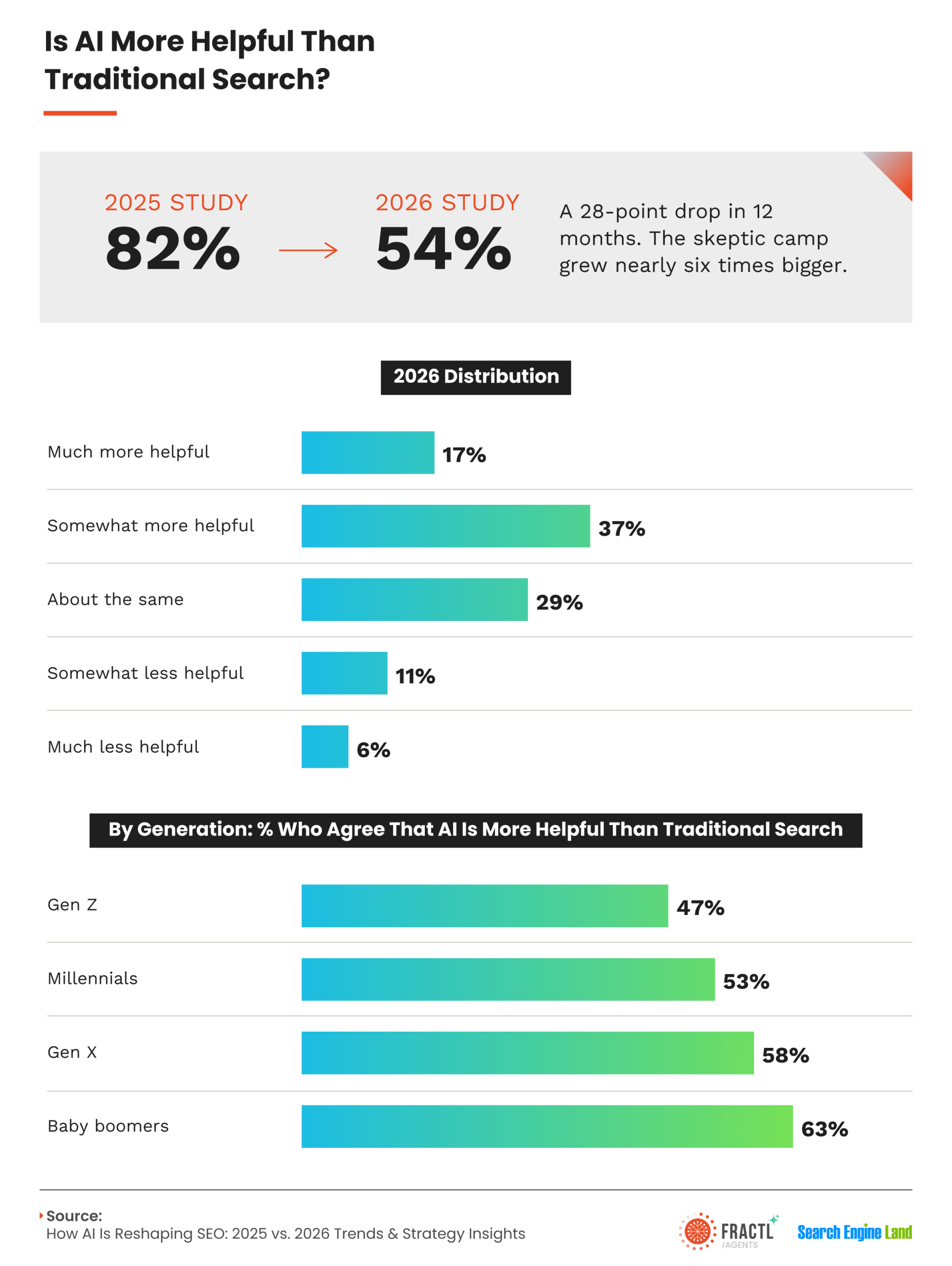
The skeptic camp (consumers who actively rate AI less helpful than search) grew from 3% to 17%. Nearly six times bigger.
The most counterintuitive cut: Baby Boomers (63%) are now more likely than Gen Z (47%) to find AI more helpful. The audience with the most exposure is the most disillusioned.
3. AI use isn’t a risk. AI slop is.
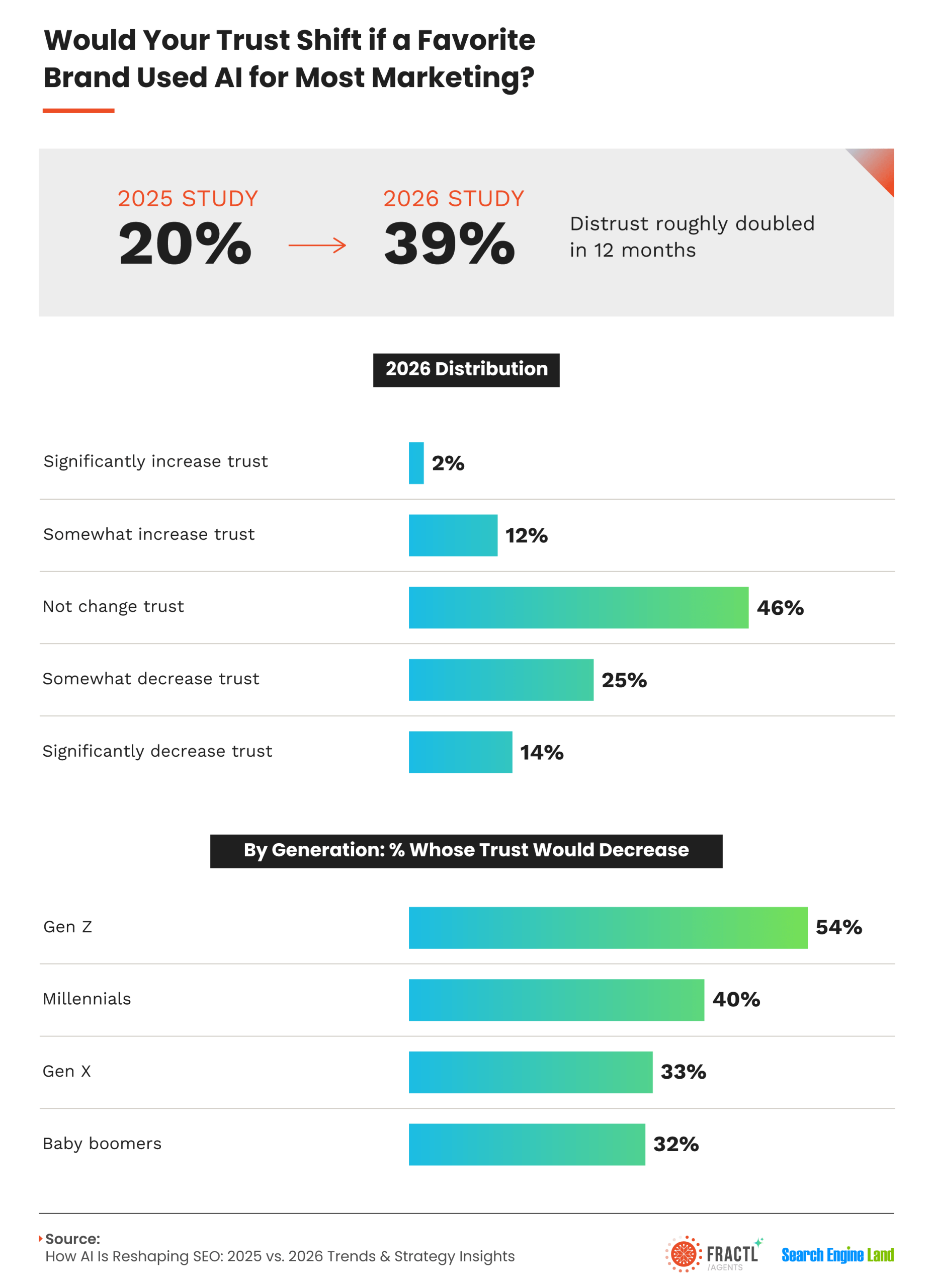
In 2025, only 20% of consumers said heavy AI use would decrease their trust in a favorite brand. In 2026, that number is 40%. Distrust roughly doubled in twelve months.
14% say their trust would decrease significantly. That strongly-negative camp alone is now larger than the entire negative camp was a year ago. Only 14% would trust a brand more for using AI heavily.
Heavy AI adoption is no longer a signal of innovation. It’s a brand-trust liability.
4. The most AI-native audience has the highest standards.
Gen Z penalizes brands the hardest. 54% say their trust would decrease if a favorite brand used AI for most marketing, versus 33% of Gen X and 32% of Baby Boomers. Women penalize more than men (44% vs. 34%).
The pattern is worth sitting with: the audience that grew up alongside AI is the same audience demanding the most from brands that use it. Familiarity hasn’t bred acceptance. It sharpened the bar.
5. Across every format, consumers want AI content labeled.
84% want written AI content labeled. 91% want video labeled. 90% for images. 87% for audio.
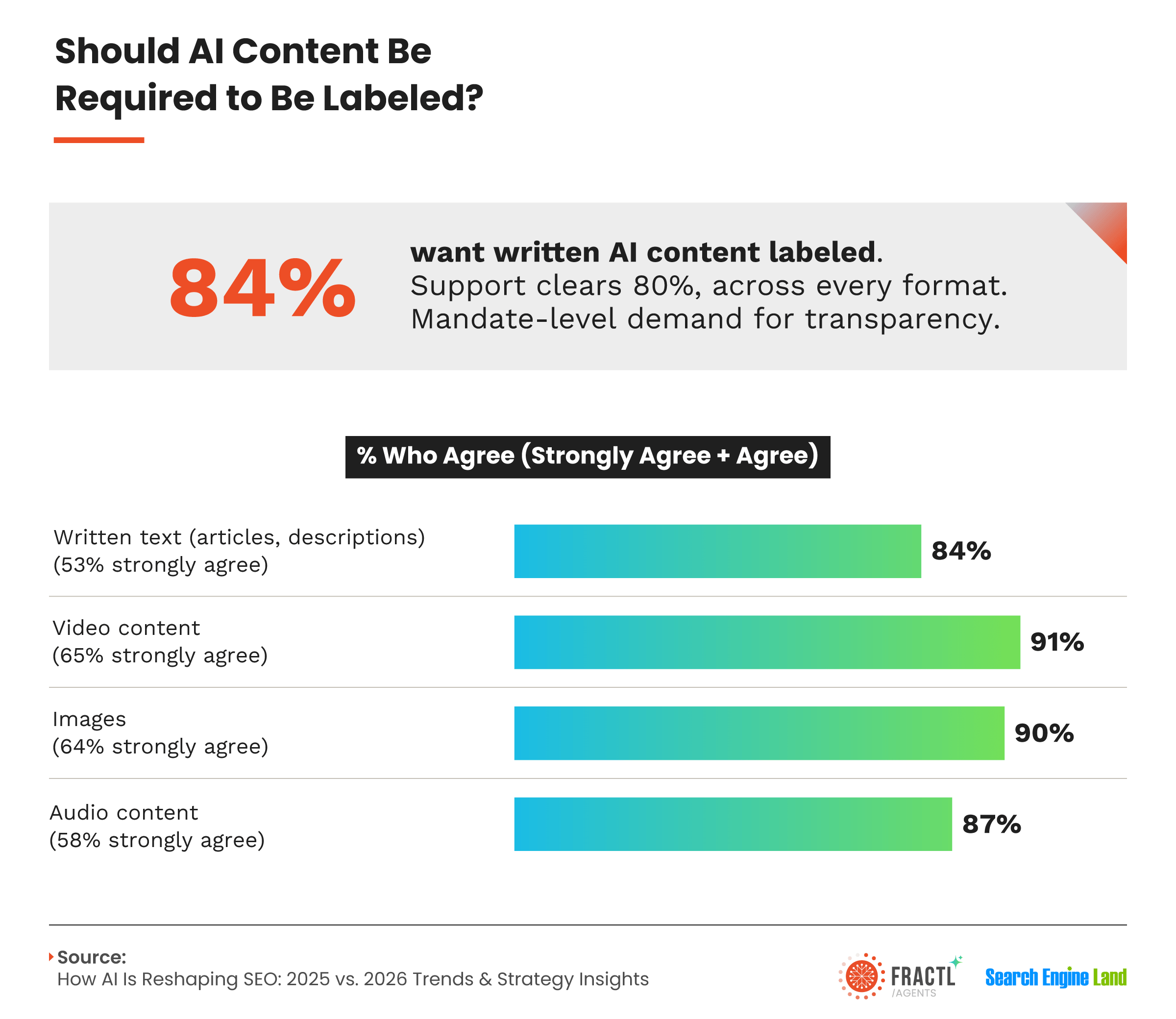
The strongly-agree numbers alone clear 50% across every format. This isn’t a soft preference. It’s a mandate.
Consumers don’t treat labeling as format-specific. They treat it as a universal principle. Brands publishing AI content without disclosure are betting against an 80%+ majority.
6. Consumers expect AI search to win, even when they don’t fully trust it.
64% of consumers agree AI will replace traditional search engines within five years — essentially flat with 66% in 2025.
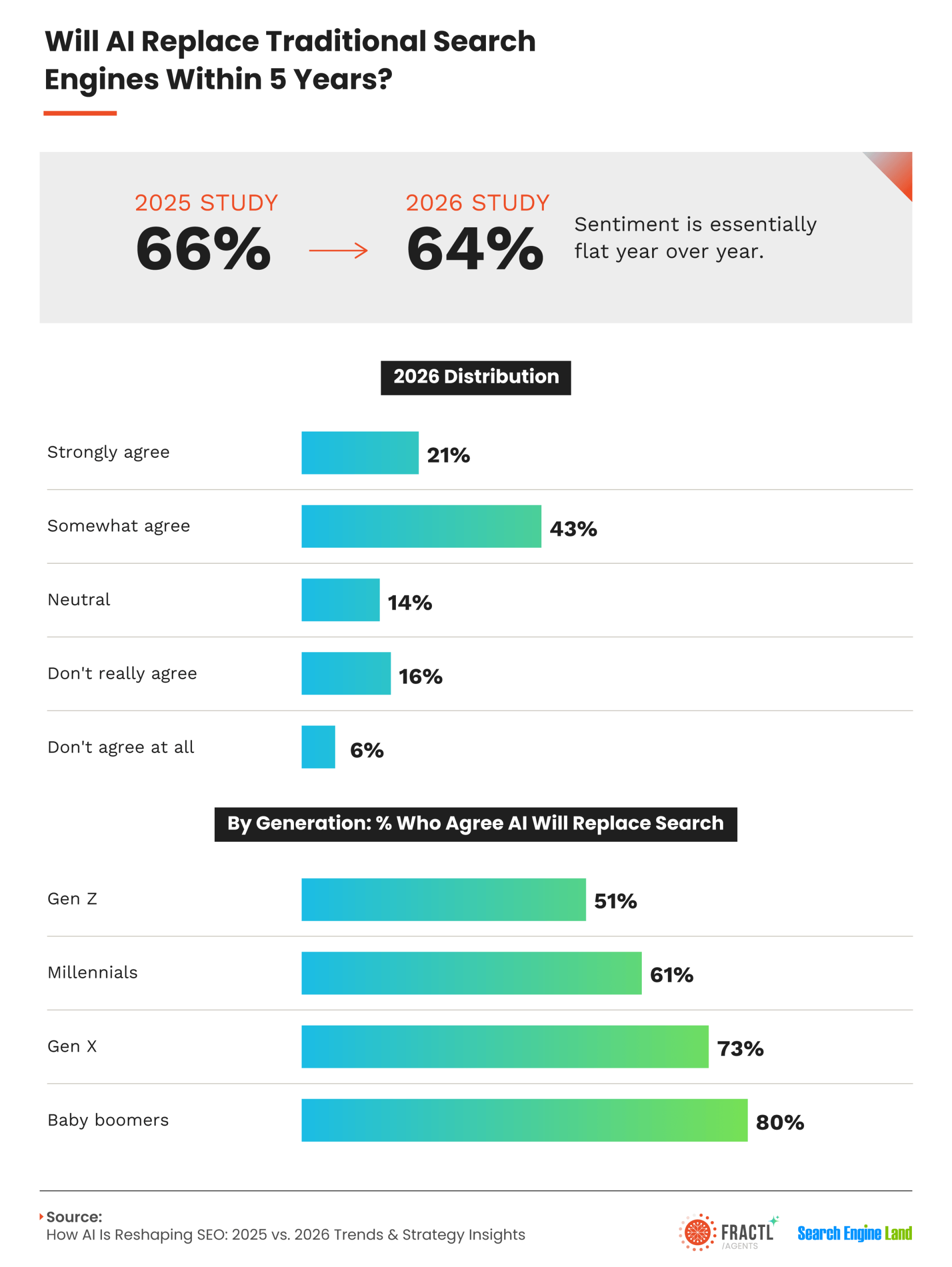
The disruption thesis holds steady even as helpfulness ratings collapse. Consumers expect the future. They just aren’t enjoying what it currently delivers.
The generational read is also worth flagging: 80% of Boomers expect AI to replace search, versus 51% of Gen Z. The least AI-native group is the most convinced of its inevitability.
AI is replacing generic answers, not trusted sources.
7. When money is on the line, Google still wins trust.
Asked who they trust most for product recommendations, consumers gave Google search results 39%.
Reddit (15%) edged out AI tools (14%) for second. Review sites (11%) and friends or family (11%) tied for fourth. AI tools are now an established player but not a trusted one. Google leads AI roughly 3 to 1 for purchase-grade recommendations.
The trust infrastructure consumers built around Google didn’t transfer to AI when AI arrived. It has to be re-earned.
8. Every query has its own trust path.
Google still wins 5 of 6 search categories. Local businesses (74%), product research (58%), travel planning (57%), and health (55%) all default to Google first.
The exception: how-to guides, where YouTube takes the top spot at 50%.
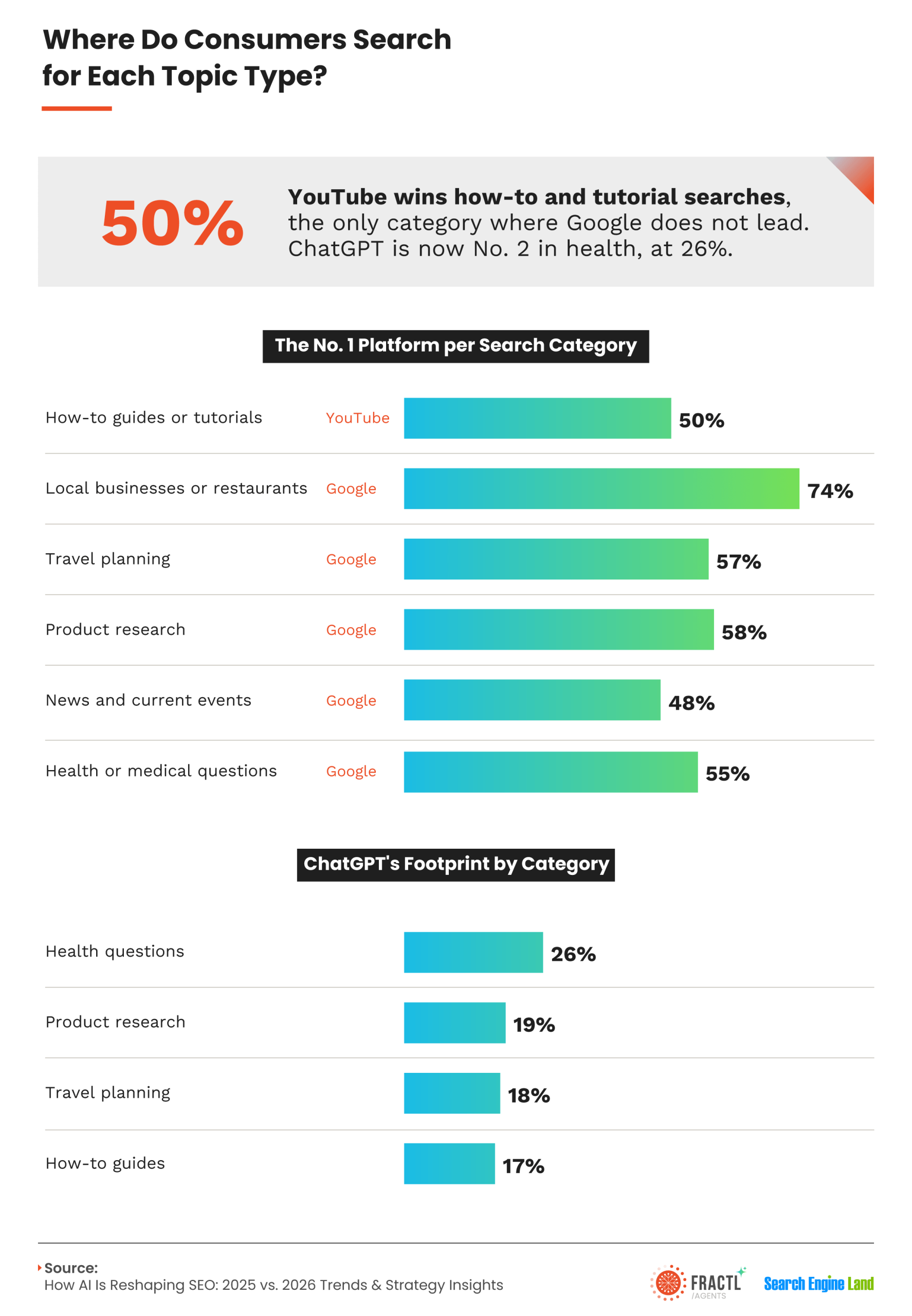
ChatGPT has quietly become the #2 destination for health questions at 26%, ahead of WebMD-class sites. Its other strongest categories: product research (19%), travel (18%), and how-to (17%).
There is no single “AI search” anymore. The platform a consumer trusts depends on what they’re trying to do.
9. Buyers don’t trust one touchpoint anymore.
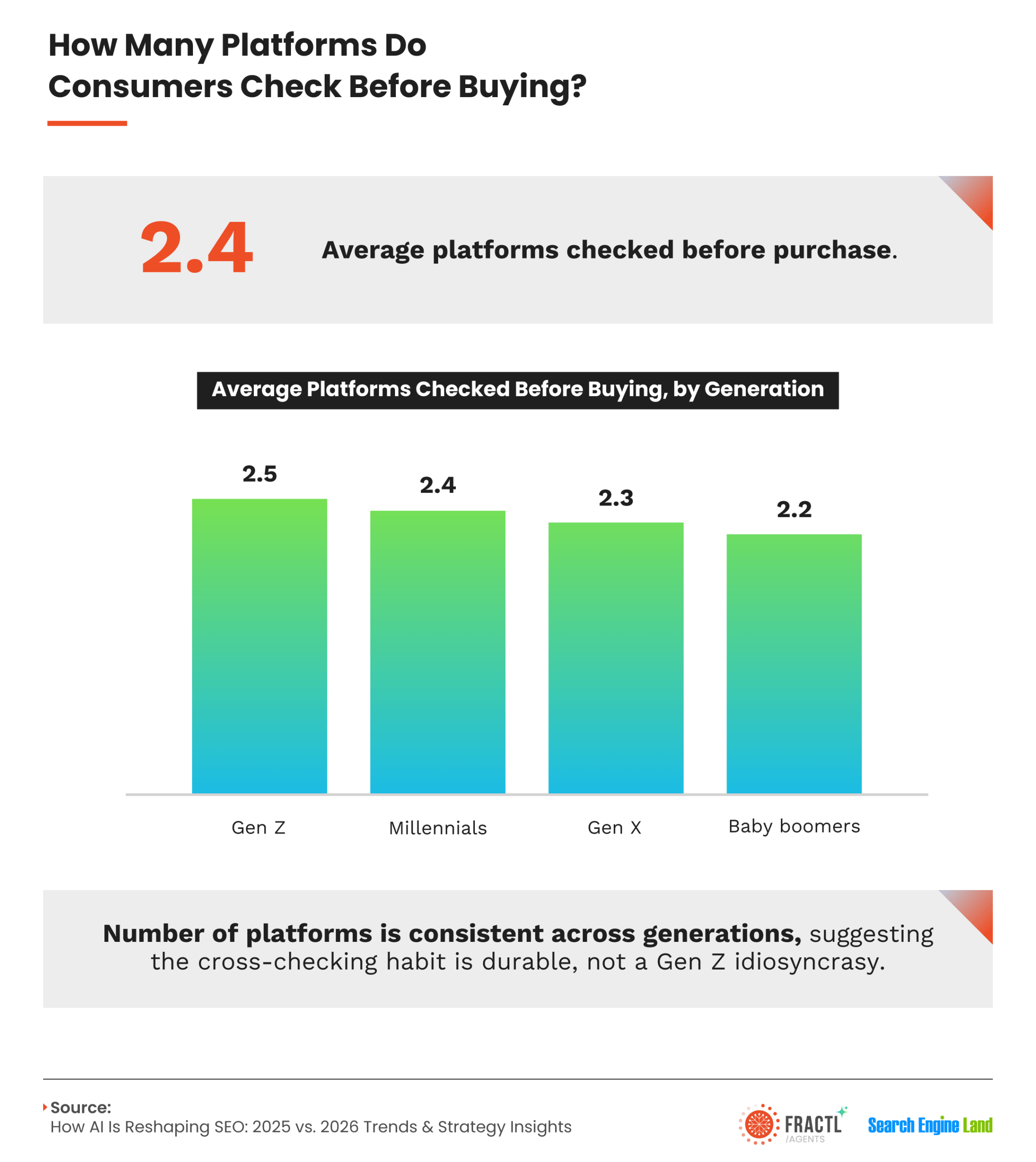
Consumers check an average of 2.4 platforms before a purchase decision.
The cross-checking habit holds steady across generations, with Gen Z checking 2.5 platforms, Millennials 2.4, and Gen Xers 2.3. This isn’t a Gen Z idiosyncrasy. It’s category-wide behavior.
Brands that exist on only one surface are losing decisions they don’t know they’re in.
AI is accelerating marketing, but eroding quality and trust
10. Marketers are trapped in an operational pressure cooker.
53% of marketing work now passes through AI tools, up from approximately 38% in 2025. The shift in twelve months is the equivalent of one full workday per week now running through AI.
59% of marketers say at least half of their work involves AI. 27% say at least three quarters.
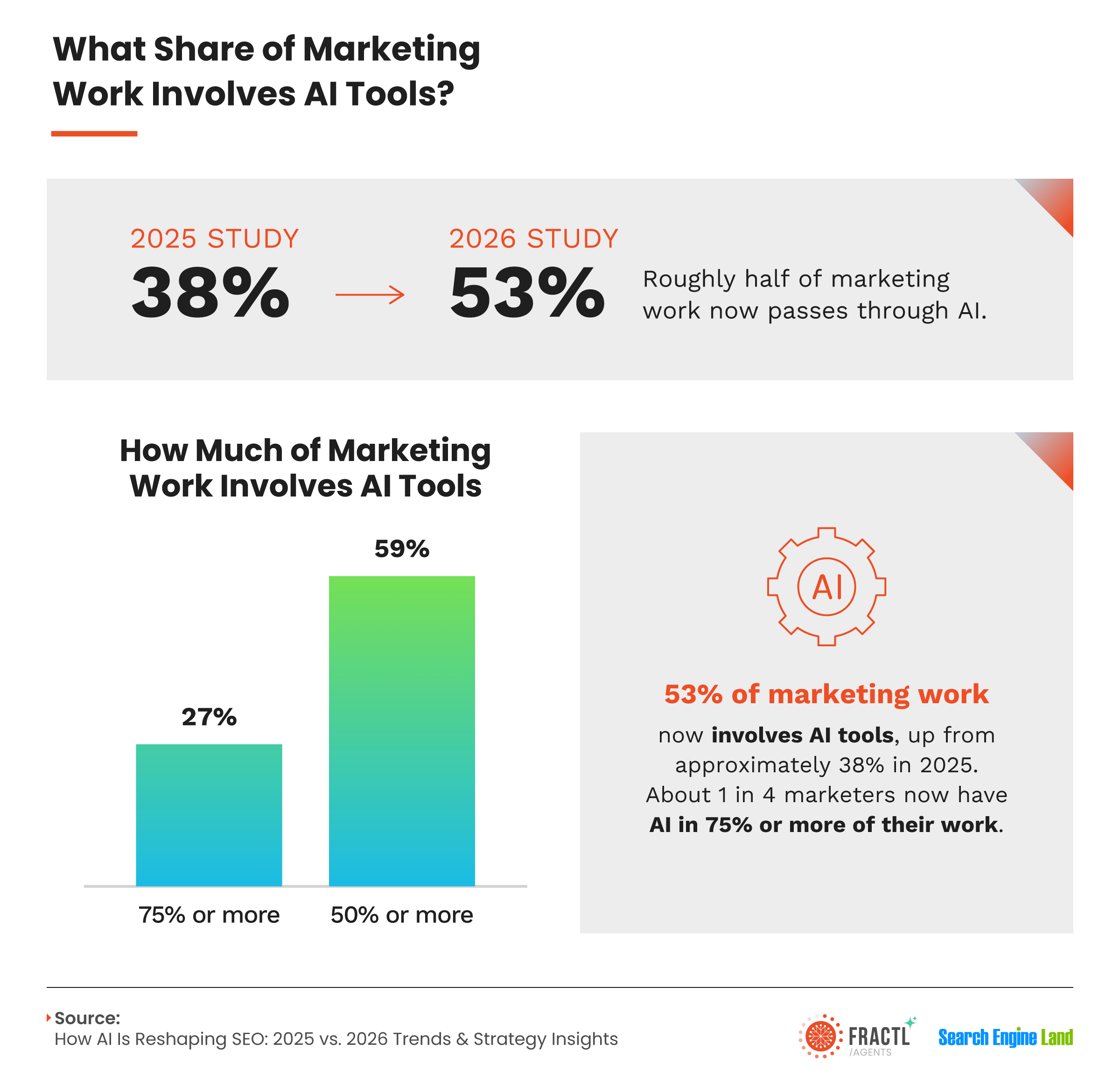
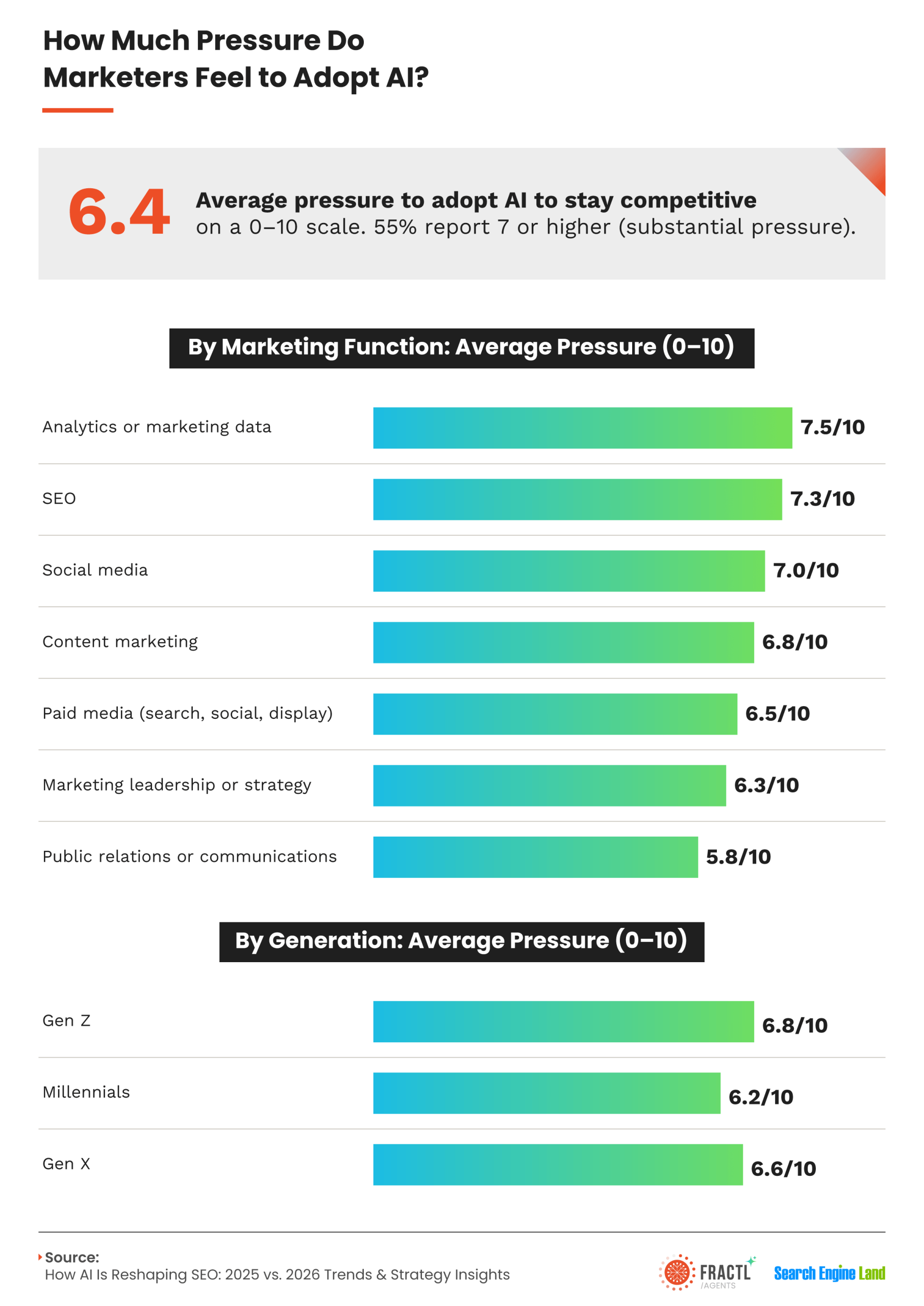
Average pressure to adopt AI sits at 6.4 out of 10, with 55% reporting 7 or higher. AI has crossed from optional tool to baseline expectation. The question isn’t whether marketers use it. It’s whether they can keep up with how fast it’s reshaping the work.
11. The pressure is being felt across every marketing function.
Analytics teams report the highest pressure at 7.5 out of 10. SEO follows at 7.3. Social media at 7.0. Content marketing at 6.8.
The functions closest to algorithmic distribution feel it most. Public relations sits at 5.8, the lowest score and the only major marketing function that doesn’t yet have an AI version of itself.
For now, PR is the negative space in the AI-marketing map. That probably won’t last.
12. Marketers are buying speed at the cost of distinction.
48% of marketers say AI made their work faster but more average in quality.
Only 26% report faster AND better. 7% say quality has actually declined. 13% see no change.
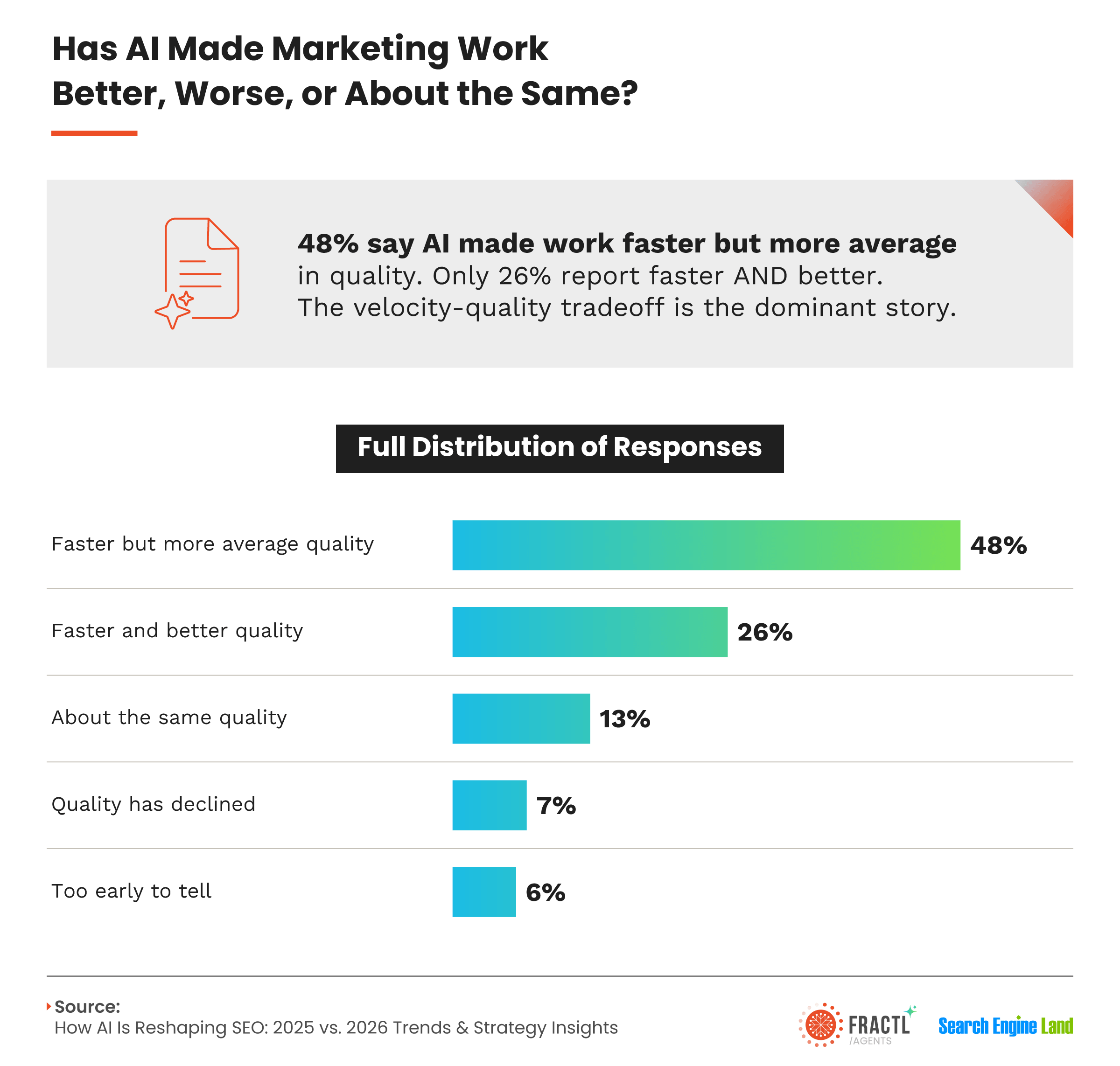
This is the velocity-quality tradeoff that defines 2026 marketing operations. AI isn’t collapsing quality outright. It’s flattening it. Nearly half the field is producing more content at a baseline good-enough bar, and the marketers know it.
13. The human-in-the-loop layer is dangerously thin.
72% of organizations run human editorial review before publishing AI content. That looks reassuring on the surface.
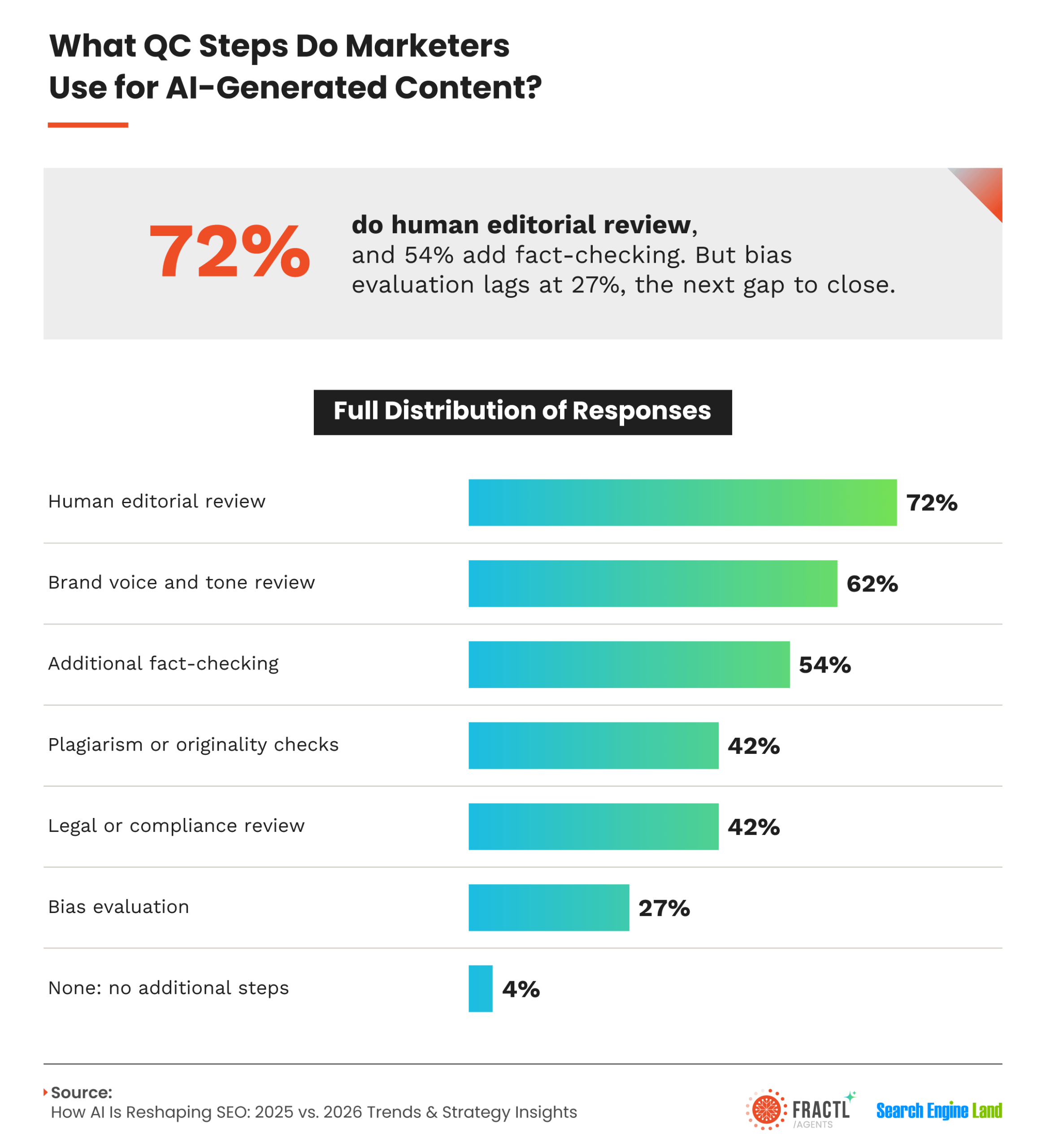
Below the surface, the gaps appear fast: only 54% add fact-checking, 42% add legal or compliance review, and just 27% conduct bias evaluation, the QC step that matters most for trust.
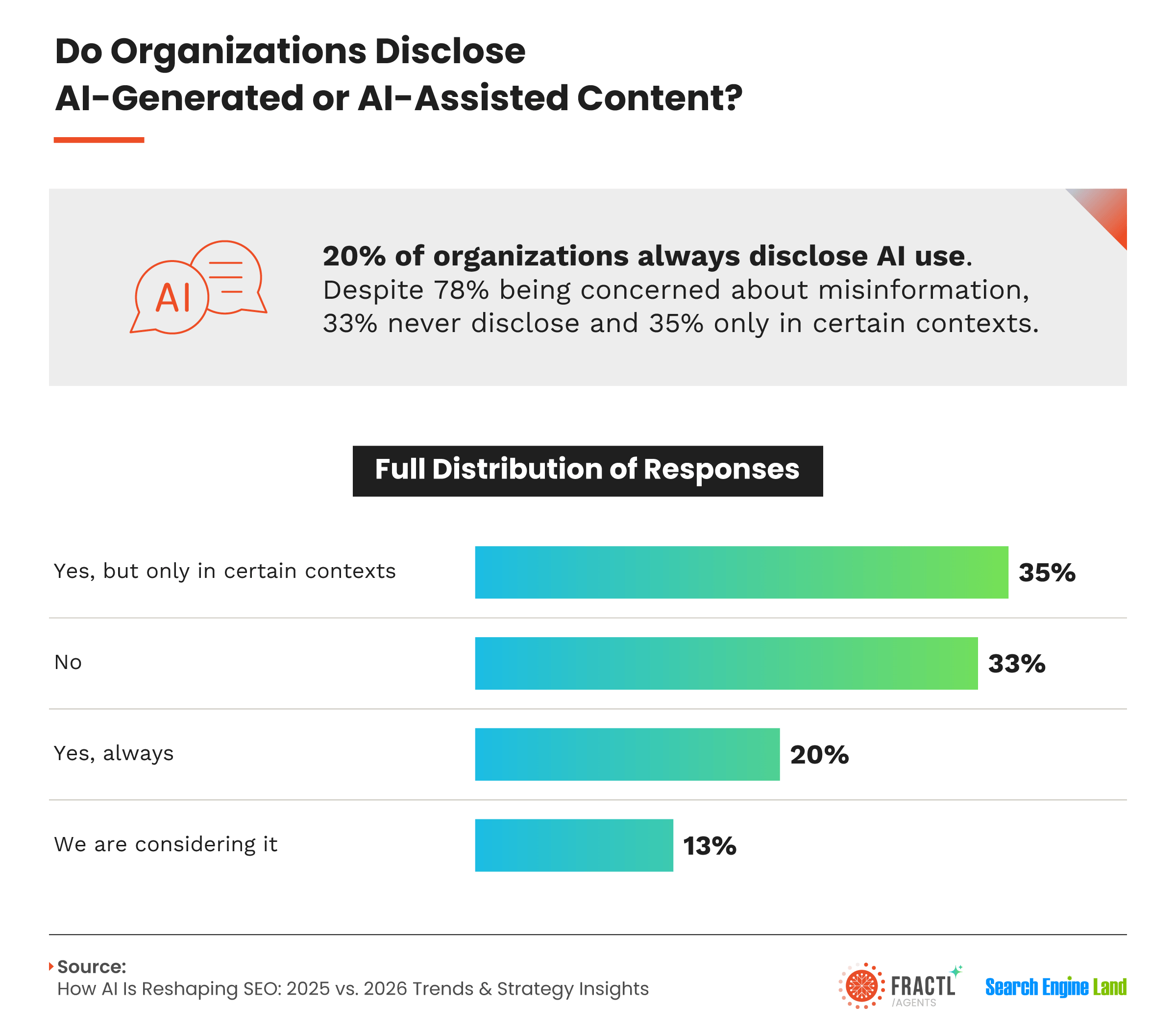
The bigger gap is disclosure. Only 20% of organizations always disclose AI use to their audiences. 33% never disclose at all. Set that against the 84–91% of consumers who want labeling required, and the supply-demand math is brutal.
14. The biggest PR risk is an AI answer you didn’t write.
27% of marketers say their brand has been inaccurately described or misrepresented in an AI-generated response. 14% say an AI inaccuracy has impacted a real customer relationship, sale, or PR situation.
The business cost is no longer hypothetical.
Yet only 24% of organizations have a formal documented monitoring process for AI brand mentions. 31% have had their legal or compliance team review their AI exposure.
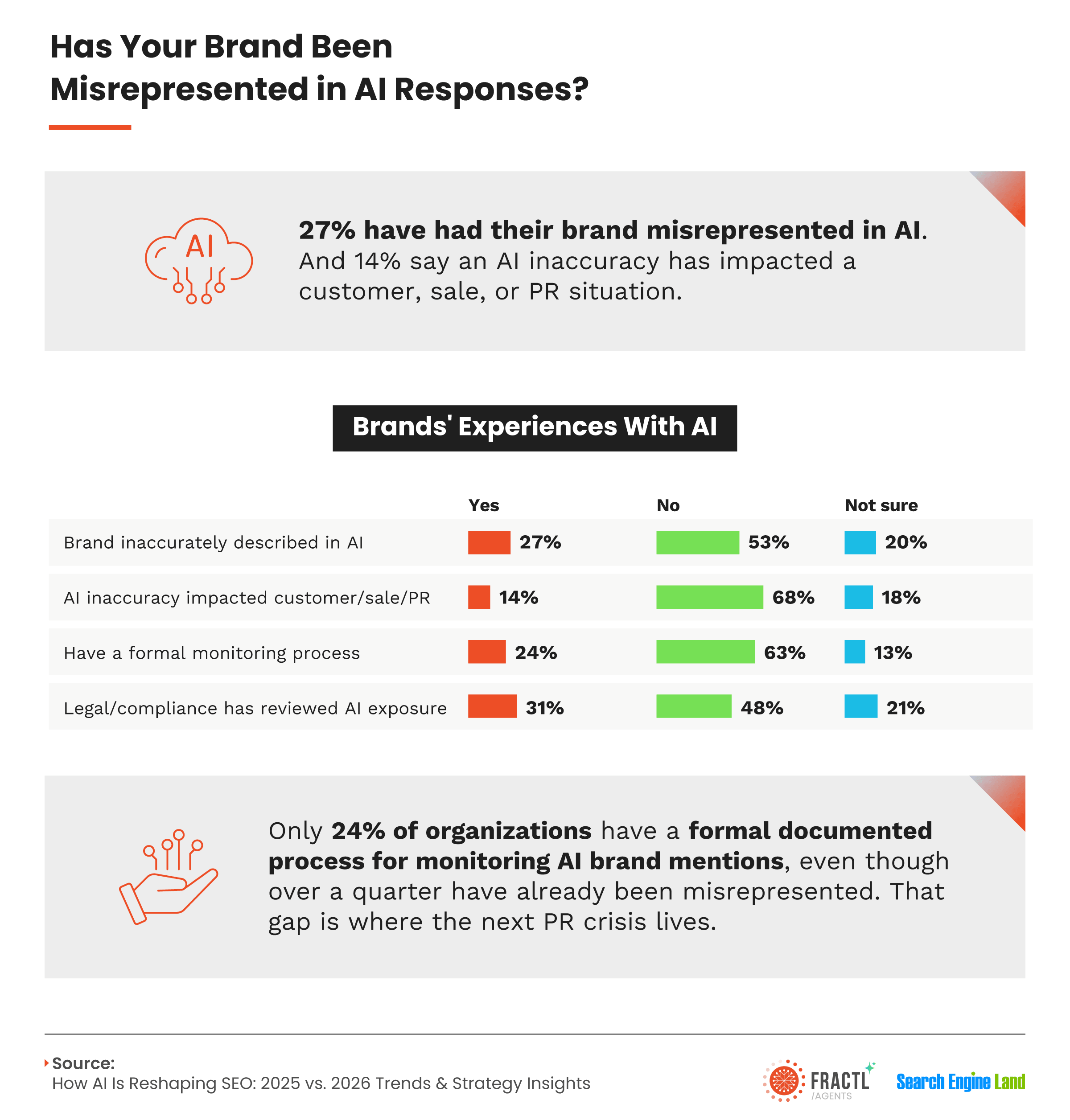
More than a quarter of brands have been misrepresented. Less than a quarter have a process for catching it. The exposure-to-readiness gap is where the next PR crisis lives.
15. AI visibility moved from curiosity to necessity.
49% of marketers now actively monitor LLM impact on brand visibility — up from 22% in 2025. The share more than doubled in twelve months.
Including marketers planning to monitor, 82% have LLM brand visibility on their radar in some form. Only 14% have written it off.
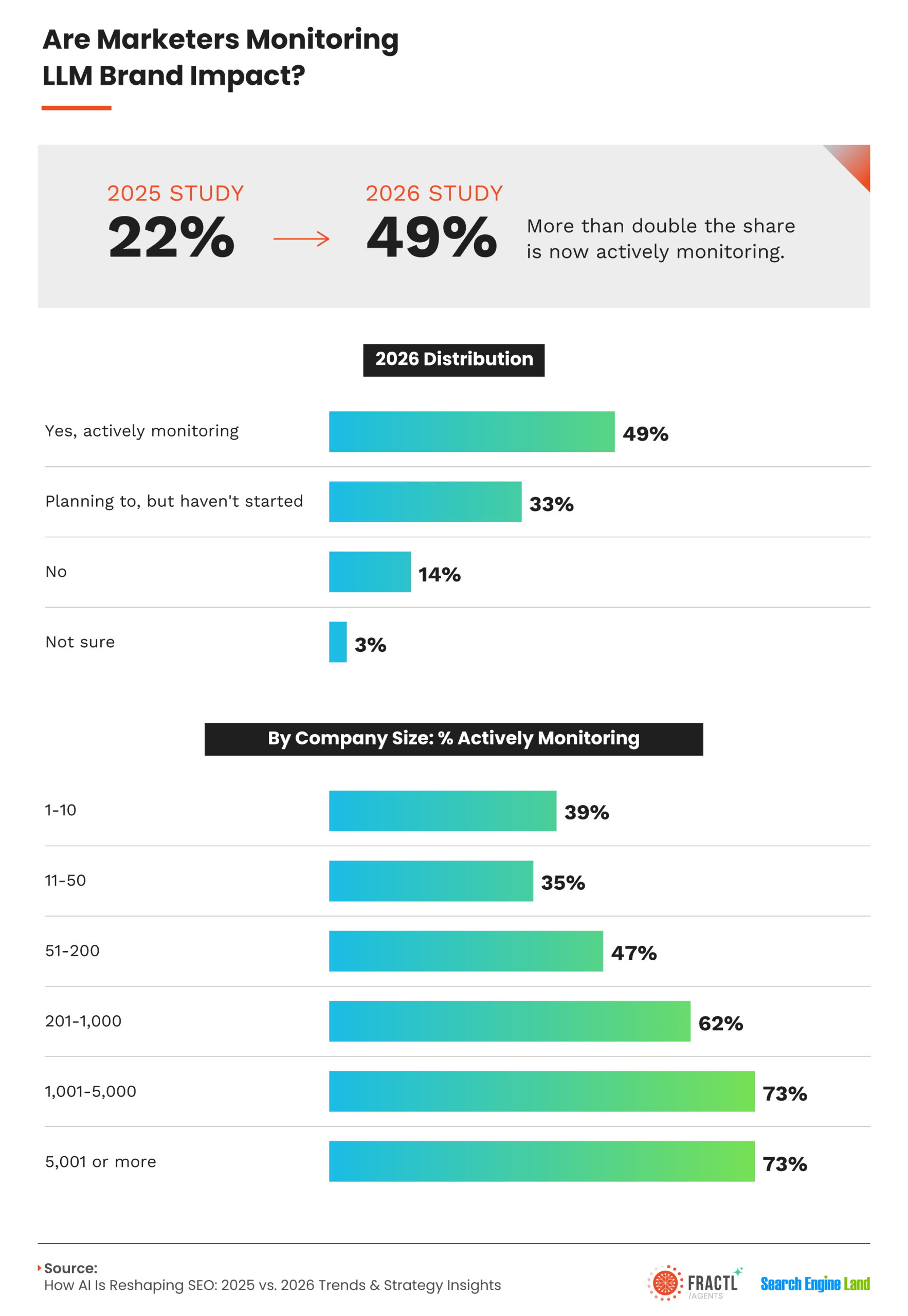
The shift is steepest at scale: 73% of marketers at companies with 1,000+ employees actively monitor, versus 39% at companies of 10 or fewer. The largest teams are formalizing the practice first. Smaller teams have the same exposure with less tooling to track it.
The 2026 playbook
16. Organic visibility is under pressure, not dead.
50% of marketers report decreased organic traffic since AI Overviews launched. 41% slight decrease, 9% significant.
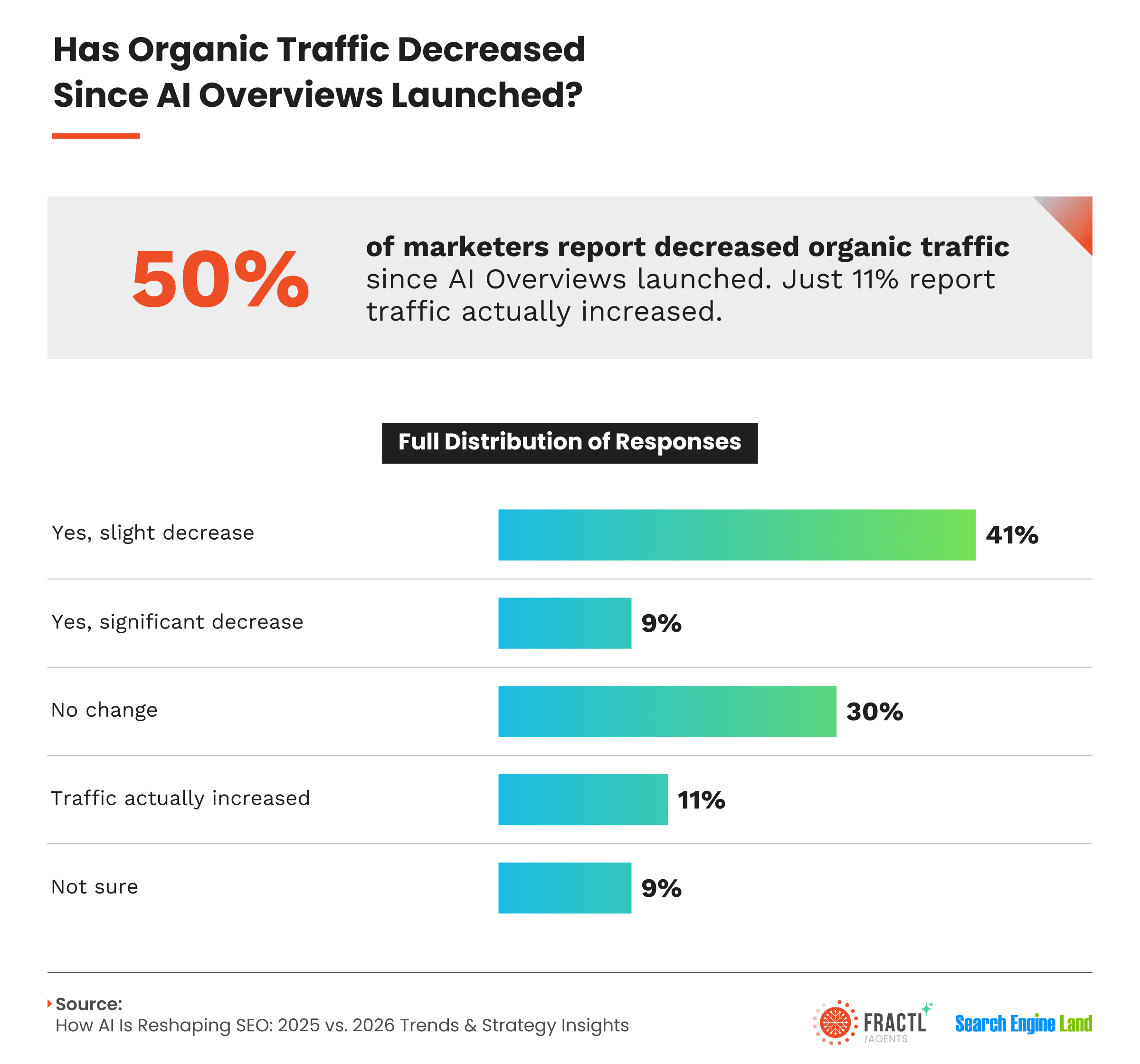
Just 11% say traffic has actually increased. For every marketer who gained ground in the AI Overviews era, roughly five lost it.
61% of marketers attribute the declines to AI tools, with 19% calling AI a significant factor. The decline is concentrated in traditional Google organic; 43% cite it as the most-impacted channel, with social discovery surfaces (13%) emerging as the next concern.
17. Brand visibility isn’t disappearing. It’s shifting.
The same survey that captured the traffic crunch also captured where brands are finding new ground.
57% of marketers see visibility growth from social platforms (TikTok, Reddit, YouTube), the top-cited growth channel. 40% see growth from AI assistants like ChatGPT, Gemini, and Perplexity, early validation that GEO investment is paying off. 31% see growth in direct or branded traffic. Only 10% report no growth anywhere.
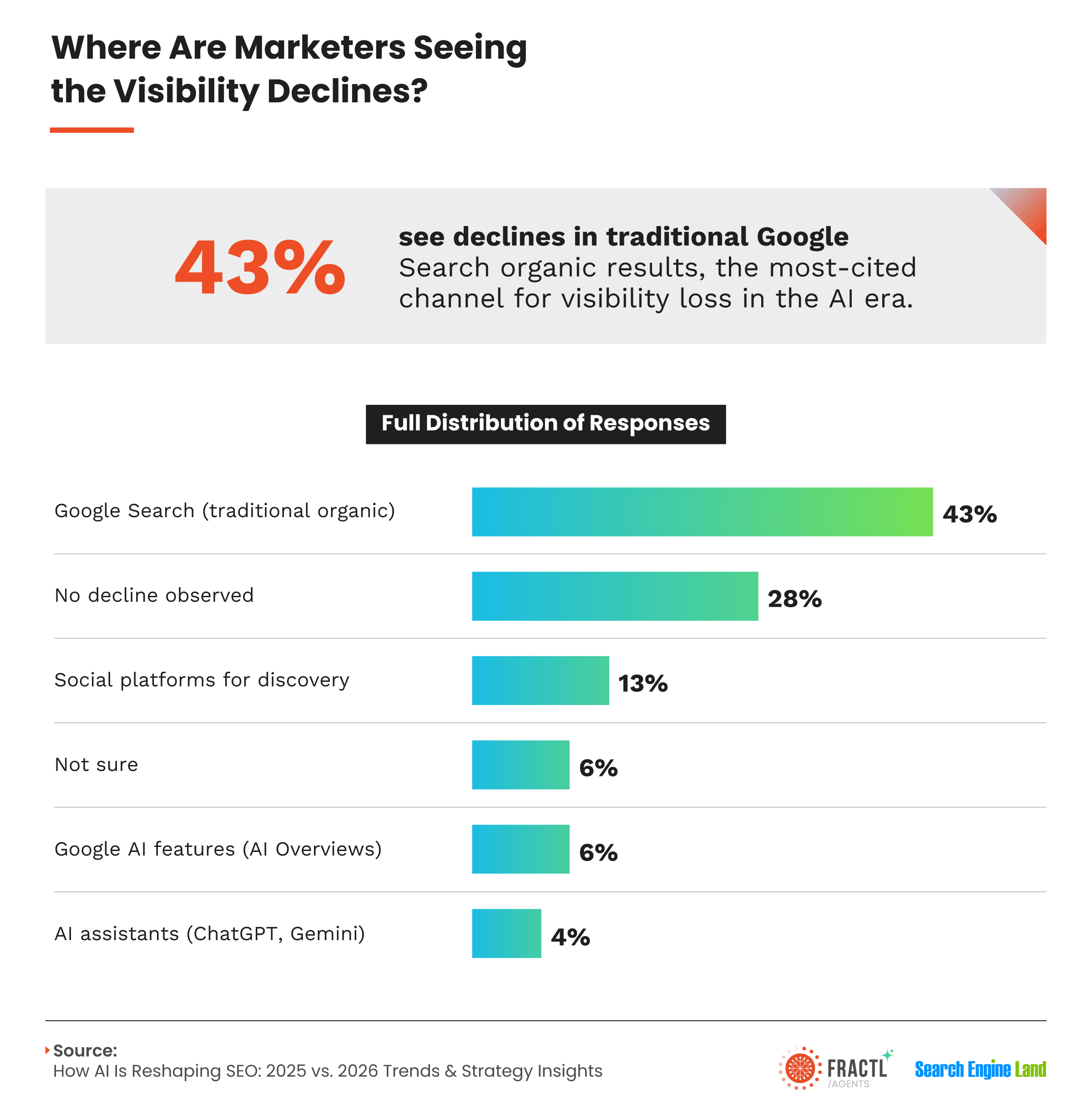
Brand-visibility action has moved off Google. The marketers complaining about organic declines are often the same marketers seeing gains on the surfaces that replaced it.
18. Marketers are chasing visibility, but missing the moat.
The most-prioritized strategies for offsetting AI’s impact: social platform brand presence (59%), GEO/AEO (54%), authoritative expert content (44%), paid spend (38%), and email or owned audiences (37%).
The least-prioritized: original research and data, at just 15%.
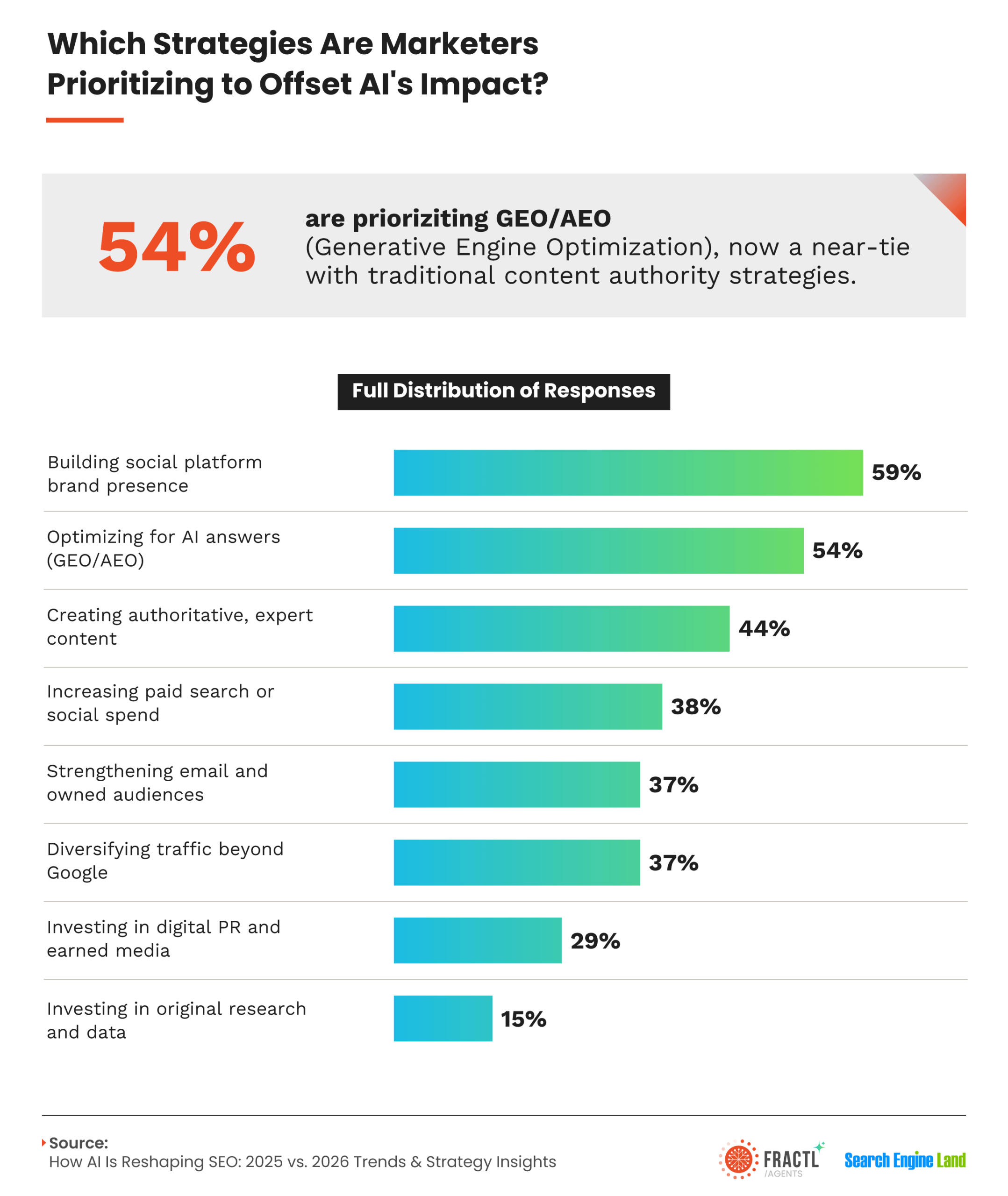
That’s an inversion. Original research is one of the hardest assets for AI to replicate or summarize away. Yet it’s the strategy few marketers are running. Most teams are doubling down on tactics AI commoditizes most easily.
19. Entity authority creates the biggest moat. Most marketers are optimizing for the easiest tactic.
Among marketers running GEO tactics: 49% optimize FAQ and question-based content. 43% focus on brand mentions and entity optimization. 36% build topical authority. 35% create original data, research, or proprietary studies. 30% use structured data markup. 24% pursue digital PR and link-building specifically for AI citations.
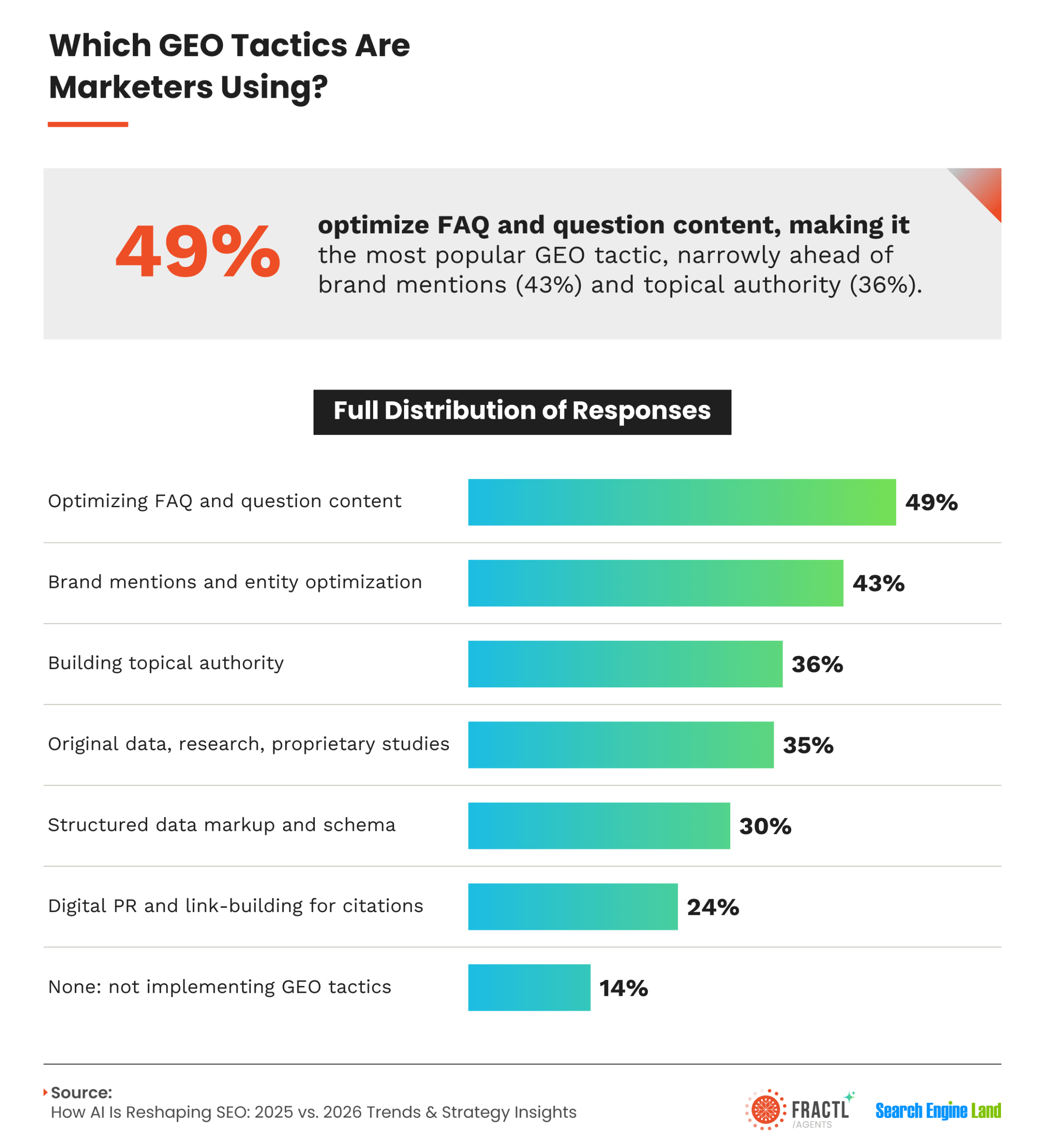
FAQ optimization is the easiest content for AI to replicate. Entity authority and original research are the hardest. The marketers building durable moats are doing the harder work and they’re outnumbered by the marketers chasing the easier tactic.
20. GEO is growing faster than its measurement model.
61% of marketers express some confidence in their GEO strategy. Only 12% are very confident with measurable results.
49% are somewhat confident, seeing early signs that are hard to measure. 19% are executing but unsure. 8% have no way to measure at all. 12% have no GEO strategy.
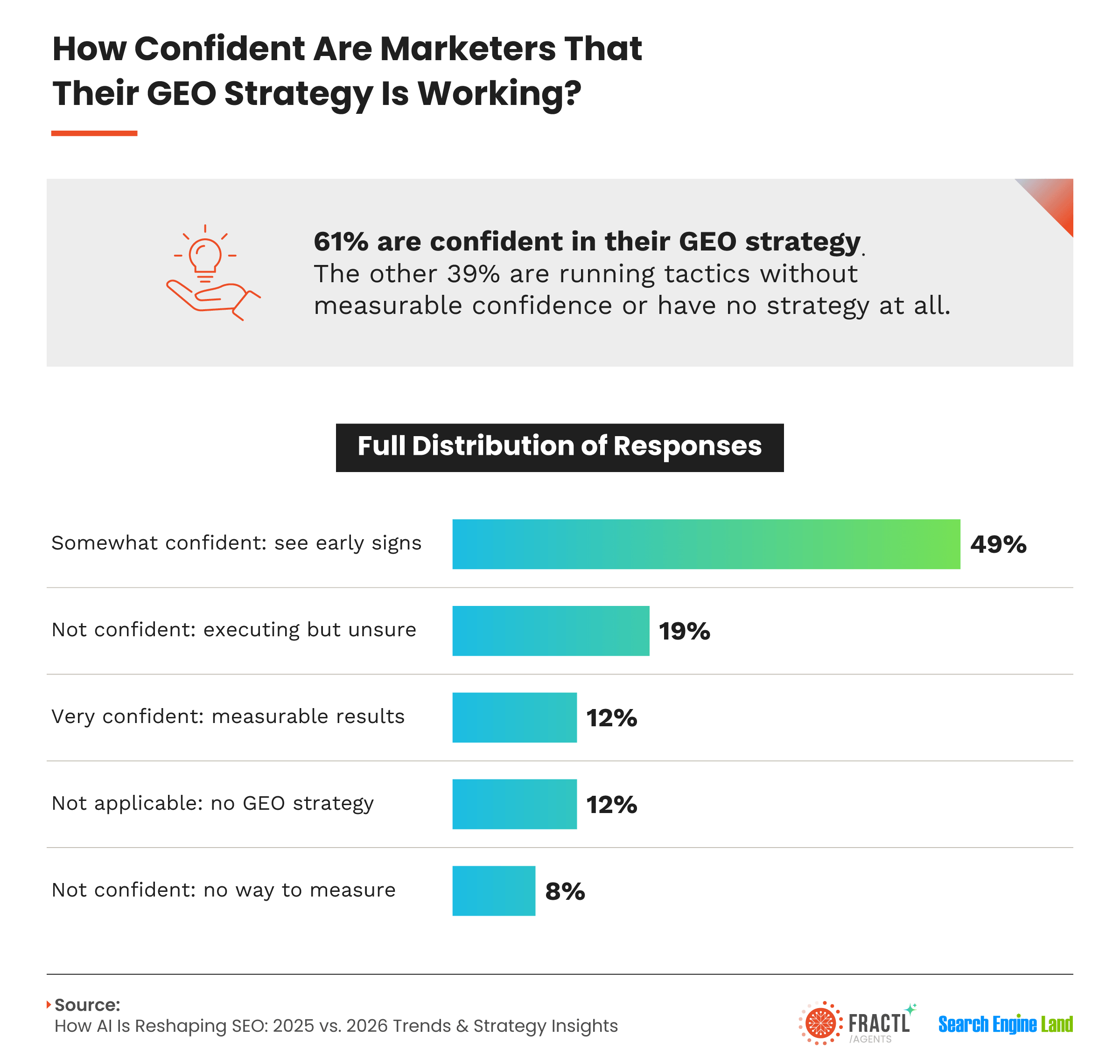
Combined: 76% of marketers are running GEO tactics with limited or no proven attribution. The tactics are scaling faster than the measurement framework, which means the next twelve months of marketing budgets are partly faith-based.
21. Your AI bottleneck is training, not budget.
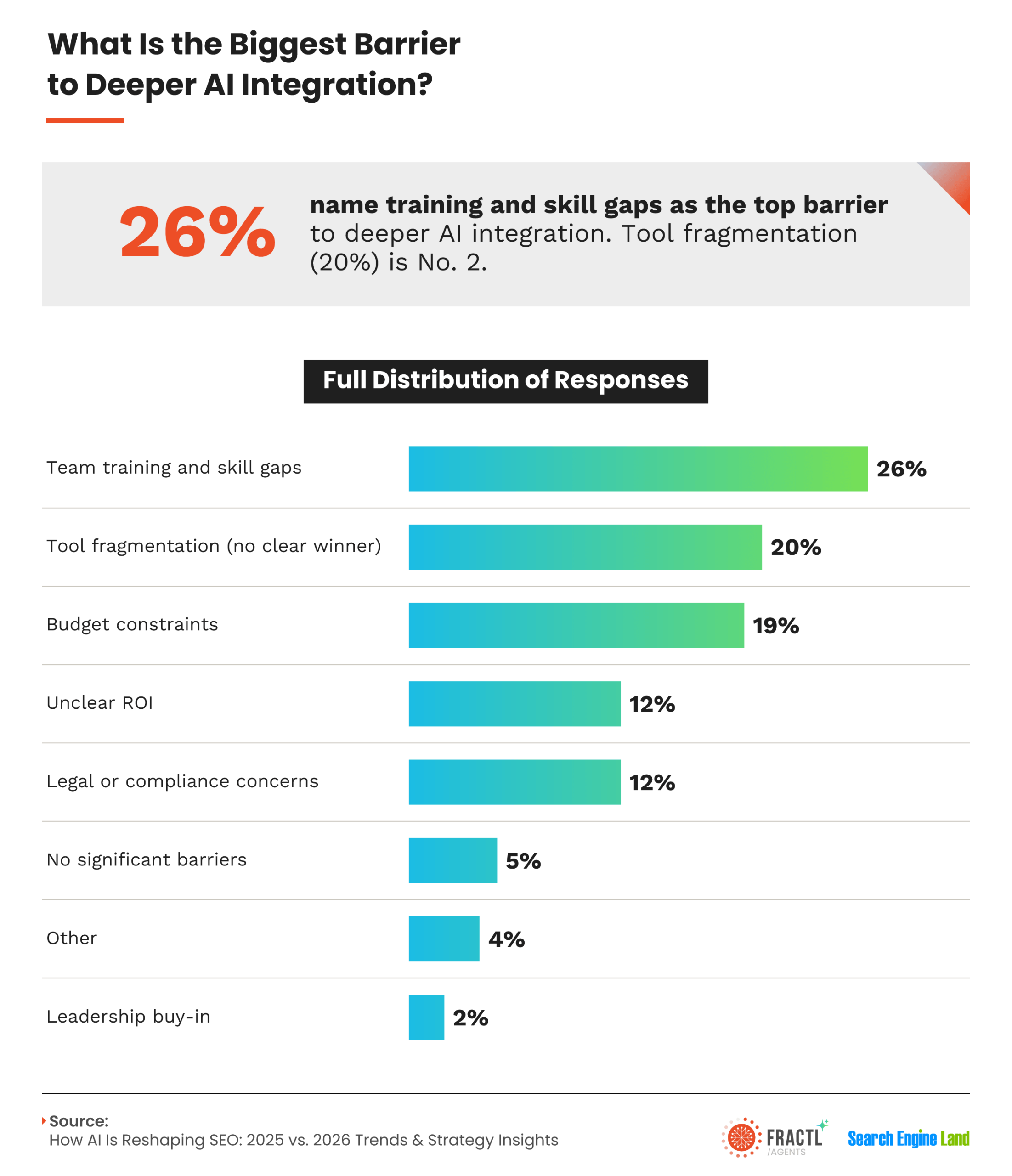
The top barrier to deeper AI integration: team training and skill gaps (26%). Then tool fragmentation (20%), budget (19%), unclear ROI (12%), and legal or compliance concerns (12%).
Leadership buy-in trails at just 2%.
Marketers have moved past “should we.” They’re now on “how do we do this well.” The executive support is in place. The skill set isn’t. The companies that close that gap first will lead the next year.
AI rewards brand equity. It doesn’t create it.
The data tells a coherent story across both audiences. Consumers are adopting AI faster than they’re trusting it. Marketers are accelerating with AI faster than they’re governing it. Both gaps create commercial risk and commercial opportunity for the brands that close them first.
Four moves matter:
- Monitor influential platforms. Track accuracy, inclusion, sentiment, and citations across Google, AI Overviews, ChatGPT, Gemini, Perplexity, Reddit, YouTube, and review surfaces. 27% of brands have already been misrepresented in AI responses. The brands that catch it first contain the damage.
- Build entity authority. Invest in original research, named experts, source transparency, and assets AI systems can verify and cite. The 15% of marketers prioritizing original data are building the hardest moat. Everyone else is competing on the easiest tactic.
- Triangulate brand visibility. Consumers check 2.4 platforms before buying. Stop optimizing for one destination. Make your brand the consensus answer across search, social proof, video, reviews, and trusted media.
- Govern for trust. Formalize AI disclosure, human review, hallucination escalation, and brand safety as operating rules, not one-off tactics. The 20% disclosure rate against 84%+ consumer demand isn’t a marketing problem. It’s a reputational liability waiting for its catalyst.
The brands that win 2026 won’t be the ones with the most AI in their stack. They’ll be the ones whose name comes up when AI is asked the question.