




Table of Contents
- Content Discoverability Has Moved Beyond Google
- AI-Driven Search Is Reshaping Organic Traffic
- Social Media Is Becoming a Primary Search Engine
- Depth Beats Volume: The Shift to Buyer-Journey Content
- How To Optimize Content for AI Citation
- Future-Proofing Visibility by Building Authority Beyond One Algorithm
- What To Call This: GEO, AISO, AISEO, and the Terminology Debate
- Thought Leader Consistency Is Rare — and Undervalued
- The Metrics That Matter for Modern Content Discoverability
- Related Resources
The content discovery process is shifting faster than most digital marketing teams can keep up. Google still matters, but AI-powered answers, social-first search behavior, and a growing preference for conversational tools are fragmenting where and how audiences find brands. For marketers, the question has long been “How do we rank on the search engine results page?” Now, however, it’s “How do we earn visibility everywhere our target audience actually looks?”
Originally presented on Majestic’s “How to Set an SEO Strategy for 2026” livestream, featuring Georgia James, Kelsey Libert, Sabine Ljunggren, and Sukhjinder Singh, hosted by David Bain.
Watch the Full Conversation
Key Takeaways
- AI search is already cutting into organic traffic. Nearly four in 10 marketers report organic traffic declines since AI-powered answers rolled out, even when rankings hold steady.
- Gen Z searches on ChatGPT almost as much as Google. Among 18–24-year-olds, 66% use ChatGPT for information — just three points behind Google at 69%.
- Social media is the new search engine. 41% of Gen Z now turn to social platforms first when they need answers, outpacing traditional search at 32%.
- Depth beats volume. 83% of marketers say it’s better to post less often with high-quality content than to churn out high volumes.
- Brand mentions are the strongest signal for AI visibility. Brands in the top quartile for web mentions earn 10× more placements in Google’s AI search results.
- Freshness gives you an edge with AI. Content cited by AI systems is 25.7% more recently updated than standard top results.
- GEO is the industry’s preferred term — but nobody has fully settled. 84% of SEO professionals recognize it, yet fewer than one in three thought leaders have stayed consistent in how they talk about AI-era search.
Content Discoverability Has Moved Beyond Google
For over a decade, “content discoverability” was essentially synonymous with “Google ranking.” That era is over. Today, visibility means earning attention across every platform and content discovery platform where your target audience spends time, from traditional search engines to artificial intelligence assistants to social media feeds. The entire ecosystem has fragmented, and the content discovery strategy that worked five years ago won’t cut it in 2026.
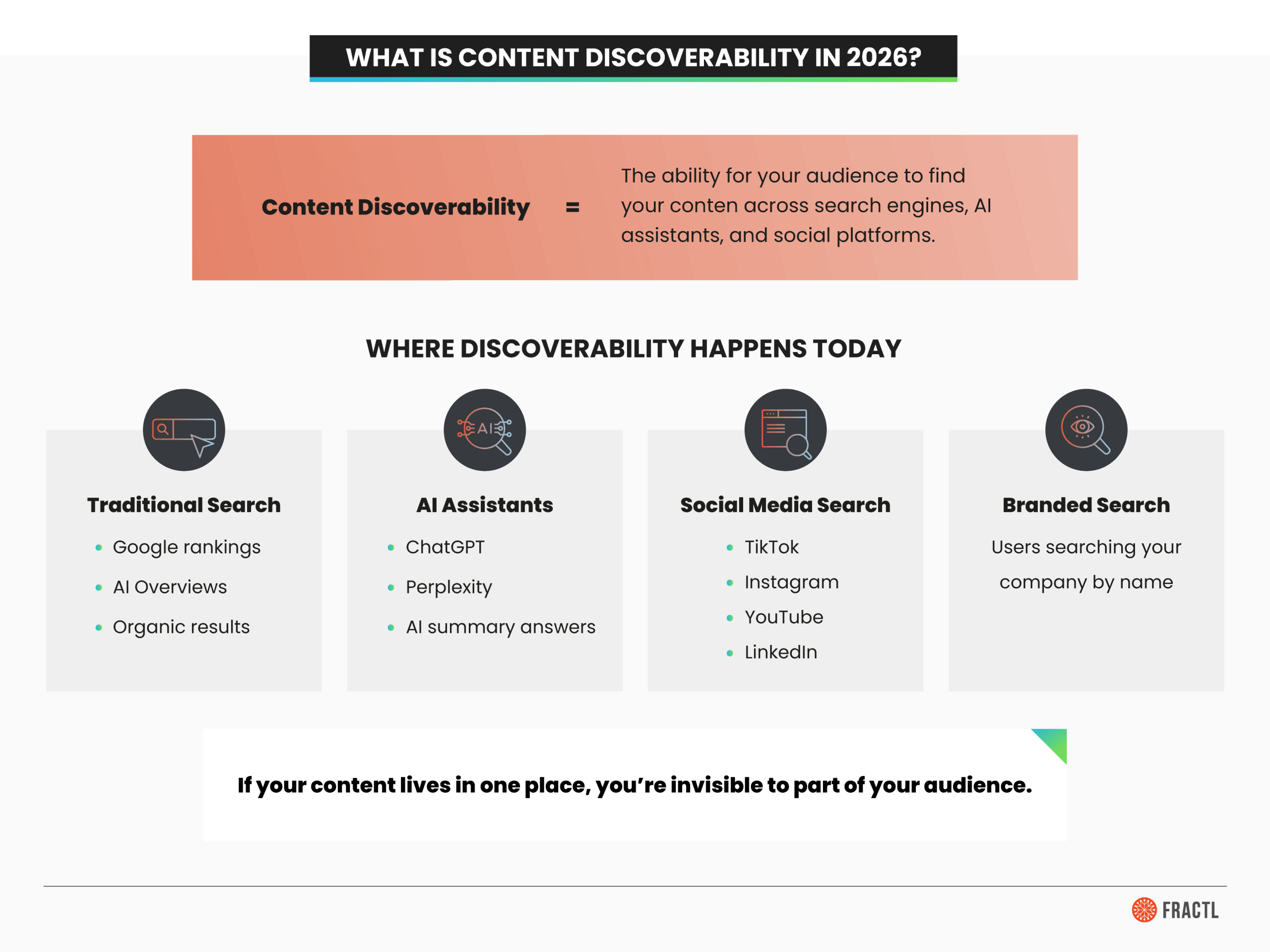
The data tells a clear story: 41% of consumers now rely on AI summary boxes instead of clicking through to websites, and 13% skip search engines entirely in favor of chatbots like ChatGPT or Perplexity. The click — once the fundamental unit of search engine marketing — is becoming optional for many users. User behavior is shifting away from browsing a list of 10 blue links toward expecting a single, direct answer.
This shift is most pronounced with younger audiences. Among Gen Z (ages 18–24), 66% use ChatGPT to find information, nearly matching the 69% who still turn to Google. Meanwhile, nearly four in 10 Gen Z respondents say TikTok and Instagram are their go-to search engines for content recommendations, how-tos, and trending topics. Traditional SEO remains foundational, but it’s no longer the whole picture. Platforms like Spotify and Amazon have also become content discovery platforms in their own right, surfacing relevant content based on user preferences and machine learning algorithms. The lesson: If your content only lives in one place, you’re invisible to a growing share of your audience.
The question is no longer just “How do we rank?” It’s “How do we earn visibility everywhere our audience actually looks?”
AI-Driven Search Is Reshaping Organic Traffic
Google’s AI Overviews (formerly SGE) are causing a measurable drop in clicks on traditional results. Nearly four in 10 marketers (39%) report organic traffic has declined since AI answers rolled out, even when their rankings haven’t budged. The traffic is still going somewhere; it’s just not reaching your site. These AI systems are designed to resolve queries inside the search engine itself, which means every piece of content you publish now competes not only with other sites, but with the search engine’s own generated answer.
That said, perspective matters. ChatGPT use is rising, but Google still drives the lion’s share of referral traffic. The takeaway isn’t to abandon SEO, but to layer in new strategies that account for how artificial intelligence is changing the user’s journey from query to answer.
In practice, AI visibility demands a different emphasis than traditional keyword targeting:
- Conversational query coverage. Matching the natural-language questions people ask AI assistants matters more than chasing high-volume head terms. Think about the FAQs your audience is actually typing into chatbots.
- External validation. Earned media mentions and authoritative citations carry more weight with machine learning models than owned content alone. AI-powered search algorithms rely heavily on signals of trust from third-party sources.
- Structure over keyword density. Clear formatting, metadata, and well-labeled sections help AI systems parse and cite your content accurately.
Social Media Is Becoming a Primary Search Engine
The idea that “no one searches on social media” hasn’t been true for a while, and the data now makes it undeniable. A mid-2025 Sprout Social survey found that 41% of Gen Z turn to social media first when they need answers, compared to only 32% who start with a traditional search engine. For this generation, social platforms function as content discovery platforms as naturally as Google does for older demographics.
And it’s not only Gen Z. Over one-third of all consumers prefer social platforms as their first stop for product reviews (37%) or local business recommendations (35%). These are people actively seeking answers, rather than casually scrolling, and they’re starting on Instagram, TikTok, and YouTube instead of Google. Video content in particular is driving this shift, with short-form tutorials and explainers becoming the preferred format for how-to queries and trending topic exploration.
For brands, this means your content creation and distribution strategy has to extend well beyond SERPs. Content creators who build native presences on social platforms — not just reposting blog links — are capturing an audience that traditional SEO misses entirely. The curation of what surfaces on these platforms depends on algorithms tuned to user preferences, not backlinks, which requires a fundamentally different approach to optimization.
If your audience is searching for answers on social platforms and your content only lives on your blog, you’re invisible to a growing share of potential customers.
Depth Beats Volume: The Shift to Buyer-Journey Content
The vast majority of marketers (83%) now say it’s better to post less often with high-quality content than to churn out high volumes for clicks. This reflects a broader move toward content marketing that serves the buyer’s needs at each stage of their journey, rather than content creation that merely fills an editorial calendar.
A strong content discovery strategy maps directly to the buyer’s journey, ensuring the right content reaches the right person at the right time:
- Awareness. Educational, top-of-funnel content — such as original research, explainer articles, and webinar recordings — that helps people understand a problem or opportunity.
- Consideration. Case studies and expert commentary that demonstrate how specific solutions work in practice, giving your audience the relevant content they need to evaluate options.
- Decision. Detailed comparison guides and ROI analyses that help buyers make final selections. Every piece of content at this stage should directly address purchase-ready questions.
Google’s algorithm updates reinforce this shift. Many digital PR professionals (68.2%) say their campaigns are more effective than a year ago, largely because Google now prioritizes high-quality content that meets user intent over thin, high-volume output. The compounding effect is significant: Depth builds organic links, audience trust, and sustained rankings. Volume alone rarely delivers any of those.
The compounding effect is significant: Depth builds links, trust, and sustained rankings. Volume alone rarely delivers any of those.
How To Optimize Content for AI Citation
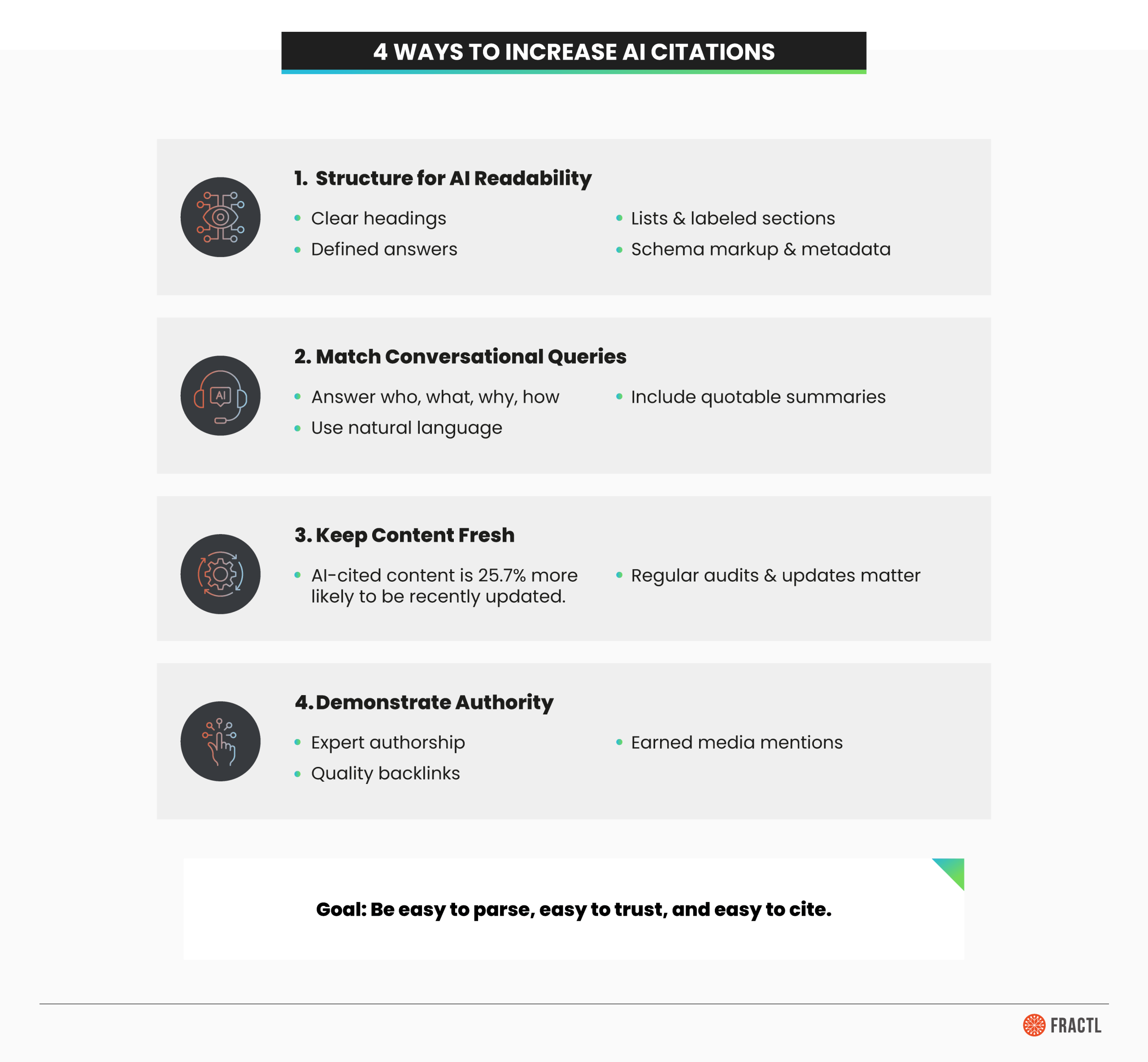
If you want AI systems to cite your content, not just rank it in traditional results, you need to think about structure, tone, freshness, and authority differently. Here’s what the data shows works.
Structure Content for AI Readability
AI models need to parse your content before they can cite it. Using clear structure, schema markup, and well-labeled FAQ sections helps models understand your page’s information hierarchy. In practice, this means formatting content with defined answers, lists, and headings so an AI can extract a snippet and credit you. Metadata, including structured data, descriptive title tags, and well-organized FAQs, is now as important for AI readability as it is for traditional SEO.
Our research shows that leading brands are now writing “summarization-first” content and crafting sections meant to be scraped or quoted by AI tools. Think of it as writing for two audiences simultaneously: the human reader who values good user experience, and the algorithm that will decide whether to feature you. Content repositories and knowledge bases that organize information in clearly labeled, modular sections give AI models the structured input they need to generate accurate answers and cite your brand.
Match Conversational Tone and Intent
AI assistants field natural-language questions, so content that mirrors a conversational Q&A format tends to perform well. Creating sections that directly answer who, what, why, and how questions in a straightforward tone increases the likelihood that an AI platform will pull your text as an answer.
A practical approach: Include an easily quotable one-sentence summary or a bullet list of key facts near the top of each section. The goal is to optimize for answer engines — generative engines — rather than search engines. The industry increasingly calls this practice GEO, or generative engine optimization.
Keep Content Fresh and Up to Date
Recency is a notable factor in AI citation. One analysis of 17 million AI citations found that content cited by AI was 25.7% more recently updated on average than content in Google’s regular top results. Publishing new content regularly and updating existing pages with real-time data points boosts their chances of being used by AI as a current reference. Content management practices like scheduled audits, freshness reviews, and automation of update workflows can help teams keep pace without burning out.
Demonstrate Authority and Accuracy
Machine learning models are trained to avoid dubious sources, so they gravitate toward content that carries expertise signals — well-researched, properly cited, and authored by recognized experts. AI assistants lean heavily on well-known publications and trusted brands in their answers, often drawing from a slightly different set of trusted sites than traditional SEO. Building your site’s authority through quality backlinks, expert mentions, and high-quality content increases the likelihood that an AI will choose you.
Future-Proofing Visibility by Building Authority Beyond One Algorithm
The most resilient digital marketing teams are optimizing for more than a single platform. They’re building authority that carries weight across the entire ecosystem. A Google update or social algorithm tweak shouldn’t singlehandedly tank your visibility.
Consider this: Nearly half of all Google searches (45.7%) are now branded searches, where the user is directly seeking a known company or product. A strong brand generates its own search demand where customers find you by name on every search engine, social media platform, and AI assistant. This makes you far less vulnerable to ranking shifts.
Brand Mentions Are the Top Signal for AI Visibility
A 2025 study of 75,000 brands found that those in the top quartile for web mentions earned 10× more placements in Google’s AI search results than the next tier down. Branded web mentions showed the strongest correlation with AI visibility (correlation coefficient of 0.664), far outranking traditional link metrics.
Cultivating press coverage, social buzz, and community engagement not only boosts SEO and referral traffic today but also positions your brand to be favored by future AI and search features.
The more people talk about your brand online, the more likely AI is to feature you.
Build a Multi-Channel Presence
A future-proof content discovery strategy means developing multiple pillars of visibility. Savvy teams combine SEO with digital PR, social media, and emerging platforms so no single algorithm controls their fate. They publish authoritative research that earns organic links while syndicating insights on LinkedIn or industry forums. They engage in guest podcasts, webinar series, and YouTube channels, growing an audience that seeks them out regardless of Google.
Some of the most effective initiatives we see involve repurposing a single deep-dive study into multiple formats: a pillar page for the homepage or blog, video content for YouTube and social, an email newsletter for direct subscribers, and bite-sized content recommendations for LinkedIn. Marketers now value unlinked brand mentions nearly as much as backlinks, and they monitor brand search volume and direct traffic as key performance indicators. The goal: become the go-to authority in your niche so that, whether it’s a search engine, an AI assistant, or an entirely new content discovery platform, your brand shows up as a reliable source.
What To Call This: GEO, AISO, AISEO, and the Terminology Debate
The industry hasn’t settled on one label for AI-era visibility work, and that confusion carries real consequences for how teams position themselves, hire, and report on results. Fractl’s research into AI search terminology reveals a fragmented landscape:
- GEO is the most recognized term. 84% of SEO professionals recognize it, and 42% use it as their primary label for AI-era visibility work.
- ASO and GEO are the fastest-growing search terms. This signals demand for execution-oriented language over theory.
- AISEO performs best on social media. It earns the highest engagement because it’s literal and easy to understand at a glance.
- AISO dominates hiring posts. It now appears in more job listings than SEO, GEO, AEO, and LLMO combined, which is a signal that hiring managers are adopting different labels than practitioners.
For content creators and content marketing teams, the practical takeaway is this: Use the term your audience recognizes. GEO is the safest bet for thought leadership. AISO may be better for recruiting or internal comms. And if your audience skews social-first, AISEO may be the most clickable option.
Thought Leader Consistency Is Rare — and Undervalued
Fractl’s analysis of SEO thought leaders on LinkedIn reveals that fewer than one in three have stayed consistent in how they talk about AI-era search terms over the past year. The terminology is shifting so fast that many experts are changing labels mid-stream, making it harder for their audiences to follow along.
Our other key findings from the analysis include:
- 43% of thought leaders still brand themselves around SEO. Only 3% include GEO in their LinkedIn headline, suggesting slow adoption of AI-era positioning.
- Over 70% of AI-SEO posts are positive. Sentiment is broadly optimistic, though the most active posters often show the widest sentiment swings.
- Steady, optimistic voices carry the most trust. The most trusted voices cluster in the “steady + optimistic” quadrant — fewer posts, clearer points of view.
For brands building thought leadership content, the lesson is clear: Consistency and clarity matter more than frequency. Taking a clear stance (even if the terminology is still evolving) signals confidence and builds audience trust over time.
The real signal isn’t what people are saying about AI search, it’s how often they’re changing their minds.
The Metrics That Matter for Modern Content Discoverability
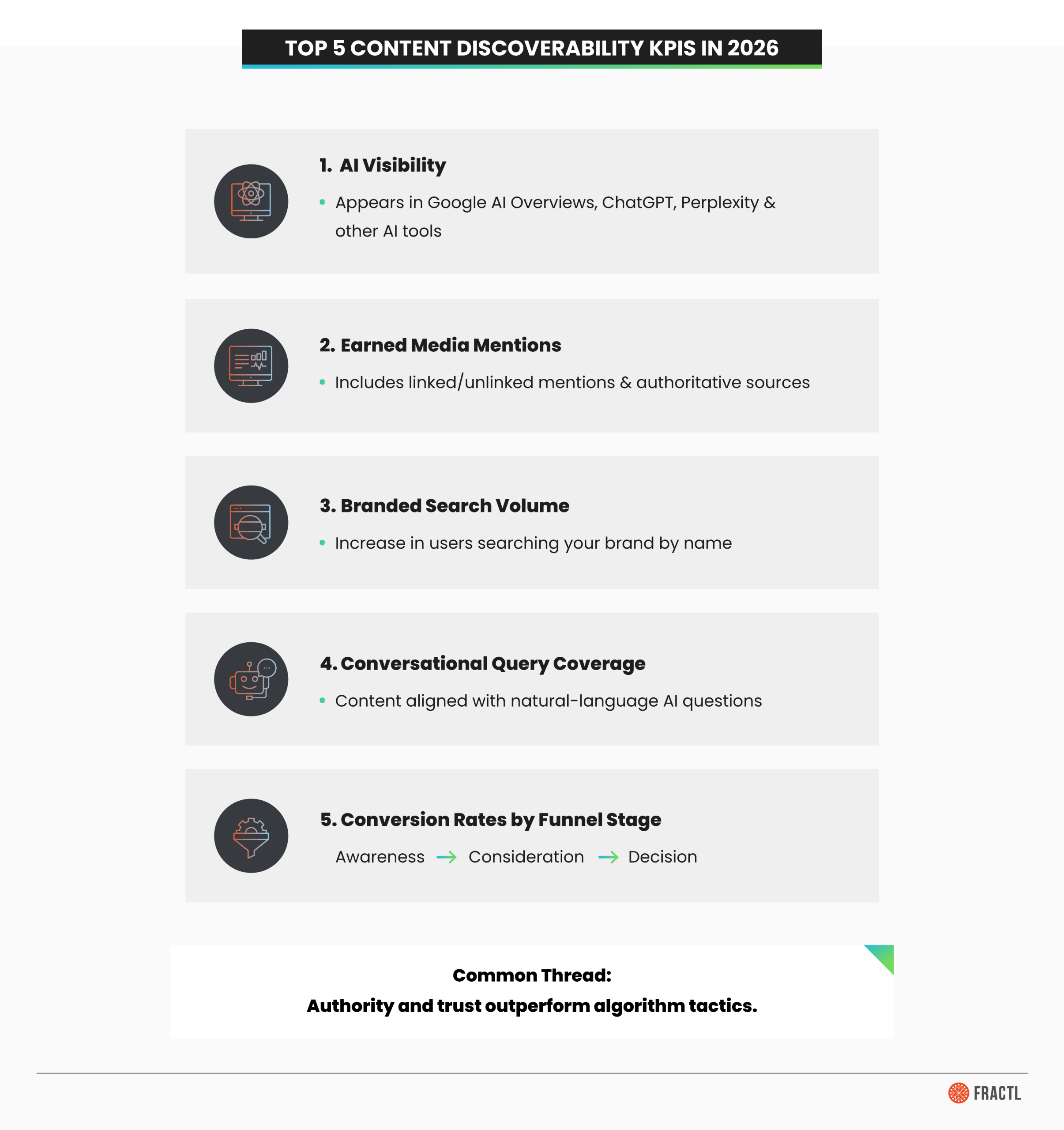
When visibility is spread across search, social media, and AI, traditional SEO metrics alone don’t capture the full picture. The smartest teams are expanding the KPIs they track and rethinking how each metric functions within a broader content discovery strategy:
- AI visibility. This is how often your brand appears in AI-powered answers across platforms like Google AI Overviews, ChatGPT, and Perplexity. Tracking this requires new automation tools, since traditional rank-tracking software wasn’t built for generative results.
- Earned media mentions. Both linked and unlinked brand mentions on authoritative, widely cited sites are valuable. These build entity recognition that AI systems and machine learning models rely on when deciding which sources to cite.
- Branded search volume. An increase in people searching for your brand by name is one of the strongest signals that your content marketing and digital PR initiatives are working.
- Conversational query coverage. This considers whether your content answers the long-tail, natural-language questions your audience is asking AI assistants. Monitoring this helps you identify gaps and optimize for the queries that matter most.
- Conversion rates by content stage. Content tailored to specific audiences — persona-led content nurtures — should be measured by how well it moves prospects through the funnel, not just by pageviews. Tying content management efforts to conversion rates ensures every initiative has a clear business impact.
The common thread: Every KPI on this list ties back to building real authority and genuine audience trust instead of trying to game a single algorithm. The best content discovery process goes beyond hacking a ranking signal and makes your brand the source that people and AI systems turn to first.
Related Resources
Explore more from Fractl on related topics: