




Table of Contents
- 15 Thought Leadership Link Building Strategies
- Measuring Your Thought Leadership Link Building Results
- Turn Your Team's Expertise Into a Link Building Engine
- FAQs
In our survey of 1,300 high-authority publishers, we found that 88% write stories from pitches a few times a month or less. At best, that’s a 0.5% success rate. The link-building strategies that consistently break through share one trait: They’re rooted in thought leadership. Original research, expert commentary, and proprietary data earn editorial links from authoritative websites, not link farms, spammy directories, or black hat tactics.
Google’s algorithm increasingly rewards E-E-A-T, and backlinks remain a core ranking factor. But hyperlinks from recognized experts and authoritative web pages carry far more weight in the SERPs than low-quality links from irrelevant sites. Search engine optimization has shifted toward content-led approaches where relevant links come to you because publishers genuinely need what you’ve created. A single editorial link from a tier-1 publisher outperforms dozens of directory, forum, or guest posting links.
At Fractl (ranked #1 for content marketing on Clutch’s Leaders Matrix), we’ve spent over 10 years refining growth strategies that turn thought leadership into measurable link-building results. Here are 15 we use as a digital marketing and link-building agency, backed by real campaign data.
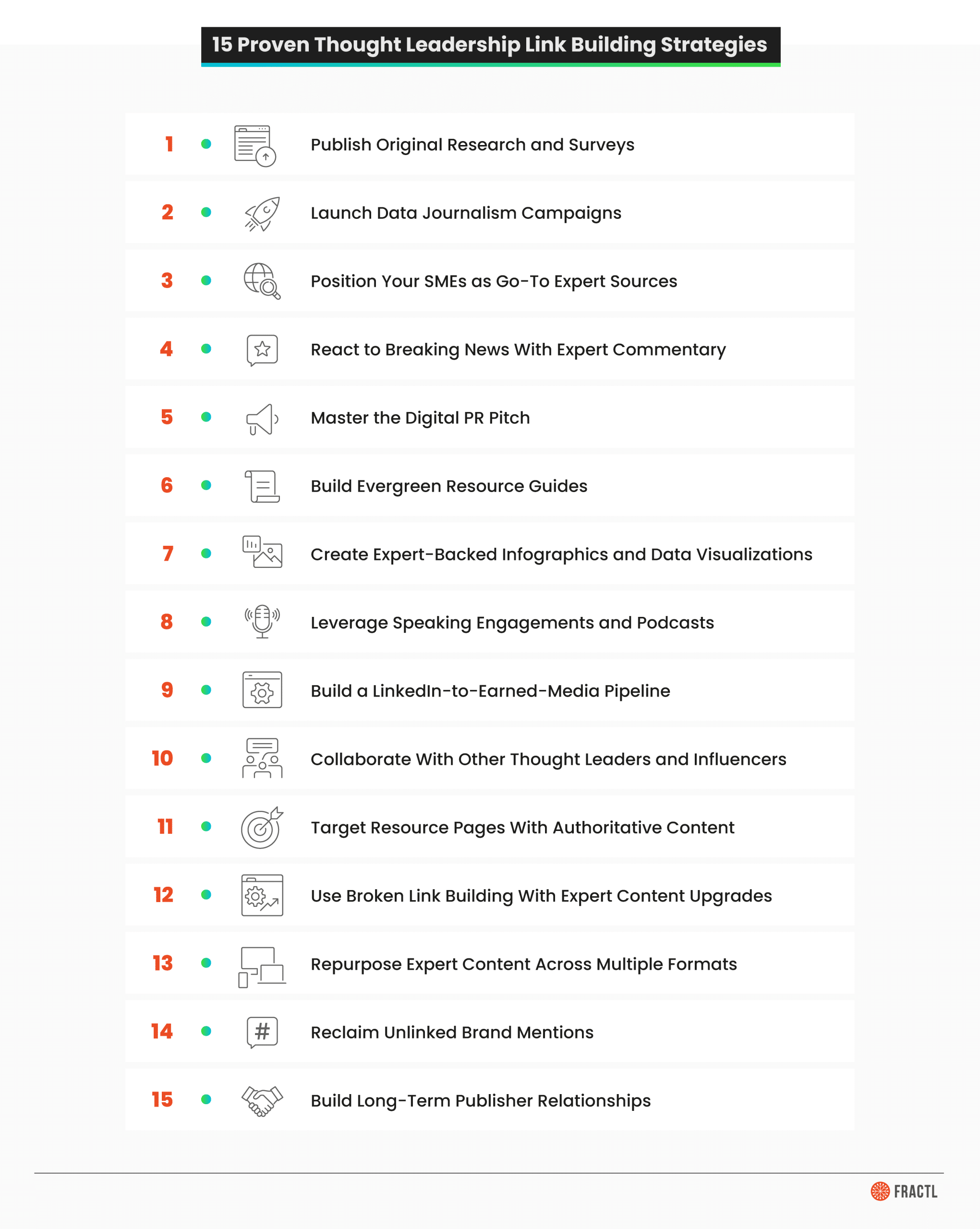
15 Thought Leadership Link Building Strategies
These range from high-investment campaigns that earn hundreds of referring domains to low-lift tactics you can start this week. I’ve ordered them roughly by impact, starting with the approaches that consistently deliver the strongest results for our clients.
1. Publish Original Research and Surveys
Original research is the single most effective thought leadership link-building strategy available. When you conduct a survey, analyze proprietary data, or commission a study that produces citable statistics, every site that references your findings links back to your research page. That’s the definition of a vote of confidence in SEO terms.
The key is picking a research angle that fills a genuine data gap. If journalists, bloggers, and content creators are already writing about a topic but lack hard numbers, your study becomes the primary source they all cite.
How it works in practice: Our team at Fractl produced a survey-based study for a couponing-focused client on the best cities in America for secondhand shopping. The study analyzed Yelp data for city rankings and surveyed 1,000+ Americans on thrifting habits. It accumulated 370+ inbound links with placements in CNET, The Street, Real Simple, The Penny Hoarder, and Bored Panda.
You don’t need a massive budget to start. A well-designed survey of 500–1,000 respondents on a topic your target audience cares about can produce enough unique insights to attract coverage from reputable sites for months.
2. Launch Data Journalism Campaigns
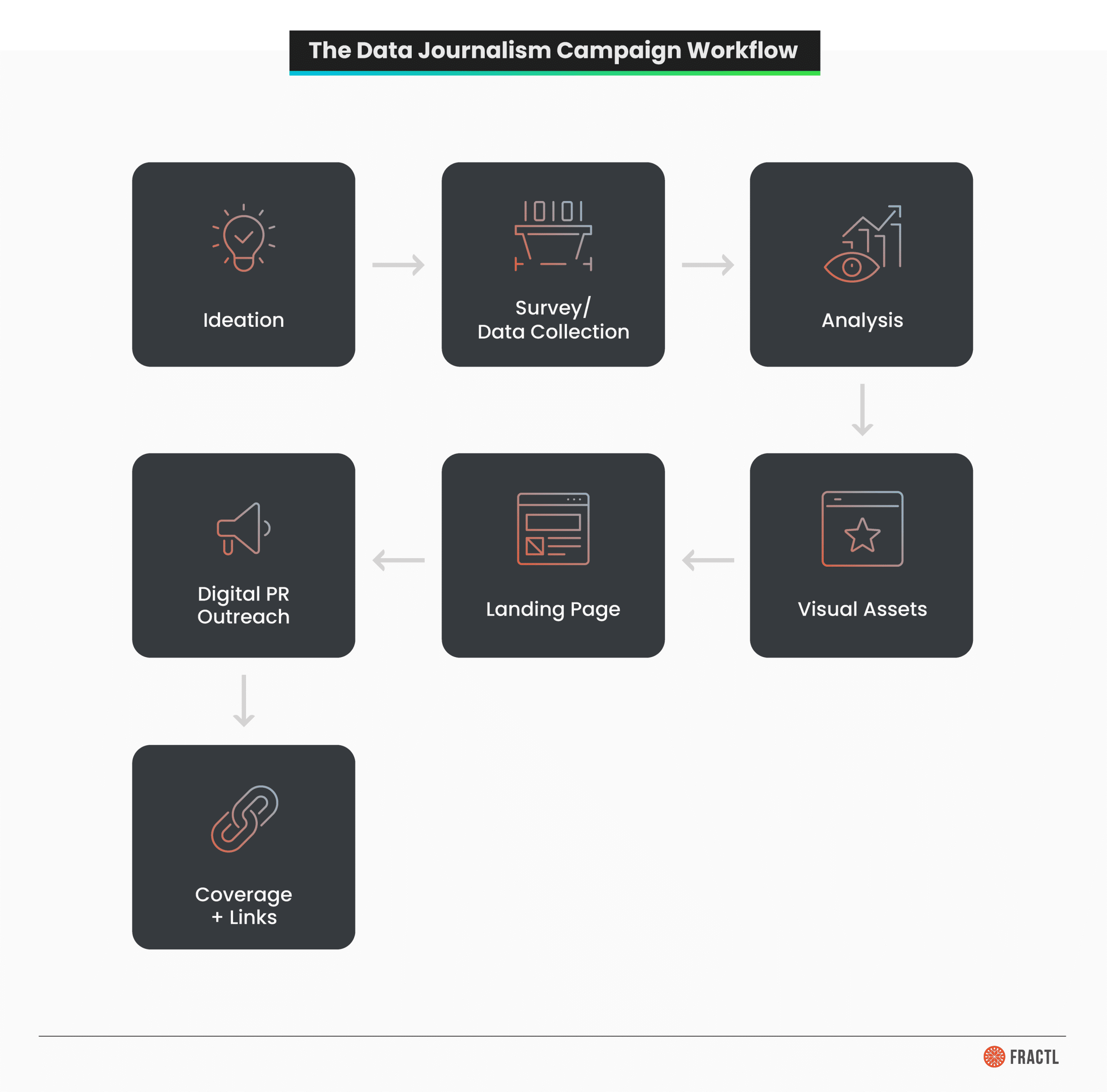
Data journalism takes original research a step further by wrapping it in a newsworthy narrative. You’re not just producing a report; you’re creating data-driven storytelling on topics with broad consumer appeal, designed to earn coverage from tier-1 news outlets.
A data journalism campaign typically features up to three visual assets showcasing the most surprising findings, hosted on a landing page with editorial copy that weaves the story together. The production timeline runs two to three weeks, followed by four to six weeks of scaled digital PR outreach to high-authority publishers.
Real results: Over a six-month engagement, we produced nine data journalism campaigns for Adobe that earned 390 new referring domains and drove 56,000 additional monthly visits in combined traffic.
Data journalism campaigns work because they give publishers something they can’t produce themselves: proprietary data wrapped in a story their audience wants to read. When your brand is the source, every placement links back to you.
3. Position Your SMEs as Go-To Expert Sources
Proactive PR is one of the highest-ROI link-building strategies because it requires minimal content production. Instead of creating an entire campaign, you’re positioning your subject matter experts to provide expert commentary on topics journalists are already writing about.
Here’s how it works:
- We actively monitor platforms where journalists seek industry experts for commentary.
- When a relevant query surfaces, we draft quotes on behalf of the client’s leadership team and respond quickly.
Speed matters; the first expert to respond with a strong quote often gets the placement.
Examples: Through proactive PR, we placed Payless Power’s CEO, Brandon Young, in a GoBankingRates article about how holiday lights affect electric bills. Our couponing-focused client’s money-saving expert was quoted in Newsweek on Thanksgiving dinner costs and inflation, and again in Yahoo Money on consumer spending habits.
Each placement included an editorial link back to the client’s site. These are genuine citations from journalists who sought out our clients’ expertise because we’d positioned them as trusted sources in their area of expertise.
How To Activate Your SMEs
Making this strategy work requires choosing the right subject matter experts and leveraging them effectively. A few principles that keep the process efficient are:
- Find the right experts. Not every executive is the right fit. C-suite leaders and people in leadership roles aren’t always the best choice; mid-level experts with deep domain knowledge often make stronger thought leaders because they’re closer to the work. The value of thought leadership comes from real experience, not job titles.
- Extract insights without burning people out. Run 30-minute structured interviews, record the conversation, pull the best quotes, and let your content marketing team handle the writing. Build a quotes bank: pre-approved quotes on key topics that your team can deploy immediately for proactive and reactive PR.
- Map SMEs to topic areas. Consider the types of thought leadership each person can deliver: some are natural writers, others are better on camera or in interviews. When a journalist needs a quote on industry trends or a data point needs expert context, you shouldn’t have to scramble.
- Demonstrate ROI early. Show decision-makers what competitors’ business leaders are doing in the press. One podcast appearance or one expert quote placement costs minimal time and demonstrates clear, measurable results. Once leadership sees how a single piece of content or marketing effort translates into coverage and links, scaling becomes an easy conversation.
4. React to Breaking News With Expert Commentary
Reactive PR (sometimes called newsjacking) means responding to breaking news with rapid original research or expert commentary. The timeline is tight: You need to ideate, produce, and pitch within 24 to 48 hours to stay ahead of the news cycle.
That speed is the barrier to entry, and it’s why this strategy earns disproportionate results. Most brands can’t move fast enough, so the ones that do capture an outsized share of media coverage.
Case study: When NYC Public Schools banned ChatGPT in January 2023, our team at Fractl quickly surveyed students and professors on usage, fears, cheating, and policies. The Study.com campaign landed coverage in The Wall Street Journal, Business Insider, USA Today, EdWeek, Futurism, and Forbes within days.
Reactive PR requires a subject matter expert who’s pre-approved to provide commentary on relevant topics, a content team that can produce survey-based research fast, and a digital PR team with existing journalist relationships. If those pieces are in place, it’s one of the most efficient ways to earn high-authority backlinks at scale.
5. Master the Digital PR Pitch
Even the best thought leadership content won’t earn links if the pitch falls flat. Our research into publisher preferences (surveying 1,300 high-authority publishers, with findings previously featured in the Harvard Business Review) uncovered what actually works in outreach.
The data paints a clear picture of what publishers want and what they don’t:
- Keep it short. Half of the surveyed publishers preferred pitch emails between 100 and 200 words (including introduction and conclusion). Say what needs to be said and stop.
- Lead with data. Statistic-based subject lines are among the most successful formats. For business and finance publishers, data-driven subject lines outperform other types. Keep subject lines to 45–65 characters and no more than 10 words.
- Don’t be self-promotional. Fifty-six percent of publishers said they commonly reject pitches for being too self-promotional. Position your pitch around the value to their readers, not your brand.
- Don’t be boring. Fifty percent of publishers turn down pitches that are just plain boring. Lead with your most surprising statistic or finding to hook them.
- Proofread everything. Forty-two percent of respondents said they’d flag a pitch as spam if they found a spelling error. One typo can kill an otherwise strong pitch.
- Personalize the intro. Show you’ve read the writer’s work. A generic opening signals you didn’t do your research, and they’ll move on.
On follow-ups: 63% of publishers said one follow-up is appropriate, and 18% said two. Never send more than two follow-ups if you’re not getting replies. Wait at least two business days before the first one, and provide additional value when you do.
For a standard promotional run, allocate four to six weeks: one to two weeks for exclusive pitching to top-tier publishers, then three to four weeks for syndication to a broader list.
6. Build Evergreen Resource Guides
Evergreen resource guides (what we call “link magnets”) are 10x content pieces designed to be the definitive resource on a topic. They earn links passively because other content creators reference comprehensive resources as sources when writing their own content. The initial digital PR push seeds the page with high-authority links, and then it continues earning links naturally over time.
Results at scale: We produced resource guides and pillar content for McAfee that captured 586 high-value featured snippets and drove a $324,927 monthly increase in traffic value, along with 1,186,193 new monthly visitors.
The thought leadership angle matters here. A resource guide written by a genuine industry expert, backed by original data and unique insights, outperforms a generic roundup every time. Search engines and human readers both recognize the difference.
7. Create Expert-Backed Infographics and Data Visualizations
Infographics aren’t dead; they’ve evolved. The ones that still earn high-quality backlinks are backed by proprietary data or original research from credible sources. Generic infographics with recycled stats from third-party sites won’t cut it.
The approach that works: Take a key finding from your original research (see strategies 1 and 2) and turn it into a visual asset that publishers can embed. Every embed includes a link back to your landing page.
Data visualizations work especially well for data journalism campaigns. When a complex dataset gets translated into a clear, shareable visual, it gives publishers a ready-made asset for their story, which reduces friction and increases the likelihood of coverage and a backlink.
8. Leverage Speaking Engagements and Podcasts
Getting your subject matter experts on stage at industry conferences or on popular podcasts builds thought leadership credibility and creates multiple link-building opportunities.
The direct links are straightforward: Event websites link to speaker bios and company pages, and podcast directories link to guest profiles. But the indirect value is bigger. Speaking engagements position your SMEs as recognized industry experts, which makes every other strategy on this list more effective. Journalists are more likely to quote someone who recently spoke at a major conference. Publishers are more likely to cover research from a recognized thought leader.
You can maximize the link-building value of every speaking engagement by repurposing the content across channels.
- Repurpose talk transcripts into blog posts with unique insights
- Create social media posts highlighting key takeaways
- Pitch recap articles to industry publications
- Turn webinar content into downloadable whitepapers or resource guides
One speaking engagement can generate content for months if you’re strategic about repurposing it across formats.
9. Build a LinkedIn-to-Earned-Media Pipeline
LinkedIn has become the primary platform where business leaders and decision-makers share thought leadership content. A strong LinkedIn presence for your SMEs goes beyond building brand awareness and creates inbound media opportunities that generate backlinks.
Journalists and bloggers actively scout LinkedIn for expert sources. When your C-suite or senior team members consistently share unique insights, challenge industry trends, and engage in meaningful conversations, they become visible to reporters covering your space.
The pipeline from LinkedIn thought leadership to earned media follows a repeatable pattern:
 Establish a consistent cadence of LinkedIn posts from your SMEs |
 Share original data points, contrarian takes, and a clear point of view on industry topics |
 Engage with journalists’ posts and relevant industry forums |
 Convert inbound media requests into coverage with editorial links |
This strategy takes time to build, but the links it produces are among the highest quality because they’re entirely earned. No outreach required; the journalist comes to you.
10. Collaborate With Other Thought Leaders and Influencers
Joint content with other recognized experts in your space earns links from both audiences. Co-authored research, collaborative webinars, expert roundup posts, and cross-promoted content all generate backlinks from multiple sources.
The key is choosing collaborators whose expertise complements yours rather than competes with it. When two credible voices combine on a piece of original research or an in-depth guide, the result carries more authority than either could produce alone, and publishers treat it accordingly.
The best influencer collaborations for link building produce genuinely valuable content with people whose audiences overlap with your target market. Skip the sponsored post route entirely. Co-create something worth citing, and the links follow because publishers recognize the combined authority.
11. Target Resource Pages With Authoritative Content
Resource page link building is a well-established strategy, but thought leadership transforms it from a numbers game into a quality play. When your content is genuinely the best resource available on a topic (because it’s backed by original research, expert analysis, or proprietary data), resource page outreach works dramatically better.
Website owners and webmasters curating resource pages are looking for the most helpful, authoritative content for their audience. A link request backed by a comprehensive, expert-written guide with original data converts at a much higher rate than one backed by generic content. The linked page needs to genuinely earn its place as the best resource available.
Use link-building tools like Ahrefs or Semrush to find resource pages in your niche, or search Google for relevant pages using queries like inurl:resources “your topic” or intitle:resources “your industry.” Combine this with keyword research to identify the topics where your thought leadership content can provide the most value, then pitch it as an addition that strengthens their page.
12. Use Broken Link Building With Expert Content Upgrades
Broken link building remains effective when paired with thought leadership. The strategy: Find broken links on relevant websites, then offer your superior expert content as a replacement.
The thought leadership advantage here is clear. When you email a webmaster about a broken link and offer a generic replacement, you’re one of many. When you offer an original research study, an expert-written guide, or a data visualization from a recognized authority, you’re providing a genuine upgrade. That distinction is what turns a cold outreach email into an accepted link placement. Pay attention to the anchor text on the broken link: If it describes a specific topic, make sure your replacement content addresses that topic directly.
Tools like Ahrefs and Semrush make it easy to find broken external links on relevant websites in your industry. Focus on pages where the broken link pointed to content similar to what you’ve already created through your thought leadership initiatives. Check whether the broken link used a nofollow attribute; followed links pass more value, so prioritize those opportunities.
13. Repurpose Expert Content Across Multiple Formats
One piece of thought leadership content can generate links from dozens of sources when you repurpose it across formats. A single 30-minute SME interview can become a blog post, an infographic, a series of social media posts, a podcast episode, a webinar presentation, and a downloadable whitepaper. Each format reaches a different audience and earns links from different types of sites.
Here are the formats that tend to earn the most links when repurposed from a single piece of expert content.
 Long-form blog posts Deep dives into the data or expert insights |  Infographics Visual summaries of key findings |
 Social media posts Bite-sized takeaways for LinkedIn, Twitter |  Podcasts or video The SME discussing findings in their own words |
 Whitepapers or e-books Comprehensive guides for lead generation |  Webinar presentations Interactive sessions with audience Q&A |
Content repurposing multiplies your link-building results without multiplying your content creation costs. You’re not producing six separate pieces of content; you’re producing one strong piece of thought leadership and distributing it strategically across formats. Each format reaches different web pages and audiences, which means more external links pointing back to your original research. It’s one of the most efficient optimization tactics in any content marketing strategy.
14. Reclaim Unlinked Brand Mentions
When your brand, your SMEs, or your research gets mentioned online without a hyperlink, that’s a link reclamation opportunity. Publications often reference expert commentary or cite data without linking to the source, and a polite email requesting attribution usually works.
This strategy becomes more powerful as your thought leadership grows. The more visible your brand and experts become through marketing efforts like speaking engagements, original research, and social media, the more unlinked mentions you’ll accumulate. Set up monitoring with Google Search Console, Ahrefs, or Semrush to catch these mentions early. Internal links from your own site to the linked page also help search engines understand your content’s relevance.
The outreach email is simple: Thank them for the mention, explain where readers can find the full research or expert profile, and suggest adding a link. Since they’ve already chosen to reference you (which means they find your content valuable), the conversion rate on these requests is high compared to cold outreach.
15. Build Long-Term Publisher Relationships
The most sustainable link-building strategy isn’t a tactic at all. It’s building genuine relationships with the journalists, editors, and bloggers who cover your industry.
Our publisher research confirms that most publishers prefer email for ongoing correspondence. But here’s what separates relationship-building from transactional pitching: Don’t always send them content related to your work. Share articles you think they’d find interesting. Comment on their recent pieces with genuine feedback. Connect on a personal level.
When you’ve built rapport with a journalist, your pitches skip the slush pile. They already know your content is credible, your data is sound, and your SMEs give strong quotes. That trust translates directly into more coverage, more editorial links, and a stronger backlink profile over time.
One note from our publisher survey: Don’t overdo follow-ups. Build trust first, and the links follow naturally.
Measuring Your Thought Leadership Link Building Results
Track these metrics to understand whether your thought leadership strategy is translating into link-building results:
- New referring domains per month. Domain diversity matters more than total backlink count. Track acquisition trends in Ahrefs or Semrush.
- Domain authority growth. DA is a lagging indicator, but rising authority correlates with improved search engine rankings for competitive keywords. PageRank’s successor metrics work the same way.
- Referral traffic. Direct traffic from publisher links shows the immediate impact of each placement. If a link from a relevant website sends qualified visitors, that’s a high-quality link.
- Organic search growth. The compounding SEO effect: As your backlink profile strengthens, more pages rank higher, driving more organic traffic across your site.
- Brand mentions (linked and unlinked). Unlinked mentions represent future link reclamation opportunities. Track total mentions to gauge your thought leadership visibility.
- Competitor backlink gap. Compare your referring domain growth against competitors to understand your relative position.
Benchmark example: Through a full-service engagement combining data journalism, proactive PR, and rank-worthy content, we helped Payless Power achieve a 25% increase in organic traffic over 16 months, a 55% increase in referring domains, and 1,208 press mentions, including 450 from publishers with a domain authority above 60.
Turn Your Team’s Expertise Into a Link Building Engine

Link-building strategies come and go. The tactics that work today (outreach templates, broken link building, guest blogging) will keep evolving as Google’s algorithm gets smarter and publishers get pickier. What doesn’t change: Brands that invest in genuine thought leadership (original research, expert positioning, and high-quality content) consistently earn the best links.
At Fractl, we help companies build thought leadership programs that earn high-authority links at scale: data journalism campaigns, digital PR, proactive and reactive expert commentary, and rank-worthy content. If you’re ready to turn your team’s expertise into measurable organic growth, let’s talk about what that looks like for your brand.
FAQs
What is the difference between link building and digital PR?
Link building is the goal: earning backlinks from other websites to improve your search engine rankings. Digital PR is one strategy for achieving it through media coverage, journalist outreach, and earned media placements. Other link-building strategies include content marketing, resource page outreach, broken link building, and thought leadership content creation. Digital PR tends to earn the highest-authority links because placements come from established publishers.
How long does it take to see results from thought leadership link building?
It depends on the strategy. Reactive PR can earn links within days of a breaking news event. Data journalism campaigns typically take six to eight weeks from production to coverage. Proactive PR placements can happen within a week of a journalist’s query. Evergreen resource guides build links gradually over months to years. For a comprehensive thought leadership link-building campaign, expect measurable backlink profile improvements within three to four months.
Do you need a big budget for thought leadership link building?
Not necessarily. Expert commentary and social media thought leadership require minimal financial investment (mostly your SMEs’ time). Data journalism and original research campaigns require more resources but deliver at scale. Agency pricing for comprehensive digital PR and link-building programs ranges from $5,000 to $75,000 per month, depending on scope: small brands typically invest $5,000 to $10,000, midsized companies $10,000 to $35,000, and large or enterprise brands $50,000 or more.
What types of content earn the most backlinks?
Original research, data visualizations, and expert commentary consistently outperform generic blog content for earning high-quality backlinks. Content with unique, citable data points earns the most passive links over time because other creators reference your statistics as primary sources. Case studies show that content-led approaches generate significantly more links than outreach-driven ones over an 18-month timeline.
What is thought leadership, and why does it matter for SEO?
Thought leadership is content that offers unique insights, original research, or an expert perspective from someone with demonstrated authority in their field. It matters for SEO because Google’s algorithm rewards E-E-A-T signals (Experience, Expertise, Authoritativeness, Trustworthiness). Thought leadership content naturally generates these signals through expert authorship, original data, and earned media coverage, which drives both backlinks and improved search engine rankings.