




Table of Contents
- Why Hire a Content Marketing Agency?
- Top Benefits of Outsourcing Content Marketing
- Key Factors To Consider When Hiring an Agency
- Questions To Ask a Content Marketing Agency
- KPIs To Look for When Evaluating Agencies
- How To Score and Compare Agencies
- Examples of Great Content Marketing in Action
- How Successful Content Marketing Supports Business Goals
- Choosing the Right Fit for Your Needs
- Social Media and Influencer Content: What To Expect
- FAQs About Hiring a Content Marketing Agency
Content marketing has become one of the most effective ways for brands to connect with their target audience. Not only does it build trust, but it also increases visibility online. For many companies, hiring an agency is the best way to manage the many moving parts of a successful strategy, from producing educational, data-driven, newsworthy content to conducting high-touch outreach that earns authoritative, mainstream media coverage, boosting your brand authority and visibility across platforms.
At its core, effective content marketing involves creating valuable articles, videos, and social media posts that attract and educate potential customers. A well-executed content marketing strategy enhances your cross-channel brand visibility and ensures that campaigns effectively reach and resonate with your target audience.
Because every company has unique marketing campaigns and growth goals, choosing the right partner matters. Let’s review what to look for in an agency, which key performance indicators (KPIs) to track, and how to score potential partners against your business goals. It’s a practical resource for evaluating options and identifying the agency best positioned to deliver measurable impact.
Why Hire a Content Marketing Agency?
Partnering with a great content marketing agency can give businesses an edge by providing resources and support that in-house teams may not have. Key advantages include:
- Comprehensive services. From data journalism campaigns that build brand authority, to content hubs that nurture customers, to social media assets that drive engagement, the best agencies repurpose your content strategies to cover the full spectrum of your buyer’s journey with a singular campaign.
- Diverse content formats. Your customers engage across many different platforms, which requires you to produce content that reaches them on each platform. The best agencies produce a large variety of assets, including both long-form content like research-backed campaigns and pillar pages, to interactive calculators and landing pages, to multimedia video content and social reels.
- Scalability. The best agencies offer scale through pre-trained teams of data journalists, writers, editors, designers, developers, and earned media specialists—allowing you to launch faster, reduce costly investment in internal teams, and scale results through proven processes with minimal oversight.
- Specialized expertise. Rather than building from the ground up with costly management, training, and ongoing oversight, agencies give you immediate access to experienced teams with proven cross-industry frameworks and established relationships with the media outlets you’re aiming to earn coverage from.
- Faster ROI. Maximize reach and engagement by leveraging agencies with decades of earned media experience, proven strategies, and established media relationships—rather than scaling an entry-level team still learning the fundamentals.
Top Benefits of Outsourcing Content Marketing
Outsourcing content marketing, rather than onboarding a direct hire, allows businesses to stay efficient while gaining access to specialized expertise, proven processes, and scalable resources. Key benefits include:
- Time savings. Free internal teams from day-to-day content production and distribution so they can focus on higher-impact priorities.
- Creative perspective. Bring in fresh ideas and tested strategies that align content with measurable business outcomes.
- Advanced tools. Leverage enterprise-grade automation, analytics, and reporting platforms to improve targeting and performance measurement.
- Scalability. Ramp efforts up or down quickly in response to market shifts, campaign needs, or growth goals.
- Customer retention. Build trust and loyalty through consistent, high-quality content delivered across the right channels.
Key Factors To Consider When Hiring an Agency
Choosing the right content marketing partner requires more than comparing price points. A strong agency should demonstrate flexibility, cross-format expertise, and a clear ability to drive measurable business impact.
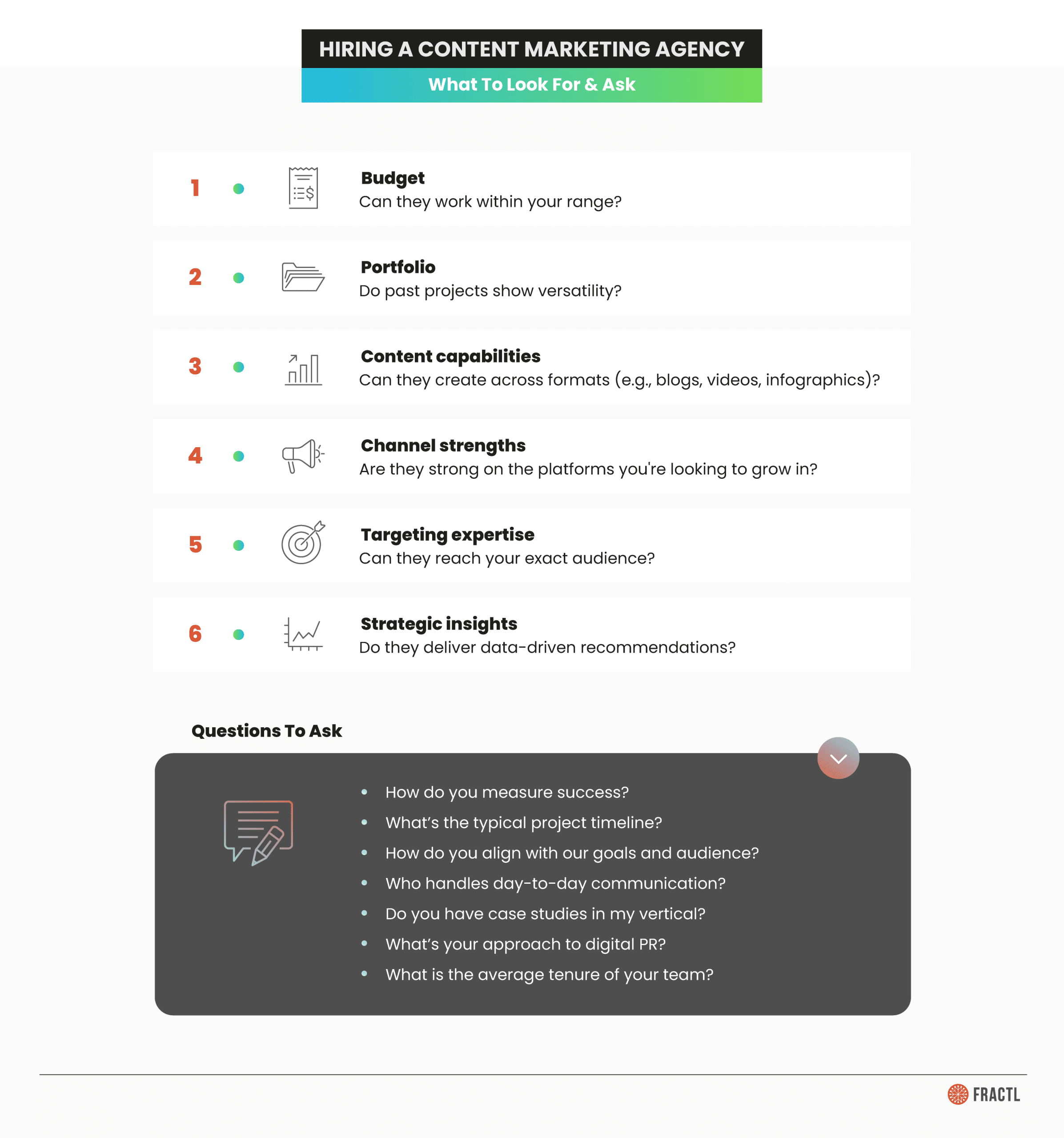
Key factors to evaluate include:
- Budget. Establish clear financial expectations upfront and focus on partners that can deliver results within your budget.
- Portfolio. Review past work to assess the agency’s ability to adapt across formats, industries, and brand voices.
- Content capabilities. Seek partners who can execute beyond single assets, with experience building content hubs, leading data journalism initiatives, launching interactive tools and calculators, and extending impact through social amplification.
- Channel strengths. Evaluate where the agency performs best, whether that’s earned media, organic search, social distribution, or industry-specific strategies.
- Targeting expertise. Ensure the agency can identify and reach the right audiences using research-backed targeting and distribution methods.
- Strategic insights. Prioritize partners who go beyond execution to provide data-driven recommendations, testing frameworks, and measurable outcomes.
Questions To Ask a Content Marketing Agency
Before choosing a partner, it’s important to ask the right questions. These discussions help you determine if the agency is a good fit for your needs and can produce measurable results:
- How do you measure content marketing success? Agencies should provide you with clear metrics and reporting methods that your team can easily understand.
- Can you walk me through a typical project timeline? A detailed overview shows how they structure workflows and hit deadlines, and what you should expect.
- How do you align projects with my goals and target audience? Tailored strategies matter for reaching the right person on across search, social, and AI-driven discovery.
- Who manages day-to-day communication? Clarifying this upfront prevents confusion and encourages accountability.
- Do you have case studies in my vertical? Each niche thrives with slightly different strategies, so it’s important that an agency has experience working in your industry.
- What’s your approach to digital PR? Avoid agencies that rely on mass outreach or paid placements, as these can damage your brand’s reputation and visibility. Instead, look for teams known for high-touch outreach and trusted relationships with reputable publishers in your niche to earn media and brand mentions that build authority.
- What is the average tenure of your team, or the people I’ll be working with directly? High turnover can mean junior team members are driving strategy, whereas a stable, experienced team has already proven its expertise in driving results.
KPIs To Look for When Evaluating Agencies
Tracking performance requires more than surface-level results. These metrics provide insight into the strength of an agency’s content marketing efforts:
- Organic traffic growth. Increased non-paid visitors show improved visibility and search engine performance.
- Engagement metrics. Bounce rate, time on page, and shares reflect how users interact with content and overall user experience.
- Conversion metrics. Downloads, leads, or sign-ups demonstrate whether campaigns drive meaningful results.
- Search engine rankings. Higher positions and stronger keyword visibility signal strong optimization practices.
- Content quality. The depth, clarity, and value of deliverables indicate whether the agency consistently produces valuable content and the best content types for your brand.
- Earned media performance. Metrics like unique linking domains (ULDs), domain authority, and coverage from mainstream and niche-relevant publishers demonstrate an agency’s effectiveness in securing high-quality media placements that establish authority and drive referral traffic.
These KPIs highlight whether an agency creates effective content that aligns with long-term goals.
How To Score and Compare Agencies
After researching potential partners, use a clear checklist to compare your options and find the perfect match. Use these criteria to guide your decision-making:
- Strategic alignment. Assess how well the agency matches your business goals and long-term strategy.
- Content capabilities. Make sure the agency can create the types of content your audience wants — like blogs, videos, podcasts, or infographics — that keep people interested and coming back.
- Case studies and ROI. Review past results and metrics to see if they consistently drive engagement and measurable returns.
- Execution and timeliness. Evaluate whether they meet deadlines and maintain quality standards.
- Cultural fit. Consider communication style, transparency, and shared values to ensure collaboration is smooth.
- Trustworthiness. Run a trial project to test reliability and ability to deliver against expectations, and review third-party validation. Fractl, for example, is ranked as Clutch’s top content marketing company — a distinction that reinforces proven results and client satisfaction.
- Innovation and adaptability. Check their awareness of trends and ability to evolve various types of content across new platforms and channels.
Examples of Great Content Marketing in Action
Some of the best lessons come from real-world case studies. Here are a few examples from Fractl that show how content marketing can deliver measurable growth:
Health Tech Brand Achieves 2,124% Traffic Growth in 7 Months
Fractl partnered with a health tech company to accelerate its organic growth through high-impact content and link building. Over just seven months, the site saw a 2,124.8% increase in organic traffic, adding more than 24,000 new monthly visitors and boosting traffic value by $45,686. Referring domains jumped by 749.2%, page views hit 3.86 million, and domain authority rose nearly 95%.
Financial Brand Gains 520K Monthly Visitors Through Strategic Link Building
A financial solutions company turned to Fractl for long-term SEO gains. Over two years, Fractl’s link-building campaigns helped drive a 119% increase in organic traffic and a $354,000 jump in monthly traffic value. The brand gained 520,000 new monthly visitors, a 14% boost in domain authority, and a 421% rise in referring domains.
Fractl Helps a New Energy Brand Rank for 500+ Keywords
A client in the deregulated energy space started with no domain authority and no content library. Fractl created 50 in-depth pillar articles using AI-assisted frameworks and expert editorial oversight. Within months, the brand ranked for more than 500 keywords and earned placements in outlets like Dallas News and MSN.
Fanatics: 1,100% Traffic Growth in Six Months
Fractl helped Fanatics relaunch its We Are Fanatics blog and blend evergreen and timely content. Over six months, the brand achieved a 1,100% increase in organic search traffic and a 230% rise in ranking keywords, with placements on outlets such as USA Today, MSN, and The Score.
How Successful Content Marketing Supports Business Goals
When tied directly to business objectives, content marketing becomes a driver of measurable growth and stronger customer relationships. Key ways it supports business goals include:
- Organic growth. Drive search rankings and organic traffic through refined SEO practices.
- Lead quality. Refine your targeting and use clear, focused messaging to attract the right audience — helping you build genuine interest while avoiding wasted spend on leads that aren’t a good fit.
- Credibility. Build trust with consistent, high-value content that reinforces expertise.
- Brand awareness. Increase visibility across channels, making prospects more likely to trust and convert.
- Sales enablement. Equip sales teams with content that supports conversations and drives purchase decisions.
- Long-term ROI. Align campaigns with revenue objectives to deliver sustainable returns.
- GEO strategies. Measure how content and brand mentions drive brand visibility on AI-discovery platforms.
Choosing the Right Fit for Your Needs
Finding the right agency is all about compatibility. Before making a decision, you need to consider the following factors:
- Agency size vs. company growth. A boutique agency may provide more personalized service, while larger firms can scale with rapid expansion and broader bandwidth.
- Internal team support. Evaluate how well an agency complements your marketing staff, whether through strategy, production, or campaign management.
- Industry specialization. Some agencies focus on specific verticals such as health care, while others serve a wide range of markets. Choosing the right focus ensures better alignment with your audience.
- Support model. Decide whether your needs call for full-time retainer-based support, project-based flexibility, or hybrid structures.
Matching agency structure to your priorities helps ensure a permanent position for content marketing within your broader strategy, which ultimately opens doors to brand growth.
Social Media and Influencer Content: What To Expect
Strong social campaigns require more than eye-catching visuals. Agencies must deliver clear strategies that reach audiences with maximum engagement. They should be able to demonstrate:
- Platform expertise. Look for experience across leading social media platforms, from TikTok and LinkedIn to emerging channels where your audience is active.
- Strategic posting. Consistent, optimized social media posts drive visibility and support long-term goals. A structured content calendar ensures social media content aligns with campaigns.
- Successful influencer partnerships. Many agencies now find micro-influencers who reflect brand values and connect with audience demographics. This method improves credibility and builds trust through genuine endorsements.
Handled well, social media marketing can support audience growth through precise optimization.
Ready to find the right partner? Work with Fractl to build content marketing campaigns that drive measurable growth, improve visibility, and deliver long-term ROI.
FAQs About Hiring a Content Marketing Agency
Many companies have similar questions when considering hiring an agency for content creation. These FAQs address common concerns about costs, timelines, and tools.
What Should I Expect To Pay for Content Marketing Services?
Pricing varies widely depending on the scope of work and the agency’s level of experience. You may pay up to $70,000 per month for an in-depth strategy. A smaller service provider may charge less, while larger teams offering full services command higher rates. Always ask what deliverables are included in monthly packages, from blog posts to keyword research, so you know exactly what you’re getting.
How Long Before I See Results?
Most businesses start noticing meaningful improvements in SEO and brand awareness within three to six months. Early signs may include better engagement on posts and steady growth in organic traffic. While content marketing results depend on campaign size and industry, consistent execution helps agencies adapt to shifting marketing trends and accelerate performance over time.
What Tools Do Agencies Typically Use?
Agencies rely on a mix of different technologies and techniques. For example, they may use tools like Clearscope to do keyword research and facilitate content creation, while scheduling software supports automation across multiple channels.
Project management platforms also help teams coordinate, keeping assignments organized and improving collaboration. These tools align efforts with marketing trends while ensuring a smooth workflow for every campaign.