




Table of Contents
- What Is a Digital PR Agency and How Does It Work?
- Digital PR vs. Traditional PR
- Why Hire a Digital PR Agency?
- KPIs To Measure Earned Media Success
- Questions To Ask Before Hiring a Digital PR Agency
- Create a Digital PR Agency Scorecard
- Examples of Successful Digital PR Campaigns
- How To Choose the Right Digital PR Agency for Your Business
- Build a Partnership That Drives Results
- FAQs About Hiring an Agency for Digital PR
Hiring an agency to manage your digital PR efforts is a major long-term investment in your brand’s reputation and growth. A digital PR agency combines media relations, search engine optimization (SEO), and digital marketing to secure high-quality brand mentions that increase your brand authority, visibility, and engagement.
You need to carefully review agencies to avoid missing key performance indicators (KPIs) and wasting your budget. Make confident and informed choices by learning what to ask, which metrics to track, and how to assess proposals.
I’ll go over exactly what to look for, including KPIs, essential vetting questions, and customizable scorecards, to help you find a digital PR partner that gets results and aligns with your goals.
What Is a Digital PR Agency and How Does It Work?
An effective digital PR strategy improves your brand’s visibility across search, social, and GenAI platforms by combining data, storytelling, and SEO strategies to earn brand mentions on trusted, high-authority sites. These brand citations develop a digital footprint of your expertise and authority online, which increases your brand’s qualified traffic across numerous channels where your target market resides.
A digital PR agency typically manages the full lifecycle of a content marketing campaign, including:
- Developing newsworthy, data-driven content that captures media and audience interest
- Pitching to journalists and securing brand mentions from authoritative mainstream news sites and niche-relevant publishers
- Tracking performance to show measurable impact on brand visibility and qualified search traffic
By aligning creative storytelling with measurable SEO outcomes, digital PR ensures that every campaign not only earns attention but also drives real business results.
Core Functions of Digital PR Agencies
Digital PR agencies serve as extensions of your marketing team, handling ideation, content creation, outreach, and relationship building at scale. They pitch stories to journalists, bloggers, and media outlets to earn high-authority brand mentions that strengthen your brand’s entity, authority, and visibility across search, social, and GenAI platforms.
Here’s how most agencies operate:
- Content creation. Teams produce newsworthy data studies that capture the interest of journalists and your target market.
- Media outreach. Digital PR teams build compelling pitches tailored to individual journalists to earn brand mentions.
- Placement delivery. Agencies secure authoritative backlinks and brand citations that improve search engine rankings and brand visibility in GenAI platforms.
Hiring an agency that’s experienced in these strategies can significantly reduce the amount of time you spend hiring, training, and managing teams to replicate these processes, while also allowing you to tap into that agency’s rolodex of established contacts and industry trust.
Benefits of Digital PR Services
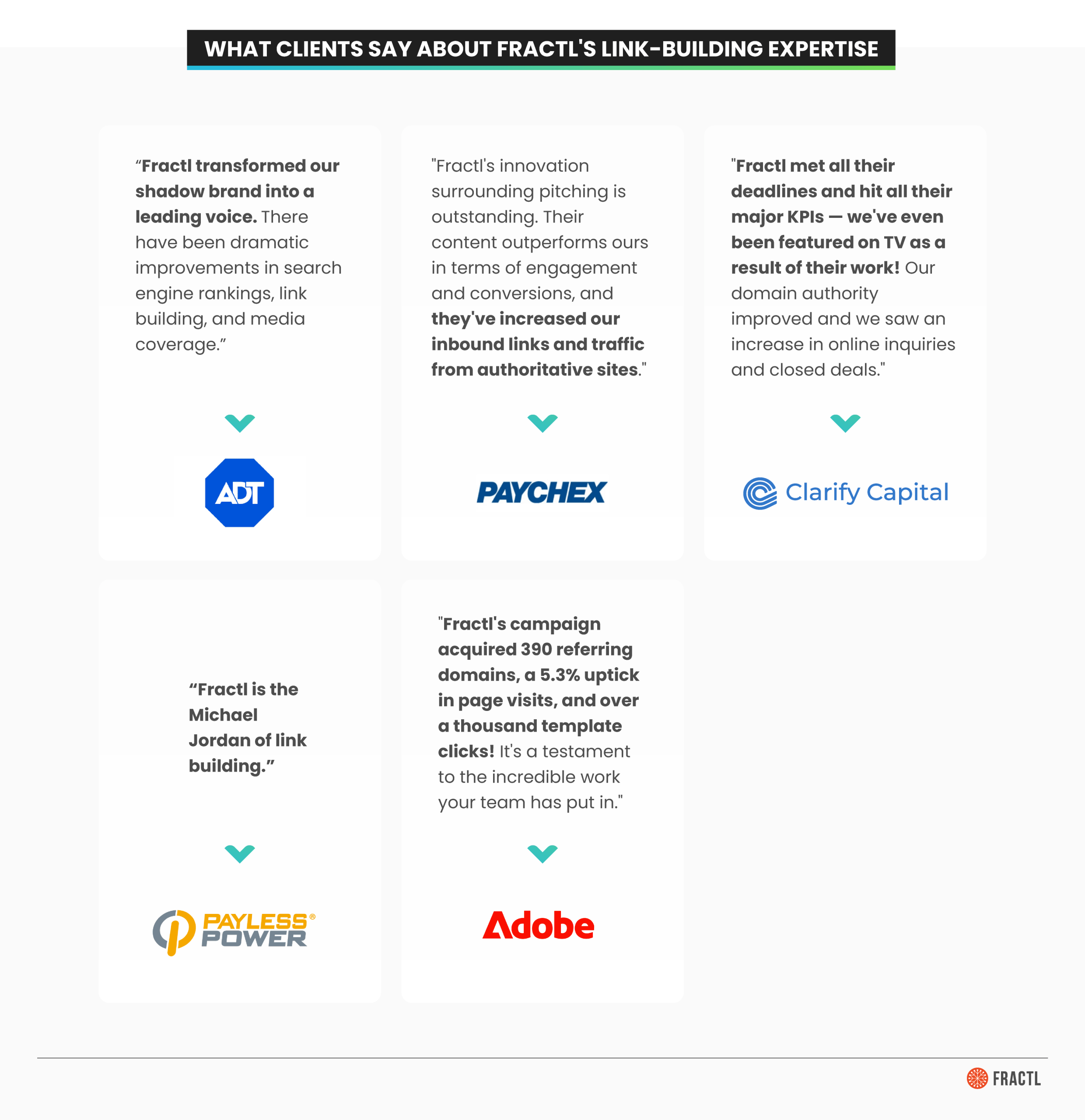
Digital PR services drive measurable outcomes that support long-term brand growth. In addition to visibility, these efforts directly impact your SEO and online credibility.
Key benefits include:
- High-quality brand mentions and backlinks. Digital PR helps brands earn coverage across mainstream media outlets, niche industry publishers, podcasts, YouTube channels, and social creators, expanding brand visibility across the platforms where audiences consume information.
- Stronger entity authority and brand visibility. Coverage in trusted publications reinforces your brand as a recognized entity, strengthening credibility signals across search engines and AI discovery platforms.
- Expanded brand awareness and audience reach. Strategic media placements amplify your presence across search engines, social platforms, and creator channels, introducing your brand to new audiences while reinforcing visibility among existing ones.
When executed strategically, digital PR drives both immediate brand visibility and long-term organic growth through stronger authority signals, media coverage, and sustained qualified traffic.
Digital PR vs. Traditional PR
Digital PR and traditional PR share a common goal: increasing brand visibility. However, they achieve this through very different channels and outcomes.
Traditional PR focuses on offline media such as print publications, television, and radio. While these placements can build awareness, their impact is often difficult to measure and rarely contributes directly to search performance or long-term organic discovery.
Digital PR, by contrast, is designed to support modern search and content ecosystems. Through data-driven content, newsworthy campaigns, and targeted publisher outreach, digital PR earns high-authority media coverage and brand citations that strengthen search visibility and drive qualified traffic.
As search engines, social platforms, and generative AI increasingly shape how people discover and evaluate brands, digital PR has evolved from a supplementary tactic into a core driver of organic visibility and brand authority.
Digital PR Advantages
Digital PR doesn’t just boost rankings — it future-proofs your brand’s visibility in both human and machine-powered ecosystems. Blending data-driven storytelling with SEO-aligned outreach helps brands stay present in the shrinking landscape of “influenceable” content that AI systems and journalists actually cite.
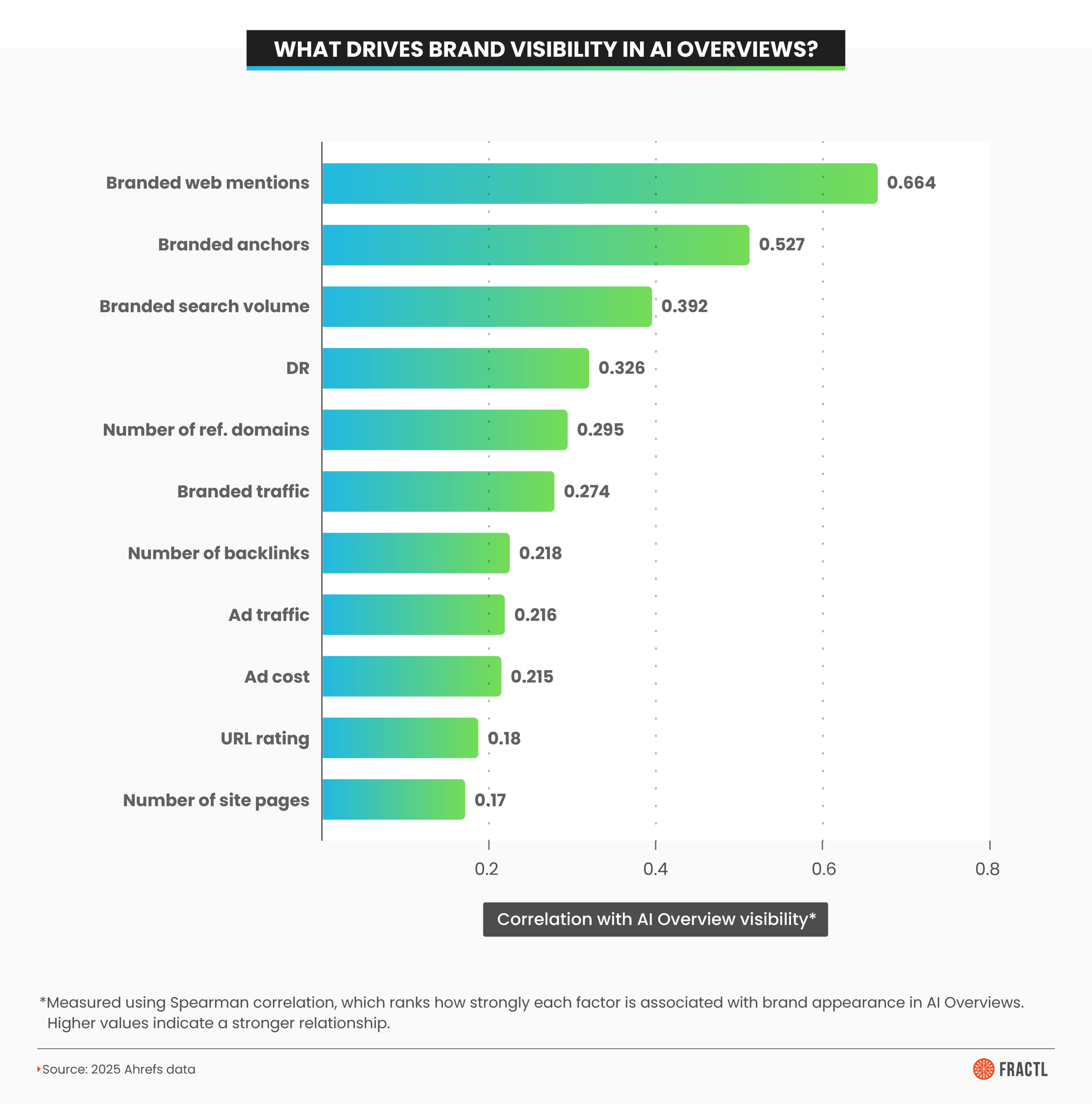
Ahrefs’ 2025 study of roughly 75,000 brands found that branded web mentions correlate more than three times as strongly with AI Overview visibility than traditional backlink counts.
These advantages make digital PR the go-to strategy for CMOs aiming to strengthen brand authority, search equity, and AI discoverability — even in today’s crowded and increasingly algorithmic market:
- Link-building with SEO & AI impact. The strongest correlating factors for visibility in Google’s AI Overviews and ChatGPT citations still trace back to earned authority — domain trust, branded mentions, and strong backlink profiles. A digital PR campaign earns links and unlinked brand mentions from reputable, context-rich media that improve both search and generative-engine visibility.
- Improved authority across ecosystems. From top-tier press to long-tail educational hubs, strategic placements and thought-leadership content create a halo effect — increasing branded web mentions, which Ahrefs found correlate 10× more strongly with AI visibility than backlinks alone.
- Scalable, influenceable media outreach. Only one-third of the web is truly “pitch-worthy,” according to Ahrefs’ 2025 study of ChatGPT citations. Digital PR taps that influenceable third — research-driven media, explainers, blogs, and educational content — to secure placements that not only earn authority but feed into how AI systems learn about your brand.
Traditional PR Limitations
While traditional PR can help build brand credibility, it also comes with clear limitations — especially for SEO-focused campaigns. Because its focus remains on offline media, traditional PR doesn’t generate backlinks or improve your position in search results.
Another drawback is measurement. Without tools like Google Analytics, traditional PR efforts are difficult to quantify. Digital PR, by comparison, provides detailed performance data, allowing marketers to track outcomes like referral traffic, earned media value, and domain authority gains.
Why Hire a Digital PR Agency?
A digital PR agency helps brands grow by improving their reputation, increasing visibility, and building trust with the right audience. These agencies combine content creation, media outreach, and SEO strategy to deliver results that align with broader marketing goals.
Hiring the right agency can offer:
| 🏆 Reputation building High-quality placements in reputable outlets shape a brand’s reputation and enhance credibility. | 📈 SEO growth Strategic outreach earns backlinks that boost search engine rankings and organic traffic. | 🤝 Audience trust Storytelling, data, and expert commentary help connect with your target audience on a deeper level. |
| 📣 Influencer integration Many agencies partner with influencers and creators to extend reach across platforms. | 🎯 Strategic alignment Agencies can tailor PR efforts to support human resources campaigns, staffing solutions, or job market visibility, making them a perfect match for brands seeking top talent. |
KPIs To Measure Earned Media Success
Measuring Digital PR success in 2026 means expanding how we define visibility. Traditional metrics like backlinks and rankings still matter, but they’re only part of the story. As AI search ecosystems evolve, the real measure of authority is how consistently your brand appears across search engines, social ecosystems, and LLMs.
The right KPIs connect your storytelling efforts to tangible business outcomes, helping you scale what works and defend ROI to stakeholders.
Core digital PR KPIs include:
| 💬 Earned mentions and media quality Go beyond counting placements — evaluate the quality of earned coverage by domain authority, sentiment, and topical alignment. A single DA 70+ placement on a relevant, high-context outlet can yield longer-term visibility than dozens of generic low-authority mentions. | 👑 Domain and page authority Monitor Domain Rating (Ahrefs), Domain Authority (Moz), or Authority Score (Semrush) to evaluate how earned media improves domain trust — one of the strongest long-term predictors of SEO and AI Overview visibility. |
| 💰 Engagement and conversions Monitor key actions such as signups, demo requests, or sales influenced by PR exposure. Use assisted conversion reporting to capture PR’s indirect impact on revenue and brand lift across the funnel. | 🔍 Keyword and SERP visibility Track rankings for mid- to bottom-funnel keywords targeted in PR-linked content. Combine with share-of-voice analysis to understand how earned coverage impacts your competitive visibility across SERPs. |
Next-Generation KPIs for the AI Search Era
As AI search transforms discovery, visibility now depends on how both humans and machines interpret, cite, and trust your brand. These emerging KPIs align Digital PR with AI-driven discoverability:
- Brand visibility across LLMs. Track where and how often your brand appears in generative platforms like ChatGPT, Gemini, Claude, and Perplexity. Tools like Fractl’s LLM Visibility Tracker (part of Fractl Agents) or Ahrefs Brand Radar can benchmark your presence across models.
- Share of voice in AI search. Measure how your brand compares to competitors within AI-generated answers (e.g., Google AI Overviews, Bing Copilot). This KPI reflects how effectively your earned and owned content shapes machine-generated narratives.
- AI search visibility by topic. Segment visibility by topic or vertical — finance, health, tech, energy, etc. — to identify where your campaigns are earning traction and where your expertise still needs reinforcement.
- AI-influenced traffic & conversions. Look for attribution patterns linked to AI surfaces, such as branded query spikes or referral growth following AI Overview exposure. This emerging metric quantifies the real-world impact of generative visibility.
- Branded search demand. Track growth in branded keyword volume and impressions—one of the strongest indicators of PR-driven awareness. Ahrefs’ 2025 study found that branded search and web mentions correlate far more strongly with AI Overview visibility than backlinks alone.
- Brand mentions (linked + unlinked). Monitor both linked and unlinked mentions across media, social, and niche publications. LLMs rely on textual and contextual mentions — not just hyperlinks — to understand brand authority.
- Trust & authority signals (E-E-A-T). Measure improvements in expert bylines, data citations, and consistent messaging across your brand footprint. These signals shape how AI systems and audiences perceive your brand’s reliability and domain expertise.
Questions To Ask Before Hiring a Digital PR Agency
A good digital PR partner doesn’t just chase links. They know how to build authority, tell compelling stories, and drive visibility across search, social, and AI ecosystems.
To separate true strategic partners from vendors, ask questions that reveal whether an agency can deliver measurable, compounding ROI:
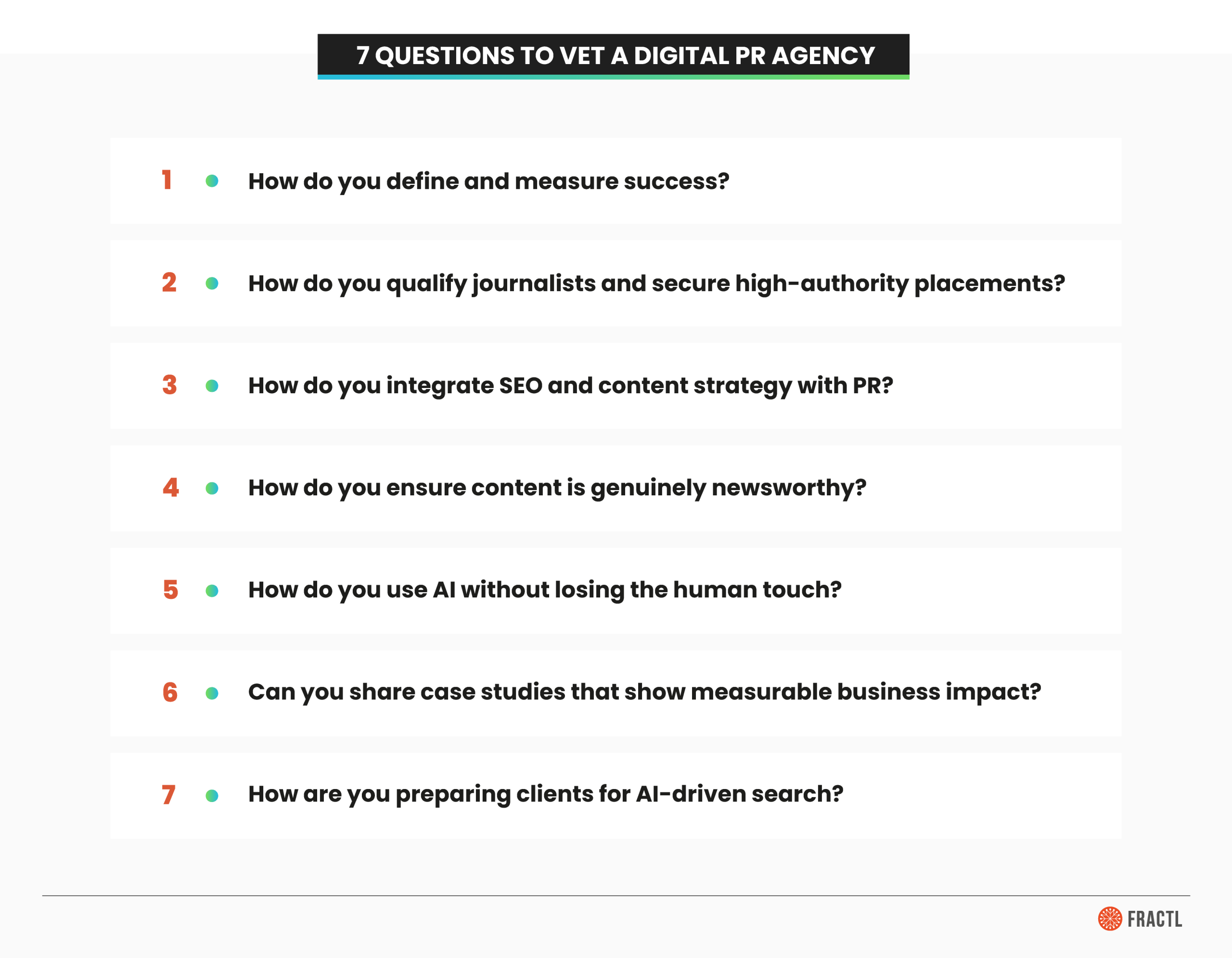
1. How do you define and measure success?
If the answer stops at “links,” that’s a red flag. Modern digital PR and content marketing campaigns should be evaluated across SEO KPIs that reflect both on-site performance and off-site influence.
Digital PR performance is measured across earned media, SEO, and business impact. Key indicators include press mentions, social shares, referral traffic, and coverage across influential publishers and creator platforms. We also track search rankings, high-quality backlinks, brand mentions, and branded search demand to evaluate SEO impact. Finally, we measure qualified traffic growth across search, referral, and social channels, along with downstream outcomes such as lead generation and sales influence.
As search engines, social platforms, and generative AI tools increasingly shape how audiences discover brands, we also monitor the AI media partnerships influencing these platforms to ensure campaigns drive both immediate earned media coverage and sustained long-term visibility.
2. How do you qualify journalists and secure high-authority placements?
Ask about their approach to media targeting. The best teams use relationship-driven outreach, not spam lists. They understand which newsrooms, beats, and bylines align with your story, and how to position data to fit journalists’ editorial calendars.
3. How do you integrate SEO and content strategy with PR?
Strong PR campaigns should strengthen your site’s topical authority and mid-bottom funnel visibility. Ask how they connect earned media with on-site content hubs, tools, FAQs, and pillar pages that attract qualified traffic long after a campaign launches.
4. How do you ensure content is genuinely newsworthy?
Look for an agency that validates ideas using data journalism, surveys, and subject matter experts, not just trending topics. Fractl’s research-backed creative and Digital PR processes are rooted in more than a decade of proprietary marketing research, which is how our agency became the #1 trusted content marketing agency on Clutch.
5. How do you use AI without losing the human touch?
AI should enhance, not replace, relationship building. Ask how they use AI to scale processes responsibly (prospecting, scoring, personalization) while keeping pitching and storytelling human-led. At Fractl, our proprietary agentic workflows streamline production and list building, freeing our team to focus on creativity and human connection.
6. Can you share case studies that show measurable business impact?
The right partner should show quantifiable outcomes: increased organic traffic, branded search volume, domain authority, and even acquisition-stage results. Look for transparent reporting and examples of coverage from reputable media brands relevant to your niche.
7. How are you preparing clients for AI-driven search?
As Google AI Overviews, ChatGPT, and other LLMs shape how information is discovered, your agency should already be tracking brand mentions, citations, and visibility across AI platforms. Fractl’s team leads the industry in Generative Engine Optimization (GEO), helping clients future-proof their visibility where AI systems source and cite brands.
👉 Want to see how Fractl builds brand visibility across both search and AI ecosystems? Explore our case studies ›
Create a Digital PR Agency Scorecard
Using a scorecard can simplify agency comparisons and keep your decision-making focused on what matters most: results, alignment, and expertise.
Evaluate potential partners using the following criteria:
- Backlink quality. Assess whether the agency earns links from reputable — and relevant — sites that improve SEO.
- Content quality. Review samples to ensure their work reflects audience alignment and strong thought leadership.
- Placement track record. Examine featured placements for other clients and the frequency of securing high-value coverage.
- Strategic fit. Determine whether their digital PR strategy aligns with your larger marketing goals.
- Team and experience. Consider the PR team’s size, experience, and ability to collaborate effectively.
- User experience. Look at how their campaigns perform from a customer or end-user perspective — is the messaging clear and engaging?
Download our Digital PR Agency Scorecard PDF to assess and compare agencies based on the criteria that matter most to your brand’s success. Rate each category and track notes to make a confident, informed decision.
Examples of Successful Digital PR Campaigns
Let’s review three examples of digital PR campaign that garnered real results.
Recovery Brands: 1,100% Organic Traffic Growth Through 90+ Campaigns
In partnership with Fractl, a wellness brand focused on helping families in addiction recovery ran 90+ campaigns that collectively drove a 1,100% increase in organic traffic, 4 million page views, and over 1.2 million social shares. These campaigns were featured in outlets including The Atlantic, Vice, The Guardian, and Business Insider.
Fractl tailored content formats — from interactive features to quizzes — to match audience interest, all while maximizing press coverage and authority.
Superdrug Online Doctor: 238% Traffic Growth and 1.6 Million Social Shares
Over a 16-month engagement, Fractl produced 26 campaigns for Superdrug Online Doctor with the goal of improving off-page SEO. The team leaned into broadly appealing, tangential content, connecting the brand’s health and wellness products to topics with wide audience interest.
One standout campaign, Perceptions of Perfection, asked graphic designers across the globe to Photoshop the same image of a woman based on their country’s beauty standards. BuzzFeed’s coverage alone earned more than 3.5 million views, and the campaign generated over 925,000 social shares.
Across all 26 campaigns, Fractl secured placements in the New York Times, CNN, Yahoo, Huffington Post, Mashable, and BuzzFeed — driving a 238% increase in organic search traffic.
Porch: 3,500+ Press Mentions and National Broadcast Coverage
During a 12-month partnership, Fractl earned Porch.com more than 3,500 individual press mentions and nearly 38,000 social shares through a mix of on-brand and tangential content campaigns. The work earned widespread national coverage from NPR, CBS, NBC, The Washington Post, The View, and Forbes, among others, and added over 23,000 new monthly site visitors.
Fractl’s success with the engagement also led to an expanded contract into traditional PR services, including byline placements and press release distribution for Porch’s network.

How To Choose the Right Digital PR Agency for Your Business
Selecting the right digital PR agency requires a strategic approach that balances staffing needs, goals, and fit. Use these suggestions to guide your hiring process.
Define Staffing Needs and PR Goals
To find quality candidates who are equipped to deliver effective results, you need to understand your goals. Before you begin outreach, clarify your internal bandwidth and campaign objectives:
- Are you looking for short-term support or a long-term PR team?
- Do you need placements to support a product launch?
- Do you want ongoing link-building for SEO?
These questions will help you find quality candidates who are equipped to deliver effective results.
Review Case Studies and Past Results
Ask each service provider for a case study or campaign breakdown and review it for results that align with your business goals.
Some of the results to look for include:
- Actionable leads
- High-value conversions
- Quality backlinks
- Increased brand visibility
If the agency is unable to demonstrate success, you may need to keep looking for one that can achieve the results you need.
Assess Pricing and Fit
Pricing models can vary significantly. Compare proposals for clarity and fit with your budget. Make sure that the agency’s service model suits your team’s workflow.
Require Cultural and Strategic Alignment
Consider more than credentials. A strong agency-client relationship often comes down to shared values, communication style, and creative alignment.
Build a Partnership That Drives Results
Choosing a digital PR agency is about building a partnership that moves your brand forward. Carefully vet each agency before hiring one to ensure you get measurable, SEO-driven outcomes from your PR efforts.
- Use KPIs and scorecards. These tools enable data-backed decision-making and keep campaigns accountable.
- Prioritize alignment. Successful digital PR partnerships are built on trust, shared goals, and compatible values.
- Invest in a long-term strategy. The right agency won’t just earn coverage — they’ll support your goals for SEO, brand awareness, and sustained growth.
Ready to find a partner who delivers real impact? Explore Fractl’s digital PR services to see how our team can support your next campaign.
FAQs About Hiring an Agency for Digital PR
Hiring a digital PR agency can raise many questions, especially when it comes to measuring success, understanding trends, and choosing the right partner. We answer the most common questions businesses ask when exploring digital PR support.
What trends are shaping digital PR today?
Digital PR continues to evolve as new platforms, strategies, and content formats emerge. Key trends include:
- Influencer marketing and podcasts. Brands are teaming up with influencers to appear on podcasts so they can connect with specific audiences on social media.
- Social-first storytelling. Campaigns are designed for social sharing. Media pitches often include customization for the most popular platforms like LinkedIn, Instagram, and TikTok.
- Data-driven decision-making. Tools like Google Analytics help PR teams monitor what’s working, while trending topics provide fresh angles for media outreach.
- Industry-specific momentum. Sector alignment is critical — what works in health care may not work for a human resources company.
These shifts are helping brands move faster, reach broader audiences, and tie PR efforts directly to performance metrics.
How do you measure the success of a digital PR campaign?
A successful digital PR campaign shows measurable impacts. Key KPIs to monitor include:
- Domain authority. Higher authority signals stronger SEO performance.
- Website traffic. Look at both total and organic traffic to assess reach.
- Conversions. Track form fills, downloads, or purchases tied to PR exposure.
- Referral traffic. Use analytics tools to see the amount and types of traffic that come from media placements.
- Search engine rankings. Monitor how your keywords perform over time.
- Brand mentions. Measure the volume and sentiment of your brand coverage across online platforms.
Together, these metrics offer a complete view of campaign performance and long-term value.
What are the benefits of hiring an agency for digital PR?
Hiring a digital PR agency provides access to expertise, media connections, and the tools needed to scale quickly. Key benefits include:
- Time savings. Agencies handle outreach, reporting, and content creation, which gives your team more time to focus on their own tasks.
- Media access. Agencies maintain relationships with journalists, bloggers, and high-authority media outlets.
- Influencer network. Many teams also coordinate influencer campaigns for expanded reach.
- SEO support. PR efforts generate backlinks and brand mentions that directly improve search rankings.
An experienced digital PR agency can be a powerful extension of your marketing team and help you gain visibility, authority, and trust faster.