




Table of Contents
- What Commodity and Non-Commodity Content Are
- Why AI Search Is Killing Commodity Content
- Commodity vs. Non-Commodity, by the Numbers
- Five Same-Topic Pairs, Head to Head
- What Makes Content Non-Commodity
- Audit Your Content
- Stop Publishing What AI Can Reproduce
- Frequently Asked Questions
Key Takeaways
- Commodity content is what AI can already reproduce. Generic, common-knowledge pages like “7 tips” listicles add little that an AI model can’t generate on its own.
- Non-commodity content is irreproducible. Original data, firsthand experience, and a unique angle are what AI can’t replicate.
- The performance gap is stark. In our portfolio, non-commodity pages were nearly twice as likely to earn backlinks and held their rankings far longer than commodity equivalents.
- Commodity content fades fast. It ages out, and your own commodity pages end up competing for the same keywords, while research-backed content keeps compounding.
Google has a name for the kind of content AI can reproduce on its own: commodity content. In its guide to optimizing for AI search, Google describes commodity content as material “based on common knowledge” that “adds little unique insight,” and contrasts it with non-commodity content that offers “unique expert or experienced takes that go beyond common knowledge.” Google’s Search Liaison, Danny Sullivan, introduced the framing at Search Central Live in Toronto in April 2026, and the guide put it in writing weeks later.
The distinction decides whether you get traffic at all, because AI Overviews, AI Mode, and assistants like ChatGPT already answer the generic questions commodity content was built for. The brands that still win build content AI can’t replicate, and our own portfolio data shows exactly how much that pays off.
What Commodity and Non-Commodity Content Are
Google frames good, non-commodity content with three qualities, and each one is the opposite of what commodity content does:
| Non-commodity content | Commodity content |
|---|---|
| Unique: Brings a viewpoint or data others can’t easily replicate. | Restates common knowledge anyone could write, like “7 Tips for First-Time Homebuyers.” |
| Specific: Covers a real instance, like “Why We Waived the Inspection and Found a $15k Sewer Problem,” not general rules. | Repeats what the top of the SERP already says. |
| Authentic: Demonstrates firsthand knowledge and direct experience. | Could be produced by a generative AI model. |
In practice, ask: does the page deliver real information gain, the mark of genuinely helpful content, or restate what’s already ranking? That’s the experience and expertise behind E-E-A-T, and the line between content quality and filler AI can generate on demand.
Why AI Search Is Killing Commodity Content
Commodity content had one job: rank for a high-volume keyword and collect the clicks. AI search breaks that model. When someone asks a generic question, the user intent behind it is already satisfied by AI Overviews and AI Mode on the results page, and by assistants like ChatGPT in the chat, so the click that used to reward a “what is” page never happens. As AI-generated content absorbs that demand and large language models (LLMs) answer it directly, the click-through rate on commodity pages erodes toward zero, no matter how much keyword research went into them.
What AI can’t do is invent your data or your experience. Generative engine optimization (GEO) and answer engine optimization (AEO) reward the sources models can’t reproduce, which is why chasing search volume with commodity content is a losing keyword-targeting strategy, and non-commodity content is the one that earns citations.
Commodity vs. Non-Commodity, by the Numbers
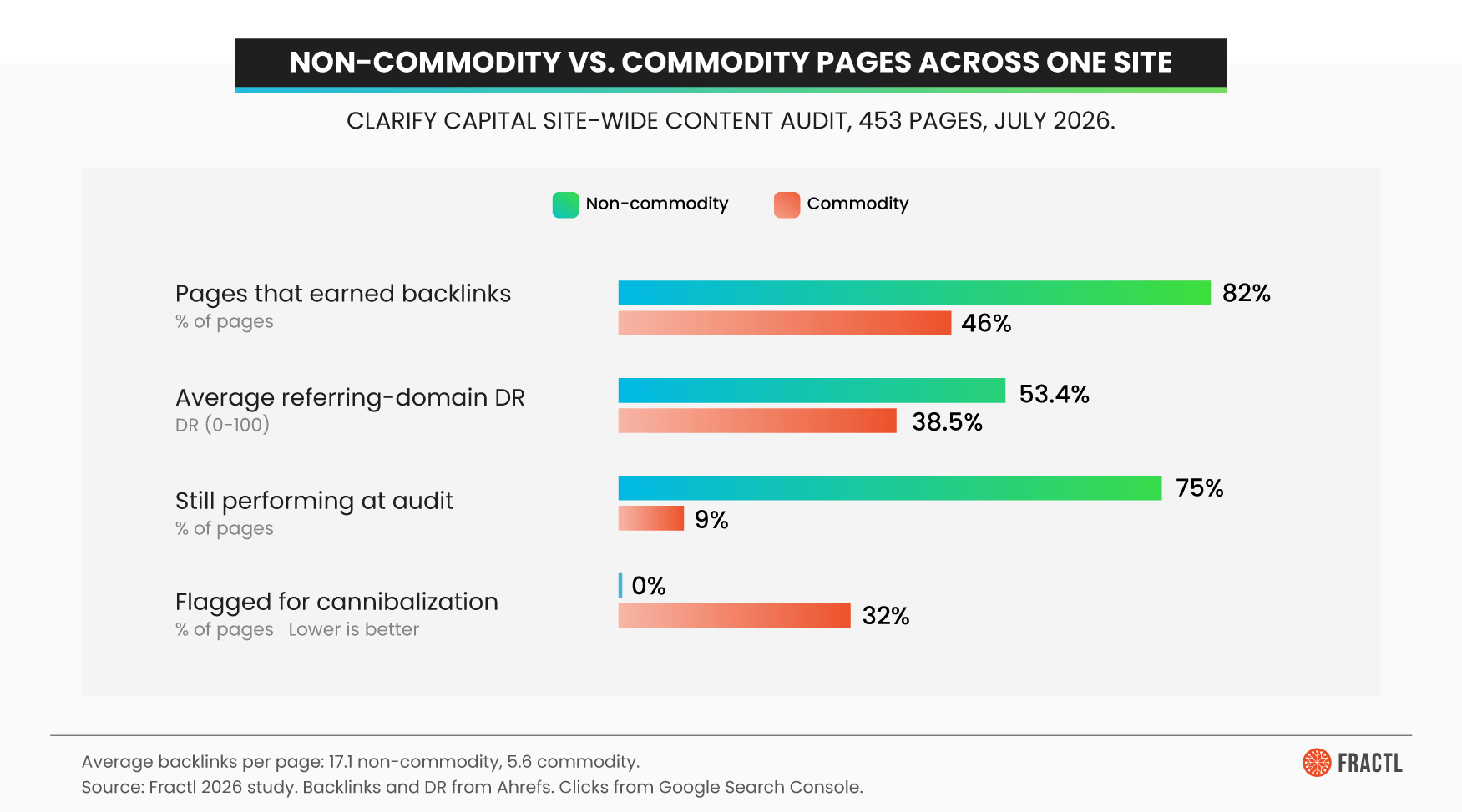
We ran the comparison on a real portfolio. In Clarify Capital’s site-wide content audit (453 pages, July 2026), we scored every page as commodity or non-commodity, then pulled backlink data from Ahrefs and traffic from Google Search Console.
| Metric | Non-commodity | Commodity |
|---|---|---|
| Pages that earned backlinks | 82% | 46% |
| Average referring-domain DR | 53.4 | 38.5 |
| Average backlinks per page | 17.1 | 5.6 |
| Still performing in a pruning audit | 75% | 9% |
| Flagged for keyword cannibalization | 0% | 32% |
Source: Clarify Capital content audit, 453 pages, July 2026. Backlinks and DR from Ahrefs; clicks from Google Search Console.
The links non-commodity content earns come from higher-authority domains, the kind of press and editorial sites that would never link to a financing guide, so they build real topical authority rather than padding a link count. And research-backed pages hold up: most were still performing at audit time, and none were splitting their own rankings, while commodity pages aged out and competed with one another for the same keywords. Traffic came in comparable either way, so the research pages gave up nothing on visibility while earning the authority commodity can’t.
Five Same-Topic Pairs, Head to Head
Averages can hide some of the story, so here are matched pairs from the same brand and domain: a research-backed page and a commodity page targeting the same vertical, measured in the same audit.
| Vertical | Page title | Type | Backlinks | Avg DR |
|---|---|---|---|---|
| Hiring | Job Seekers Beware of Ghost Jobs | Non-commodity | 450 | 53.6 |
| Hiring | Business Loans for Staffing Agencies | Commodity | 0 | n/a |
| Small business | What Percentage of Businesses Fail? | Non-commodity | 76 | 32.5 |
| Small business | Startup Business Loans for New Locations | Commodity | 0 | n/a |
| Dental | The Best US Cities for Dentists | Non-commodity | 10 | 26.4 |
| Dental | Practice Acquisition Loans for Dentists | Commodity | 0 | n/a |
| Restaurants | America’s Food Capitals | Non-commodity | 12 | 66.7 |
| Restaurants | Restaurant Business Loans and Financing | Commodity | 15 | 12.1 |
| Women in business | Best Places for Women Entrepreneurs | Non-commodity | 17 | 40.1 |
| Women in business | 22 Best Business Ideas for Women | Commodity | 0 | n/a |
Pages were classified non-commodity if they scored 5+ of 6 across three dimensions — uniqueness, original research, and first-party data — and commodity if they scored 0. Metrics reflect a July 2026 snapshot; live pages change over time.
In the restaurant pair, the commodity loan page earned more raw backlinks than the research page (15 versus 12), but from far weaker sites: an average DR of 12, against 67 for the food-culture study. The study drew links from real lifestyle and industry press, while the loan page collected low-value links that do little for authority. A high link count is easy to misread, and in AI search, it’s the authority behind the links that earns citations
What Makes Content Non-Commodity
Commodity content is usually a workflow problem, not a writer problem. Template dependency and production-first workflows optimize for volume, so every brief produces another page that looks like the last one. Non-commodity content starts from something the internet doesn’t already have. Four ingredients do most of the work:
 Original data A survey, a dataset, or an analysis no one else has run, which is the hardest thing for AI to reproduce and the easiest to earn links with. |  Firsthand experience Direct experience of doing the thing, shown through a case study or real outcomes a summary can’t fake. |
 A unique angle A specific point of view on the topic instead of the consensus take everyone else publishes. |  Specialist insights Named experts and practitioners who can say something a generalist writer can’t. |
This is the work we do through digital PR and content development: original research that earns coverage, then a content ecosystem that turns that authority into rankings. It’s also what gets you cited by AI, because the formats models pull from most are the ones with something original to pull. For the data on which content types AI cites most, see our analysis of AI citation patterns, and for the broader shift, our study of brand visibility across 22,000+ domains in AI search.
Audit Your Content
Not sure which side of the line your content falls on? Run each page through the questions below. If you can’t point to original data, firsthand experience, a unique angle, or specialist insight, it’s commodity, and AI can already do it better.
Is Your Content Commodity or Non-Commodity?
Score one page against the following signals. The more boxes you check, the further your content sits from the generic, common-knowledge pages AI search now answers on its own.
Want content AI can’t reproduce?
Contact FractlStop Publishing What AI Can Reproduce
The rules didn’t change so much as the stakes did. Generic content was always the weakest play; AI search just removed the traffic that used to make it worth doing. Non-commodity content, the kind built on original research, direct experience, and a real point of view, is now the only content that earns links, survives, and gets cited across search and AI. It’s the foundation of the content marketing model we run for clients: a content strategy built on research worth citing, turned into organic growth that compounds.
If you’re ready to stop publishing what AI can reproduce, reach out to Fractl, and we’ll build content only you can own.
Frequently Asked Questions
What is commodity content?
Commodity content is content based on common knowledge that anyone could write, and that adds little unique insight, like a generic “7 tips” listicle. Google uses the term for pages that could easily be reproduced by a generative AI model.
What is commodity vs. non-commodity content?
Commodity content restates what’s already widely available, while non-commodity content adds something only you have: original data, firsthand experience, a unique angle, or specialist insight. Google introduced the distinction as the standard for content that earns visibility in AI search.
Is SEO dead now with AI?
No, but commodity SEO is fading. AI Overviews and assistants answer generic questions directly, so pages that only restate common knowledge lose their clicks. Non-commodity content that AI can’t reproduce still ranks, earns backlinks, and gets cited.