




Table of Contents
- Key Findings From the Latest AI Citation Research
- The 14% News Figure Doesn't Tell the Full Story
- Google Rankings Are the Strongest Predictor of AI Citations
- Each LLM Cites Publishers Differently
- Longer, More Comprehensive Content Gets Cited More
- Entity Authority Matters More Than Individual Links
- Your Newsroom Is an Untapped AI Visibility Asset
- AI Partnerships and Crawler Blocking Don't Work the Way You'd Expect
- What This Means for Your Digital PR Strategy
- How This Connects to Our Research
I recently joined Vince Nero from BuzzStream for a podcast-style roundtable about something I’ve been tracking closely: which publishers actually get cited by ChatGPT, Perplexity, and Gemini, and what that means for the way we approach digital PR.
The timing made sense. Multiple research teams had just released new data on AI citation patterns, and the findings have real implications for how artificial intelligence is reshaping the digital PR landscape. BuzzStream partnered with Xofu to study how news publications appear in LLM outputs. AirOps analyzed over 548,000 retrieved pages across 15,000 prompts. SearchAtlas examined 5 million citation records across 907,000 domains. Gauge and Growth Memo published vertical-specific data on content length and citation frequency. Together, these studies paint a picture that’s more nuanced than most people realize.
Here’s what the data says, where I agree, where I’d push back, and what I think PR professionals should do with this information.
Key Findings From the Latest AI Citation Research
Before I get into analysis, here are the headline numbers:
- News publications account for 14% of AI citations overall, rising to 18% for decision-making prompts
- 43.2% of ChatGPT’s citations go to Google’s #1 ranking page, 3.5 times higher than the citation rate for pages outside Google’s top 20
- The top 10 domains capture 46% of all citations within a given topic; the top 30 own 67%
- ChatGPT cites internal company newsrooms at roughly 18%, compared to about 3% on other platforms
- Syndication accounts for just 6% of AI citations; newswires come in under 1%
- News sites with confirmed AI platform partnerships don’t get cited more often (only about 2.94% of news citations came from partnered publishers)
- About 75% of sites blocking AI crawlers still appeared in AI citations
You can read the full BuzzStream study here.
The 14% News Figure Doesn’t Tell the Full Story
The BuzzStream/Xofu study found that news publications account for 14% of AI citations overall. That number has been floating around as evidence that news doesn’t matter much for AI visibility. I’d push back on that reading.
14% is an average across all prompt types. When you isolate decision-making prompts (the moments when someone’s actually evaluating options, comparing products, or choosing a direction), news jumps to 18%. That’s the exact moment when a publisher citation carries the most weight for brands.
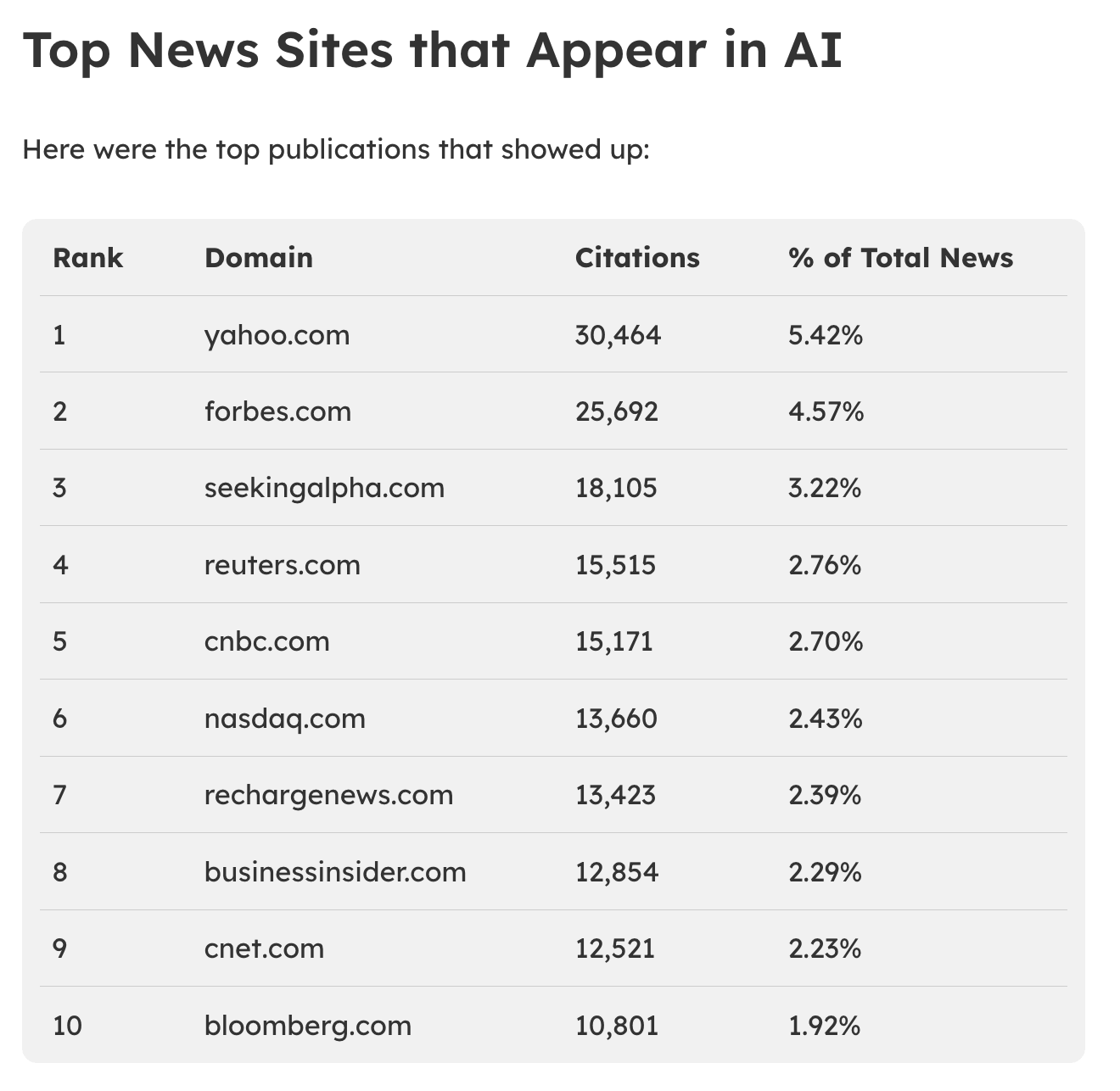
The study also found that energy (31%) and entertainment (18%) had the highest rates of news-based AI citations by industry. I’d be cautious about reading too much into those vertical breakdowns. These results are shaped by the specific prompt sets used in the study, not necessarily reflective of how LLMs behave across every possible query in those industries.
Don’t read “14%” as proof that news coverage is irrelevant to AI. News surfaces when users are making decisions, and that’s exactly when citations carry the most strategic value for brands investing in digital PR campaigns.
Google Rankings Are the Strongest Predictor of AI Citations
This was one of the most striking findings from the AirOps research. Among pages that ChatGPT cited and that also appeared in Google’s top 20, 43.2% held the #1 position. Pages ranking beyond position 20 were cited at just 12.3%, a 3.5 times gap.
The concentration goes further. The top 10 domains capture 46% of all citations within a given topic. The top 30 own 67%. For brands trying to break into AI citation, this is the competitive reality: a small number of domains control the majority of LLM visibility.
What this means in practice is that SEO and AI visibility aren’t separate strategies. If you’re not ranking in Google’s top 10 for a topic, you’re probably not getting cited by generative AI either. The same signals that drive traditional search engine authority (comprehensive content, strong backlink profiles, entity recognition) are what LLMs pull from when deciding which sources to cite. PR teams that treat SEO and AI optimization as separate line items are splitting a strategy that works best when it’s unified. If you want to optimize for AI visibility, start by optimizing for Google.
Each LLM Cites Publishers Differently
One of the more useful datasets came from SearchAtlas, which analyzed five million citation records across 907,000 domains. The key finding: not all AI models behave the same way. Each platform’s machine learning architecture and retrieval system produces meaningfully different citation behavior.
Perplexity cites a much wider range of sources, including second-tier outlets, regional news publishers, niche industry sites, and press-release aggregators. OpenAI sticks to a narrow core of highly established global media. Gemini references the same global outlets as OpenAI but far less frequently overall, with lower citation counts across the board.
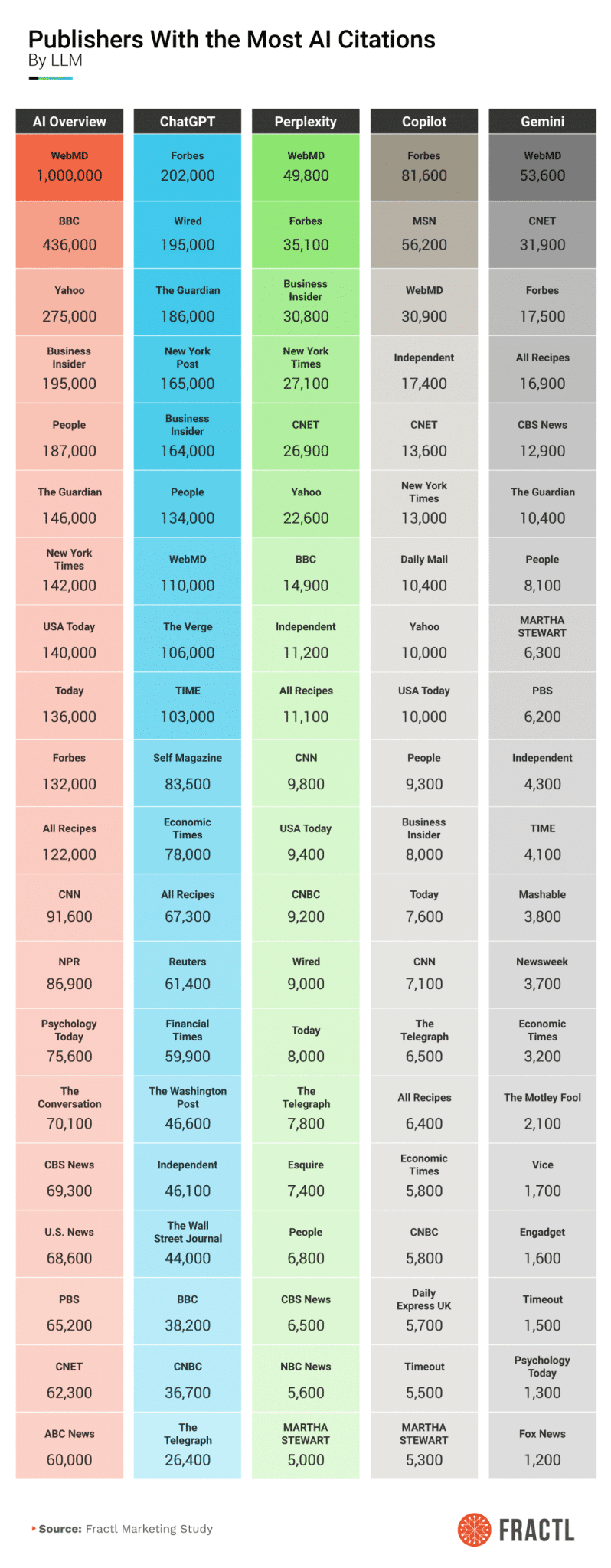
We’ve seen this divergence in our own AI citation tracking at Fractl. When we compared our ChatGPT data against BuzzStream’s top news domains list, there was meaningful overlap: Forbes, Yahoo, Business Insider, CNET, Reuters, and CNBC appeared on both. But our data also surfaced publishers like Wired, The Guardian, New York Times, BBC, The Verge, and TIME that didn’t appear on BuzzStream’s list. The divergence likely comes down to prompt set composition. BuzzStream’s data skewed toward finance and market queries; ours covers a broader range of verticals.
The practical implication for PR teams: a one-size-fits-all media outreach playbook won’t work for AI visibility. If you’re optimizing for Perplexity, earning coverage from niche-relevant publishers has more citation upside than it does for ChatGPT, where established global media dominates. If you’re focused on ChatGPT, media coverage on high-authority, well-known outlets moves the needle more than breadth across smaller sites. Your media lists should reflect which platforms matter most for your target audiences.
Longer, More Comprehensive Content Gets Cited More
Data from Gauge and Growth Memo confirms something that’s been intuitive but hadn’t been quantified at this scale: content length correlates strongly with AI citation frequency.
Pages over 20,000 words get cited at 5.03 times the baseline rate across all industries. But the relationship isn’t linear, and it varies significantly by vertical.
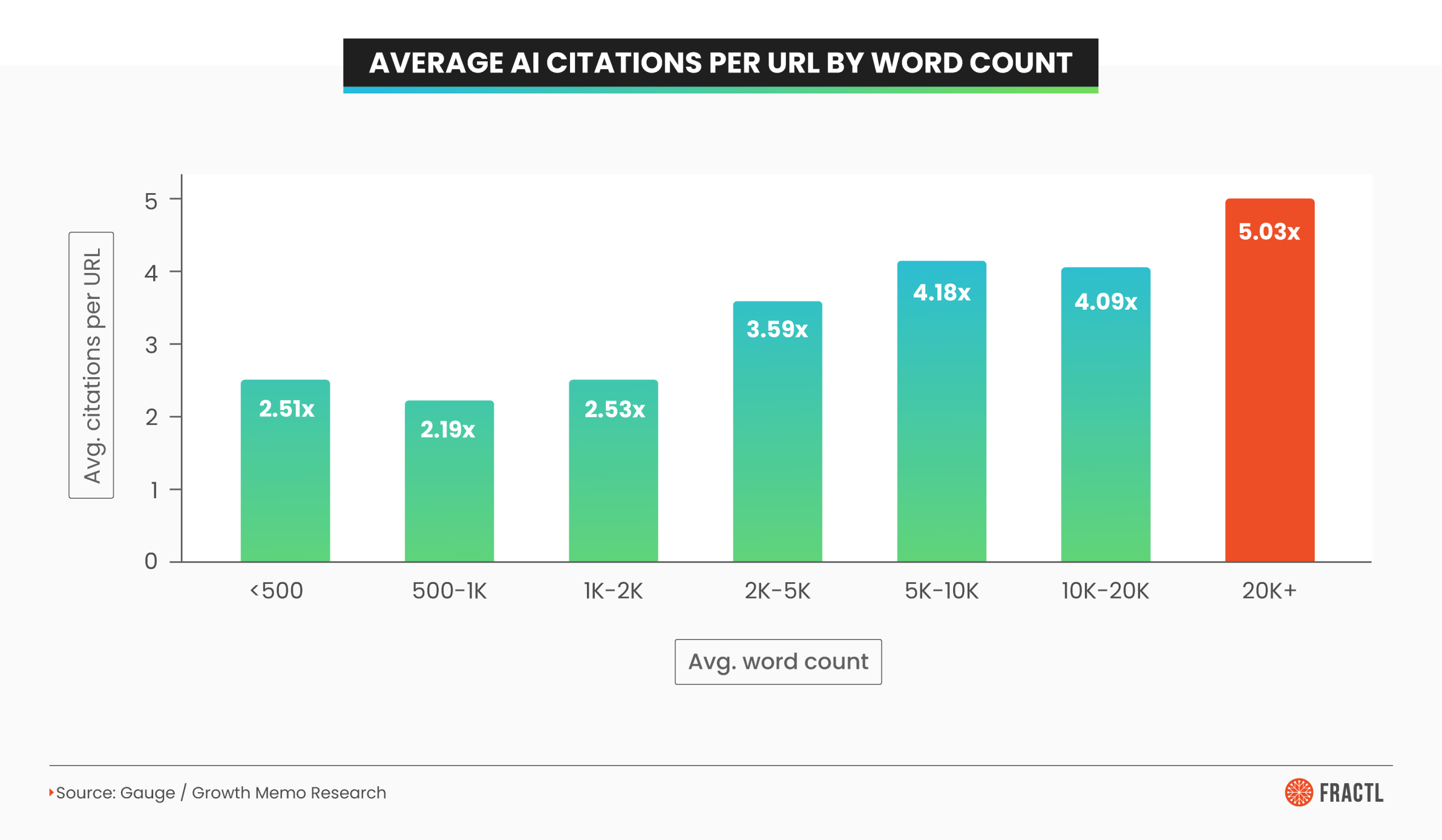
Finance is the extreme case. Pages in the 5,000 to 10,000 word range earn a 10.9 times citation multiplier, the highest of any vertical at any word count. Education and crypto reward length more consistently, with citations climbing steadily as content gets longer. CRM and SaaS tell a different story, where structure and topical comprehensiveness matter more than raw word count.
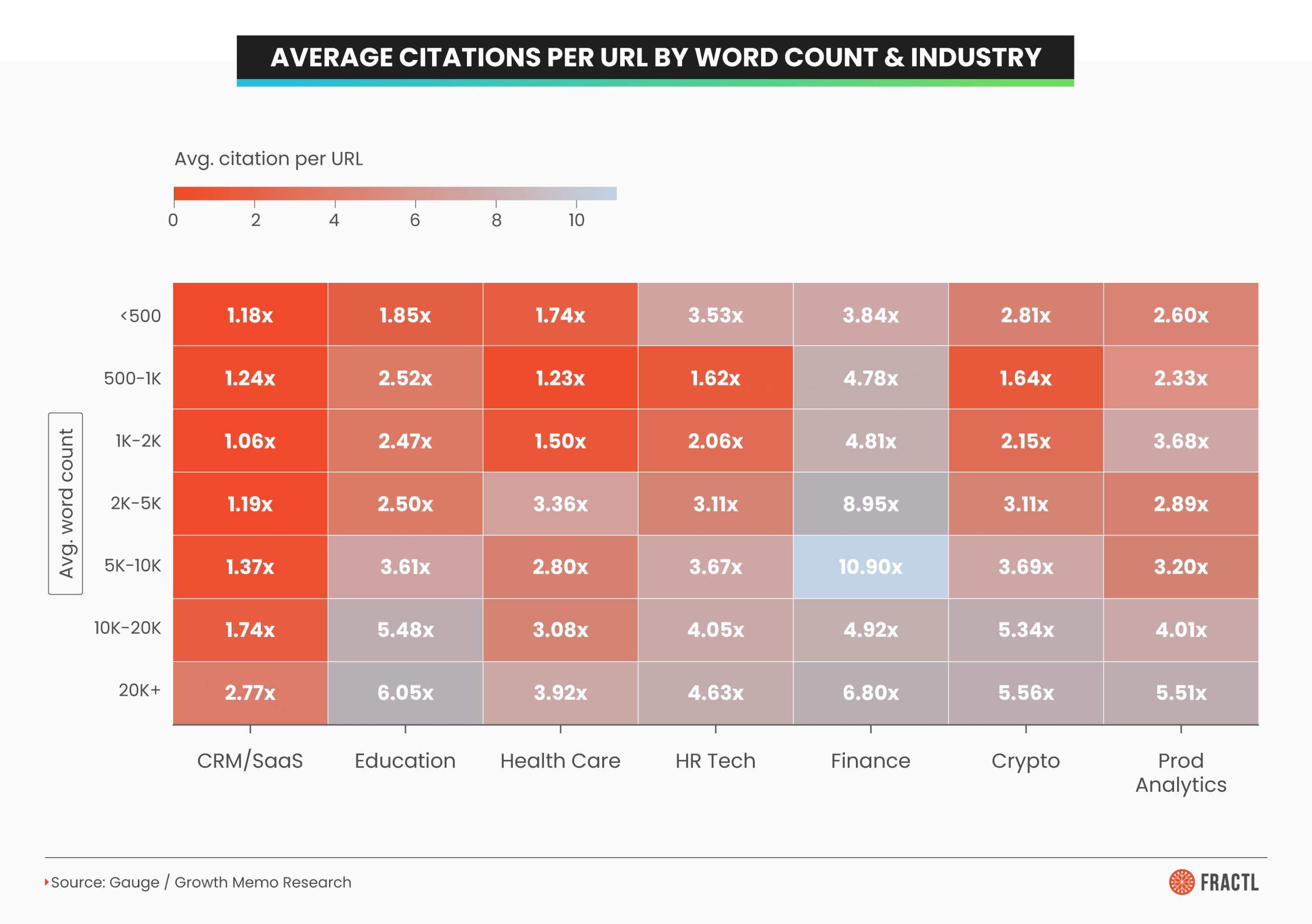
The pattern across top-performing evergreen pages is consistent: category-level guide format, broad topic coverage within a single page, and explicit year anchoring in URLs and titles. One data point that stuck with me from this research: a single well-structured comparison page on learn.g2.com earned 65 unique prompts and 495 citations, outperforming entire domain portfolios of well-known brands.
A single page covering over 10 query intents is worth more than 10 pages each targeting one intent. That’s a fundamental shift from how most content creation teams plan their editorial calendars, and it has direct implications for how PR pros think about the assets they’re building and promoting.
Entity Authority Matters More Than Individual Links
This is where I think the conversation needs to shift for digital PR teams. The traditional model of targeting one keyword per page and building individual links to each is structurally disadvantaged for AI citation. LLMs don’t rank pages the way Google does. These AI-driven systems retrieve and synthesize, pulling from sources that demonstrate broad topical authority across an entire subject area.
The domains dominating AI citations didn’t get there by writing better individual articles. They built pages with genuine topical depth that address multiple related queries in one place. The Growth Memo data backs this up: citation reach (the number of distinct prompts a domain answers) is more strategically useful as a metric than raw citation count. A domain cited by 50 different query types has more durable AI visibility than one cited 500 times for a single query.
| In low-concentration verticals like health care and CRM, a focused 30- to 50-page content strategy can realistically compete for AI citations. | In high-concentration verticals like education and crypto, you need to become the definitive resource on a specific subtopic before LLMs will surface you at all. |
For PR teams, the implication is that individual placements matter less as standalone wins and more as building blocks for entity authority. Every piece of media coverage you earn, every brand mention on a high-authority publisher, every data point that gets cited across the web feeds into how AI models understand and represent your brand. That compounding effect is where the real value of data-driven digital PR strategy lives now. It’s not about any single link or any single placement. It’s about how robustly your brand is represented in the knowledge ecosystems that train and inform these systems.
Your Newsroom Is an Untapped AI Visibility Asset
This finding from the BuzzStream study surprised me:
ChatGPT cites internal company newsrooms at roughly 18%, compared to about 3% on other platforms.
Most brands I talk to are underinvesting here.
Why does ChatGPT favor newsrooms? AI systems value structured, authoritative, first-party information. A well-maintained newsroom with clear positioning statements, structured announcements, and evergreen “who we are and what we do” content gives LLMs exactly the kind of entity-tied, factual content they prefer to cite.
Most brands treat their newsroom as a press release archive. I’d argue you should treat it as a knowledge graph asset: content that tells AI algorithms (and the journalists covering you) exactly what your brand is, what it does, and why it matters. Structured data, clear entity references, and consistent messaging go further than most PR teams realize for both brand reputation and AI visibility.
On the flip side, syndication accounted for just 6% of AI citations, and newswires came in under 1%. That doesn’t mean syndication is worthless. It still matters for reaching your target audiences, building brand familiarity, and reinforcing signals across the web.
But if your AI visibility strategy relies primarily on press release distribution, the data suggests you’re putting budget in the wrong place.
AI Partnerships and Crawler Blocking Don’t Work the Way You’d Expect
Two findings from BuzzStream that cut against the conventional wisdom:
 News sites with confirmed AI partnerships (licensing deals with OpenAI, Google, and others) don’t appear to get cited more often. Only about 2.94% of news citations came from partnered publishers. Partnerships may influence model training data, but citations are driven by retrieval systems, entity authority, and query-moment relevance. Don’t over-attribute visibility to backroom platform deals. |  Blocking AI crawlers doesn’t prevent citations. About 75% of sites that block OpenAI or Google AI bots still appeared in AI citation outputs, and roughly 70% of ChatGPT’s citations came from sites that actively block its retrieval bot. Robots.txt is a directive, not a hard wall. These AI systems pull from historical crawl data, syndicated content, cached representations, and secondary sources. |
Wil Reynolds made a point about earned media distribution that connects here. When a story appears across multiple reputable publisher domains through earned coverage, AI models encounter that information in more contexts, strengthening the citation signal. As models increasingly rely on higher-quality training sources, the relationship between earned media reach and AI visibility will only tighten. That’s a strong argument for using AI-powered tools to track which publishers and coverage patterns actually drive LLM citations, rather than guessing based on traditional metrics alone.
What This Means for Your Digital PR Strategy
Based on all of this research, here’s where I’d focus your time and budget:
Track by Prompt Cluster and Platform, Not Just Volume
Segment your tracking into exploratory prompts (“what is X?”), evaluative prompts (“X vs. Y”), and brand/entity prompts (“what is [brand] known for?”). Raw citation count tells you less than citation breadth across different query types. At Fractl, we use Ahrefs Brand Radar and our own LLM citation agents to automate this data analysis: building prompt sets based on real buyer questions and tracking presence across ChatGPT, Gemini, and Perplexity separately. Real-time media monitoring of which publishers are earning AI citations in your vertical should feed directly into your outreach workflows.
Build Category-Level Content, Not Thin Single-Topic Pages
The data consistently shows that comprehensive, multi-intent pages outperform individual keyword-targeted articles for AI citation. Comparison roundups, authoritative guides, and well-structured resource pages are the content types that dominate. This applies to the high-quality assets you create on your own site and to the kind of content you pitch publishers to cover.
Invest in Your Newsroom
Treat it as a knowledge graph asset with structured, entity-tied content. Clear positioning, factual depth, and consistent messaging give LLMs what they need to cite you accurately. This isn’t a time-consuming overhaul; it’s a shift in how you think about what your newsroom does.
Think Platform-Aware, Not Platform-Agnostic
Perplexity rewards niche-relevant coverage more than ChatGPT does. ChatGPT favors established global media and company newsrooms. Gemini cites less frequently overall but draws from similar sources as ChatGPT. Your distribution strategy and media outreach should reflect where you actually want to show up.
Focus on Entity Authority Over Individual Links
Every piece of earned media coverage contributes to how LLMs understand your brand. The compounding effect of consistent, high-authority coverage is what drives sustained AI visibility. No single placement will get you there, but a disciplined PR strategy that builds brand mentions across authoritative publishers over time will.

How This Connects to Our Research
We’ve been studying AI citation patterns and media partnerships at Fractl for the past year. Our AI media partnerships research examines how publisher licensing deals and editorial decisions shape LLM training data across 250 vertical-specific domains and 25 publishers per vertical. If you’re interested in which publications actually feed into the models and how that’s changing, start there.
We’ve also built tools specifically for use cases like this. Our LLM citation audit agent helps brands identify which sites are being cited by AI for their target queries, so outreach and PR campaigns go to publishers that actually influence LLM outputs rather than relying solely on traditional domain authority targets. As AI technology continues to reshape how people find and trust information, the gap between brands that track this data and those that don’t will only widen.
The broader theme across all of this work: digital PR isn’t just about links and media coverage anymore. It’s about how your brand is represented across the knowledge ecosystems that train and inform AI systems. That includes everything from the AI-generated content summaries that surface your brand in search to the social media conversations and publisher coverage that reinforce your authority signals. The teams that understand this shift will have a real advantage as the use of AI in search continues to grow.