



Table of Contents
- How Search Is Changing Right Now
- Personalized AI Is the Bigger Shift in Search Behavior
- The Long Tail of Search Will Get Bigger
- Reviews Will Matter More, If They Can Be Trusted
- Marketing Language Will Stop Working
- Authority Will Come From Trust Signals
- How We Use AI Agents To Research Faster
- Spend Less Time on AI Visibility Scores and More on Customer Research
- What These Changes Mean for Your SEO Strategy Today
- Start Investigating Your Own Industry
- Related Resources
- FAQ
Search is changing on two timelines. The first is already here: Google’s AI Mode passed one billion monthly users within a year of launch, and Google is adding AI agents that work in the background. The second is still coming, and I think it will change marketing more. AI models will soon keep learning from each person who uses them.
I talked through both timelines with Tyson Stockton on Voices of Search. We covered what’s changing in search right now and what I expect personalized AI to do to rankings, reviews, and content strategy. Originally presented on Voices of Search, hosted by Tyson Stockton.
Listen to the Full Conversation
Key Takeaways
- Search has become a conversation. Google now lets people ask follow-up questions from an AI Overview and continue in AI Mode, which passed one billion monthly users in its first year.
- AI agents now search for people. Google is adding information agents that monitor the web in the background, plus booking and calling for local services.
- Old habits still shape behavior. In Nielsen Norman Group’s study, every participant still used traditional search engines alongside AI chatbots.
- Personalization is the bigger shift. AI that learns continually from each user will make results and user behaviors differ more from person to person.
- The long tail will get bigger. Personalized answers will surface niche sources that broad rankings bury today.
- Reviews will matter more. AI can read reviews to learn who a business is best for, not just whether people liked it.
- Marketing language will lose value. Models judge a brand on evidence, so accurate, specific claims will beat superlatives.
- Original research is the moat. AI agents make deep investigations fast enough for any brand to run them.
How Search Is Changing Right Now
The shift from a list of blue links to AI-generated answers, led by Google’s AI Overviews and generative AI chatbots, is well underway. At its I/O event in May 2026, Google described its new intelligent Search box as “the biggest upgrade to our Search box in over 25 years.” Google also says AI Mode queries have more than doubled every quarter since launch.
The announcements move Google Search from answering questions toward doing tasks for people:
| What Google added | What it does |
|---|---|
| Intelligent Search box | Expands as you type and accepts text, images, files, videos, or Chrome tabs |
| AI Overview follow-ups | Lets you ask a follow-up from an AI Overview and continue in AI Mode |
| Information agents | Monitors the web in the background and sends updates on a topic you choose |
| Agentic booking and calling | Finds local services with live availability and can call some businesses for you |
| Personal Intelligence | Connects apps like Gmail and Google Photos so AI Mode can use your context |
| Generative UI | Builds custom layouts, such as tables, graphs, or simulations, for a single answer |
People are adopting AI search fast, too. In a Fractl and Search Engine Land survey of 2,000 people, two-thirds (66%) expected AI to replace traditional search within five years. Among people who use AI tools, 41% said they rely more on AI summaries than on links. A search that ends in a summary, without a click to any site, is a zero-click search.
Habits change more slowly than the technology. Nielsen Norman Group’s usability study of nine participants found that “information-seeking habits are sticky.” Every participant still used traditional search, and many used AI chatbots and Google in tandem to check each other’s answers.
Personalized AI Is the Bigger Shift in Search Behavior
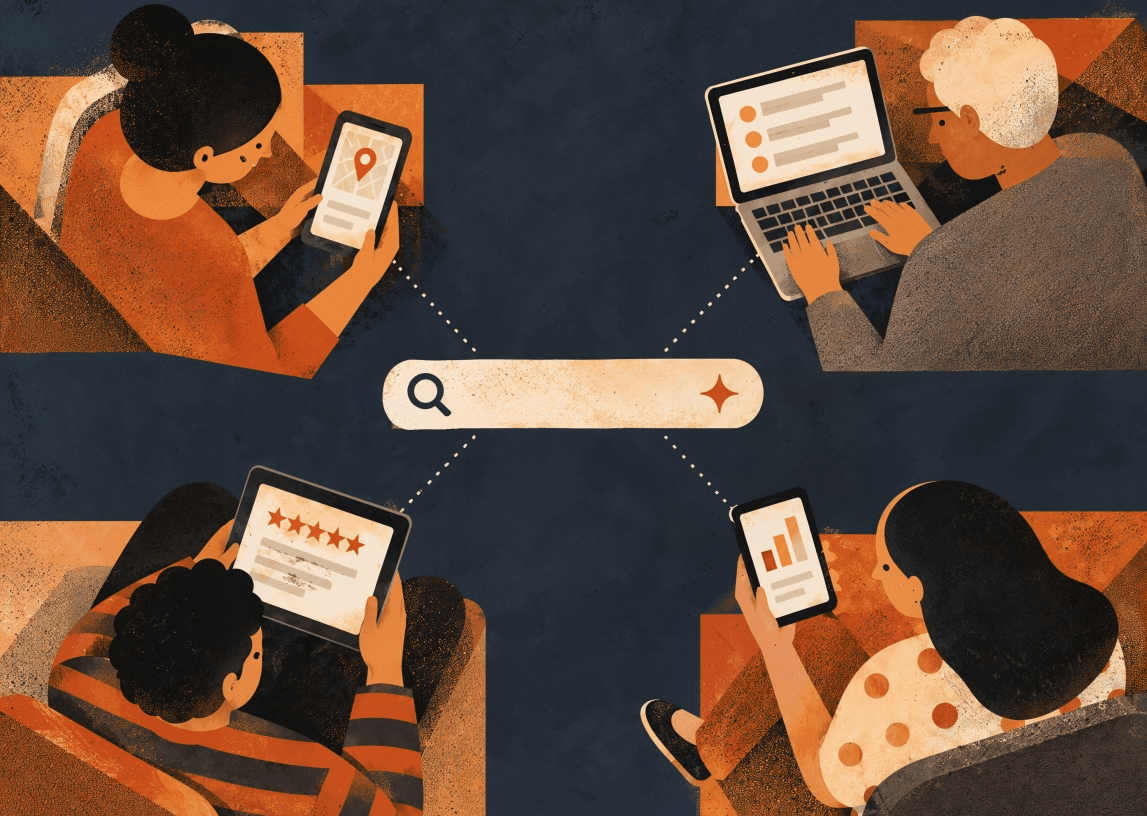
Today’s large language models (LLMs) are trained once, then answer questions without learning from you. The next generation of models will learn continually, and I expect that within the next three to five years, each person could have an AI that grows with them and understands their history, interests, and intent.
I also expect AI to move from massive data centers onto phones, because next-generation models will need far less computing power. Google’s Personal Intelligence, which connects your Gmail and Photos to AI Mode, is an early step toward search shaped by personal context.
For marketers, personalization means more variance.
Results already shift: in Fractl’s study of 11,573 AI answers, asking a chat engine the identical question twice changed roughly half the recommended brands. Personal models will widen that gap, because the answer will depend on who’s asking.
That raises the stakes on knowing precisely who your brand serves, which I wrote about in The Future of AI Search: Why Depth Beats Reach.
The Long Tail of Search Will Get Bigger
Search rankings today work almost like winner-take-all. If you’re not in the top results, or not mentioned in AI-generated answers, you’re close to invisible. Personalized AI changes that.
When the answer is written for one person instead of millions, it can come from a super specific source. I think the long tail will get served much more often, and the middle of the tail will grow, too.
A few universal answers will stay winner-take-all, but most categories will split into many niche winners.
Restaurants are a good example. Today, AI might decide whether a restaurant is good or bad. A personalized model can tell that the same restaurant is perfect for one kind of diner and wrong for another.
It will be less about trying to become popular and more about trying to define who you are in detail.
That also changes which topics are worth covering. A small niche group of customers used to be too small to justify a big research project. When personalized search can match those people to your content, small topics become reachable, and AI tools make them cheaper to cover.
Reviews Will Matter More, If They Can Be Trusted
I think review platforms become more useful in AI search, not less. A star rating averages everyone together. AI can read the reviews themselves and learn what a business does well, what it doesn’t do, and who it doesn’t serve.
Plenty of businesses get three stars because they’re great for some customers and a poor fit for others. A personalized model can show that business as five stars to the people it serves well, and skip it for everyone else. Negative reviews become data about fit, not just damage.
Reviews become much more important with the caveat that they need to be trusted.
Trust is the catch. Model makers have to decide which review sites to include in training data, and some platforms vet reviewers more strictly than others. Reviews from platforms with strict onboarding standards will likely carry more weight.
Marketing Language Will Stop Working
Calling yourself “the best” doesn’t move an AI model. Models assess a brand on their own, using everything they’ve read about it. Superlatives and exaggeration add nothing they can use.
Fluff language, marketing language, all of it will be less useful.
What works instead is presenting the truth accurately, including what you don’t do. Clear boundaries help a model serve you to the right customers. When you’re matched to the people you serve, conversion rates rise, and conversions become the metric that matters most.
Brands that rely on fluff, offer nothing new, and sit in the undifferentiated middle of their market will suffer most. I think brands need to ask what they contribute informationally, beyond their service offering.
Authority Will Come From Trust Signals
Links still matter as a vote of confidence, but they’re becoming table stakes rather than a deciding factor. AI models already understand which publications are well known and which brands those outlets reference. I expect some form of whitelisting, too, where trusted domains carry more weight in what models learn from.
The goal is coverage that mentions your brand in the context of your service and the customers you serve. That’s the kind of authority digital PR builds, and it’s what AI models read as trust signals. On-site technical details, like internal linking structure, will likely matter less to AI than to traditional search engines.
How We Use AI Agents To Research Faster
Most of our work at Fractl is data journalism for brands: gathering datasets, analyzing them, and finding what’s newsworthy. AI agents now handle much of the technical work, like writing scrapers, cleaning data, and running statistical analysis. So, a data journalist doing every step instead starts directing what’s interesting about the story.
Current models still make things up, so we build guardrails into the process:
 Test-driven code The agent writes a test first, then the code, then runs the test, so results come from the data instead of the model’s memory. |  A written constitution Each agent works from a document that defines the process and what a good result looks like, and it checks its work against that document. |
 Agents as peer reviewers Agents critique our analysis to make sure we’ve explored every angle and haven’t misrepresented the data. |  Reusable modules When we build a scraper or analysis step for one project, we reuse it on the next one. |
I do most of this work in Cursor, where a frontier model can split a large project across several agents that work in parallel. Picking a model is its own tradeoff: the best model costs more, while a cheaper one may need several rounds of fixes. If you don’t know each model well, a mid-priced, high-performing model is a safe default.
Fractl Agents packages recurring marketing workflows we built inside the agency.
You don’t need to be a coder, you don’t need to be a statistician, you don’t need to have gone to school for this — you just need to have an idea.
Spend Less Time on AI Visibility Scores and More on Customer Research
Today’s AI models are black boxes, even to the companies that build them. Tools that claim to measure AI visibility precisely, or to detect AI-written text reliably, will struggle with high error rates. And even perfect visibility data wouldn’t tell you what to change.
The bigger misconception runs in both directions. Some marketers underestimate what these models can do, and others overestimate them. The only fix is working with them consistently enough to learn both their capabilities and their limits.
A much bigger focus of marketing will be consumer research and profiling different individual personas.
Understanding every persona in your market, and what each one needs, tells you whether your content and services cover the full range of search intent. That’s more useful than a single visibility number.
What These Changes Mean for Your SEO Strategy Today
None of this replaces the fundamentals yet. AI-powered search still depends on content that search engines and AI crawlers can access and understand. I’d adjust a content strategy for today’s search behavior in six ways:
 Map intent by type Informational questions are the ones AI summaries answer most directly, while transactional searches are where Google’s new agents book and call. Navigational searches still send people to your site. |  Write for conversational queries People type and speak full questions, a habit that voice search and featured snippets started. Answer them in natural language, with clear headings and bullet points. |
 Keep structured data accurate Schema markup helps search engines understand what your pages are about. Keep it matched to what’s visible on the page. |  Let the right crawlers in Check that robots.txt and your CDN settings allow the search and AI crawlers you want reading your site. |
 Track AI referrals Use Google Analytics to watch traffic from ChatGPT, Perplexity, Gemini, Grok, and Copilot in Bing alongside organic search. |  Publish helpful content Original research and specific answers give artificial intelligence something new to cite, which generic pages can’t. |
Whether you call it SEO, AEO, or GEO, the underlying work doesn’t change: be the clearest, best-supported answer for the people you serve.
Start Investigating Your Own Industry
If I had to give one piece of advice, it would be to find the questions your customers ask that no one in your industry has answered with data, then investigate them. AI tools now make that kind of research possible without a data science team, as long as you keep the AI on track with a test-driven process.
Brands that publish original findings expand what people and AI models know about their category. Fractl builds that research and the digital PR that gets it covered, across search, social, and AI platforms. Reach out if you want help turning your questions into investigations.
Related Resources
- What AI Actually Recommends
- Commodity Content vs. Non-Commodity Content: Why AI Search Is Killing Generic SEO
- AI vs. SEO: How Generative Search Is Reshaping Discovery, Content Strategy, and Consumer Trust
FAQ
Why is Google Search changing?
Google is adding AI because people now ask longer, conversational questions and expect direct answers. Fractl tracks how these changes affect brand visibility across search and AI platforms.
Is SEO dead or evolving in 2027?
SEO is evolving. Search engines and AI tools still rely on crawlable, well-structured, authoritative content. Fractl pairs SEO with digital PR and original research so brands appear in both rankings and AI answers.
What has happened to Google Search?
Google added AI Overviews, AI Mode, a redesigned Search box, and agents that monitor the web or book services. Fractl’s research tracks which sources these AI features cite.
How will AI change the future of search?
AI models that learn continually will personalize results for each user, so answers will vary more from person to person. Fractl helps brands define who they serve clearly enough for personalized AI to match them.
Do reviews matter for AI search?
Yes, and likely more over time. AI can read reviews to learn who a business serves best. Fractl’s digital PR work builds the third-party coverage and mentions that AI models treat as trust signals.