




Table of Contents
- Search Vocabulary Among Marketers
- Half the Industry Is Looking Up the Vocabulary
- AI Search Reshuffled Who's Investing
- 65% Call AI Search an Opportunity. 35% Expect Job Losses Anyway.
- Case Studies Beat Acronym Fluency by 4 to 1
- 66% Are Using AI to Vet AI Vendors
- Vocabulary Isn't Strategy
Agencies are pitching GEO, the trade press is debating AEO, and LinkedIn is awash in posts about LLM Optimization. But behind the scenes, in Slack channels and Google search bars, marketers are still typing the same three letters they’ve used for two decades: SEO.
Fractl surveyed 343 U.S. marketing decision-makers in charge of AI visibility at their organizations to find out which terms show up in their day-to-day work. We also asked about how much of their budget is moving toward AI search, and what makes them trust (or write off) a vendor pitching this stuff. The gap between the industry’s pitch deck vocabulary and the words its customers actually use affects who gets clicks, meetings, or dismissed before the second slide.
Key Takeaways
- 81% of marketers still use “SEO” when discussing AI search visibility strategy internally, while 19% have adopted “GEO,” and 10% use “AEO.”
- 70% of marketers would type “AI Search Optimization” (46%) or “SEO” (24%) when hunting for AI visibility help online. GEO captures 12% of searches, and AEO just 3%.
- Only 27% of marketing teams have formally adopted any term beyond “SEO” for AI search work; 73% are still debating or have not moved.
- 36% say heavy buzzword use without clear explanation is the No. 1 vendor red flag, well ahead of no case studies (21%), vague claims (20%), and repackaged SEO (16%).
- 66% of marketers have used AI tools to research marketing vendors. That jumps to 89% among SEO specialists and to 81% among C-suite leaders.
- 35% believe AI search will eliminate more marketing jobs than it creates. Only 10% expect a net increase.
- Marketers now route 24% of search or content budgets to AI visibility on average, while 18% have yet to allocate anything.
- ChatGPT Search leads platform priorities for visibility at 34%.
Search Vocabulary Among Marketers
Despite the marketing industry’s push to rebrand search work for the AI era, most office vocabulary hasn’t moved. Many marketers (81%) still use “SEO” when discussing AI search visibility strategy with their teams. Fewer have shifted to acronyms like GEO (19%), LLM optimization (15%), and AEO (10%).
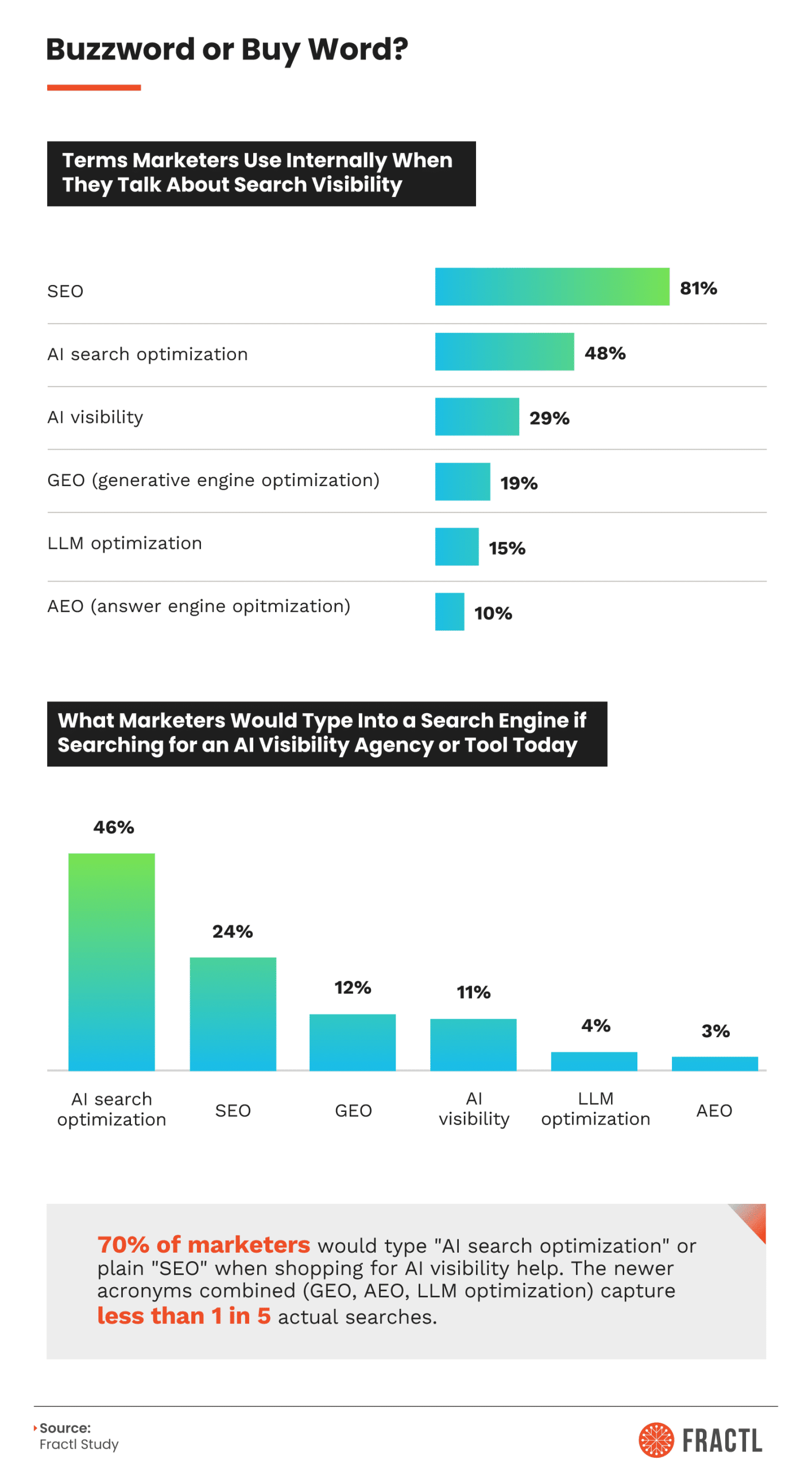
“AI search optimization” is the middle-ground term. Nearly half of marketers (48%) use it internally. It’s plain English and the closest thing the industry has to a consensus label. It’s also the term marketers most often type when searching online for an agency or tool to help with AI visibility. Most marketers (70%) would type either “AI search optimization” (46%) or “SEO” (24%) when searching online, while “GEO” captures just 12% of searches and ‘AEO’ just 3%.
But adoption varies across these demographics:
- C-suite marketers use “GEO” (28%) and “AEO” (17%) at roughly 3x the rate of individual contributors (9% and 3%).
- “LLM optimization” use also shows a gap between the C-suite (19%) and ICs (12%).
- SEO specialists use “GEO” most (29%), followed by those in performance (27%), growth (24%), content (14%), and brand (13%) marketing.
- B2C and e-commerce marketers default to plain “SEO” when searching at 33%, the highest of any vertical. Media or publishing leans hardest toward “AI search optimization” at 50%.
- Gen X leads on “AI search optimization” searches at 51%, versus millennials (49%) and Gen Z (39%). Gen Z is the most likely group to stick with “SEO,” at 23%.
If you’re optimizing a service page, a vendor name, or an ad campaign to capture marketing demand for AI visibility services, “AI search optimization” and “SEO” are where the searches actually live.
Half the Industry Is Looking Up the Vocabulary
Public-facing pitches have made the new AI search vocabulary feel ubiquitous. Behind the scenes, marketers are still calibrating: 50% have looked up an unfamiliar term after seeing it in a colleague’s or competitor’s content.
Only 27% of marketing teams have formally adopted any terminology beyond “SEO” for AI-related search work. Another 42% have explicitly declined to adopt new terminology, and 31% are still debating.
That puts the loud minority on the side of the rebrand and the quiet majority on the side of “we haven’t moved.” It also explains why the same acronym can read as cutting-edge in one pitch and as red-flag jargon in another. There’s no shared standard yet.
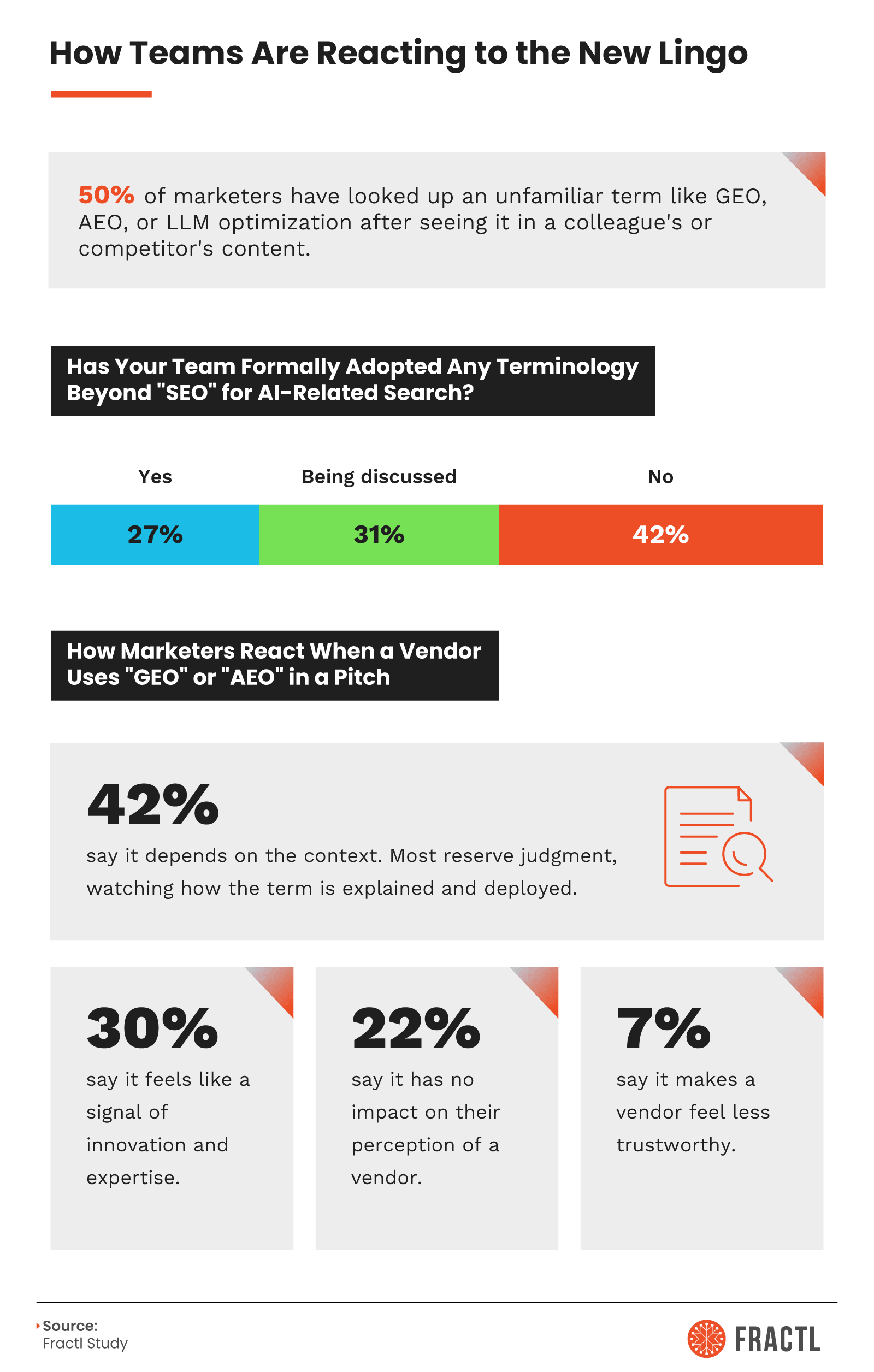
When a vendor uses “GEO” or “AEO” in a pitch, 42% of marketing decision-makers say their reaction depends on context. The acronym only works if you explain it well. Another 30% read it as a signal of innovation and expertise, or cutting-edge. 22% say the terminology has no impact on perception. But 7% actively penalize vendors who lean on the new acronyms, calling them less trustworthy.
Formal adoption of new terminology climbs with rank: 15% of individual contributors (ICs, aka employees who don’t manage other people) say their team has officially moved beyond “SEO,” compared with 30% of managers, 36% of directors, and 36% of C-suite professionals. The vocabulary is a top-down rollout in progress, and even the leaders driving it are still catching up themselves: 56% of C-suite pros have looked up a term they didn’t recognize (the highest rate of any seniority group).
Generational findings here flip a stereotype. Gen Z marketers are the most likely to have looked up an unfamiliar AI search term after encountering it (59%, versus 45% for millennials and 46% for Gen X). The generation generally considered the most fluent is also the one doing the most catch-up.
Gen X, meanwhile, is the most likely generation to call new terminology “cutting-edge” (37%) — but also the least likely to call it “less trustworthy” (3%). Just because something’s new doesn’t mean they’ll discount it.
Tenure tells a similar story: 49% of marketers with under 2 years of experience have looked up a term, rising to 56% for those with 2 to 5 years and 54% at 6 to 10 years, before dropping to 37% for those with over 10 years.
Mid-market is the adoption sweet spot. Formal adoption peaks at 35% for 1,001 to 5,000-employee companies and 32% at 51 to 200, ahead of both small businesses (25%) and enterprises (26%).
AI Search Reshuffled Who’s Investing
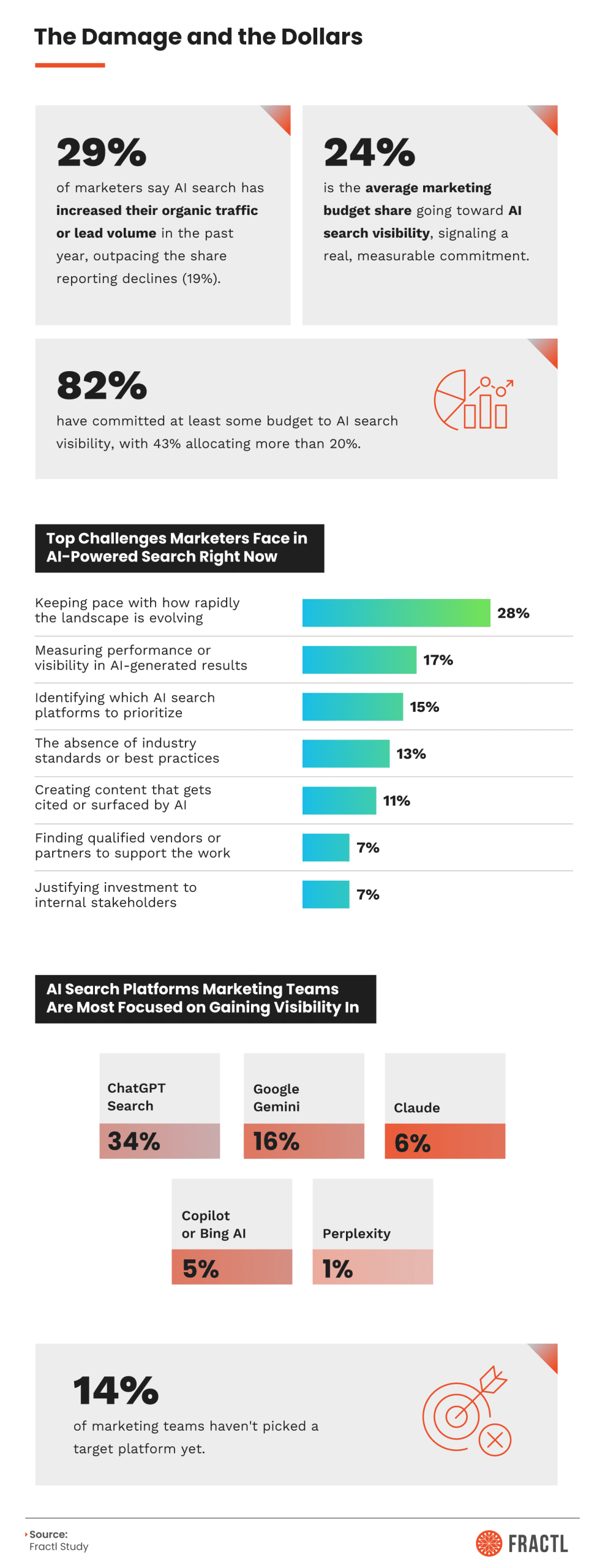
The headline that “AI Overviews killed organic traffic” doesn’t survive the data: 29% of marketers report moderate or significant traffic gains from AI search features in the past year, while 19% report declines. That’s roughly a 3-to-2 ratio favoring gains, not universal damage.
But the distribution varies sharply by vertical:
- Healthcare: 32%
- B2B technology: 28%
- Financial services and media or publishing: 23% each
- B2C or e-commerce: 9%
Financial services has the most asymmetric pattern. It also leads all verticals in traffic gains at 42%, likely because AI assistants lean on authoritative finance sources for their answers. That same vertical leads on budget commitment, allocating 39% of search or content spend to AI visibility on average, nearly double B2C/e-commerce (19%) and well ahead of media and publishing (24%).
A budget gap is forming. Marketers route an average of 24% of search or content budgets to AI visibility; 82% have allocated at least some budget, and 43% are spending more than 20%. The flip side: 18% have allocated nothing at all.
By function, the teams closest to measurement are moving first. SEO (31%) and performance marketing (32%) spend the highest share of their budgets on AI search visibility. Content (20%) and brand (21%) spend the least.
But the bigger surprise is what marketers say is actually keeping them up at night; not ranking, not measurement. The single biggest challenge in AI-powered search right now is “keeping pace with how rapidly the landscape is evolving” at 28%, well ahead of measuring performance (17%), identifying which platforms to prioritize (15%), and the absence of industry standards (13%).
Marketers can live with measurement gaps. What they can’t get comfortable with is committing to a strategy that may be obsolete before it ships.
When asked which AI platform they’re prioritizing for visibility, ChatGPT Search wins at 34%, ahead of Gemini (16%) and Copilot or Bing AI (5%). Another 14% report no platform focus yet, while 23% are focused on Google AI Overviews.
Perplexity is the line worth pausing on. Despite its outsized share of industry coverage and the running joke that every SEO Twitter thread mentions it, just 1% of marketing teams prioritize it. The “no platform focus” cohort — roughly 1 in 7 teams (14%) — is the one to talk to. They’re still up for grabs, and the vendors who frame the conversation first will shape it.
ChatGPT focus increases with seniority: 29% of ICs, 35% of managers, 36% of directors, and 42% of C-suite all prioritize it for AI visibility. Among marketing functions, SEO specialists prioritize ChatGPT Search the most, at 46%.
Enterprise sites have the most to lose. By size, organizations with 5,001-plus employees report the highest traffic decline rate at 26%, compared with 17% for small businesses of 1 to 50. Bigger surface area, bigger exposure.
65% Call AI Search an Opportunity. 35% Expect Job Losses Anyway.
Underneath the operational worries, there’s a bigger question about the profession itself. We asked marketers how they expect AI search to reshape the work.
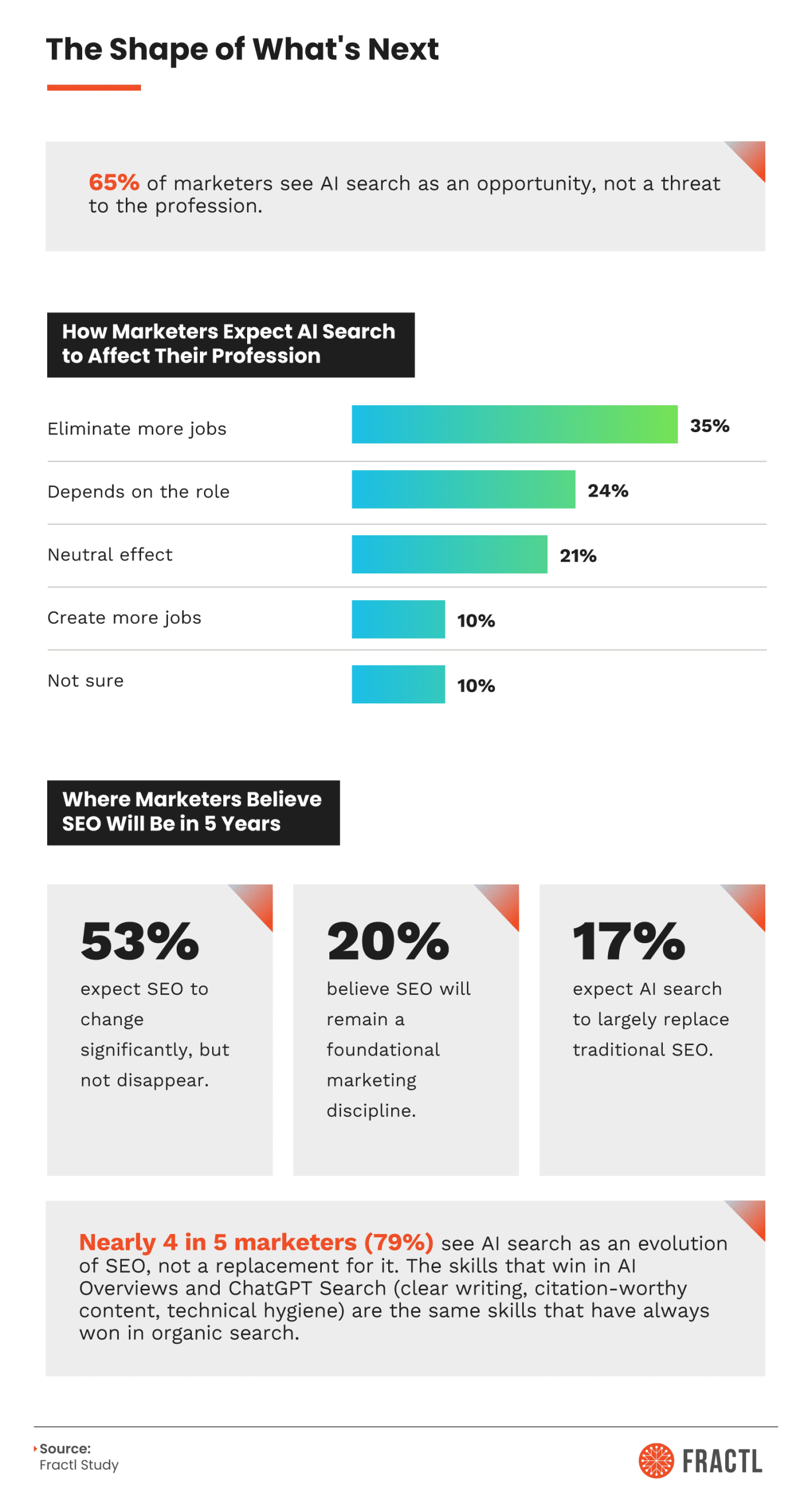
Marketers expecting AI search to eliminate more jobs than it creates outnumber those expecting a net increase 35% to 10%, a 3.5-to-1 pessimism ratio. That gap is significant, but it isn’t the full picture; most marketers fall somewhere between outright pessimism and outright optimism.
24% say job impact depends on the role or specialty, 21% expect a neutral effect, and 10% aren’t sure. Roughly two-thirds of the industry sees opportunity or specialty-dependent outcomes rather than blanket destruction.
The marketers most worried about job losses are the ones you’d expect: the newest, the most junior, and the older generations:
- 41% of marketers with under 2 years of experience expect job eliminations, compared with 30% with 10+ years of experience. People earliest in their careers see the biggest threat to their own.
- 38% of ICs are worried about eliminations; only 31% of C-suite pros are. Leadership is more sanguine.
- Gen X is the most pessimistic at 40%, then millennials and Gen Z tied at 35%. Gen Z is 2x to 5x more likely than older cohorts to expect net job creation (17% vs 3% of Gen X and 7% of millennials).
Marketers are less dramatic than the trade press on whether SEO itself is on a five-year clock. A small minority of marketers (17%) believe traditional SEO will be largely obsolete within five years. The majority (53%) expect significant evolution without disappearance, and another 20% believe SEO will remain a core marketing discipline.
C-suite is the most likely to predict obsolescence (25%, versus 16% of ICs). Leaders see the biggest shift; the rank and file expect more continuity.
Marketers see the skills shift as evolutionary, too. Most (79%) view AI search as an evolution of SEO, either “a mix, some new skills, many transferable” (46%) or “primarily an extension of existing SEO” (33%). A small minority (10%) see it as a fundamentally different skill set.
SEO specialists are the most confident on this: 49% call AI search an extension of what they already do. Performance marketers and growth/demand gen are the most likely to call it fundamentally different (12% each). Content marketing lands between the two, with 56% saying AI search is a mix for them. This suggests they see it as both a new discipline and a continuation of their existing craft.
The skills that win in AI Overviews and ChatGPT Search (clear writing, citation-worthy content, technical hygiene) are the same skills that have always won in organic search. When most marketers describe the shift as evolutionary, they’re describing what their actual workflow looks like.
Case Studies Beat Acronym Fluency by 4 to 1
Agencies have spent the past year repositioning around AI search, GEO, and AEO. Pitch decks have new glossaries. Capability slides have new headers. But when decision-makers actually sit down to evaluate a vendor, the signals they reward are familiar.
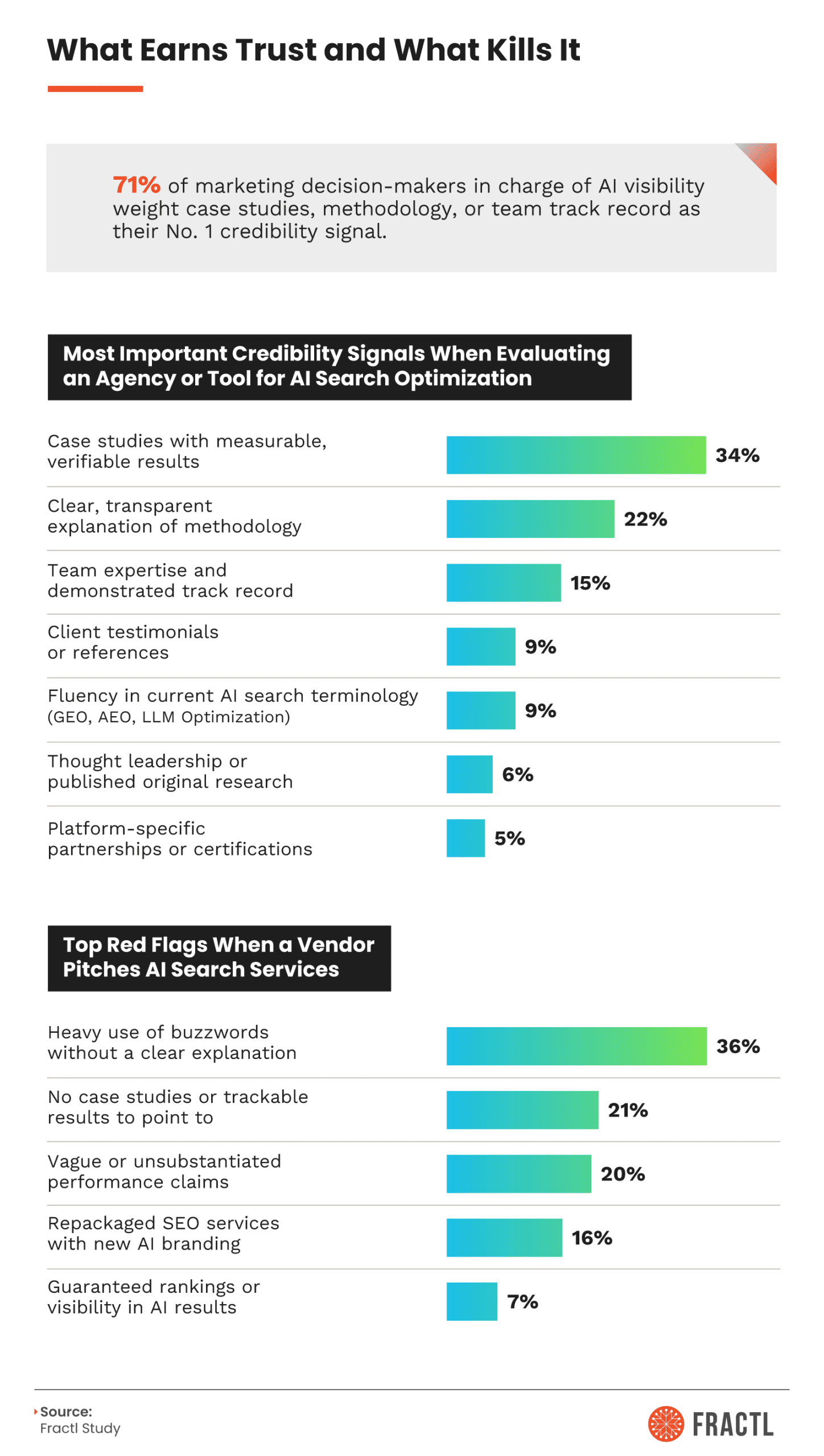
When asked for the single most important credibility signal when evaluating an AI search agency or tool, case studies with measurable, verifiable results lead at 34%, followed by clear methodology (22%), team expertise (15%), client testimonials (9%), terminology fluency (9%), thought leadership (6%), and platform partnerships (5%).
Case studies are chosen nearly 4x more often than terminology fluency as the top credibility signal. 71% of marketing decision-makers weight case studies, methodology, or team track record as their No. 1 signal. The fundamentals of vendor evaluation haven’t changed in the AI era.
Terminology fluency is an entry-level trap: 17% of ICs weight it most. That drops among managers (6%), directors (6%), and C-suite pros (3%). Agencies selling to senior buyers by leading with acronyms are pitching to 3% of the decision-makers who actually weight it.
Gen Z weights terminology fluency (14%) almost 3x more than Millennials (5%). Acronym fluency reads as expertise to newer marketers and as noise to seasoned ones. If your sales motion is built on impressing entry-level marketers with a vocabulary blast, you’ll close deals — just not the ones with budget.
What marketers reward in credibility signals, they punish in red flags. Heavy use of buzzwords without a clear explanation is the single biggest red flag at 36%, ahead of no case studies (21%), vague or unsubstantiated performance claims (20%), repackaged SEO services with new AI branding (16%), and guaranteed rankings (7%).
Among C-suite leaders, 33% point to “repackaged SEO with AI branding” as their top red flag, more than double the rate among ICs, managers, and directors (14 to 15%), and only 17% pick buzzwords. Leadership sees through the rebrand before the jargon registers as a problem. Senior buyers aren’t asking, “Do you know what GEO means?” They’re asking, “Is this last year’s deck, edited with find-and-replace?”
By vertical, B2C or e-commerce marketers are the most alert to repackaged SEO (21%), while financial services (10%) and B2B technology (12%) are the least bothered. Smaller companies (1 to 50 employees) are more suspicious than enterprises (19% vs 9%). Bigger budgets may buy more patience with the rebrand.
66% Are Using AI to Vet AI Vendors
There’s a recursive quality to this market. The marketers being sold AI visibility services are also the most prolific users of the tools those services are trying to appear in. The customer is also the test bed.
66% of marketers have personally used an AI search tool (ChatGPT, Perplexity, or Gemini) to research or evaluate a marketing vendor or agency.
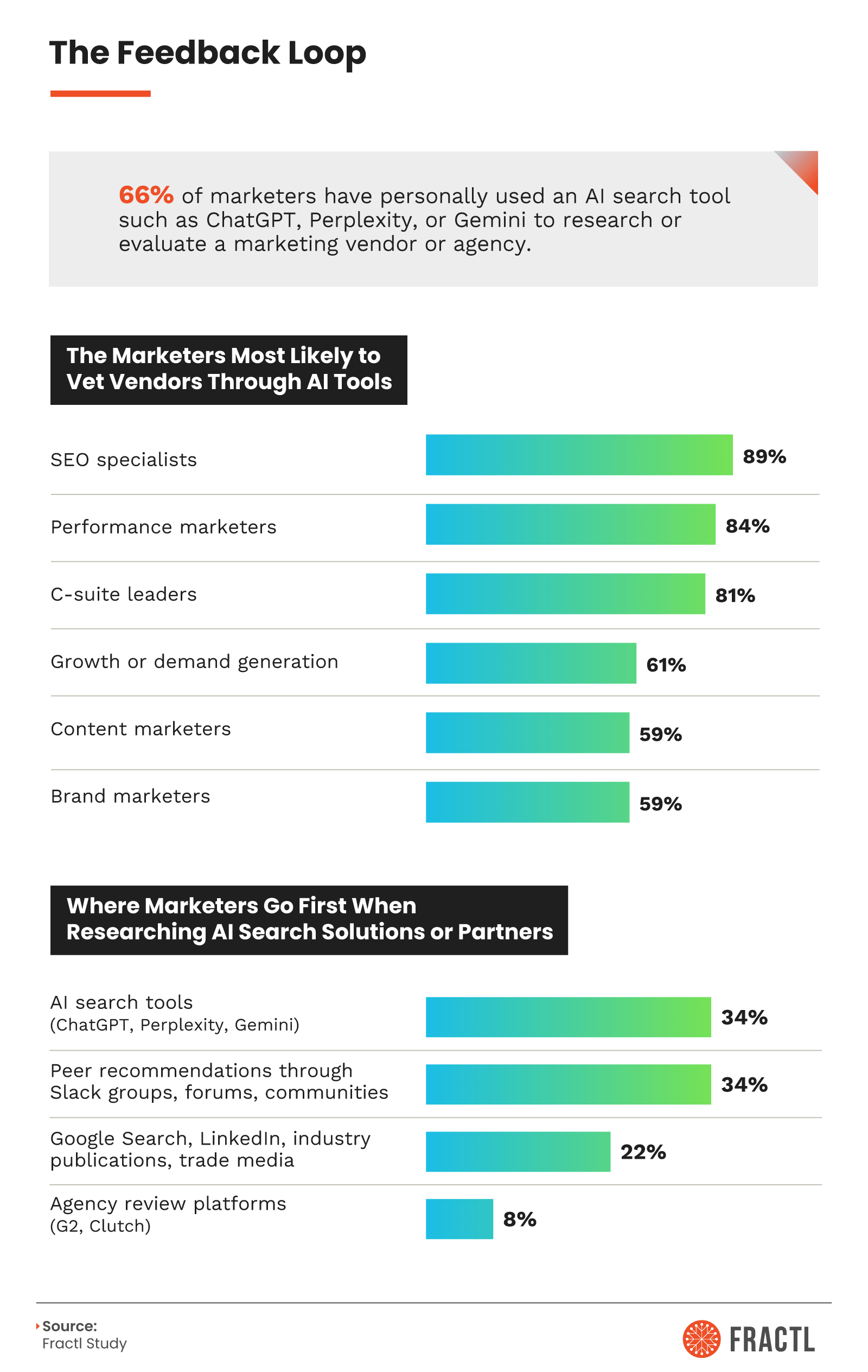
The rate climbs steeply among the functions closest to AI search work. SEO specialists lead at 89%, followed by performance marketing (84%) and C-suite leaders (81%). Growth and demand generation sit at 61%, with Content and Brand at 59% each.
C-suite leaders use AI tools for vendor research at a 19-point premium over ICs (81% vs 62%). Senior buyers are adopting these tools faster than their teams, not slower.
The first-stop data is even more interesting. When researching AI search solutions or partners, marketers turn to AI search tools and peer recommendations (through Slack groups, forums, and communities) at equal rates: 34% each. Together, those two channels account for 68% of all first-stop vendor research. Traditional discovery channels (Google Search, LinkedIn, and trade media) pull a combined 22%, and agency review platforms like G2 and Clutch get just 8%.
AI tools are the most common first stop among ICs (44%) and C-suite leaders (47%). Directors, oddly, default to peer communities (51%), and only 21% start with AI. Middle management leans hardest on its network, possibly because that’s where most of their hiring conversations already happen.
The generational pattern is the most counterintuitive in the dataset. Gen X (44%) and Gen Z (41%) are the most likely to start with AI tools. Millennials are the least, at 26%, with 38% preferring peer communities. The middle generation has the deepest professional networks, and it shows.
Company size barely registers. Small businesses of 1 to 50 employees use AI for vendor research at 67%, essentially tied with mid-market (68% at 51 to 200) and enterprise (63%). Everyone is doing it.
If you’re an agency or tool trying to capture AI search demand, two channels matter: Show up in the AI answer and in the Slack group. The combined share of those two is more than 3x what Google and LinkedIn pull together.
Vocabulary Isn’t Strategy
Trade press and LinkedIn thought leadership have built the AI search story around new acronyms and big shifts, but the data tells a different version. Marketers are still searching for the same words they’ve used for two decades, still calling the work “SEO” over Slack, still weighing vendors on case studies and methodology before terminology. Budgets are moving into this category, but they aren’t moving toward whoever has the loudest glossary.
The agencies that win the next round will be the ones explaining the work clearly, proving it with results, and skipping the rebrand while everyone else relitigates the label.
Methodology
Fractl surveyed 343 U.S. marketing decision-makers to understand how the emerging AI search vocabulary (GEO, AEO, LLM optimization, AI visibility) compares to the language marketers actually use when evaluating strategies, searching for solutions, and vetting partners.
The demographic breakdowns were as follows:
- Gender: 61% women, 38% men, 1% non-binary
- Generation: 48% millennials, 32% Gen Z, 18% Gen X, 2% baby boomers
- Marketing role: 33% worked in brand marketing, 28% in content marketing, 14% in performance marketing, 10% in SEO, 10% in growth or demand generation, 5% in other functions
- Job level: 44% were managers, 30% individual contributors, 14% directors, 10% C-suite, and 2% vice presidents
- Company size: 45% worked at companies with 1 to 50 employees, 20% at 201 to 1,000, 17% at 51 to 200, 10% at 5,001 or more, and 8% at 1,001 to 5,000
- Industry: 27% worked in B2C or e-commerce, 20% in media or publishing, 19% in B2B technology, 15% in other industries, 9% in financial services, 7% in healthcare, 2% in SaaS.
- Experience: 34% had 2 to 5 years of digital marketing experience, 24% had more than 10 years, 24% had 6 to 10 years, 17% had less than 2 years
Some numbers don’t total 100 due to rounding.
About Fractl
Fractl is a growth marketing agency that helps brands earn attention and authority through data-driven content, digital PR, and AI-powered strategies. Our work has been featured in The New York Times, Forbes, and Harvard Business Review. Fractl is also the team behind Fractl Agents, where we build AI workflows that help marketers produce content strategies designed to surface across both traditional and generative search.
Fair Use Statement
Fractl encourages journalists and publishers to share findings from this study with proper attribution. Please link back to this page when referencing or citing our research so readers can access the full context and explore the complete dataset behind the insights.