





Table of Contents
- AI Adoption in SEO and Content Marketing Workflows
- Organic Search Performance in the Age of Generative AI
- Search Behavior and the Rise of GEO
- Content Quality, Authority, and Trust Signals
- SERPs, Rankings, and Search Visibility
- Content Formats That Perform in Modern SEO
- B2B SEO, Thought Leadership, and Lead Generation
- GEO and AI Search Metrics in Google Search
- What These Statistics Mean for SEO and GEO Going Forward
- Use Content Marketing Statistics to Your Advantage
Search engine optimization is changing fast. As AI-powered search, generative AI, and large language models (LLMs) reshape how people discover content, traditional SEO strategies focused solely on rankings and backlinks are no longer enough.
In 2026, visibility in AI-generated answers, search summaries, and conversational search results will increasingly define success. This shift (often referred to as generative engine optimization or GEO) builds on SEO while accounting for how modern search engines, algorithms, and user behavior now work.
The following content marketing statistics reveal how SEO, content creation, and digital marketing are evolving, supported by recent industry benchmarks to provide a complete picture of where SEO is headed next.
AI Adoption in SEO and Content Marketing Workflows
As AI-powered tools become more common across digital marketing teams, these statistics show how marketers are currently using AI within SEO, content creation, and broader content marketing workflows:
- Fractl’s research shows that 83% of marketers already use AI tools in some part of their content marketing or SEO process.
- 90% of agency marketers report using AI, compared to 81% of in-house marketing teams, suggesting agencies are moving faster to modernize workflows.
- Despite widespread experimentation, only 4% of marketers say AI powers most or all of their content creation efforts.
- 35% of marketers believe they are underusing AI tools, even though they already have access to them.
- Nearly 47% of marketers struggle to integrate AI into existing workflows, especially for SEO and content strategy.
- In a 2024 survey, 62% of marketers said they use AI primarily for content planning and research, indicating that ideation and outlining are key use cases — more than full content generation.
- 52% of marketers say they make use of AI tools for topic clustering and keyword grouping, showing that AI assists SEO strategy and research tasks widely.
- 81% of B2B and other marketers reported using AI tools in 2024, but teams still struggle to integrate them effectively into workflows, showing that AI supports work rather than replaces traditional processes.
Organic Search Performance in the Age of Generative AI
As generative AI features reshape Google Search and SERPs, these statistics highlight how organic website traffic, rankings, and search visibility are already being affected:
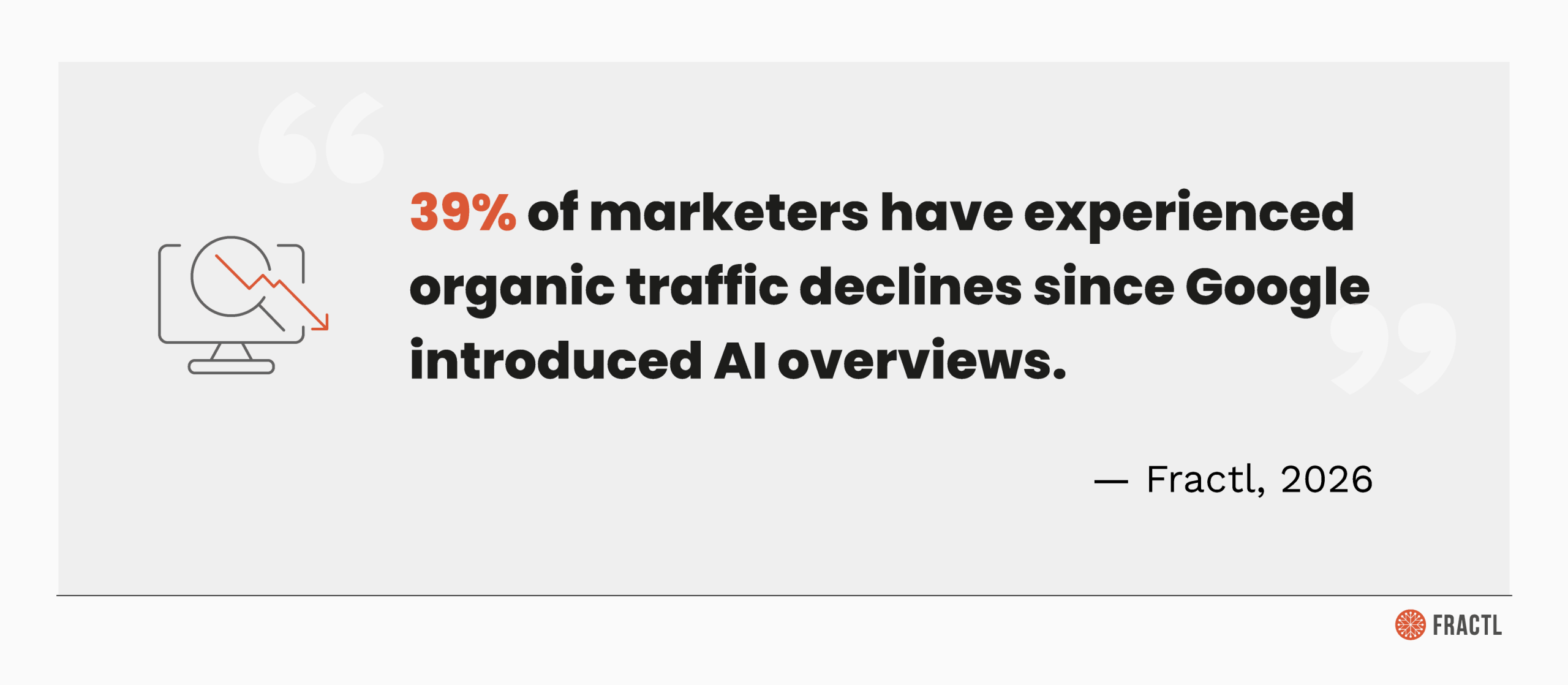
- Fractl found that 39% of marketers have experienced organic traffic declines since Google introduced AI overviews.
- 44% of technology brands report traffic losses tied to generative search features.
- 43% of travel and hospitality brands have seen organic traffic decrease following AI-powered SERP changes.
- 35% of retail and e-commerce brands report similar organic traffic declines.
- Zero-click searches now account for more than half of all Google searches, reducing traditional website clicks.
- AI overviews (AI-generated summaries) reduce organic CTR significantly — one study found click-through rates can drop by 61% when overviews appear.
- AI overviews and other SERP features now occupy most of the visible screen on mobile, with AI overviews and featured snippets together accounting for 75.7% of screen space and pushing organic results below the fold.
Search Behavior and the Rise of GEO
User expectations are shifting toward AI-driven discovery, and these statistics illustrate how search behavior is evolving and why GEO is becoming essential:
- Fractl’s consumer research shows that 66% of users expect AI to replace traditional search engines within five years.
- Search engines process billions of queries daily, reinforcing the foundational role of search behavior.
- Research shows that AI-generated answers increasingly rely on a small set of authoritative sources, meaning brands that establish topical authority are more likely to be cited repeatedly across generative search responses.
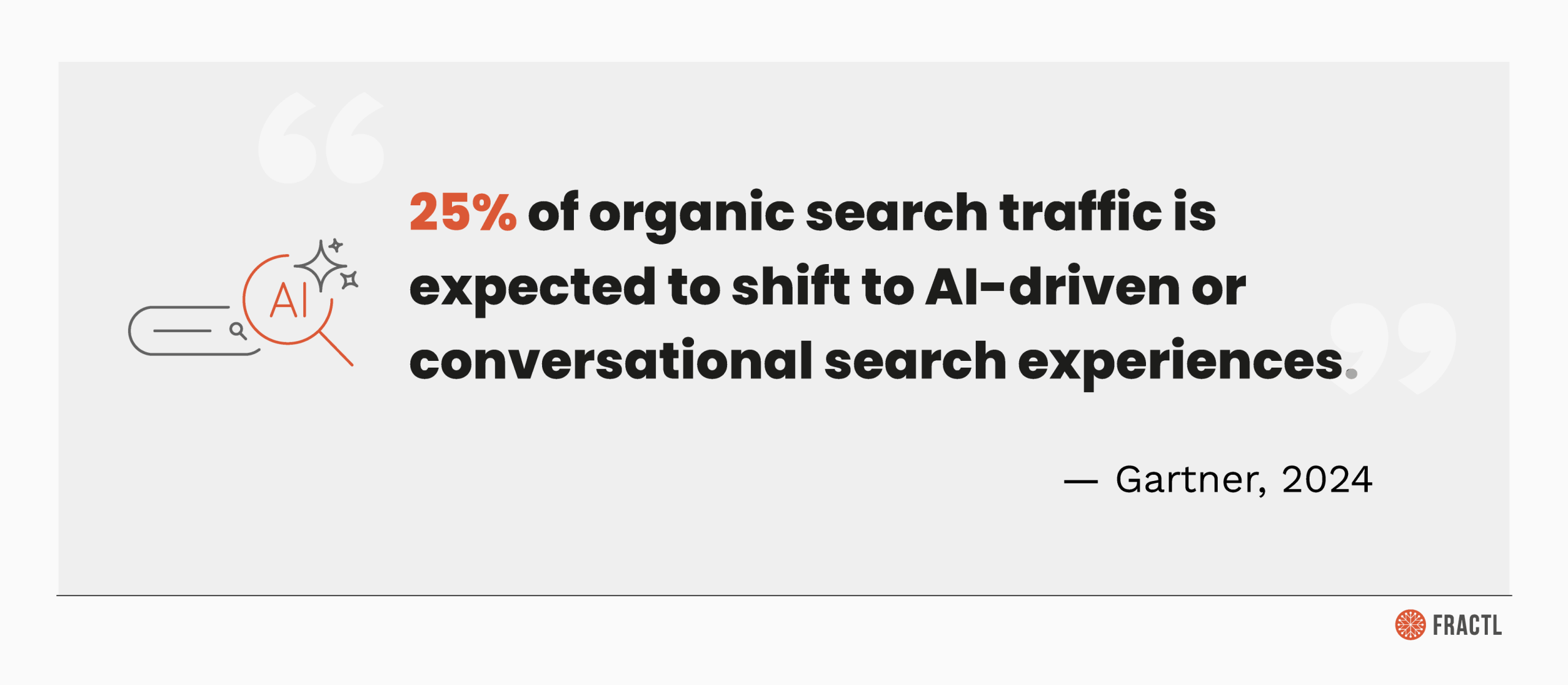
- According to Gartner, by 2026, 25% of organic search traffic is expected to shift to AI-driven or conversational search experiences, accelerating the need for GEO strategies alongside traditional SEO.
Content Quality, Authority, and Trust Signals
As search algorithms place greater emphasis on helpfulness and credibility, these statistics explain why content quality, authority, and trust signals remain foundational to SEO and GEO:
- High-quality backlinks remain one of the strongest SEO ranking signals.
- 51% of B2B buyers said content was “too generic and irrelevant” in 2024, up from 38% in 2023.
- 51% of buyers said there were “too many steps” required to access content in 2024, up from 30% in 2023.
- 54% of buyers said vendor content was “not objective/too much of a sales pitch” in 2024.
- 89% of respondents said they downloaded and consumed assets they found themselves (self-serve discovery), which supports the shift to self-directed journeys.
- 46% of buyers said they reviewed more content on social media in 2024, reinforcing that trust signals and discovery happen off-SERP, too.
SERPs, Rankings, and Search Visibility
As search engine results pages become more complex, these statistics show how rankings, visibility, and engagement are changing across modern SERPs:
- Ahrefs found that when a query triggers Google AI overviews, the #1 result’s average CTR is ~34.5% lower (based on 300,000 keywords).
- For every 1,000 Google searches, only ~360–374 clicks go to the open web.
- Google’s structured data documentation reports a case study where Nestlé measured an 82% higher CTR for pages showing as rich results vs. non-rich results.
Content Formats That Perform in Modern SEO
These statistics highlight which formats contribute most to SEO visibility, engagement, and authority:
- Demand Gen’s 2024 benchmark found 67% of buyers said short-form content was most valuable in their decision-making process.
- 65% of buyers said webinars/digital events were most valuable, and webinar value rose from 52% (2023) to 65% (2024).
- Videos embedded in galleries, blog posts, and landing pages see average engagement rates above 40%.
- Lead-gen form completion can jump to 65% when the form appears at the end of a 60-minute video.
- Well-placed CTAs can drive video conversion rates as high as 40% (with placement patterns varying by video length).
B2B SEO, Thought Leadership, and Lead Generation
As B2B buyers rely heavily on search throughout longer decision cycles, these statistics demonstrate how SEO and thought leadership content support lead generation and brand trust:
- Over half of B2B decision-makers (52%) and C-suite executives (54%) dedicate at least one hour per week to consuming thought leadership content.
- 75% of senior decision-makers said a single piece of thought leadership prompted them to explore a product or service they had not previously considered.
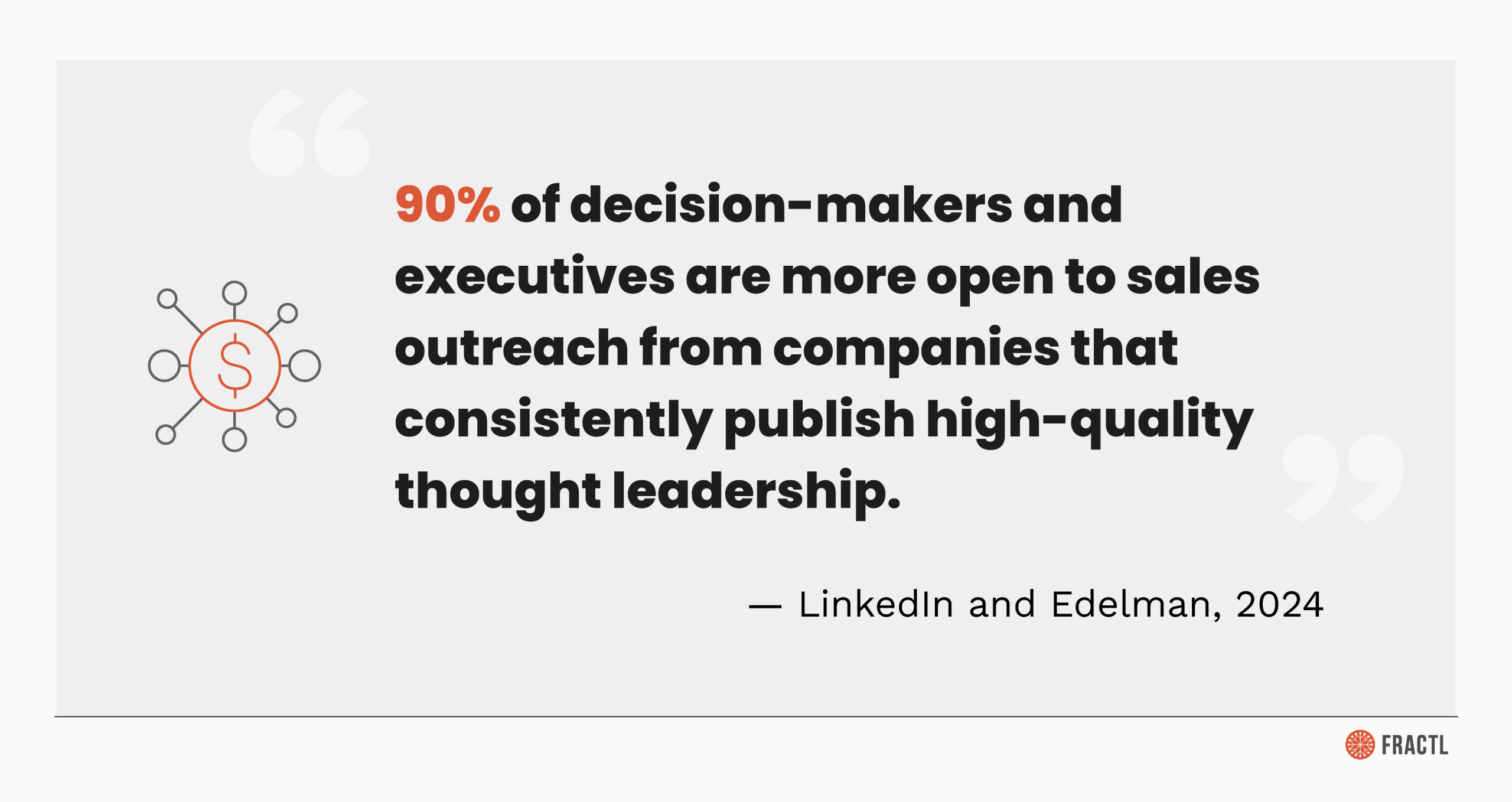
- 90% of decision-makers and executives are more open to sales outreach from companies that consistently publish high-quality thought leadership.
- 70% of C-suite leaders said that thought leadership content has, at least occasionally, caused them to reconsider an existing vendor relationship.
GEO and AI Search Metrics in Google Search
With generative AI now embedded into search engines, these GEO and AI search metrics show how visibility, traffic, and discovery are changing:
- Google reports that its AI-generated search summaries (AI overviews) have been rolled out to over 200 countries and territories and support more than 40 languages, making generative results accessible to a vast global audience.
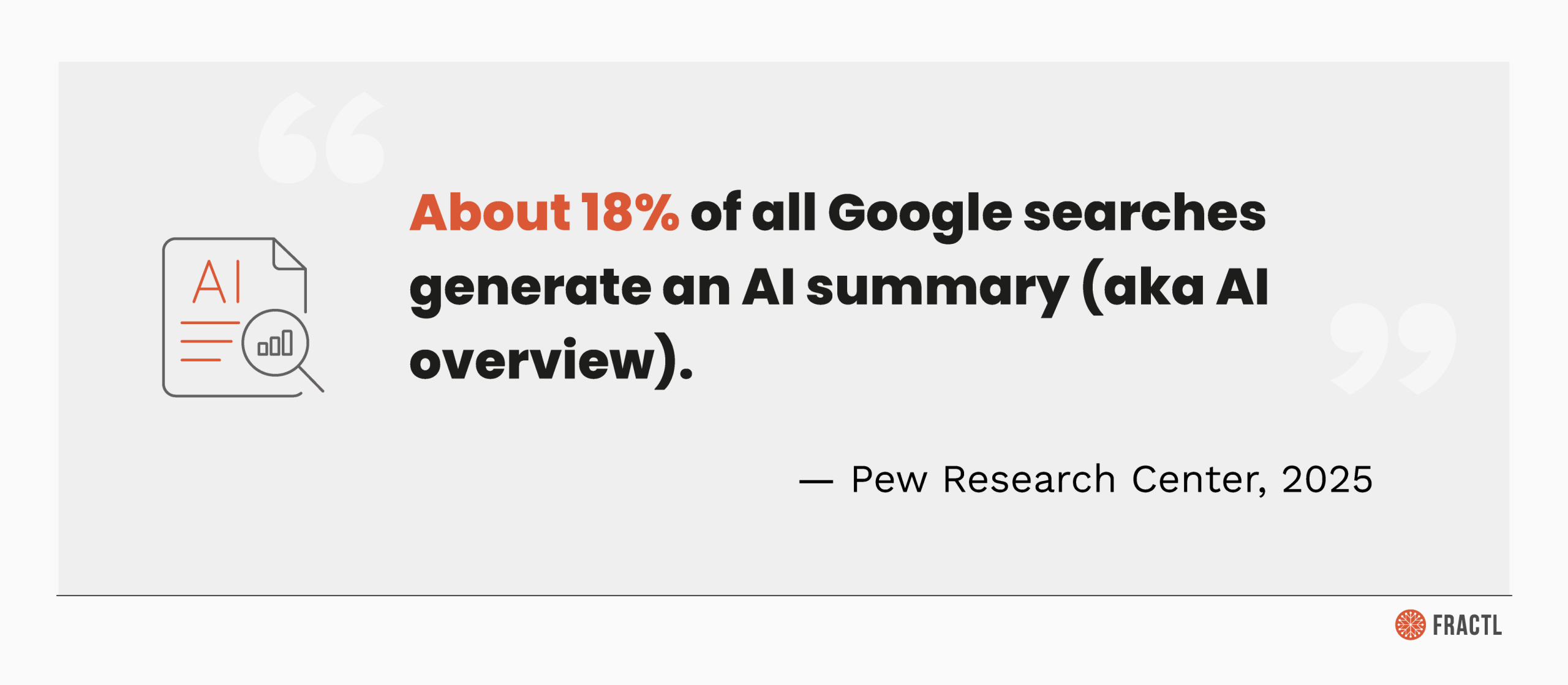
- Research shows that about 18% of all Google searches generated an AI summary (also known as an AI Overview), indicating how often generative responses now appear alongside traditional results.
- AI overviews frequently combine links from several of the top organic results, drawing from multiple high-ranking pages rather than a single source.
- Longer and more complex queries have grown by 49% in AI Overview results, meaning generative search is most commonly triggered by nuanced questions rather than simple keywords.
What These Statistics Mean for SEO and GEO Going Forward
Taken together, these statistics show that SEO and GEO are not separate strategies; they are increasingly two sides of the same content ecosystem. The fundamentals that drive strong search rankings today are the same signals generative systems like ChatGPT and Google’s AI overviews rely on when selecting sources, summarizing answers, and surfacing brands.
Rather than replacing SEO, GEO builds on it by changing how content is evaluated and where visibility happens. The key takeaways include:
- High-quality content still wins — just in more places. A single piece of content now supports traditional search rankings and generative answers, meaning thought leadership, original insights, and clarity matter more than ever.
- Well-structured formats are becoming a ranking and citation signal. Content organized with clear headings, FAQs, summaries, and logical flow improves user experience while making it easier for AI systems to extract and reference information.
- Authority fuels both SEO and GEO visibility. Signals like expertise and brand credibility influence classic rankings and determine whether a brand is cited in AI-generated responses.
- Automation changes workflows, not strategy. Automation can speed up research, drafting, and optimization, but the underlying marketing strategy still depends on human judgment, subject-matter expertise, and intent alignment.
- B2B marketers must optimize for discovery before conversion. Long buying cycles mean content must support early-stage research across search engines, AI tools, and channels like email marketing — often before a prospect ever fills out a form.
- User experience is the connective tissue. Any piece of content that answers questions clearly, anticipates follow-ups, and guides readers will naturally perform better in search rankings and is more likely to be selected by AI systems.
Use Content Marketing Statistics to Your Advantage
Content marketing statistics do more than validate trends; they help guide smarter decisions as search continues to change. The data shows that SEO and GEO are becoming increasingly intertwined, with the same signals driving visibility across traditional search rankings and AI-powered search experiences.
Using these statistics to your advantage means moving beyond surface-level metrics and focusing on what consistently works: well-researched insights, clear formatting, and content built to answer real questions. When content is grounded in data and designed for both users and machines, it supports brand awareness, improves user experience, and extends reach across search engines, AI tools, and automated discovery channels.
At Fractl, we help brands transform data into high-performing content that earns attention across SEO and generative search engines. Through original research, digital PR, and content strategies built on real statistics, Fractl helps teams turn insight into visibility.
Contact us today to learn how Fractl can help you use content marketing statistics to drive measurable SEO and GEO results.