



Table of Contents
- Key Takeaways
- The Same Authority Problem, One Layer Deeper
- How To Research AI Visibility When the Outputs Keep Shifting
- AI Use Is Rising, but Trust Is Falling
- There's No Universal GEO Checklist, but There Is a Universal Authority Model
- Brand Mentions Now Matter More Than Backlinks
- Why the Right Niche Publisher Can Beat a Big Logo
- Automate the Mechanics, Protect the Meaning
- How We'd Spend $20,000 in 90 Days To Build AI Visibility
- The Question That Won't Go Away
- Frequently Asked Questions
AI assistants like ChatGPT, Gemini, Claude, and Perplexity now decide which brands people see when they search, and they don’t agree on who to recommend. Every marketer wants to know why AI picks some brands and skips others, especially when the platforms are opaque, volatile, and constantly changing how they source answers.
The short version: AI doesn’t rank brands from a single system. It reads your entire digital footprint and decides if you count as a trusted authority worth repeating.
Here, I break down how AI decides which brands to cite, from why brand mentions now outweigh backlinks to how we’d spend $20,000 in 90 days to build visibility across search and AI. Originally presented on the StanVentures SEO podcast.
🎧 Listen to the Full Episode
Check out the full conversation on the StanVentures SEO podcast:
Key Takeaways
- AI visibility is the machine-readable version of reputation. AI systems retrieve, summarize, and repeat the brands with the strongest distributed evidence around them.
- Brand mentions now outweigh backlinks. In a study of 75,000 brands, branded web mentions correlated with AI visibility at 0.664, roughly three times stronger than backlinks at 0.218.
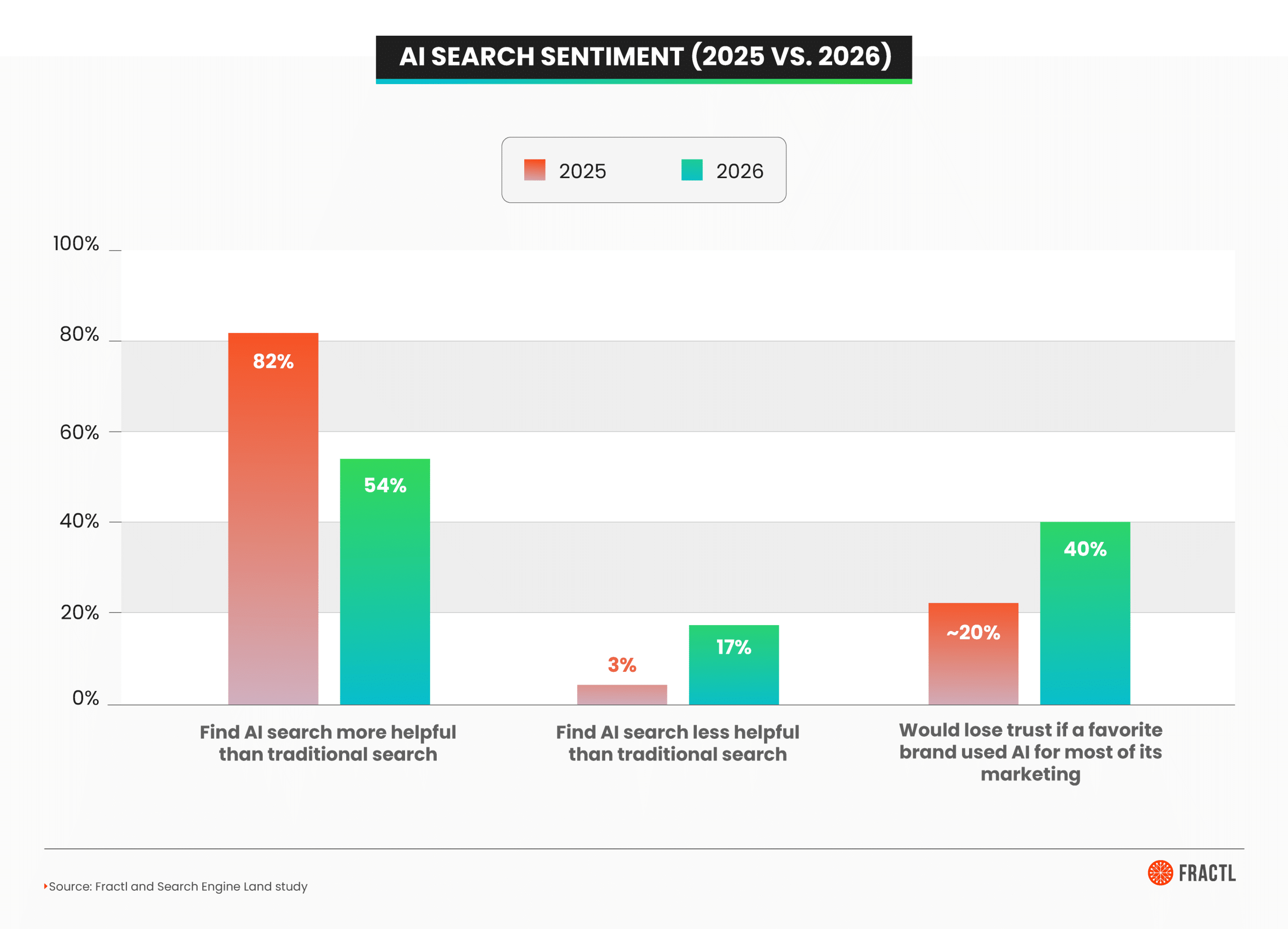
- AI is getting more useful and less trusted at the same time. The share of people who call AI search more helpful than traditional search fell from 82% to 54% year over year, while distrust in AI-heavy marketing doubled from 20% to 40%.
- Consumers are filtering out AI slop. Buyers now check an average of 2.4 platforms before acting, treating AI as one step in a validation path rather than the final word.
- The right niche publisher can beat a big logo. Our SparkToro-backed research found hidden-gem publishers delivered 1.7 times higher affinity with the right readers than major outlets despite 130 times less traffic.
- Automate the mechanics, but keep it human-led. AI now touches 53% of marketing work, and 48% of marketers say it makes their output faster — but also more average.
- AI visibility is earned across the open web. The brands that win create consistent, credible evidence across search, publishers, communities, and their own content.
The Same Authority Problem, One Layer Deeper
For years, our research at Fractl centered on two questions: why people share content, and why journalists cover certain stories.
The first was about attention and motivation, or what makes someone care enough to pass something along. The second was about newsworthiness and credibility, or what makes a story timely, useful, surprising, or authoritative enough to earn coverage.
Studying why AI systems cite certain brands is the next layer of that same problem. AI doesn’t care about a story the way a person or an editor does, but it trains on, retrieves from, and summarizes the exact artifacts those humans create: journalism, expert commentary, reviews, Reddit threads, YouTube videos, research reports, and the brand mentions scattered across the open web.
So the strategic question barely changes: does the market have enough credible evidence to believe you? What changes more is how credibility gets judged. People use judgment, emotion, and context. AI systems infer it from patterns: source authority, repeated mentions, entity associations, citations, freshness, and consistency.
AI visibility is the machine-readable version of reputation.
Ahrefs’ study of 75,000 brands found that branded web mentions had the strongest correlation with AI Overview visibility, at 0.664, well ahead of backlinks at 0.218. And a May 2026 Muck Rack analysis of more than 25 million cited links across ChatGPT, Claude, and Gemini found that earned media accounted for 84% of AI citations, while paid or advertorial content accounted for 0.3%. Across both: AI rewards brand equity; it doesn’t create it.
How To Research AI Visibility When the Outputs Keep Shifting
The biggest mistake in this space is treating a single AI answer like a fixed search result. A screenshot from ChatGPT or Perplexity isn’t research, it’s an anecdote. AI visibility isn’t a fixed position; it’s a probability distribution.
The way we approach it is to treat AI outputs as a volatile sample. That means repeated prompts, multiple platforms, consistent query sets, clear timestamps, and a clear taxonomy of what you’re measuring: brand inclusion, source citation, sentiment, accuracy, position inside the answer, and which URLs get used as evidence.
I look for repeatable patterns across unstable systems, not one lucky answer.
Credible AI visibility research follows a few rules:
 Vary your prompts Span informational, commercial, comparison, and recommendation queries instead of one |  Test every platform ChatGPT, Google Gemini, Perplexity, Claude, Grok, Microsoft Copilot, Google AI Overviews, and Google AI Mode all behave differently |
 Repeat over time Volatility isn’t a flaw in the data, it’s part of the finding |  Triangulate signals Compare against search rankings, brand mentions, and earned media |
 Measure more than presence Track how you’re described, whether sources are cited, and whether the answer is accurate | |
A word of caution, though: most generative engine optimization (GEO) research right now is correlational. That’s still useful, but we have to be careful not to turn “associated with visibility” into “causes visibility.”
The outputs also shift from run to run. Semrush’s study of 5,000 keywords and 150,000 citations found major differences across AI Mode, traditional Google, AI Overviews, ChatGPT, and Perplexity, with Perplexity overlapping Google’s top 10 far more than ChatGPT did. Ahrefs found that only 38% of pages cited in AI Overviews also ranked in Google’s organic top 10, down sharply from about 76% in July 2025.
My breakdown of what a million keywords reveal about AI’s impact on search also shows how this kind of competitive benchmarking and competitive intelligence has to be repeated, not treated as a one-time snapshot.
AI Use Is Rising, but Trust Is Falling
AI search is caught in a contradiction: people are using it more and trusting it less. What they’re pushing back on is AI used without judgment.
AI search still had novelty value in 2025. It felt better than Google and almost magical. By 2026, people had more lived experience with the downsides: hallucinations, weak sourcing, generic AI-generated answers, outdated information, and brands publishing content that reads like it was generated at scale with no human point of view.
Consumers aren’t rejecting AI. They’re rejecting AI slop.
Our Q2 2026 study with Search Engine Land, covering 1,008 U.S. consumers and 150 marketers, found that 70% of consumers said their use of AI tools for search increased over the past year, and only 4% said they’d never used AI to search. But the share who called AI-powered search more helpful than traditional search dropped from 82% to 54%, while the “less helpful” group climbed from 3% to 17%.
Distrust rose in step: 40% of consumers said they’d lose trust if a favorite brand used AI for most of its marketing, up from about 20% a year earlier.
The trust gap shows up as a transparency issue. Consumers overwhelmingly want AI-generated content labeled, with expectations ranging from 84% for written content to 91% for video, yet only 20% of organizations always disclose AI-generated or AI-assisted content.
Buyers are hedging, too. When people decide what to buy, Google still leads AI tools by nearly 3-to-1 (39% trust Google most, versus 14% for AI tools), and consumers check an average of 2.4 platforms before deciding.
AI is becoming part of how people validate a decision, not a replacement for it. It also means AI search results can name your brand without sending much referral traffic, so the mention itself becomes the metric worth tracking.
There’s No Universal GEO Checklist, but There Is a Universal Authority Model
Because ChatGPT, Gemini, Perplexity, and Google’s AI results pull from different source universes, a universal tactic checklist is impossible. A universal strategy is not.
A lot of generative engine optimization advice, sometimes called answer engine optimization (AEO) or AI search optimization, still reads like classic SEO advice: add FAQs, add structured data, answer questions, publish more content. Most AI SEO advice stops there. Some of that helps. It just isn’t enough on its own, because the platforms don’t retrieve from the same places. Google’s AI results are tied more closely to search infrastructure. Perplexity behaves like a citation-heavy answer engine. ChatGPT and Gemini lean on different retrieval systems, sourcing arrangements, and answer-generation logic.
Here’s the best strategy: build a brand that’s easy to retrieve, easy to understand, easy to verify, and repeatedly validated by sources your market and AI systems already trust. In practice, that’s a five-part operating model:
 Monitor Track where you appear and your share of voice across AI assistants using an AI visibility tool or manual checks, and how you’re described. |  Build citable evidence Publish original research, expert content, tools, definitions, and benchmarks with transparent sourcing. |  Influence the source ecosystem Use digital PR, high-affinity publishers, YouTube, Reddit, podcasts, and industry communities to shape what AI retrieves. |
 Validate Measure whether those efforts change AI mentions, citations, sentiment, and accuracy. |  Govern the trust layer Put checks in place so AI use doesn’t create brand risk. | |
The page-level fundamentals still earn their keep. A 2025 study of citation behavior across AI answer engines found that metadata and freshness, semantic HTML, and structured data were among the strongest page-level associations with getting cited. A foundational GEO research paper also found that GEO methods, including adding citations, authoritative sourcing, quotations, and statistics, could lift visibility in generative responses by up to 40%, though results varied by domain.
Community sources matter more than most teams assume, too: the Semrush study found Reddit was a leading source across AI Mode, AI Overviews, ChatGPT, and Perplexity, with AI Mode surfacing about seven unique domains per response versus roughly three in AI Overviews.
Brand Mentions Now Matter More Than Backlinks
If you’ve spent years treating the backlink as the main prize, the AI era demands a recalibration. AI systems aren’t just counting links. They’re trying to understand entities: who you are, what you’re known for, which topics you’re repeatedly tied to, and whether trusted sources describe you consistently.
That’s why unlinked mentions, co-citations, expert references, YouTube mentions, Reddit discussions, and earned media all help build the entity authority and topical authority AI uses to understand a brand.
The figures below are correlation coefficients from a study of 75,000 brands: a score closer to 1.0 means that signal tracks more tightly with showing up in AI Overviews. Brand mentions lead by a wide margin, while backlinks come in near the bottom:
| Signal | Correlation with AI Overview visibility |
|---|---|
| Branded web mentions | 0.664 |
| Branded anchors | 0.527 |
| Branded search volume | 0.392 |
| Referring domains | 0.295 |
| Backlinks | 0.218 |
Source: Ahrefs study.
Ahrefs’ cross-platform follow-up found branded web mentions stayed highly correlated across ChatGPT, AI Mode, and AI Overviews, in the 0.66 to 0.71 range, with YouTube mentions among the strongest signals of all.
Don’t stop building links. Stop mistaking the link for the whole authority signal.
So what can marketers responsibly conclude, and what would be an overreach?
The responsible conclusion is that brand mentions need to become a core visibility metric, not a secondary PR metric. The overreach is saying “backlinks don’t matter” or “brand mentions cause AI visibility.” Most of this research is correlational, and bigger brands naturally have more mentions, more search demand, more reviews, and more press. Links still matter for traditional SEO, crawl paths, search traffic, and authority signals. The link just isn’t the whole authority signal anymore.
The practical move is to build enough credible, consistent third-party citations across mainstream publishers, niche sites, expert roundups, Reddit, YouTube, podcasts, and industry sources that AI systems can confidently understand and recommend you.
Stacker’s 2026 GEO study reinforces the point: distributing content through earned media produced a median 239% lift in AI search visibility, with 64% of AI citations coming from third-party publisher sources. As with the rest of this field, that’s observational data, so treat it as strong support for earned distribution as a signal, not a guaranteed causal lever in every case.
I make the fuller strategic case in my piece on why PR is becoming more essential for AI search visibility.
Why the Right Niche Publisher Can Beat a Big Logo
Top-tier press still matters. A Wall Street Journal, New York Times, or CNBC placement creates enormous trust, reach, and validation, and those logos aren’t going anywhere. The mistake is treating big logos as the whole media strategy.
For years, PR and search teams built media lists around domain authority, traffic, and prestige. That made sense when the goal was high-authority links. But in AI-driven discovery, the question isn’t only “How big is this site?” It’s “Does this source help AI systems and buyers tie our brand to the category we want to own?”
The right small readership can be more strategically valuable than the wrong huge one.
A smaller, high-affinity publisher may have less traffic but a far higher concentration of the exact buyers, practitioners, and decision-makers you need to reach. In AI visibility terms, that kind of source can reinforce entity associations more clearly than a broad mention on a massive general-interest site.
Our SparkToro-backed affinity research found that hidden-gem publishers delivered 1.7 times higher affinity with the right readers than major outlets despite receiving 130 times less traffic, and that YouTube was the top high-affinity destination in seven of eight industries analyzed, with Reddit frequently the runner-up.
Our Fractl Agents research across more than 22,000 domains points the same direction. Across 8,090 keywords and 25 verticals, cross-system domain recognition was rare: AI Overviews tended to favor mainstream authorities, while large language models often surfaced niche authorities. That’s the case for a blended model, not an either-or. Use mainstream authority for scale, high-affinity niche publishers for category relevance, and community-led surfaces like YouTube, Reddit, podcasts, and newsletters for repetition.
I cover how this plays out in practice in my work on how media relationships influence brand visibility in GenAI research.
Automate the Mechanics, Protect the Meaning
This is one of the most important operational questions in marketing right now, and the answer is a line between mechanics and meaning.
Teams should use AI to speed up the mechanics: research synthesis, query clustering, media-list enrichment, journalist beat analysis, transcript review, competitive scans, first-pass ideation, data QA, coverage monitoring, and reporting. Those are high-friction tasks where AI genuinely saves time and improves pattern recognition. A tool suite like Fractl Agents exists to handle exactly that layer.
The work that creates authority should stay human-led: the original research question, the strategic point of view, the methodology, the claim you’re willing to stand behind, the expert interpretation, the final pitch judgment, the journalist relationship, and the fact-checking layer. The danger was never that AI makes us faster. It’s that teams use that speed to publish more average work into a market already drowning in it.
The data shows why the checks matter. In our 2026 marketer research, 53% of marketing work now involves AI, up from 38% in 2025, but 48% of marketers said AI made their work faster and more average, versus just 26% who said it made the work faster and better.
The governance gap is wide, too: 72% of marketers report human editorial review, but only 54% add fact-checking, 42% run legal or compliance review, and 27% evaluate for bias. AI becomes a competitive advantage only with the right checks and balances, effective sources of truth to train the workflow, and a human in the loop refining the output.
How We’d Spend $20,000 in 90 Days To Build AI Visibility
Say a relatively unknown company has $20,000 and 90 days to improve its visibility across search and AI platforms. We wouldn’t spend it on generic blog volume, paid ads, or buying links. The goal in 90 days isn’t fame. It’s to become the most credible answer for a specific category question that search engines, AI systems, journalists, and buyers can all understand.
With $20,000 and 90 days, I’d spend it on evidence, not volume.
We would allocate the $20,000 like this:
| Budget | Where it goes | Why it matters |
|---|---|---|
| $2,500 | Baseline visibility and entity audit | Measure where the brand appears today across Google, AI Overviews, AI Mode, ChatGPT, Gemini, Perplexity, Reddit, YouTube, and review surfaces, testing 25 to 50 category, competitor, comparison, and recommendation prompts to surface AI visibility gaps and content gaps. |
| $6,000 | One proprietary data asset | Create a single original research asset the company can own, such as a survey, industry benchmark, pricing analysis, or public-data study, because AI can summarize existing advice but can’t invent proprietary evidence that doesn’t exist. |
| $3,000 | A “source of truth” content hub | Build or improve the owned page that should become the definitive answer hub, with definitions, methodology, FAQs, charts, comparison points, author expertise, and clear citations that serve both traditional search and AI retrieval. |
| $6,000 | High-affinity earned media and expert distribution | Pitch the data asset to a blended list of a few mainstream or industry-authority outlets, several high-affinity niche publishers, relevant newsletters, podcasts, YouTube channels, and community sources. |
| $1,500 | Community and platform repurposing | Turn the research into LinkedIn posts, executive commentary, short video clips, and newsletter content, aiming for credible repetition rather than spammy promotion. |
| $1,000 | Measurement, cleanup, and reruns | Every two to three weeks, rerun the original prompts and queries to see whether the brand started appearing, whether cited sources changed, and whether AI is describing the brand accurately, then update your AI visibility report and AI visibility score. |
The allocation fits where the market is right now. Our research with Search Engine Land found only 15% of marketers were prioritizing original research and data, even though proprietary evidence is one of the few assets AI can’t synthesize from existing content.
Combine that with the finding that only 38% of AI Overview citations also rank in Google’s top 10, and there’s an opening for focused, well-structured, credible content reinforced by third-party validation. This is the core of a data-driven content marketing and content strategy: earn the evidence first, then distribute it where AI and buyers both look.

The Question That Won’t Go Away
The answer to “Why does AI choose some brands and ignore others?” isn’t one ranking factor. It isn’t structured data, or backlinks, or publishing 200 AI-generated blog posts. AI systems are looking at the same fragmented trust ecosystem consumers are: search results, trusted publishers, YouTube, Reddit, reviews, expert sources, brand mentions, and owned content.
The platforms will keep changing. The models will keep disagreeing. But the underlying question only gets more important: when AI looks across the web for evidence, does your brand have enough of it to be included in the answer?
AI visibility isn’t won inside the chatbot. It’s earned across the open web.
Ready to become the brand AI recommends? Partner with Fractl to build visibility that lasts across search and AI.
Frequently Asked Questions
Got questions about AI visibility? Here are answers to the ones we hear most.
What is AI visibility?
AI visibility is how often, how accurately, and how favorably AI assistants like ChatGPT, Gemini, Claude, and Perplexity mention or recommend your brand. It reflects the evidence about your brand distributed across the open web, not a single ranking in one system.
Do brand mentions really matter more than backlinks for AI?
In a study of 75,000 brands, branded web mentions correlated with AI Overview visibility at 0.664, well ahead of backlinks at 0.218. Links still matter for traditional search, but mentions now carry more weight as an AI visibility signal.
How do you track brand visibility across tools like ChatGPT and Gemini?
Treat AI outputs as a volatile sample: run a consistent set of prompts across multiple platforms on a schedule, and log brand inclusion, sentiment, accuracy, and which sources get cited. One screenshot is an anecdote, not a measurement.
Is there a GEO checklist that works on every AI platform?
No, because ChatGPT, Gemini, Perplexity, and Google’s AI results pull from different sources. The strategy that travels across platforms is building a brand that’s easy to retrieve, understand, verify, and repeatedly validate through trusted third parties.
Can you buy your way into AI recommendations?
Not reliably. A May 2026 analysis of more than 25 million cited links found earned media made up 84% of AI citations while paid or advertorial content accounted for 0.3%, so credibility earned across the open web matters far more than paid placement.