




Table of Contents
- Understanding Fraggles: Fragments and Handles in SEO
- Fraggles and Generative AI: Building Brand Visibility
- How GenAI Changes Search, Content, and SEO
- Brand Visibility vs. Brand Awareness
- GenAI Use Cases Driving Brand Visibility
- Challenges and Ethical Considerations of GenAI
- The Future of Fraggles, GenAI, and SEO
Fraggles — a portmanteau of “fragments” and “handles” — are an evolving concept in SEO. They refer to linkable, indexed content fragments that search engines can surface independently in response to queries.
As search engines change with generative AI (GenAI), fraggles are becoming important for improving brand visibility on AI-driven platforms. They help brands organize content, so even small sections can rank or be cited. This strategy works well with how foundation models and neural networks process and retrieve information.
This shift is important because search engines depend more on detailed content to support generative artificial intelligence outputs. If your brand’s content isn’t optimized for fraggles, it risks being ignored by both traditional and GenAI-powered discovery systems.
So, let’s explore how fraggles work, why they’re essential for search engine optimization (SEO) in a GenAI context, and how to structure your content to surface consistently in AI outputs. We’ll provide practical strategies for aligning your content with emerging search behaviors and advancements in AI technology so you can stay relevant and visible in an evolving online environment.
Fraggles in Action: How Structured Content Drives Results
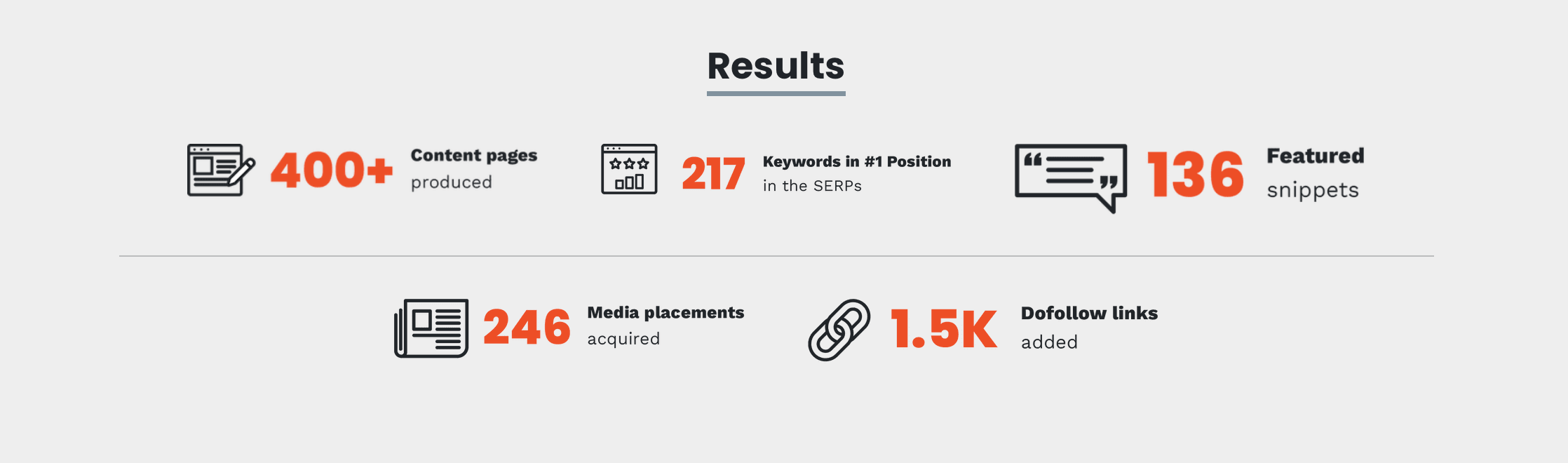
Fractl’s 18-month partnership with College Finance shows what fraggle-optimized content looks like in practice. The team created 400 pages of structured, SEO-driven content that earned featured snippet positions for over 136 search queries — proof that well-organized fragments can consistently surface in search results. The engagement also added 29,000+ monthly organic visitors and generated 1,500+ dofollow links, demonstrating how fraggle-friendly content architecture directly translates to measurable brand visibility.
Understanding Fraggles: Fragments and Handles in SEO
Fraggles are an SEO concept that blends two technical elements — fragments and handles — into a powerful structure that improves how search engines understand and index content. A fragment is a specific, identifiable piece of content on a page, while a handle is the mechanism (like a jump link or named anchor) that lets users and search engines navigate directly to that content.
By combining these, fraggles help search engines crawl and categorize content more effectively. They also improve the way information is displayed in the search engine results page (SERP), such as enabling site links, jump links, or deep results under a single URL. With proper markup, fraggles make it easier for algorithms to pinpoint valuable sections, making content more accessible to both users and crawlers.
How Fragments Work in Search
Fragments allow search engines to zero in on highly specific parts of a page. These are the pieces that often appear in featured snippets or as highlighted text in search engine results when answering a direct query.
By structuring content into meaningful, self-contained sections, SEO practitioners give crawlers a clear signal of relevance. That makes fragments crucial for content visibility, especially as search evolves to prioritize clarity and precision over page-level indexing.
What Handles Do in SEO
Handles, also called jump links, named anchors, or bookmarks, are navigational tools that link directly to a specific part of a web page. In an SEO context, they help both users and search engine crawlers move efficiently through a site’s content.
Proper use of handles improves site structure, enhances internal linking, and increases the chance of earning site links in the SERP. With the right markup, handles can turn regular content into clear, organized sections that make it easier for search engines to find and display.
Why Fraggles Matter for Modern SEO
Fraggles are key to how content gets found, displayed, and ranked — especially on mobile and AI-powered search platforms. Their setup supports mobile-first indexing, making it quicker and easier for users to reach the exact part of a page they need without scrolling endlessly or clicking through multiple links.
Fraggles also influence how content is pulled into featured snippets, People Also Ask sections, and voice search results. Because they enhance clarity and scannability, they increase the chances of being selected by algorithms trained to summarize or extract direct answers across different AI systems.
Ultimately, using fraggles strategically strengthens SEO performance by aligning your content with how both users and search engines — human and AI — consume information today.

Fraggles and Generative AI: Building Brand Visibility
As GenAI reshapes modern searches, it also changes how fraggles show up in search results. Unlike traditional algorithms, large language models (LLMs), machine learning systems, and AI agents rely on deeper context and meaning. They use tools like knowledge graphs and structured workflows to connect relevant fraggles to user queries.
This shift creates new pathways for brand visibility. When content is optimized for GenAI — structured, labeled, and embedded with clearly marked fraggles — it becomes more discoverable across generative AI tools, voice assistants, and smart search outputs. That visibility is no longer limited to just SERPs. It now extends to AI-powered experiences that drive brand discovery.
Fraggles also play a role in shaping the outputs of generative AI models by helping these systems identify trusted, digestible content chunks. As natural language processing improves, so does the ability of GenAI to find and surface the most relevant fraggles, giving structured content a competitive edge in an AI-first search environment.
How GenAI Changes Search, Content, and SEO
As search is fracturing across platforms — AI, social, and SERPs — brand visibility now hinges on a unified strategy that emphasizes semantic clarity, structured data, and authority signals. To stay competitive, marketers must understand three key shifts:
- Authority still drives visibility. The same E‑E‑A‑T signals (expertise, experience, authoritativeness, and trustworthiness) that influence Google rankings also determine whether brands are cited in AI-generated responses. AI tools reward strong, well-sourced, and original content.
- Brand mentions and contextual relevance now outweigh backlinks. LLMs don’t “rank” content by links — they generate answers based on how often and in what context a brand appears in trusted sources. Repeated, high-quality mentions matter now more than ever.
- Semantic structure matters. AI platforms retrieve and generate content based on meaning, not surface-level keywords. This makes formatting, structured data, clear headings, and concise language crucial for being discoverable and cited by AI systems.
Brand Visibility vs. Brand Awareness
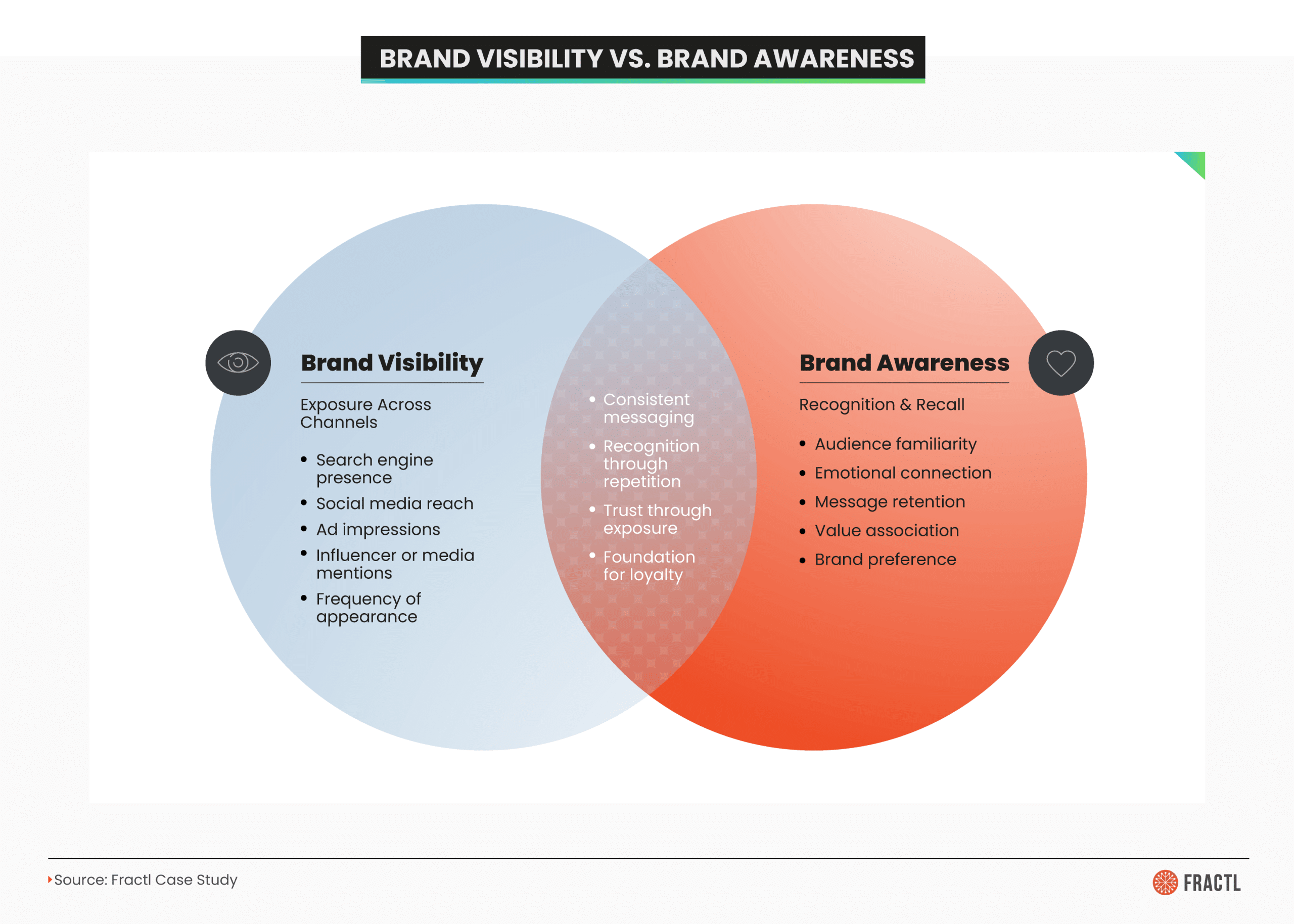
Brand visibility is the extent to which your brand is seen by your target audience, both in search results and across digital channels. It’s a measurable signal of presence that answers the question: Is your brand showing up where it matters?
While often used interchangeably, brand visibility and brand awareness are distinct. Visibility is about exposure — how frequently your brand appears in search, on social, or through partnerships. Awareness goes a step further, measuring how well your audience recognizes and remembers your brand identity, values, or message.
Both are necessary in building a strong brand. Visibility drives discovery, helping you reach new audiences. Awareness creates familiarity and trust, making your brand more recognizable and more likely to be chosen. Many companies partner with enterprise SEO agencies to scale visibility efforts while strengthening brand awareness. Together, they lay the foundation for a brand that not only gets noticed but also builds trust and long-term loyalty.
Strategies To Increase Brand Visibility Online
To increase your brand’s presence online, companies can use a mix of digital marketing tactics designed for maximum reach and engagement:
- Social media platforms. These platforms increase visibility by putting your brand in front of targeted audiences in real time.
- Influencer marketing and sponsorships. Collaborating with trusted voices helps expand your reach and associate your brand with established credibility.
- Partnerships and backlinks. Strategic collaborations and earned links improve brand exposure and authority in search results.
- Content marketing and podcasts. These long-form formats allow for deeper storytelling, building brand awareness through consistent, valuable engagement.
- GenAI integration. Companies are using generative AI to automate new content creation, analyze audience behavior, and scale efforts — making visibility more efficient and data-driven.
How To Measure Brand Visibility
Tracking your brand’s visibility online now requires measuring performance across both traditional and AI-driven environments. A comprehensive view includes these key metrics:
- Website traffic and brand mentions. These show how often users are finding and engaging with your content, especially as brand citations influence AI rankings.
- Analytics tools. Platforms like Google Analytics and Semrush offer insights on keyword ranking, referral sources, branded search demand, and AI-influenced traffic and conversions.
- Social listening and sentiment analysis. Tools like Brandwatch or Sprout Social help assess how your brand is perceived, identifying high-impact mentions that may inform AI model training data.
- Conversion rates and customer loyalty. Visibility doesn’t stop at exposure. Tracking who returns and takes action shows whether your content drives meaningful results.
- Share of voice. Measure your brand’s presence in comparison to competitors across traditional search, social, and AI platforms to gauge influence.
- Brand visibility across LLMs. Tools like Fractl Agents or custom dashboards can track how often your brand is mentioned across large language models like ChatGPT, Gemini, or Perplexity.
- Share of voice in AI search. Benchmark your presence in AI-generated answers across key queries and topics.
- AI search visibility by topic. Track how consistently your brand appears in answers related to priority themes or areas of expertise.
These metrics together will give you a holistic picture of brand visibility that reflects where your audience is and how search is evolving.
GenAI Use Cases Driving Brand Visibility
Generative AI is changing how brands appear online. It is not only increasing content production but also improving the consistency and creativity of brand expression. Let’s explore how brands are using GenAI tools to boost visibility across channels:
- Text generation for consistent content. Tools like GPT-5 and Google Gemini help brands maintain a steady publishing cadence with cutting-edge efficiency, generating articles, product descriptions, social posts, and FAQs that align with SEO goals, like increasing E-E-A-T.
- Image generation for visual marketing. Platforms like DALL·E, MidJourney, and Stable Diffusion allow marketers to create high-quality, brand-aligned visuals without needing stock imagery or in-house design.
- Chatbots and AI agents for customer engagement. AI-powered interfaces improve customer experience by offering real-time, personalized support, which keeps users on-site longer and increases positive brand interactions.
- Simulations and AI applications for expanded reach. Brands are using synthetic data, generative adversarial networks (GANs), and simulations to test campaigns, train systems, and explore real-world markets more efficiently, all while reinforcing their digital footprint with every interaction.
Each of these tools amplifies the power of generative AI to make brand engagement more scalable, personalized, and discoverable.
Challenges and Ethical Considerations of GenAI
While GenAI opens doors for visibility, it also brings risks that can undermine trust and brand image if not handled carefully.
- Deepfakes and misinformation. AI-generated content can spread false information that harms brand credibility, like the Chicago Sun-Times fake book list, which went viral for all the wrong reasons.
- Brand voice misalignment. AI tools trained on broad datasets can stray from your brand’s tone, weakening brand recognition and potentially alienating core audiences.
- Ethical AI use builds trust. Transparent deployment and clear labeling of AI-generated content strengthen customer experience and reinforce brand values.
- Balancing innovation and responsibility. The most successful brands are those that use LLMs and deep learning to enhance storytelling while safeguarding user trust and decision-making integrity.
Ignoring these challenges can result in bad brand visibility — the kind driven by backlash rather than engagement. Ethical use is essential to building a strong, resilient brand in the GenAI era.

The Future of Fraggles, GenAI, and SEO
Over the next decade, fraggles and GenAI will keep changing how brands handle SEO and digital visibility. As search engines become AI-focused platforms, content pieces with solid structure will form the basis for search and AI results, which makes them crucial for long-term improvement.
At the same time, GenAI developments will simplify content creation. This will allow brands to publish extensively while keeping quality and consistency. These tools will also help develop better marketing strategies. They will assist brands in understanding audience behavior, customizing messages, and increasing their reach on social media channels like LinkedIn, TikTok, and others.
For forward-thinking brands, the opportunity lies in integrating GenAI into their marketing efforts today. Doing so strengthens brand awareness, attracts new customers, and expands market share, all while building the structured, searchable content GenAI thrives on.
Looking to stay ahead of the curve? Fractl’s research-driven strategies have produced results like a 1,100% organic traffic increase over 36 months and 136+ featured snippet wins from a single content engagement. See how a structured, data-backed approach to SEO and content marketing drives real impact for brands ready to grow their visibility in an AI-driven world.