



Table of Contents
- What's Inbound Marketing?
- What's Outbound Marketing?
- What People Told Us About Each
- What $10,000 Bought Across Channels
- How To Combine Both
- Build the Mix Your Buyers Respond To
- Methodology
- Frequently Asked Questions
Key Takeaways
- The split is about who starts the conversation. Inbound earns attention from people already looking; outbound buys attention from people who weren’t.
- Neither one is a complete marketing strategy. Outbound creates the demand that inbound captures, which is why the two work better when funded together than traded off.
- People research before they ever reach you. When we surveyed more than 1,000 people, 88.3% used online search to look into a company, and 81.9% read customer reviews.
- Some outbound channels actively cost you sales. Email marketing, display ads, paid search, and mobile app ads were the tactics most likely to push respondents away from a purchase.
- The cost gap is the strongest argument for inbound. One $10,000 content campaign reached as many people as roughly $75,000 of primetime TV would have.
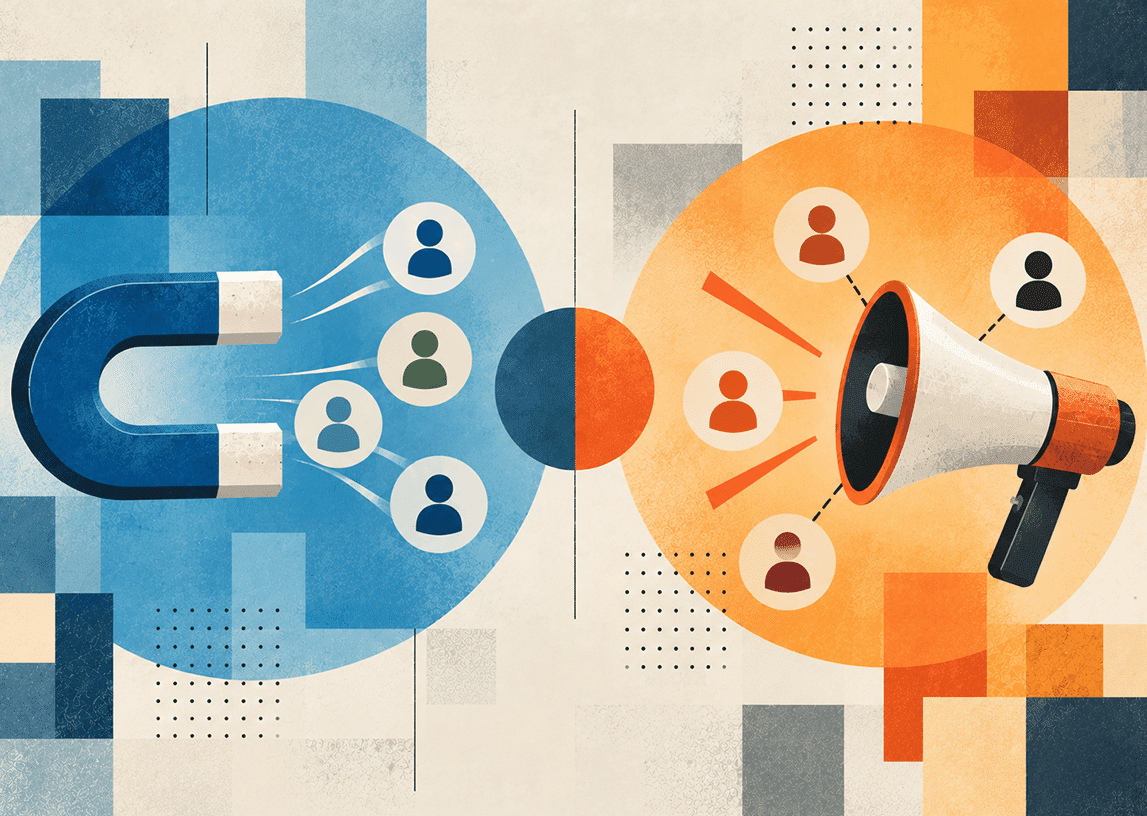
Inbound marketing vs. outbound marketing is the difference between earning attention and buying it. Inbound marketing pulls people in who are already searching, reading, or asking; outbound marketing pushes a message at people who weren’t looking for one. Every channel a marketing team runs falls on one side of that line, and the two behave very differently on cost, timing, and trust.
We surveyed more than 1,000 people to find out which side they respond to, then priced what the same budget buys across both. The short version is that the answer isn’t one or the other, and our respondents were more specific than that about which tactics to drop.
| Inbound marketing | Outbound marketing | |
|---|---|---|
| Who starts it | Someone looking for an answer, by searching or reading | The brand, by interrupting |
| Typical tactics | Blog and educational content, SEO, webinars, podcasts, thought leadership, email to people who opted in | Cold calling, telemarketing, cold email, direct mail, trade shows, billboards, TV commercials, radio ads, print advertising, display ads |
| How it’s paid for | Production and promotion up front, then compounding organic traffic | Per impression or per placement, every time |
| Speed | Slow to start, durable once it ranks | Immediate reach, stops when spending stops |
| Best at | Lead generation from people already partway through a buyer’s journey | Brand awareness with people who have never heard of you |
What’s Inbound Marketing?
Inbound marketing earns its readers by publishing something worth finding. HubSpot popularized the term in the mid-2000s, and the mechanics have held up: you answer the questions your target audience already types into a search engine, and the people who arrive have selected themselves.
Inbound tactics run from blog posts and educational content through search engine optimization (SEO), webinars, podcasts, original research, and thought leadership pieces that put a named expert behind a point of view. The work compounds. A page that ranks keeps delivering organic traffic months after it’s published, which is what makes organic search economics different from paid. It also takes time to start, and a landing page nobody links to goes unread, however good the copy.
The benefit is durability. Production and promotion cost more before anything returns, and then the same page keeps working with no further spend behind it.
Our respondents said the same thing from their side, rating search and online articles among the strongest positive influences on a purchase. The challenge is patience: nothing ranks the day it publishes.
The channel most often miscategorized here is email marketing. Email sent to a list that opted in is inbound; the same message sent cold to a purchased list is outbound.
What’s Outbound Marketing?
Outbound marketing, sometimes called push marketing or traditional marketing, buys its way in front of people. Cold calling, telemarketing, cold email, direct mail, trade shows, billboards, TV commercials, radio ads, print advertising, and display ads all work the same way underneath: you pay per impression or per placement, and the reach stops the moment the ad campaigns do.
That reputation for interruption has made outbound unfashionable, and marketers overcorrect. Outbound is the only reliable way to reach people who have never heard of a category, which makes it the engine of brand awareness. A digital marketing strategy that skips it starves the rest. Digital channels haven’t replaced that job, and a brand with no awareness has nothing for inbound to capture.
The benefit is speed. A placement runs the day it’s bought, with no waiting for anything to rank. The cost is waste: you pay for the impressions whether or not anyone wanted them, and the reach disappears with the budget.
What People Told Us About Each
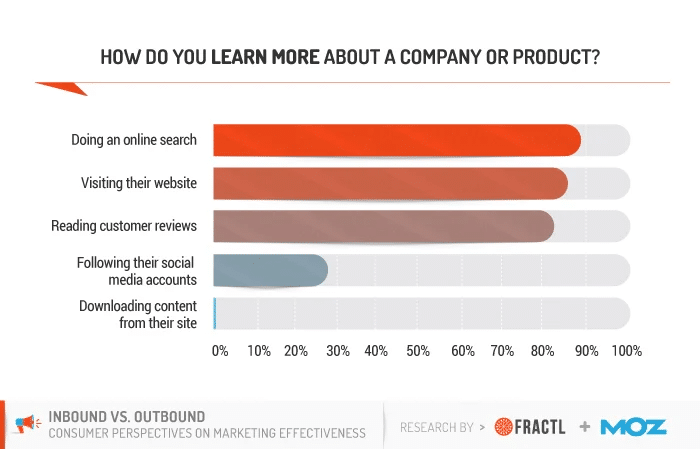
In July 2015, Fractl and Moz surveyed more than 1,000 people about how they research companies and which marketing they respond to. The clearest result was how much research happens before a brand knows a buyer exists. Among respondents, 88.3% used online search to look into a product or company, just over 85% visited the company’s website, and 81.9% read customer reviews. Only 27.4% followed a company’s social media accounts to learn about it.
Some channels moved people the wrong way.
Customer reviews, search, online articles, traditional advertising, and direct mail were the tactics most likely to positively influence a purchase.
Mobile app ads, display ads, paid search, and email marketing were the ones most likely to influence it negatively, which is a different and more useful finding than a channel simply underperforming. Meanwhile, 58% of respondents were running ad-blocking software, so a share of the outbound spend aimed at them never arrived at all.
Direct mail is the result that surprised us, and it still complicates the tidy story that outbound is dead. Respondents rated it among both the most effective tactics for attracting business and the most positive influences on a purchase, alongside content marketing and appearing in search results.
What $10,000 Bought Across Channels
The second half of the study priced the same budget across media, using median CPMs at the time:
| Channel | Median CPM | What $10,000 achieved |
|---|---|---|
 Direct mail, letter-sized | $583.00 | 17,152 households |
 Primetime spot TV | $33.85 | Almost 300,000 local viewers, one 30-second spot |
 Magazines | $14.00 | Circulation of about 715,000 |
 Facebook ads | $1.54 | Almost 6.5 million impressions |
Source: Fractl and Moz, “Consumer Survey Reveals the Efficacy of Inbound vs. Outbound,” September 2015. CPMs are medians as of that study.
Content marketing has no standard impression unit to divide a budget by, so the study priced it against television instead. A Fractl client campaign placed on BuzzFeed earned more than 3.2 million views within days of publication, for a campaign budget of around $10,000 covering end-to-end strategy, production, and promotion. Reaching that many people on primetime network TV would have cost roughly $75,000 for a single 30-second spot, and counting syndication and social sharing, closer to $200,000.
That’s a 7.5x to 20x difference in what the same reach costs, and it’s the strongest argument in the study for weighting a budget toward inbound. One campaign isn’t a benchmark. A piece of content that no publisher picks up earns nothing at all, and the gap between a campaign that lands and one that doesn’t is far wider than the gap between a strong and a weak television placement.
How To Combine Both
Funding one and cutting the other is the usual mistake. A few principles carry across the programs we run:
 Fund awareness before capture Outbound and earned coverage create the demand that search captures. Ranking for a term nobody searches yet is an expensive way to learn this. |  Match the channel to the stage Brand awareness work reaches people with no intent; comparison content and demos reach people at the end of their sales cycles. |
 Kill the tactics that repel The channels our respondents rated as negative influences are the ones to cut first, ahead of the ones that merely underdeliver. |  Let earned media do both jobs Original research pitched to publishers builds brand mentions and citations that raise awareness and rankings at once, which is the work our digital PR team runs. |
 Automate the follow-up, not the thinking Marketing automation should route people by what they read; a sales team still decides who’s worth a call. | |
For the underlying economics of each side, our analysis of what content marketing returns and our content marketing statistics cover even more ground, and the rest of our original marketing research covers the neighboring questions.
Build the Mix Your Buyers Respond To
Decide the split with evidence rather than fashion: fund the outbound that creates awareness, publish the inbound that captures it, and cut the channels your own customers tell you they resent. We build the research and earned coverage that make the inbound half work. Reach out to Fractl to talk through the right mix for your category.
Methodology
Fractl and Moz conducted an online survey of more than 1,000 people in July 2015, published that September as “Consumer Survey Reveals the Efficacy of Inbound vs. Outbound.” Participants answered 13 questions about their opinions on, and recent use of, traditional advertising, direct mail, social media, content marketing, online search, display ads, ad retargeting, email marketing, paid search ads, mobile app ads, and sponsored story links. Within the survey, “traditional advertising” meant TV, radio, billboards, and print ads, and participants were shown visual examples of terms they might not have known, such as pay-per-click ads, retargeting, and sponsored story links.
Respondents skewed young and male: 73.2% were between 18 and 34, and 58.4% were men. Read the figures as a benchmark of attitudes at the time rather than a current measurement, and as weighted toward younger respondents than the U.S. population.
The second part of the study compared what a $10,000 budget bought across media, using the median CPM for each channel at the time of publication. Content marketing has no standard impression unit, so it was priced against the cost of buying comparable reach on primetime network television. The BuzzFeed placement cited is a single Fractl client campaign, not an average.
Frequently Asked Questions
What is inbound and outbound in simple words?
Inbound means people come to you, usually through search, content, or word of mouth. Outbound means you go to them, through ads, calls, mail, or events they didn’t ask for.
What are examples of inbound marketing?
Blog posts and educational content, SEO, social media marketing, original research, webinars, podcasts, customer reviews, and email sent to people who subscribed. Anything that earns a visit rather than buying one.
What are some examples of outbound marketing?
Cold calling, telemarketing, cold email, direct mail, trade shows, billboards, TV commercials, radio ads, print advertising, and display ads. The common thread across outbound tactics is paying to interrupt someone.
Is outbound marketing still worth it?
For awareness, yes. Outbound reaches people who don’t know your category exists, which inbound can’t do by definition. Our survey respondents rated traditional advertising and direct mail among the most positive influences on a purchase, while rating display and mobile app ads among the most negative.
Which one gives a better ROI?
It depends on the time horizon. Inbound costs more up front and keeps returning; outbound costs per impression and stops when the budget does. In our study, one $10,000 content campaign reached as many people as roughly $75,000 of primetime TV would have.