




A stellar piece of content can do more than look good on your site or educate your audience. When paired with thoughtful digital marketing and outreach, it can earn coverage from top-tier publishers, attract attention across the web, and play a meaningful role in your overall search engine optimization (SEO) strategy.
This type of earned media helps build a strong online presence with a solid backlink profile made up of high-quality backlinks, including dofollow links, co-citations, nofollow links, and text attributions. A balanced mix of link types and referring domains signals to search engines that links were earned organically rather than created through link schemes or other risky tactics that can lead to SEO penalties.
In this guide, we’ll break down what strengthens a backlink profile and how to build links in ways that support long-term search engine rankings. You’ll see practical strategies for earning high-quality links, avoiding SEO penalties, and real-world examples that show these approaches in action.
SEO Penalties: What They Are and How To Avoid Them
SEO penalties occur when search engines determine that a website’s backlink activity violates their quality guidelines. These penalties can be applied manually (by a human reviewer) or algorithmically (triggered automatically during algorithm updates). In both cases, penalties often result in reduced visibility in search engine results pages (SERPs) and declines in organic website traffic.
Backlinks are one of the most common causes of penalties because they are frequently manipulated through link schemes, paid placements, spammy backlinks, or over-optimized anchor text. Understanding what puts a backlink profile at risk is essential before attempting to strengthen it.
Common Backlink-Related SEO Penalties
Search engines typically penalize backlink profiles that show signs of manipulation rather than editorial value. Some high-risk patterns include:
- Large volumes of low-quality links from unrelated sites or directories
- Repetitive exact-match anchor text across multiple referring domains
- Sudden spikes in links that don’t align with content promotion or visibility
- Paid or exchanged links without proper disclosure
- Links generated through automated systems or private blog networks
These patterns can lead to algorithmic penalties that quietly suppress your website’s rankings or a manual penalty that appears in Google Search Console.
Practical Tips To Avoid SEO Penalties When Building Backlinks
No one wants their company’s search engine visibility to take a hit. SEO penalties can undo months of hard work, which is why it’s important to understand how to avoid common mistakes:
- Focus on editorial value first. Earn links through high-quality content that publishers choose to reference because it improves their articles, not because it was requested or incentivized.
- Prioritize relevance over volume. A smaller number of relevant, contextual links from trusted sources carries more value than large volumes of unrelated backlinks.
- Allow natural anchor variation. Let publishers choose how they reference your content rather than pushing exact-match or keyword-heavy anchors.
- Monitor backlinks regularly. Review new links using SEO tools and Google Search Console as part of ongoing backlink analysis to spot emerging toxic links early.
- Act quickly on risky links. When necessary, request removals or use the disavow tool to distance your site from harmful backlinks.
- Build links gradually. Consistent growth across time supports healthy link velocity and reduces the risk of suspicious spikes.
5 Ways To Strengthen Your Backlink Profile
Strengthening your backlink profile requires more than simply acquiring more links. Search engines evaluate how links are earned, where they come from, and how they grow over time. Here are strategies that focus on improving backlink quality, diversity, and sustainability, all of which are critical factors for long-term SEO success.
1. Start With High-Quality Editorial Links To Set a Strong Foundation
One of the most effective ways to strengthen your backlink profile is by earning high-quality backlinks from reputable publishers through editorial coverage. Links placed naturally within valuable content signal trust and relevance to search engines, especially when they come from sites with strong domain authority or domain rating.
To build this type of link:
- Create valuable insights. Publish original research, expert insights, or data-driven content that directly serves your target audience.
- Target relevant publishers. Pitch sites whose coverage aligns with your target keywords, industry focus, and expected user experience.
- Prioritize editorial fit. Focus on why the content benefits readers rather than requesting specific anchor text or promotional placement.
This approach limits reliance on directories, excessive guest posts, or other low-quality tactics that can introduce toxic links and increase the risk of a Google penalty.
2. Encourage Natural Syndication
Natural syndication occurs when multiple publishers independently reference or link to the same piece of content after seeing it covered elsewhere. Instead of links being placed through direct requests, other website owners discover the content organically and choose to cite it because it adds value to their own articles.
To encourage syndication without creating spammy backlinks:
- Promote content strategically. Share published coverage through social media, email newsletters, and other digital marketing channels to increase discoverability.
- Publish citation-worthy assets. Focus on topics that invite follow-up reporting, expert commentary, or discussion within your niche.
- Avoid anchor manipulation. Allow publishers to reference your content naturally without requesting specific anchor text or link placement.
3. Use Network Syndication To Build Depth Across Your Link Profile
Many top-tier news publishers have large networks of other news websites, and they will often publish their original articles across their network. This is great news.
The article that includes a link to your content is being spread across the internet, giving you more links to add to your link profile. These network syndications might not carry the same level of SEO value, but they are certainly a valuable addition to your link profile.
To benefit from network syndication:
- Choose established publishers. Work with outlets that operate legitimate, editorially managed content networks rather than loosely connected sites.
- Allow clean republishing. Let articles appear across networks without requesting edits, redirects, or forced links that could introduce spammy signals.
- Monitor syndicated links. Use SEO tools to review how these links affect your SEO performance and overall link profile health.
4. Improve Link Velocity With Consistent, Intentional Outreach
Link velocity refers to the rate at which a website gains (or loses) backlinks over time. It’s a critical SEO KPI that influences how search engines interpret your SEO efforts. Sudden spikes in backlinks, especially from similar sources, can look unnatural and increase risk during algorithm updates.
To maintain healthy link velocity:
- Space outreach over time. Plan outreach efforts across weeks or months instead of clustering link acquisition into short timeframes.
- Vary publishers and pages. Rotate content topics and link destinations, including different webpages and landing pages, to avoid repetitive patterns.
- Track growth metrics consistently. Monitor backlinks in Google Search Console and Google Analytics alongside keyword rankings, load speed, organic traffic, and overall website performance.
Over time, and hopefully after earning several links, you will have a link profile that is heavy on the dofollow links, but also a healthy mix of all link types resulting from natural syndication.
5. Extend Visibility Into GenAI-Powered Discovery
Backlinks are no longer only about influencing search engine rankings. As generative AI tools become a common way people research topics, compare options, and explore brands, the same earned media that supports a strong backlink profile also plays a role in how brands appear in AI-powered discovery.
GenAI platforms tend to surface information from credible publishers and well-cited sources. When your content earns editorial coverage, brand mentions, and links from trusted outlets, it increases the chances of being referenced in AI-generated answers, summaries, and recommendations.
By focusing on high-quality editorial coverage, natural syndication, and consistent distribution across channels, brands can strengthen visibility not just in traditional search but across social platforms and emerging GenAI experiences as well.
Getting the Most Out of Your Links With Link Conversions
Not every publisher who covers your content will include a direct backlink. In many cases, articles feature text attributions, such as brand or content mentions, without a clickable link. While these mentions still support brand awareness, they contribute far less to your backlink profile or on-site goals like conversion rate and bounce rate than an actual hyperlink.
However, by reaching out via email to the writer or editor who is responsible for a text attribution link, you may be able to request that the link to your content be added to their coverage.
Leaving the link out is often an accident, resulting from broken links or outdated references. Publishers are usually happy to update their article with your link. Of course, other times you will be declined or receive no response at all. Successfully converting these types of links can significantly improve a link profile.
Backlink Strategies in Action: Real-World Examples of Penalty-Safe Link Growth
At Fractl, we focus on earning coverage through thoughtful digital PR and legit link-building techniques. Our digital PR associates reach out to writers and editors at publications that are likely to be interested in our clients’ campaigns, focusing on building relationships rather than securing transactional placements. Because our work is created with both the client’s goals and targeted publishers’ wants and needs in mind, the content is a natural editorial fit.
Each example demonstrates how high-quality backlinks are earned through editorial decisions, organic search visibility, and consistent outreach — not through link schemes, paid placements, or other tactics that increase the risk of SEO penalties.
Securing the Exclusive
Publishers like being the first to report on things, so we used this to our advantage and offered what we call “the exclusive” to a writer at The Huffington Post.
He wrote about the campaign’s findings, gave an awesome plug and link to DIRECTV, and featured a few of the graphics in his coverage.

With a domain authority of 98, The Huffington Post certainly made a great impression at the top of our inbound link report.

Continuing Outreach
After the initial coverage, two things happen with our high-quality content:
- The digital PR associate continues pitching the campaign to other publishers.
- Other publishers catch wind of the campaign, and natural syndication occurs.
After sending the campaign to Elite Daily, it was featured there, along with a dofollow link.
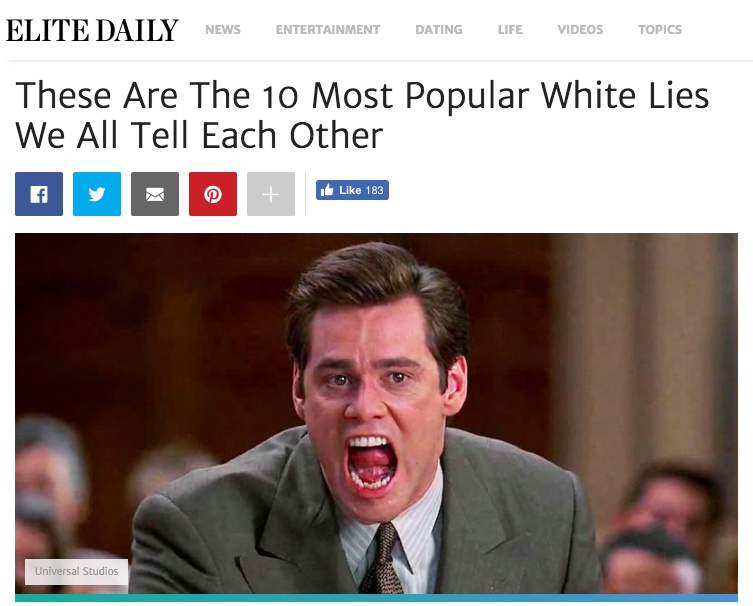
Our digital PR associate also found success with YourTango.

The backlink report presented to the client indicates close to 400 social shares. You may notice that the screenshot above shows 662 shares; this means there was a 73% jump in shares since we compiled the report.

It’s important to note that you can expect increases like that in backlink reports you compile or receive.
College Candy responded favorably to our pitch, even inserting a gallery of all the campaign’s graphics.

While the domain authority is lower (62) and social shares are fewer (32), this is still great coverage, and the link is highly valuable.

Pro tip: Don’t focus only on top-tier publishers. A well-rounded mix of links from sites with varying domain authority tells the search engines that your content and site are high quality.
Also honing in on the “sex” angle, Women’s Health wrote an article about the campaign’s results.

The story was shared 758 times, which is excellent traction.

The last placement resulting from our outreach efforts was with Teen Vogue.

With 637 social shares, this was another publication with a built-in female audience that resulted in a high number of shares.

Now, let’s look at how organic syndication creates a healthy inbound link portfolio.
Natural Syndication
Syndication occurs when one publisher’s coverage of a campaign results in another site picking up that story and covering it as well. Google prioritizes content that is helpful and reliable, making it more likely your content will be referenced on other sites.
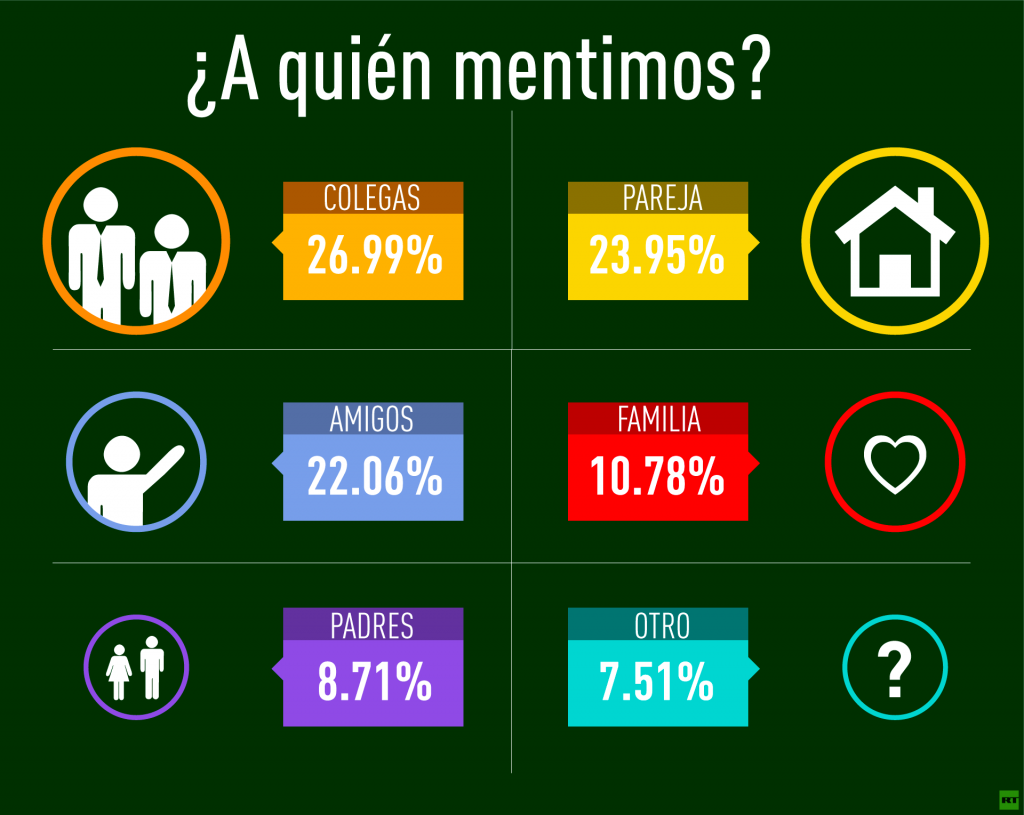
Below is an example of a Spanish-language publisher that independently picked up our original campaign. Near the top of our backlink report are two international sites with a domain authority of 90.

You’ll see plenty of other overseas publishers in the backlink report as well. These sites usually still link to and cite your content directly. See the screenshot from actualidad.rt.com below.

This publisher even redid the campaign’s graphics for its Spanish-speaking audience:
Just under the international sites on the backlink report are two local news sites that picked up the story:

The Detroit radio station WOMC not only linked to our campaign, but it also helped spread the awareness for DIRECTV’s “The Program.” Backlinks and brand recognition are closely tied to high-quality content.
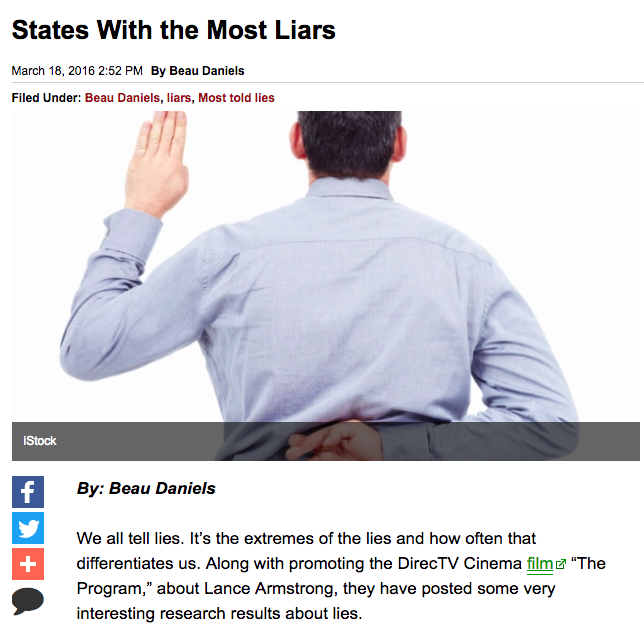
Mix 94.1, a Las Vegas radio show, also wrote about the campaign and provided a backlink to it. This is how they cited our client:

Pro Tip: If a publisher features your content or results but doesn’t include a backlink to your site, you can always request they do so. This is standard practice for our digital PR department when certain sites (e.g., high domain authority publishers) cover our campaigns but don’t include a dofollow link.
Syndicating on Low-DA Sites
While a backlink from a site with a low domain authority won’t do much for your site’s search engine ranking on its own, links from sites with a wide range of authority help to paint the whole picture for Google.
Look at these links from our report:
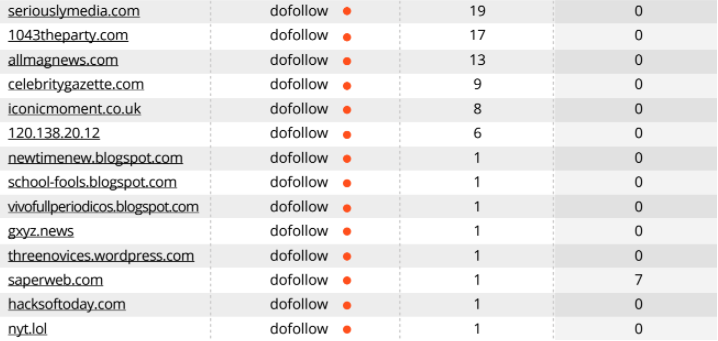
The domain authority here is rather low, which tells Google that all levels of publishers found our campaign interesting and chose to spread it on their own.
Syndication also occurs on social media, which we’ll get into in our next section.
Other Link Types
So far, we’ve examined dofollow links, which pass the most “SEO juice” from one site to another. Now, let’s look at the other types of links.
The next part of our backlink report shows co-citations (when a publisher links to a third-party site instead of yours). Co-citations incrementally raise the value of the initial link.
Here are the first three:

The LinkedIn link is an article that a user shared on their account. While LinkedIn boasts a domain authority of 100, links from users don’t carry as much weight as “regular” publishers. What matters more with social network links is engagement (comments, likes, etc.).
The MY 102.5 and Times Union links are considered a co-citation because they link to The Huffington Post article about our campaign.

Co-citations are also a valuable part of a healthy backlink report because they indicate that multiple publishers have found your content important.
In addition to over 100 co-citations, our backlink report includes four nofollow links of varying domain authority.

A nofollow link is a direct hyperlink to your content, but it blocks any SEO value from being passed. Sounds bad, right?
But there’s actually a lot of hidden value in nofollow links. When a top-tier site like Yahoo uses a nofollow link, other publishers can pick up the story and include a dofollow link to your site. Plus, getting in front of Yahoo’s audience is a great way to boost your brand!
Speaking of brand recognition, this is the main perk of the last type of link in our backlink report: text attribution.
Here are a few from the report:

Sure, it’d be great if the NY Post included a dofollow link to the campaign, but check out the nice brand plug below:
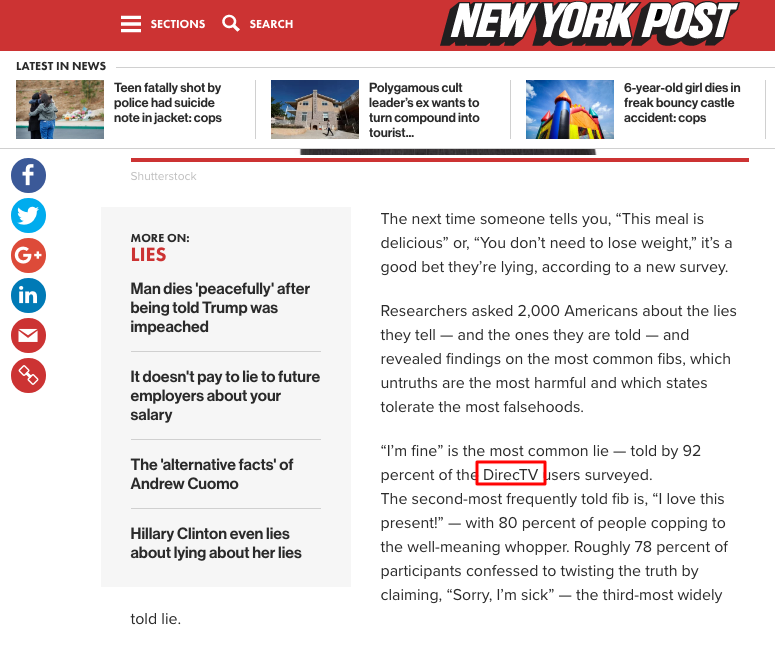
Plus, Google aims to recognize brand authority in an organic way, including text attributions.
Offline Media
While TV, radio, and print coverage can’t provide backlinks, they help with brand recognition.
Our White Lies campaign was the topic of discussion among the TODAY show anchors during a segment. And check out the nice DIRECTV plug on one of their graphics:

Interested in TV coverage? Read our post on seven other content marketing campaigns that gained screen time.
Balance Is Key to a Healthy Backlink Profile
A healthy backlink profile is about more than avoiding penalties or protecting rankings. It’s about making sure your brand shows up in the places people actually discover and engage with content today. When coverage is earned from trusted publishers, that visibility extends beyond traditional search engines into social feeds, news sites, and GenAI-powered tools that shape how audiences find and evaluate brands.
That is the approach Fractl takes. We focus on creating content that journalists and editors genuinely want to cover, then support it with thoughtful outreach and strong media relationships. The result is visibility that builds over time and reaches across search, social, and emerging AI platforms, not just one channel. By prioritizing editorial value and natural distribution, we help brands grow authority in ways that feel credible and lasting.
If you want backlinks that do more than check an SEO box, let’s talk. Fractl helps brands earn meaningful coverage and build visibility wherever people are searching, scrolling, and asking questions. We would love to help you do the same.