




Table of Contents
- The "Alien Intelligence" Moment: How Generative AI Leapt Forward
- Why Big Context Windows Change Everything
- Using Generative AI for Content Without Getting Burned by Google
- Building AI-Powered Content Pipelines
- Why Humans Still Matter: Trust, Hallucinations, and Oversight
- My Predictions: What I Got Right
- How Practitioners Can Ride the Wave
- Build Smarter Content Systems With Fractl
- FAQs
The potential of generative AI isn’t theoretical anymore. It’s here, it’s accelerating, and it’s reshaping how we create content, earn media coverage, and build brand visibility. I was even more convinced of this after I sat down with Garrett Sussman on Rankable to talk about what’s actually changing for marketers, SEOs, and content teams.
This article distills the key insights from that conversation. I’ll cover how generative artificial intelligence leapt from a novelty to a production-grade tool, why building AI-powered content systems matters more than chasing single prompts, and how practitioners can ride this wave instead of getting swept under it.
Hear the full podcast: The Scary Potential of Generative AI on Content ft. Kristin Tynski — Rankable Ep. 123
Key Takeaways
- Design content systems around information gain, not one-prompt blog posts, to align with Google’s goal of surfacing unique, useful results.
- Build multi-step AI pipelines that research, plan, draft, and refine instead of relying on a single “write this article” command.
- Use external sources of truth (data, interviews, research) to ground generative content and reduce hallucinations.
- Keep humans in the loop for data work by reviewing AI-written code and validating statistical outputs.
- Adopt AI aggressively but thoughtfully. Those who learn and apply these tools will 10x to 100x their output compared to those who don’t.
The “Alien Intelligence” Moment: How Generative AI Leapt Forward
The advancements in generative AI over the past few years have been jarring. To understand why this moment feels different, you have to look at the trajectory that got us here.
From GPT-2 to GPT-4: A Qualitative Shift
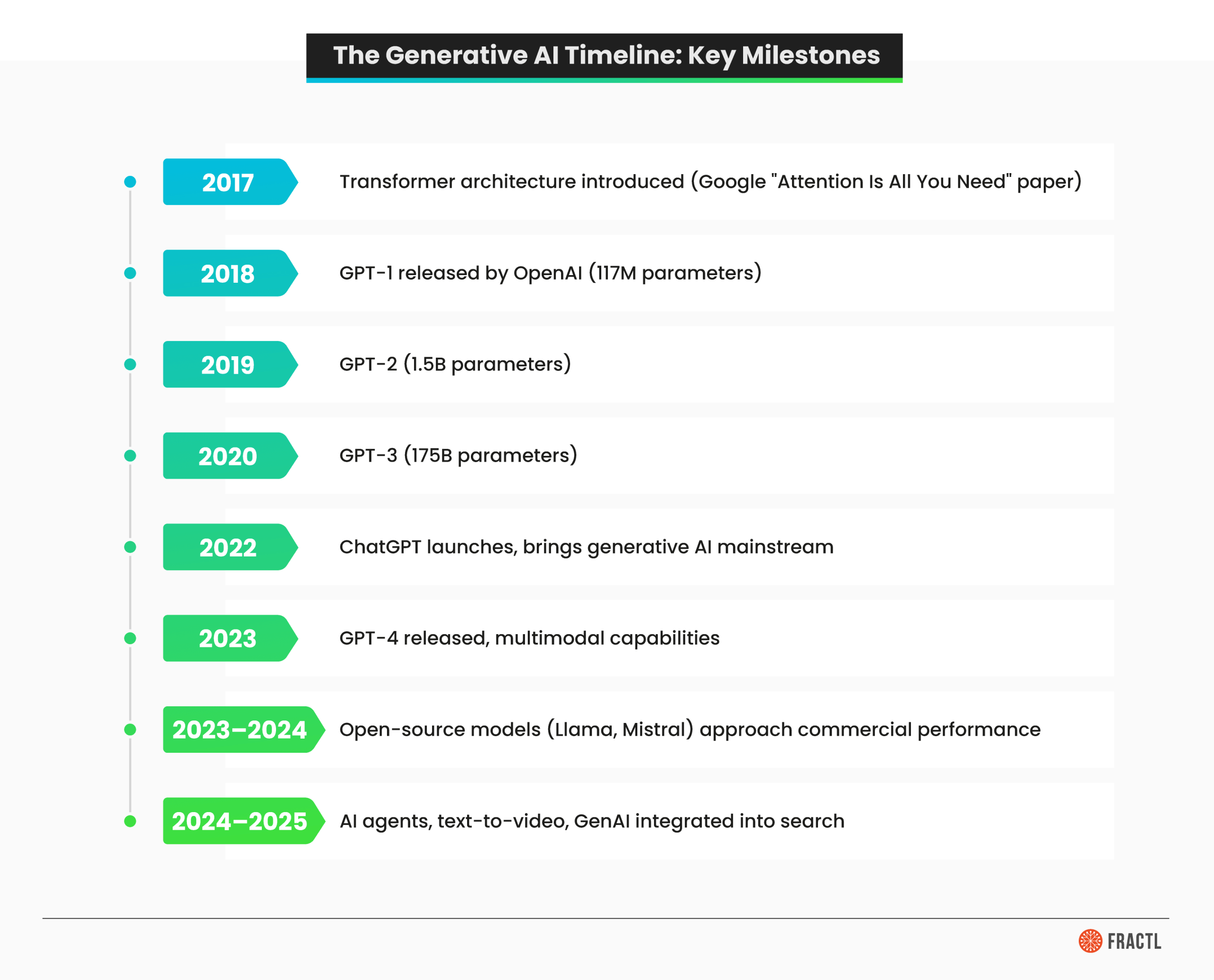
I’ve been tracking this space since the days of word2vec and GPT-2. You could see progress back then, but nobody felt the shock we all experienced when ChatGPT launched. With GPT-3.5 Turbo and then GPT-4, the industry hit a qualitative shift: large language models stopped being toys and started reliably producing human-like content, telling jokes, doing math, and passing informal Turing tests in short interactions.
The economic data backs up what practitioners felt intuitively:
- McKinsey found that generative AI has the potential to generate $2.6 trillion to $4.4 trillion in value annually across industries.
- Microsoft and Accenture projected that gen AI could contribute approximately $3.8 trillion to the U.S. economy by 2038.
What made OpenAI’s GPT series so disruptive was how transformer-based neural networks scaled with more data and compute in ways the machine learning community didn’t fully anticipate. Deep learning architectures that seemed limited a few years earlier suddenly developed emergent abilities: reasoning chains, creative problem-solving, and code generation. The breakthroughs compounded faster than anyone’s timelines predicted.
Why Even AI Developers Were Surprised
What surprised me most was actually how much it surprised everyone, including many people building these AI systems. We understand the architecture (transformers, training data, algorithms), but not the “why” behind the learned weights. As foundation models get larger, they develop richer chains of reasoning that nobody explicitly programmed.
That’s why I started describing today’s models as “talking with an alien intelligence.” They’re incredibly capable, often unpredictable, and genuinely magical compared to any earlier AI technology I’ve worked with. The pace of AI development means this capability is clearly on a trajectory to touch every industry, with marketing, SEO, and digital PR among the very first to feel the disruption.
Why Big Context Windows Change Everything
One of the most important practical shifts for builders and marketers came from OpenAI’s Dev Day announcement of GPT-4 Turbo with a roughly 125,000-token context window, plus significant price cuts. I’d rank this as one of the most transformative developments for day-to-day AI use cases.
Previously, constraints like 4K, 8K, and even 16K tokens meant you had to aggressively prune, chunk, and summarize your source material before feeding it to the model. That forced compromises: you’d lose nuance, break coherence, and degrade the outputs.
With a much larger context window, entirely new patterns emerged for content teams:
- Full-document analysis. You can drop entire reports, long-form datasets, or large document clusters into a single prompt and get coherent synthesis.
- Cross-document synthesis. Ask for thesis-level analysis across multiple sources. LLMs can now reason over an entire body of work rather than isolated fragments.
- Simpler retrieval workflows. Instead of building complex chunking frameworks, you can include more retrieved material directly in context and let the model find what’s relevant.
I’d been paying attention to Anthropic’s Claude for exactly this reason; it offered ~100K context before anyone else. Now, similar power is available across the ecosystem. For content creators, this means you can feed an AI model your full research corpus, your brand guidelines, your competitor analysis, and your Clearscope keywords all at once, and get outputs that are coherent across all of it.
Using Generative AI for Content Without Getting Burned by Google
The practical question every content team asks is straightforward: how do I actually use generative AI tools without tanking my organic visibility? I’ve spent years thinking about this, and my answer centers on one concept.
Why Information Gain Is the Only Strategy That Works
Google ultimately wants to surface the best result for a query: unique, comprehensive, genuinely useful.
If your AI-generated content is just another rephrasing of what’s already ranking, you’re competing with better-established sites and offering nothing new.
Even 20,000 AI-generated words don’t add value if they don’t contain new information.
This is the core principle behind how we approach AI and SEO at Fractl. The use of generative AI should optimize for information gain, not word count. That means grounding every piece of content in something the model can’t fabricate on its own: real data, original research, expert interviews, proprietary datasets. AI is the production accelerant. Your unique inputs are the competitive advantage.
Building Multi-Step AI Systems Instead of Single Prompts
The biggest mistake I see content teams make is “prompt-and-publish”: one prompt, one response, straight to CMS. That’s the surest way to flood the web with bland, low-value content that does nothing for your rankings or your readers.
A better approach is designing multi-step AI workflows where each stage adds clarity and depth:
- Research and aggregation. Have the AI gather, summarize, and synthesize source material from multiple inputs.
- Outline and structure. Generate an outline based on the research findings, not from generic knowledge.
- Refinement. Iterate on the structure, identify gaps, and streamline the argument.
- Drafting with grounded sources. Write the actual content, anchored to the external sources of truth you fed in during step one.
- Human review and editing. A person with domain expertise reviews, validates claims, and adds the experiential layer that AI can’t replicate.
Each step produces better decision-making. You’re not asking the AI to do everything in one pass. You’re building an automation pipeline that compounds quality at every stage.
What Google Can and Can’t Detect
I’m skeptical that Google can (or will) accurately flag individual pieces of AI-written text at scale.
Current detectors seriously struggle, and OpenAI shut down its own AI classifier after it failed to reliably label historical documents as AI-generated.
That level of accuracy is too poor to safely penalize individual pages. What’s more plausible is that Google looks for patterns across large sections of a site:
- How much of it looks AI-generated
- Whether quality and engagement signals drop
- How well the content performs against competing pages in real-world search results
That’s another reason to optimize for information gain and user value rather than worrying about whether a paragraph “looks like AI.” Build content that genuinely helps people, and the detection question becomes irrelevant.
Building AI-Powered Content Pipelines
This is where I get most excited. The real potential of generative AI for content teams is in orchestrating AI into pipelines and agentic systems that approach human-level production across multiple formats.
From Data to Draft: How a Full Pipeline Works
One of my favorite capabilities is what used to be called Code Interpreter inside ChatGPT (now “data analysis”). I see it as a bridge between generative AI and data journalism. Here’s what a full content pipeline looks like when you connect the pieces:
- Data ingestion. An agent identifies or ingests a dataset (CSV, scraped data, API pull).
- Cleaning and analysis. A machine learning model cleans, normalizes, and analyzes the data via Python, exploring different statistical angles and visualizations.
- Insight extraction. The AI surfaces the most surprising patterns and story angles from the data.
- Content drafting. Another module drafts narrative insights into a structured long-form article with embedded charts and data visualizations.
- Visual generation. Image prompts are generated and visuals created (via tools like DALL-E or similar) and placed into the piece.
At Fractl, this kind of pipeline mirrors how we’ve always approached data journalism campaigns: collect data, find the story, build the assets, distribute the work.
Multimodal Content: Text, Audio, Video, and Beyond
Once you have a strong “source” article, generative AI lets you re-express it across formats. Marketers should stop thinking of content as “a blog post,” for instance, and start thinking of it as one underlying insight expressed in:
 Audio A narrated podcast version using voice synthesis that sounds human-like and natural. |  Short-form video Explainer clips generated via digital avatar tools, ready for social media distribution. |
 Multilingual versions Translated, lip-synced content in dozens of languages, expanding your reach without a localization team. |  Interactive experiences Data-driven calculators, visualizations, or real-time chatbots built from the same underlying dataset. |
The deepfake implications here are real and worth acknowledging. The same technology that creates a helpful branded video in 15 languages can also fabricate content that’s nearly impossible to distinguish from the real thing.
As an industry, we need to grapple with the intellectual property and trust questions this raises. But for practitioners who use these tools responsibly, the content creation possibilities are transformative.
Why Humans Still Matter: Trust, Hallucinations, and Oversight
Even as I champion these advanced workflows, I want to be clear:
We’re not at the point where you can blindly trust AI’s analytical outputs, especially when real decisions or reputations are at stake.
If you’re using AI-powered data analysis functions to clean survey data, normalize dates, or run statistical comparisons, you still need:
- Basic coding literacy. You need to read the Python that AI models generate, not just accept the output.
- Statistical intuition. You need to know if the analysis and conclusions actually make sense, not just look plausible.
- Review loops. Inspect both the code and the results. Chatbots and AI systems hallucinate. A confident-sounding answer isn’t the same as a correct one.
One meta-pattern I’ve found useful is using AI to watch AI: have one agent generate code, and another explain, critique, or validate that code. But there’s no substitute (yet) for a human with domain knowledge and the ability to say, “This chart doesn’t look right.” Traditional AI detection can’t catch everything, and neither can automated validation. The more multi-step and high-stakes your pipeline, the more human intelligence and oversight matter.
This is true for stakeholders at every level. Whether you’re a content strategist reviewing AI-drafted copy or a data analyst checking AI-generated statistical models, the person in the loop is still the quality backstop.
My Predictions: What I Got Right
When I recorded this episode of Rankable roughly two years ago, I hedged my forecasts (things move too fast for confident predictions), but I sketched out several trends I expected to see. Looking back, most of them played out.
Model Competition and Open-Source Breakthroughs
I predicted that major AI providers would leapfrog each other in rapid cycles, and that open-source machine learning models would approach commercial performance. Both happened:
- Anthropic’s Claude series became a serious competitor to OpenAI.
- Meta released its Llama models.
- Mistral emerged as a strong European contender.
- Microsoft deepened its OpenAI integration across Copilot and Azure.
Open-source models now run on consumer hardware with capabilities that would’ve required commercial APIs two years ago. That’s both empowering (more initiatives, more experimentation, lower barriers) and dangerous (fewer safety rails, easier misuse). The natural language processing capabilities of smaller models have improved dramatically, closing gaps that seemed permanent.
AI in Search, Video, and Interactive Experiences
I said Google would integrate generative AI into search carefully, constrained by the ad-driven business model. That’s exactly what happened with AI Overviews rolling out cautiously, with Google testing and adjusting rather than overhauling search overnight.
I also predicted text-to-video would hit its “ImageNet moment,” and it did:
- Tools like Sora, Runway, and Kling have pushed video generation past the tipping point for realism and adoption.
- Digital twins and AI avatars have gone mainstream for creators and brands producing multilingual content.
- AI-powered NPCs in gaming are advancing, though that space is still early.
The insights from this conversation reflect how we approach content and digital PR at Fractl every day. We build AI-augmented systems that produce high-authority earned media, organic traffic growth, and measurable results across search, social, and GenAI platforms. Our AI-powered agents are one example of how we’re putting these principles into practice.
If you’re looking to build content systems that actually compound over time, we’d welcome the conversation.
Across health care, supply chain logistics, and creative fields, GenAI applications have expanded faster than most timelines suggested. The gap between adopters and holdouts widened quickly, just as I warned it would.
How Practitioners Can Ride the Wave
I closed the Rankable conversation with reflections on what all this means for careers and daily practice. My advice hasn’t changed:
 Don’t freeze in fear. Every knowledge role will be touched by AI. But those who embrace it are in the best position, not the worst. |  Focus on critical thinking, not just prompts. As interfaces get friendlier, what still matters is your ability to ask sharp questions, spot flaws, and design robust workflows. |  Hold on to core SEO principles. After 15+ years in this industry, I’ve seen one throughline: value. Tactics change, algorithms change, but creating genuinely useful, differentiated experiences remains the winning strategy for AI-era SEO. |
 Experiment with multimodal workflows. Text-only content is increasingly table stakes. Build richer assets (data viz, audio, video) that are harder to replicate and more valuable to your audience. |  Adopt aggressively but thoughtfully. Those who learn to design and run AI-augmented systems will 10x to 100x their output compared to those who don’t. The transformative potential of generative AI isn’t about replacing your team. It’s about making every person on it dramatically more capable. |
This is especially important for small business owners and startups with limited resources. AI tools level the playing field, giving smaller teams the production capacity that used to require headcount they couldn’t afford.
Build Smarter Content Systems With Fractl

FAQs
What is generative AI, and how does it differ from traditional AI?
Generative artificial intelligence refers to AI systems that create new content (text, images, code, audio, video) based on patterns learned from training data. Traditional AI focuses on classifying, predicting, or analyzing existing data. Generative AI uses deep learning architectures like transformers and neural networks to produce outputs that mimic human language, creativity, and reasoning.
What are the most common use cases for generative AI in marketing?
The most common use cases include content creation and drafting, data analysis and visualization, SEO and GEO optimization, personalized outreach at scale, multimodal content repurposing (turning articles into video, audio, or social assets), and building AI-powered chatbots for customer engagement.
How can businesses use generative AI responsibly?
Ground every piece of content in external sources of truth (real data, expert interviews, proprietary research). Maintain human review loops at every critical stage. Build multi-step pipelines instead of single-prompt shortcuts. Monitor for hallucinations, and focus on information gain over volume. Your business needs should drive your AI strategy, not the other way around.