




Table of Contents
- We're in the Fourth Industrial Revolution of Marketing
- Why Single-Prompt AI Content Creation Falls Short
- What AI Agents Are (And Why They Matter for Marketing Teams)
- Inside Fractl's AI Stack: Ideation, Data Journalism, and PR
- How Mike Uses AI for Podcast and Content Prep
- Learning To Build With AI: Challenges and the Human Role
- The Ethics of AI Content: Avoiding "Dead Internet" Slop
- Measuring AI's Real Impact on Content Performance
- Start Building AI Into Your Content Marketing Infrastructure
- FAQ
I recently joined Mike Allton on the Social Pulse Podcast to talk about how we’re using AI at Fractl, and the conversation kept coming back to one point: Most marketing teams are barely scratching the surface. They’re using AI tools for content generation (a blog draft here, a few social media posts there) and calling it a strategy. That’s the equivalent of buying a CNC machine and using it as a paperweight.
Artificial intelligence is reshaping how agencies ideate, produce, and promote content. At Fractl, we’ve built AI-powered pipelines that handle everything from campaign ideation to personalized PR outreach, and the results have fundamentally changed what’s possible at our scale. Here’s what I’ve learned building these systems, where most marketing teams go wrong, and how to start thinking about AI in content marketing as infrastructure rather than a shortcut.
Watch the full Social Pulse Podcast episode:
AI in Content Marketing: From Inspiration to Execution
We’re in the Fourth Industrial Revolution of Marketing
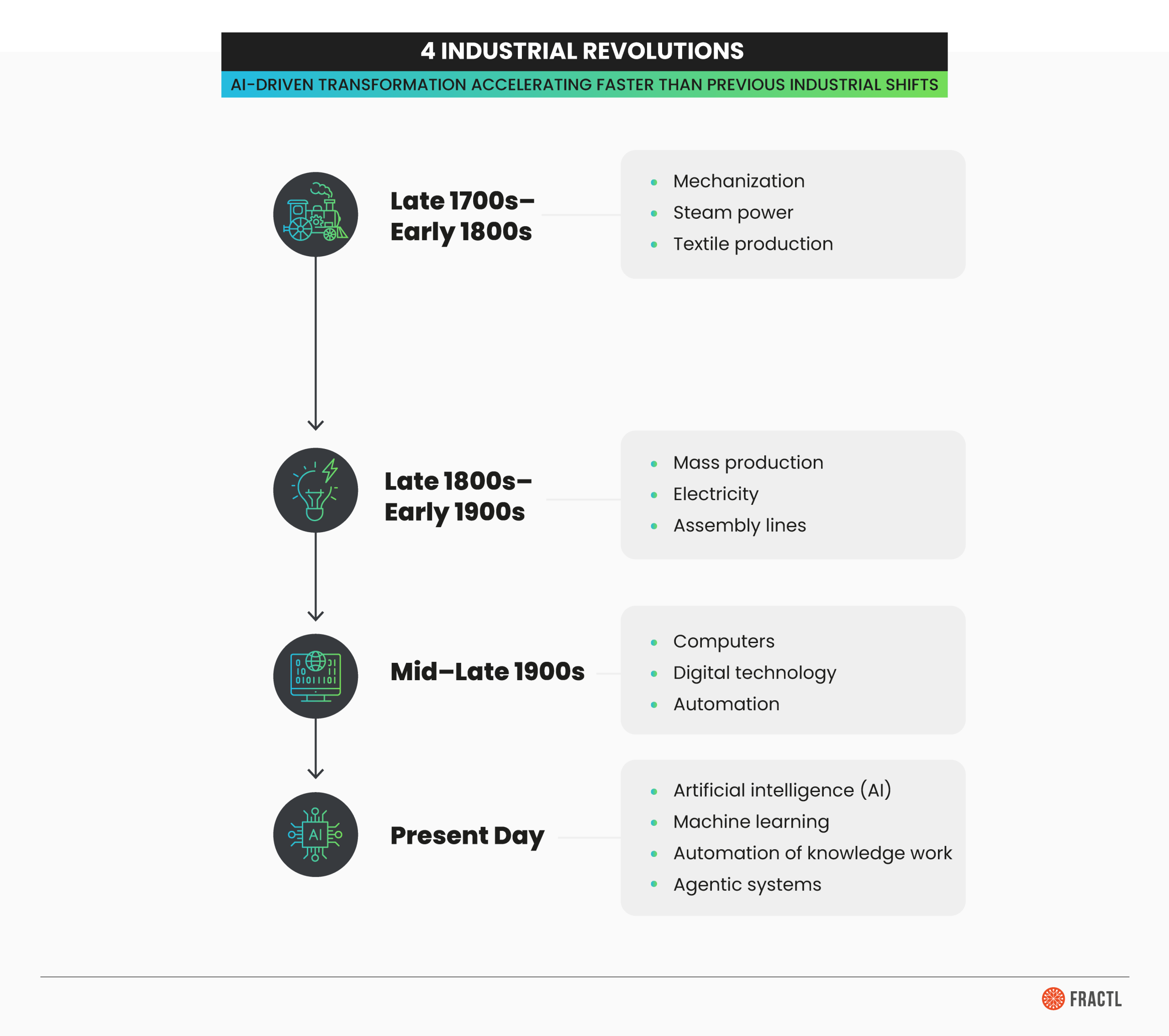
Agentic AI is on track to automate nearly every task knowledge workers perform, and the timeline is compressed. Previous industrial revolutions unfolded over decades. This one is happening in years. Reports already forecast tens of millions of roles displaced by AI-driven automation, with even more new roles created because of it.
For agencies and marketing teams, staying neutral on AI is no longer a safe position.
I’ve watched agency owners keep artificial intelligence at arm’s length, treating it as a curiosity rather than a core capability. That’s an existential risk. The agencies that survive this wave will be the ones that aggressively map AI to their core processes before their competitors do.
This doesn’t mean replacing your team with ChatGPT. It means rethinking how every one of those functions in your workflow (ideation, research, content creation, distribution, measurement) can be augmented, accelerated, or redesigned with AI-driven tools. The use of AI should touch every stage of your content marketing strategy.
Why Single-Prompt AI Content Creation Falls Short
The biggest mistake I see content creators make with generative AI is treating it as a one-shot tool. You type a prompt, get a draft, polish it, and publish it. That workflow produces exactly the kind of AI-generated content that’s flooding the internet: generic, unsourced, and indistinguishable from everything else.
Here’s the problem: With tools like GPT-4, Gemini, and Claude, the cost of “average” content is heading toward zero. Every competitor in your space can produce the same mediocre blog post in minutes. That doesn’t make content marketing obsolete; it just raises the bar.
To rank and actually drive conversions, you need content that demonstrates genuine expertise, original data, and unique perspectives.
The solution is building multi-step AI pipelines that go far beyond content generation. These pipelines gather and verify data from external sources, distill research into original perspectives, iterate multiple times before anything ships, and produce assets tuned to different formats and audience segments. AI’s job in these workflows is to amplify rigor and human creativity, not replace them.
What AI Agents Are (And Why They Matter for Marketing Teams)
When Mike asked me to define AI agents on the podcast, I kept it simple: An agent is a generative model embedded in a step-by-step process with clear inputs and outputs. Instead of a single prompt and answer, an agent takes an input (a topic, a guest profile, a dataset), runs through a series of steps (research, scoring, refinement, creation), and produces structured outputs.
In content marketing, a basic agent might research a topic and draft an outline. A more sophisticated pipeline might handle research, drafting, iteration, social media posts, email campaigns, and scheduling in sequence. The real power comes from modularity: small, focused agents that each do one task well, stitched together into workflows and coordinated by a higher-level model.
At scale, you can imagine an entire content production process orchestrated by AI, managing specialized agents underneath it. One agent handles data analysis. Another writes long-form drafts. A third generates subject lines for email marketing. A fourth creates social assets. A strategist (human) defines the inputs, quality bars, and brand guidelines. The AI handles execution across repetitive tasks.
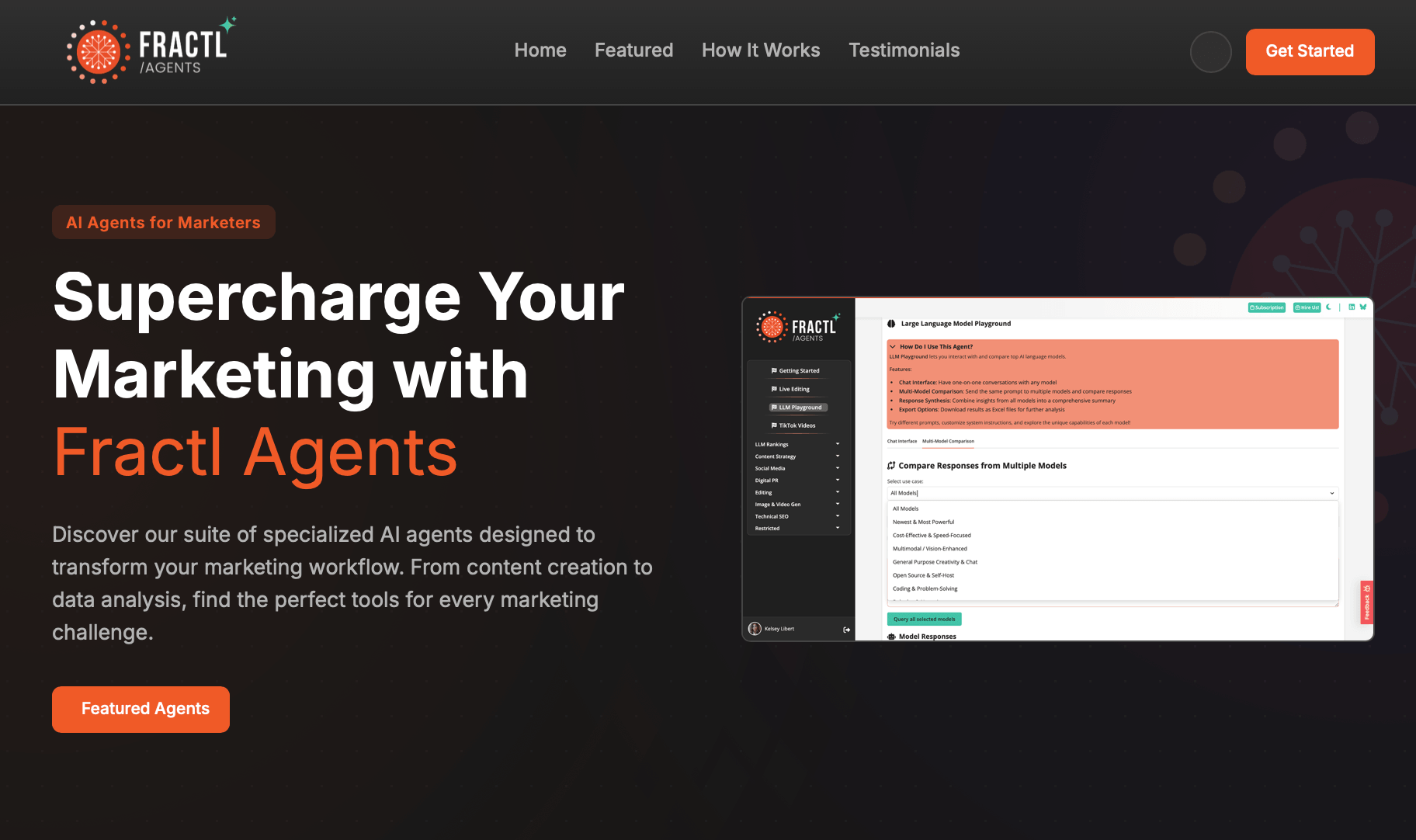
That’s where Fractl Agents came from. We built a suite of 30+ AI tools for SEO, content, digital marketing, social, and editing because we needed modular, reliable automation for our own workflows first.
Inside Fractl’s AI Stack: Ideation, Data Journalism, and PR
A big chunk of the podcast focused on how we actually use AI internally. I’ll walk through the three areas where it’s had the most impact.
Fine-Tuned Ideation at Scale
Fractl has spent over a decade creating data-driven campaigns. We turned that history into a training dataset: thousands of past content ideas with metadata like peer review scores, whether each idea was selected for production, complexity estimates, timelines, and content performance data.
We used this to fine-tune GPT-4 into what we call a “Fractl Ideator” that handles the content creation process for campaign concepts. The pipeline works in stages.
 | Takes a topic and generates hundreds of campaign ideas |
 | Passes those ideas through multiple evaluation agents that score against our internal criteria |
 | Ranks and recommends the strongest options based on actionable insights from past performance |
 | Automatically creates production cards for shortlisted ideas: deep research outlines specifying datasets, execution plans, complexity ratings, and timing |
What used to be time-consuming manual estimation work (weeks of brainstorming and vetting) now surfaces stronger concepts faster. The AI doesn’t replace our team’s judgment; it dramatically expands the search space. We’re finding “hidden gem” concepts we’d never have reached through manual ideation alone.
Content Creation With Research-Backed Pipelines
For content development, we rely on AI to build custom scrapers, interact with APIs, and run deeper data analysis and A/B testing on content approaches. The key distinction: Our AI writing workflows always ground the model in external sources of truth (search engine results, verified datasets, published research) rather than trusting the model’s internal knowledge.
A typical piece of content goes through several cycles of research, draft, refine, and re-research. The AI helps at every stage, but fact-checking against real sources happens continuously. This is how you produce high-quality content that ranks, earns links, and builds trust with your target audience, instead of the generic AI content creation output that search engines are getting better at identifying and devaluing.
Personalized PR at Scale
On the digital PR side, AI has transformed our outreach workflow. We maintain databases of journalists and the content we plan to pitch. An AI-powered pipeline analyzes a campaign and extracts newsworthy angles, then auto-builds pitch lists by matching those angles to journalists’ beats and past coverage.
For each journalist, the system generates a highly personalized content pitch informed by their previous articles and public profiles. It crafts subject lines tailored to their niche preferences (our publisher research showed that subject line type preferences vary by industry). The result is high-touch outreach at scale: personalized content that reads like a human wrote it for that specific person, because the AI had the context to do exactly that.
This kind of content personalization in PR outreach is the opposite of generic mass blasts, and it produces measurably better results.
Ready to build content pipelines that actually move rankings? Fractl’s marketing services combine AI-powered research, digital PR, and SEO strategy to produce work that stands out.
How Mike Uses AI for Podcast and Content Prep
Mike shared his own workflow on the episode, and it’s a good example of what AI-powered content optimization looks like for an individual content creator. He uses a custom GPT-style agent (his “showrunner”) for podcast prep. He feeds in a guest’s LinkedIn profile and proposed topics. The system generates topic ideas, title options, a full question set, an episode description, and a bio.
What used to take two hours of manual research per guest now takes about 20 minutes. But the speed gain isn’t even the main benefit; it’s the ability to have an iterative, back-and-forth conversation with an AI that already understands his brand voice, his audience segments, and the show’s format. He uses the same approach for shaping brand stories, exploring strategy frameworks, and repurposing existing content across channels.
That workflow pattern (feed context in, iterate with the model, refine output) is the foundation of every effective use case for AI in content marketing.
It works whether you’re a solo content creator or a 50-person agency. The sophistication scales with how much proprietary context you can give the model.
Learning To Build With AI: Challenges and the Human Role
I’m candid about this on the podcast: I only started learning to code three years ago, entirely self-taught. Early on, I didn’t even have LLMs available to help me debug or design architectures. A few lessons from that experience that apply to any marketing team trying to build AI-driven workflows.
- Programming with an LLM is its own skill. Some ways of pair-programming with AI are efficient; others waste time and create fragile code. You have to learn which prompting patterns produce reliable results for your specific use cases.
- AI-native development tools accelerate learning. Tools like Cursor (an AI-native IDE) can dramatically speed up the process of turning an idea into a working automation if you learn how to structure your work well.
- Experiment constantly, standardize what works. We’ve discarded dozens of workflow approaches that seemed promising but proved clunky. The ones that stuck became templates we reuse across projects.
- Invest in technical capability. Whether that means learning basic coding yourself or partnering with technical talent, you need someone on your team who can turn AI ideas into reliable, repeatable automations. Pricing for external AI development talent varies, but the investment pays back quickly when a single pipeline saves hundreds of hours.
As models improve, the human role shifts further toward orchestration. You’re defining what good looks like, specifying inputs and outputs, setting brand guidelines, and ensuring the pipeline produces something uniquely valuable. AI assistants handle the execution. Humans define the standard. That’s the streamline every marketing team should be building toward.
The Ethics of AI Content: Avoiding “Dead Internet” Slop
Toward the end of the conversation, we got into the ethical questions that every content strategist needs to confront.
I raised the “dead internet” theory: the concern that the web will become so saturated with low-value AI-generated content that finding real signal becomes nearly impossible. I see early signs already.
Entire categories of search results are filling up with thin, AI-written pages that add nothing for the reader.
Algorithms are adapting, but the flood of content is real.
Before deploying any automation, marketing teams should ask two questions. Does this output create genuine value for real people? Or is it generic slop created primarily for short-term SEO gain? If the answer is the latter, don’t ship it. The short-term traffic isn’t worth the long-term damage to your brand and the broader content ecosystem.
 On User Behavior and Trust Audiences are getting better at recognizing AI-generated content. Chatbots that produce formulaic responses, blog posts with no original perspective, and email campaigns that read like templates. People notice, and they disengage. The bar for what counts as high-quality content keeps rising. |  On Misinformation and Fact-Checking LLMs should be used to synthesize verified inputs, not as unquestioned authorities. That means grounding every piece of content in solid sources, checking facts against real-time data, and maintaining editorial standards even when (especially when) automations scale. This is where the human-in-the-loop matters most. |
Measuring AI’s Real Impact on Content Performance
We don’t judge our AI initiatives by hours saved alone, though the efficiency gains are significant. The bigger win is the level of sophistication we can now achieve in our data-driven content.
The performance metrics that matter most when evaluating AI in your content marketing strategy include.
- Depth of analysis. Can you now run data analysis that wasn’t feasible before? Are your datasets richer, your insights sharper?
- Content quality and originality. Is the AI-powered content production process producing work that stands out in the search engine results, or just more of the same?
- Output volume at quality. How many more pieces of high-quality content can your team produce without sacrificing standards?
- Pipeline reliability. Do your automations produce consistent, trustworthy outputs, or do they require constant manual intervention?
- Conversion impact. Is the AI-driven content actually moving metrics like conversions, qualified leads, and organic traffic?
At Fractl, AI has enabled deeper data journalism, more rigorous research, better campaign briefs, and more targeted PR outreach. The work we’re producing now simply wasn’t feasible at our previous speed and scale. That’s the measurement that matters: the sophistication of work you can now do, not just the hours you’ve saved.
Start Building AI Into Your Content Marketing Infrastructure

AI in content marketing isn’t a feature you bolt on. It’s infrastructure you build into every stage of your content strategy: ideation, research, content optimization, distribution, and measurement. The teams that treat it as a one-off tool will keep producing commodity content. The teams that build real pipelines (multi-step, data-driven, grounded in human expertise) will pull ahead.
If you’re looking for a partner that’s already built these systems and can apply them to your brand’s growth, we’d love to show you what’s possible.
FAQ
How is AI used in content marketing today?
Most marketing teams use AI for basic content generation (drafts, social captions, email subject lines). More advanced teams build multi-step pipelines where AI handles research, ideation scoring, content creation, personalization, and distribution in sequence. The most effective use of AI in content marketing involves grounding the model in real data and proprietary context rather than relying on generic prompts.
What are AI agents in marketing?
AI agents are generative models embedded in step-by-step processes with defined inputs and outputs. Instead of answering a single prompt, an agent runs through multiple stages (research, analysis, creation, refinement) and can hand off to other agents. In marketing, agents can automate ideation, content production, PR outreach, and reporting as connected workflows.
Will AI replace content marketers?
AI will replace specific repetitive tasks, not entire roles. The human role is shifting toward orchestration: defining strategy, setting quality standards, providing brand voice and creative direction, and ensuring outputs deliver genuine value. Content creators who learn to build and manage AI workflows will be more valuable, not less.
How do you avoid low-quality AI content?
Ground every AI workflow in verified external sources rather than the model’s internal knowledge. Build multi-step pipelines that include research, fact-checking, and iteration stages. Maintain human editorial oversight at key checkpoints. Ask whether each piece of content adds genuine value for the reader before publishing.