



Key Takeaways
- Count different campaign ideas. When we asked AI for 40 campaign ideas, we got roughly 14 different concepts.
- Start with a clearer assignment. Explain what you want to achieve and how the campaign should connect to your brand, while leaving room for topics beyond your products.
- Review originality and practicality separately. A more unusual concept still needs to be worth producing and pitching.
- Combine ideas from different models and prompts. Give each the same brief, combine the useful suggestions, and remove repeated ideas. Then have your team choose which campaigns to pursue.
Ask AI for campaign ideas, and it can give you the same suggestion under several different headlines. A proposed study comparing people with AI might appear again and again, even though you asked for new ideas. You still have to find a story your brand can research and a journalist would want to cover.
At Fractl, we tested what would help AI suggest a wider range of campaigns worth producing. We changed the instructions, tried different models, and asked our strategists which ideas they’d take to a client.
You can use what we learned to write a clearer campaign brief and get more useful suggestions from your next AI brainstorm. AI can widen the list, but your team still has to choose which campaigns to produce.
Why AI Brainstorms Repeat the Same Ideas
AI can change the wording of a suggestion without changing the idea behind it. Researchers have linked this to typicality bias: preference training rewards answers people tend to favor, which can steer a model toward familiar responses. In a campaign brainstorm, that can mean another version of a familiar survey or comparison instead of a new research question.
A vague brief can reinforce the problem by leaving the model to decide what a suitable campaign looks like. Our tests found more useful, distinct ideas when we clarified the goal and explicitly welcomed related topics beyond the brand’s products. The tests show what improved our results; they don’t establish a single cause of repetition across all AI models.
When we asked AI for 40 ideas for campaigns that could earn media coverage, we got roughly 14 different concepts. One suggestion, a test comparing work by people and AI without revealing who produced it, appeared seven times under different headlines.
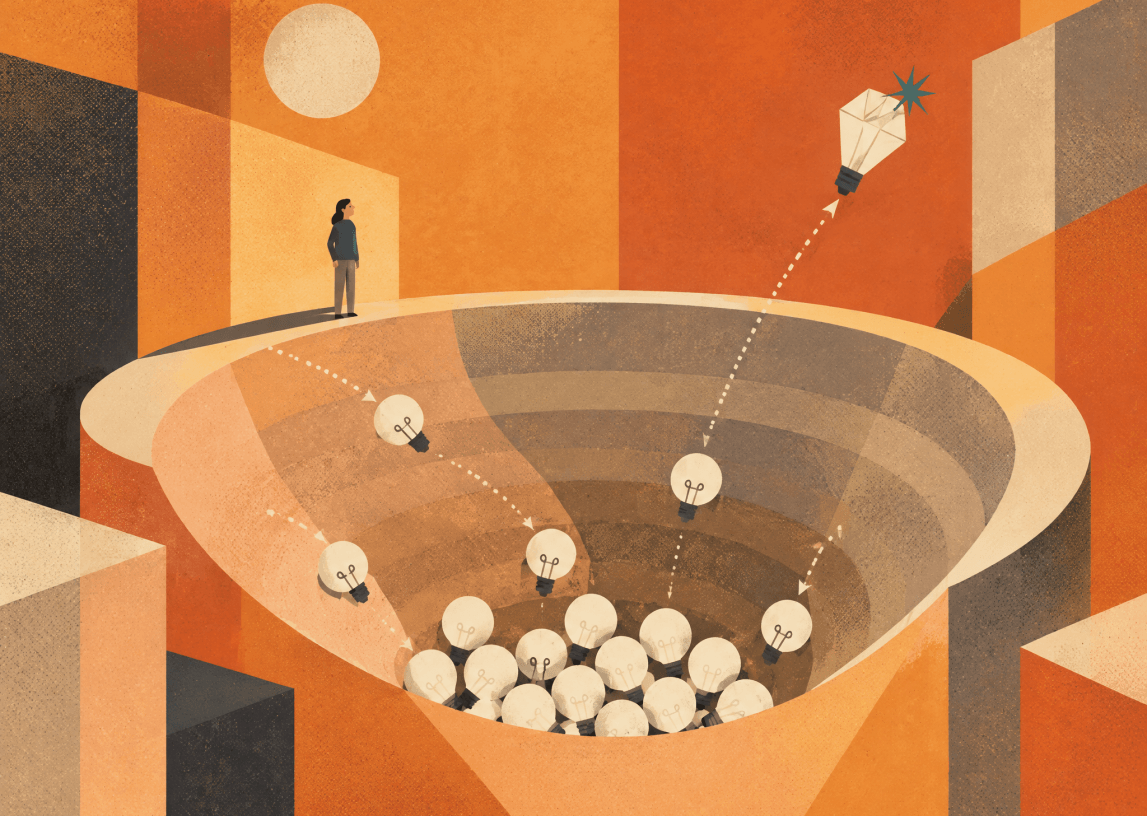
We call this an idea basin: a model’s tendency to return to a familiar set of concepts.
Changing the model’s randomness setting didn’t consistently reduce the repetition. Neither did verbalized sampling, a published technique that asks the model to list possible answers and how likely each one is. Those methods may help with other tasks, but they didn’t solve this problem in our tests.
Before you ask for more ideas, check what each suggestion would investigate. If several ask the same research question, count them as one idea.
More Original Ideas Can Be Harder To Use
We also asked AI to write a list of different one-sentence ideas before developing the campaign details. This concept-first approach produced more variety, but our first reviewer rejected more of those suggestions than the ones from a straightforward request for campaign ideas.
We asked more Fractl strategists to review both lists without telling them how the ideas had been generated. They found that the concept-first approach did contribute some additional ideas worth developing.
For the main campaign assignment, most reviewers approved 25 suggestions from the straightforward prompt and 18 from the concept-first approach.
Once we removed repeated ideas from the approved lists, the concept-first approach had 15 different campaign options, compared with 12 from the straightforward prompt.
For the other campaign assignment, the straightforward prompt produced 10 different ideas that passed review, compared with nine from the concept-first approach. The concept-first approach didn’t consistently produce more ideas worth pursuing.
Start with a straightforward request for campaign ideas.
If the suggestions keep repeating, try asking for one-sentence concepts first.
Compare the ideas your team would be willing to produce, rather than choosing the list with the most unusual titles.
Give AI a More Useful Campaign Brief
Our original assignment asked for ideas the company could produce and pitch to journalists. That left too much room for interpretation. Some ideas were interesting but had a weak connection to the company; others stayed so close to its product that they repeated familiar concepts.
We rewrote the instructions to explain the campaign’s goal and encourage topics beyond the company’s products. Each idea still needed a clear connection to the brand, so a product mention would make sense in the finished story.
With the same model, the clearer instructions produced about 20 different ideas worth developing, compared with about 12 from the original instructions.
One senior strategist reviewed those ideas without knowing which instructions produced them, and we haven’t yet confirmed the result through additional test runs and reviewers.
You can apply the approach without copying our exact wording. For example, a moving company’s campaign brief could read:
Develop research ideas about decisions people make when relocating. You can explore topics beyond moving services, provided the connection to relocation is clear. Explain why a moving company would have a credible reason to publish each finding.
That example gives the model room to consider people’s circumstances without making every concept a product pitch. You still need to assess whether the proposed research is feasible and whether the findings would interest a journalist.
Combine Different AI Approaches
We gave the clearer campaign instructions to four AI approaches: a straightforward prompt, the concept-first method, and two methods using modified models. A strategist selected the ideas worth developing, and we combined those selections into one list without repeats.
The combined list contained 64 different ideas worth developing, compared with 21 from the straightforward prompt alone. This test also relied on one strategist and hasn’t yet been repeated with additional reviewers.
 Different models Give the same campaign brief to two AI models. Compare what each adds to your shortlist. |  Different prompts Ask one model for full campaign ideas, then for one-sentence concepts. Keep the campaign brief the same. |
Compare the lists, remove repeats, and keep the ideas your team would actually produce. A second approach earns its place when it adds a worthwhile campaign the first one missed.
Using more models also gives your team more suggestions to review. Track how many additional ideas you’d pursue and how long it takes to find them.
Keep People in Charge of the Shortlist
We tested whether AI could choose the most original ideas for us. Across roughly 21,000 comparisons, we asked models to pick between pairs of ideas.
We checked the AI models against 139 comparisons in which a human reviewer chose one idea over another. Depending on the model, AI agreed with the human reviewer 43% to 55% of the time.
An AI model judging two ideas at a time may not know it has already chosen the same concept in another comparison.
It can keep rewarding a familiar idea while a strategist reviewing the whole list spots the repetition.
That’s why your team needs to assess the complete shortlist, not just accept a series of AI picks.
When we first showed AI the full list and told it which ideas had already been used, its agreement with the human reviewer rose to 63%. It still disagreed often enough that we wouldn’t leave the final selection to AI.
Use AI to group similar suggestions, then have your team check the shortlist:
- Originality. Does each suggestion ask a different research question?
- Feasibility. Can you get the data and carry out the research?
- News value. Why would a journalist cover the findings?
An impressive description won’t make an impractical idea worth producing.
Should You Modify the Model?
We also tested whether changing the model itself would produce more varied ideas. We used a model we could modify, combining its original version with one trained to follow instructions.
The modified versions suggested a wider range of ideas than the instruction-following version alone. But for our main campaign assignment, a straightforward prompt to Claude Sonnet still produced more variety.
The modified models were more useful when we gave them a narrower job:
Suggest short concepts, then let another model turn those concepts into campaigns that fit the brief.
Splitting the work this way produced more variety than asking each modified model to generate and develop the ideas itself.
For your own brainstorms, start by improving the instructions and comparing ideas from the models you already use. You don’t need to modify a model to try those changes.
How To Run Your Next AI Brainstorm
Use the next campaign assignment to test whether your process produces a stronger shortlist:
- Define the goal and the connection to your brand. Explain what you want the campaign to accomplish and why the topic fits your brand. Let AI suggest related topics beyond your products or services.
- Generate ideas through different approaches. Ask for campaign ideas directly, then compare the results with a list of one-sentence concepts or suggestions from another model. Keep the campaign instructions the same.
- Ask for the details you need to assess each idea. Have AI explain what you’d investigate, where you’d get the data, and why the topic fits your brand. Use those details to judge whether you could produce the campaign.
- Review ideas without the model names. Have your strategist choose the ideas worth developing before revealing which model or method suggested them.
- Remove repeated ideas and choose your shortlist. Count suggestions about the same research question as one idea. Keep track of which models and instructions contributed to the campaigns you’d pursue.
How We Tested the Ideas
We used two fixed campaign assignments: one for our AI platform and one for a national moving company. The research covered about 5,000 AI-generated ideas, testing different instructions and modified models.
We ran the same campaign assignments multiple times with different instructions. We grouped suggestions that repeated the same idea and compared the topics and campaign formats they proposed. Our human reviewers weren’t told which method produced each idea.
For the straightforward-prompt and concept-first comparison, an idea passed if most reviewers approved it. Seven people reviewed the main assignment and six reviewed the second. The tests of clearer instructions and combined AI approaches still relied on one reviewer’s selections.
Keep these limits in mind when applying the findings:
- We measured ideas worth pursuing. The tests didn’t measure media coverage, brand mentions, leads, or campaign returns.
- We tested only two campaign assignments. The results may differ for another brand or brief.
- The instructions weren’t identical across every stage. Some modified models started with older instructions before their ideas were developed using the updated instructions.
We use this research to improve how Fractl Agents generates campaign ideas.
Build a Campaign Shortlist Worth Producing
Choose a campaign you’re planning and spell out why the topic fits your brand before asking AI for ideas. Then have your strategist review the suggestions for a research question you can answer and a story worth pitching.
If you want support turning original research into campaigns worth pitching, reach out and partner with Fract to develop the ideas, produce the stories, and bring them to relevant journalists.
Methodology
We ran the tests in August 2026 on two fixed campaign briefs, one for our own AI platform and one for a national moving company. The main round tested 15 prompting methods. We ran each one three times per brief and asked for 40 ideas per run. With the modified-model tests, we generated about 5,000 ideas in total.
The straightforward prompt went to Claude Sonnet. For the modified models, we blended Qwen2.5-72B’s original (base) version with its instruction-following version at 30%, 50%, and 70% base. AI models from two different companies grouped the ideas that described the same campaign, and where they disagreed, we report the range. We also checked the spread with two statistical diversity scores.
Four AI models from three companies made about 21,000 head-to-head picks. We checked those picks against 139 blind human picks in which one idea clearly won. The 43% to 55% range covers all four judges, and agreement rose to 63% when the judges saw the full list of ideas first.
Seven Fractl strategists reviewed the main brief and six reviewed the second, without knowing which method produced each idea. An idea passed if at least four reviewers approved it.
We use this research to improve how Fractl Agents generates campaign ideas.