




Table of Contents
- The Four Stages of the AIDA Model and How They Map to the Buyer's Journey
- Content Marketing Formats That Drive Results at Every AIDA Stage
- How To Measure Content Marketing's Impact on SQLs
- Is the AIDA Model Still Relevant for Modern Marketing?
- Turn Attention Into Revenue With the Right Content Marketing Strategy
- FAQs
The AIDA model (which stands for Attention, Interest, Desire, and Action) is a marketing framework dating back to Elias St. Elmo Lewis in the late 19th century, and it’s still the clearest lens for understanding how potential customers make purchasing decisions.
I’ve spent the better part of a decade building content strategies around this model for Fortune 500 brands, funded startups, and SMBs. At Fractl (ranked #1 for content marketing out of 30,000 firms on Clutch), we use it as the backbone of strategies that have driven 390 referring domains for Adobe in six months, a 25% organic traffic increase for Payless Power in 16 months, and 44,884 new monthly visitors for Handshake.
Below, I’ll break down each AIDA stage with a content marketing lens, map it to the buyer’s journey, and share real campaign data that connects content to sales-qualified leads (SQLs).
The Four Stages of the AIDA Model and How They Map to the Buyer’s Journey
AIDA stands for Attention, Interest, Desire, and Action. Each stage of the AIDA marketing model describes a different phase of the customer journey, from first discovery through conversion. Here’s how each one applies to a content marketing strategy and where it falls in the buyer’s journey.
Think of the AIDA model as the psychological framework (what’s happening in your prospect’s mind) and the buyer’s journey as the operational framework (what your marketing team does at each point). Together, they form the foundation for a content marketing strategy that moves people through every stage of the buying cycle.
| AIDA stage | Buyer’s journey stage | What it means | Key content formats | Metrics to track |
|---|---|---|---|---|
Attention | Awareness | Reaching potential buyers who don’t know your brand yet and attracting attention at scale | Data journalism campaigns, reactive PR, proactive PR, social media campaigns | Brand mentions, branded search volume, referring domains, social engagement, impressions |
Interest | Awareness → consideration | Educating potential customers on topics they’re actively researching through search engines | Educational blog posts, long-form resource guides, how-to content, email newsletters, podcasts, webinars, white papers, infographics | Organic traffic, keyword rankings, time on page, search visibility |
Desire | Consideration | Building trust and emotional connection through proof, results, and third-party validation | Case studies, testimonials, product demos, comparison content, expert endorsements, video content | Engagement, return visits, MQLs, content downloads |
Action | Decision | Converting a prospect into the next measurable step: a form fill, demo request, or SQL | Landing pages, conversion interstitials, gated content, free trials, clear CTAs | SQLs, conversion rate, pipeline value |
The marketing funnel has evolved since Lewis first introduced the concept, but the underlying psychology hasn’t changed.
Your target audience moves through these stages, whether they’re scrolling social media posts, reading a long-form guide, or comparing case studies before requesting a demo.
The difference now is that the customer journey rarely follows a straight line (more on that below).
Some marketers extend the framework to AIDAR, adding retention as a fifth stage. For content marketing, retention shows up as email newsletters, social media followers, and community engagement that keep existing customers active after the initial conversion.
The hierarchy of effects model in marketing communications theory describes a similar progression, with different content formats appropriate for each stage. A data journalism campaign that earns brand coverage in Business Insider isn’t as likely to drive an immediate product conversion, but it will build your entity’s authority so your brand appears when it’s time for conversion. Likewise, a case study on your site is unlikely to build brand awareness for people who’ve never heard of you.
Matching the right content to the right stage is what separates a marketing strategy from a content calendar.
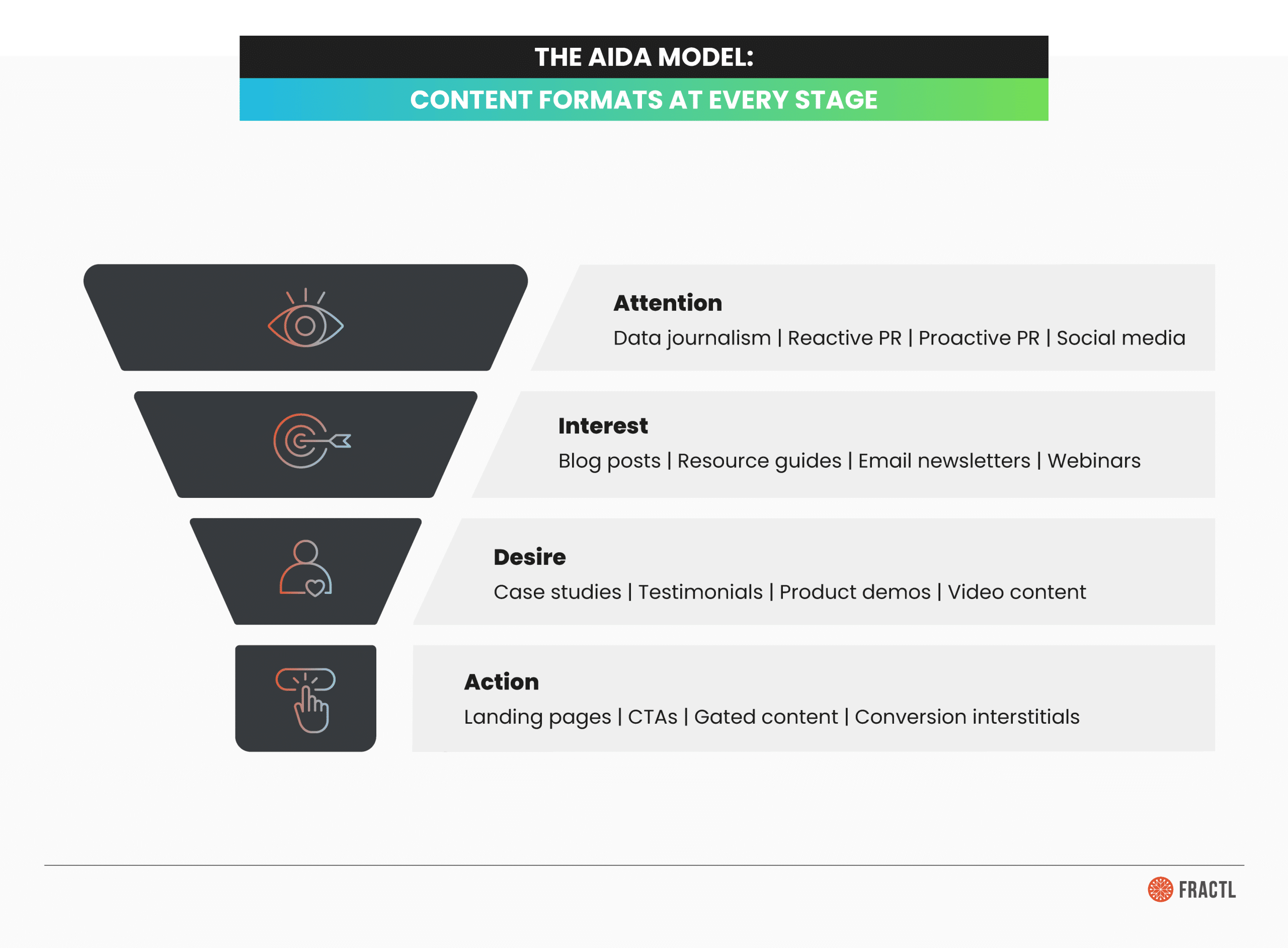
Content Marketing Formats That Drive Results at Every AIDA Stage
The table above gives you the high-level mapping. Here’s a deeper look at what each content type actually does at each stage and how to deploy it.
Earning Attention at Scale: Earned Media and Digital PR
Attention-stage and authority-building content needs to reach people who don’t know your brand yet. These content formats are designed to earn media through high-touch Digital PR efforts that build citations that establish your brand’s authority in your niche:
- Data journalism campaigns. We produce data-driven research studies on topics with broad consumer appeal and newsworthy hooks, pitched to mainstream news outlets and influential publishers in your niche. Our team identifies a newsworthy campaign concept, conducts original research (surveys, data analysis, public records), and produces data visualizations that distill a newsworthy story that journalists want to cover and cite on behalf of your brand.
- Reactive PR. We put your brand at the forefront of a breaking news story within your niche, adding exclusive data and subject matter expertise that enables your brand to add value to the emerging news cycle. For example, a pulse survey published within 48 hours of a trending story can earn brand mentions with reactive PR that might otherwise be out of reach for a traditional SEO team.
- Proactive PR. We develop a seasonal content strategy around the queries your audience returns to every year, whether it’s “Back to School,” Mother’s Day, or niche moments unique to your industry. By building brand content for predictable demand cycles, we help you capture high-intent traffic and build compounding visibility over time.
- Expert Quotes. We monitor platforms where journalists seek industry experts, then develop quotes on behalf of your leadership to earn authoritative brand mentions that build your entity’s authority and share of voice.
- Social media campaigns. We repurpose our campaign findings into short-form content for TikTok and LinkedIn reaches audiences who don’t read industry press. One data journalism study can feed dozens of social media posts across platforms.
Building Interest: Educational Content Hubs and Conversion Pages
Once someone’s aware of your brand (or your topic area), educational content helps to drive them further down the sales funnel. This is where content marketing and Digital PR work together to drive brand authority and capture search demand. Here, the goal is topical authority: your brand shows up consistently when people research your space.
Here are the content formats that are usually best suited to this stage:
- Blog posts and how-to content. We answer the specific questions your target audience is actively researching. Target keywords with informational intent to capture searchers in learning mode, especially mid-bottom funnel queries that require your unique expertise.
- Long-form resource guides. We deploy comprehensive, in-depth content that other sites naturally link to as a reference. A pillar page targeting “how to install a home security system” captures someone deep in the research phase, and ensuring your brand shows up with those in-depth resources is key to appearing at a conversion moment.
- Email newsletters. Nurturing interest over time by keeping subscribers engaged between site visits is key to building a brand community. Consistent value builds the habit of turning to your brand for trusted expertise.
- Podcasts and webinars. Offer in-depth expertise in formats that fit different consumption habits and let your audience hear directly from subject matter experts. While it’s valuable to produce your own series, it’s increasingly valuable to build citations on other reputable podcasts in your niche, as well.
- Data visualizations and white papers. Distill complex data into scannable visuals (infographics) or offer deep, downloadable analysis (white papers) that positions your brand as a primary source.
A well-researched guide that ranks for dozens of related keywords continues driving organic traffic for months or years. Unlike paid ads that stop when spending stops, educational content is an asset that builds value over time.
Generative engine optimization (GEO) adds another layer: When your content is structured for depth and authority, it’s more likely to be cited by AI platforms like Google AI Overviews, ChatGPT, and Perplexity. Optimizing for AI-powered search means thinking about cross-channel brand visibility across both traditional and generative surfaces.
Building Desire: Proof, Trust, and Third-Party Validation
Desire-stage content should answer your prospect’s remaining objections and build enough confidence that they’re ready to take the next step. These content formats do just that:
- Case studies. The strongest desire-stage format. They don’t just describe what you do; they prove it with numbers and let prospects see themselves in the client’s story. Emotional connection matters: The best case studies show the decision-making process, the stakes, and the outcome, not just a metrics dashboard.
- Testimonials and expert endorsements. Third-party validation builds trust that your own marketing can’t replicate. When an industry analyst or respected publication vouches for your approach, it carries more weight than any claim you make yourself.
- Comparison content. Head-to-head evaluations and “vs.” guides serve prospects who’ve narrowed their options and need help making a final choice.
- Video content. Product demos, customer interviews, and behind-the-scenes walkthroughs let prospects experience your product, team, or methodology in ways text alone doesn’t capture. An interactive assessment or comparison tool can do the same by personalizing the evaluation.
Driving Action: Conversion Content
Action-stage content is the narrowest layer. The prospect has the desire; now, you need to make the next step easy and obvious. That’s where these content formats come in:
- Conversion interstitials. Strategically placed CTAs throughout your content and money pages that appear at natural decision points. They bridge the gap between educational content and lead generation.
- Landing pages. Clear messaging that addresses specific pain points, transparent pricing where appropriate, and a single compelling call to action. Interactive tools like cost calculators or ROI estimators can strengthen a landing page by personalizing the value proposition.
- Gated content. Assessments, premium guides, and templates that capture contact information in exchange for value. The gated asset needs to feel worth the exchange; you won’t get form fills for content your audience can find ungated elsewhere.
- Free trials and demos. Let prospects experience your product directly. This is the lowest-friction path from desire to action for SaaS and service businesses.
How To Measure Content Marketing‘s Impact on SQLs
A sales-qualified lead (SQL) is a prospect who’s been vetted through marketing touchpoints and is ready for direct sales engagement. Unlike marketing qualified leads (MQLs), SQLs have demonstrated buying intent through specific behaviors: requesting a demo, engaging with bottom-of-funnel content, or meeting scoring thresholds your sales team has defined.
Here’s how content at each AIDA stage feeds that pipeline:
 Attention content builds volume More brand awareness means more people entering your funnel. Track referring domains, press mentions, brand search volume, and impressions. |  Interest content qualifies intent Not everyone who discovers your brand will research further. Track organic traffic growth, keyword rankings, time on page, and pages per session. |
 Desire content builds conviction Return visits, content downloads, email engagement, and demo page views signal that a prospect is actively evaluating your solution. These are your MQL indicators. |  Action content converts Form fills, MQL-to-SQL conversion rate, and pipeline value are your bottom-line metrics. These are the numbers that tie content directly to revenue. |
The key performance indicators (KPIs) change at each stage. From what I’ve seen across hundreds of client engagements, the brands that map content to AIDA stages and measure accordingly consistently outperform those running disconnected content calendars.
Measuring top-of-funnel content by SQLs alone misses the point. A data journalism campaign won’t directly generate form fills, but it creates the brand awareness that makes every downstream touchpoint more effective.
Put the AIDA model to work with this workflow:
- Start with clear business goals. Anchor your strategy before mapping anything else.
- Map content to funnel stages. Align each content format to the AIDA stage it serves.
- Build a consistent cadence. A marketing plan that produces regular output compounds over time.
- Personalize by persona and pain point. Tailor messaging at each stage to what your audience actually cares about.
- Track stage-appropriate KPIs. Measure what matches the stage you’re in (not every metric applies everywhere).
- Let tools support your strategy, not define it. Platforms like HubSpot can automate lead scoring and content management across the funnel, but the strategic foundation matters more than the tool.
Is the AIDA Model Still Relevant for Modern Marketing?
Honestly, it depends on how rigidly you apply it. The AIDA model has three well-documented limitations:
- The linear progression assumption. Real buyer’s journeys aren’t a straight line. Prospects bounce between interest stages, revisit earlier touchpoints, and make purchasing decisions across multiple channels simultaneously.
- The single-transaction focus. Traditional AIDA ends at “Action,” but some markets also require retention. Keeping customers engaged after conversion (through email marketing, content hubs, and community) is just as important as acquiring them.
- Limited personalization guidance. AIDA tells you what stages there are, but not how to tailor content for different personas or segments. A startup’s marketing strategy looks different from an enterprise one.
Content Marketing to the Rescue
Here’s where content marketing actually solves the framework’s biggest weaknesses: Content creates multiple touchpoints across stages simultaneously. A single pillar page can attract a new visitor (attention), educate them on a topic (interest), showcase expertise through data (desire), and include a CTA that converts (action).
Modern content marketing strategy also handles retention naturally. Email newsletters, social media engagement, repurposing existing content into new formats for social media platforms, and influencer collaborations all keep your brand visible after the first transaction. The real-world customer experience is messy, nonlinear, and multichannel. Your content strategy should reflect that.
The AIDA model is still relevant as a thinking tool, just not as a rigid workflow. Use it to structure your strategy, map your content, and identify gaps; just don’t expect your customers to follow the stages in order.
Turn Attention Into Revenue With the Right Content Marketing Strategy

The AIDA model gives you a framework for understanding how great content moves people from stranger to customer. Lewis got the psychology right more than a century ago. What’s changed is the ecosystem: more formats, more channels, and more data than any marketer in the 19th century could have imagined.
Use content marketing as the engine behind your AIDA strategy, measure movement between stages with the right KPIs, and build a pipeline that produces the best content for every touchpoint, turning brand awareness into qualified leads.
We’ve built full-funnel content strategies for brands across SaaS, finance, education, and e-commerce, connecting earned media at the top to measurable SQL growth at the bottom. If you’re ready to turn your content into a pipeline engine, let’s talk.
FAQs
Here are answers to some of the most common questions about the AIDA model and how it applies to content marketing strategy.
What is the AIDA model in content marketing?
The AIDA model in content marketing is a framework for mapping content formats to four stages of the customer journey: Attention, Interest, Desire, and Action. It helps marketing teams decide which types of content to produce at each funnel stage and measure how that content moves potential customers toward becoming SQLs. If you’re asking what content marketing’s role is in the AIDA framework, it’s the connective tissue that turns each stage from theory into measurable pipeline activity.
Is there a difference between AIDA and the marketing funnel?
They’re closely related but not identical. The marketing funnel (awareness, consideration, decision) describes stages from a business operations perspective. The AIDA model describes the same progression from a psychological one, focusing on what’s happening in the buyer’s mind at each stage. In marketing communications theory, these are both examples of hierarchy of effects models. Most marketing teams use both frameworks together when planning marketing campaigns.
How long does it take for content marketing to generate SQLs?
It depends on your starting point and your marketing efforts, but content marketing is a long-term strategy. Fractl’s campaign for McAfee produced a 12% organic traffic increase and $324,927 in monthly traffic value within four months. Payless Power saw a 25% organic traffic increase over 16 months. The advantage is compounding returns: Unlike paid ads, content continues generating qualified leads long after the initial investment.