




Table of Contents
- Gartner Said 25% by 2026: We Found a 29% Drop and a Wide Vertical Split
- The Redistribution in Search
- Non-Branded Queries Are the Vulnerable Class
- The Marketing Funnel Middle Is Collapsing Faster Than the Top
- Four Query Patterns AI Is Actively Replacing
- 70% of Consumers Are Using AI More. Only 17% Are Using Search Less.
- What Has Moved From Google to AI and Where the Zero-Search Buyer Lives
- Looking to the Future of Search
- What This Means for Marketers
In 2024, American research firm Gartner forecasted that traditional search engine volume would fall 25% by 2026 as consumers shifted to AI chatbots and other generative tools. The prediction was cited in trade press, agency decks, and likely in many internal AI-search strategy memos that crossed a CMO’s desk over the next 18 months.
Fractl partnered with Danny Goodwin of Search Engine Land to test it. Pulling Semrush data on 1,010,848 high-volume keywords across 379 brands in 8 verticals, we measured the past 12 months of search to see where it stands. We also surveyed 1,004 U.S. consumers about how their search habits have shifted. The headline number Gartner picked is already in the rearview. The story underneath it is more interesting than “search is dying.”
Key Takeaways
- Gartner’s 25% decline prediction for search has already been surpassed, reaching 29% as of April 2026.
- But search isn’t dying: Growing keywords (~10.31B) offset declining volume (~10.29B), with net change nearly flat at +16.8M.
- 70% of consumers say they use AI tools more now than 1 year ago, while 17% report using traditional search engines less.
- Middle-of-funnel comparison queries are collapsing fastest at 36%, not at the top of the funnel as expected. FinTech and HealthTech are the hardest-hit verticals, with 38% and 37% of search volume declining.
- How-to, health, and product queries are the top 3 categories where consumers have replaced Google with AI.
- 18% of consumers have made a purchase based on an AI recommendation without verifying through search, signaling an emerging “zero-search” purchase path that brands need to account for. Gen Z and millennials are 2.5x more likely to do this than baby boomers.
- 90% of all tracked search volume is non-branded, the exact query type that AI chatbots can easily replace.
- SaaS and Lifestyle search volume is actually growing, with 2.5x and 2.6x growth-to-decline ratios, as AI creates new discovery patterns that feed back into traditional search engines.
- 52% of consumers believe Google will still be their primary search tool in 5 years, and the top thing that would bring people back is AI providing unreliable answers (35%).
- 59% of consumers say they are likely to visit a brand’s website after an AI chatbot mentions it, making AI visibility a new front in brand discovery.
Gartner Said 25% by 2026: We Found a 29% Drop and a Wide Vertical Split
Across 1,010,848 high-volume keywords with 10K+ monthly searches, 29% of search volume is in measurable decline. The predicted shift in search was nearly on target.
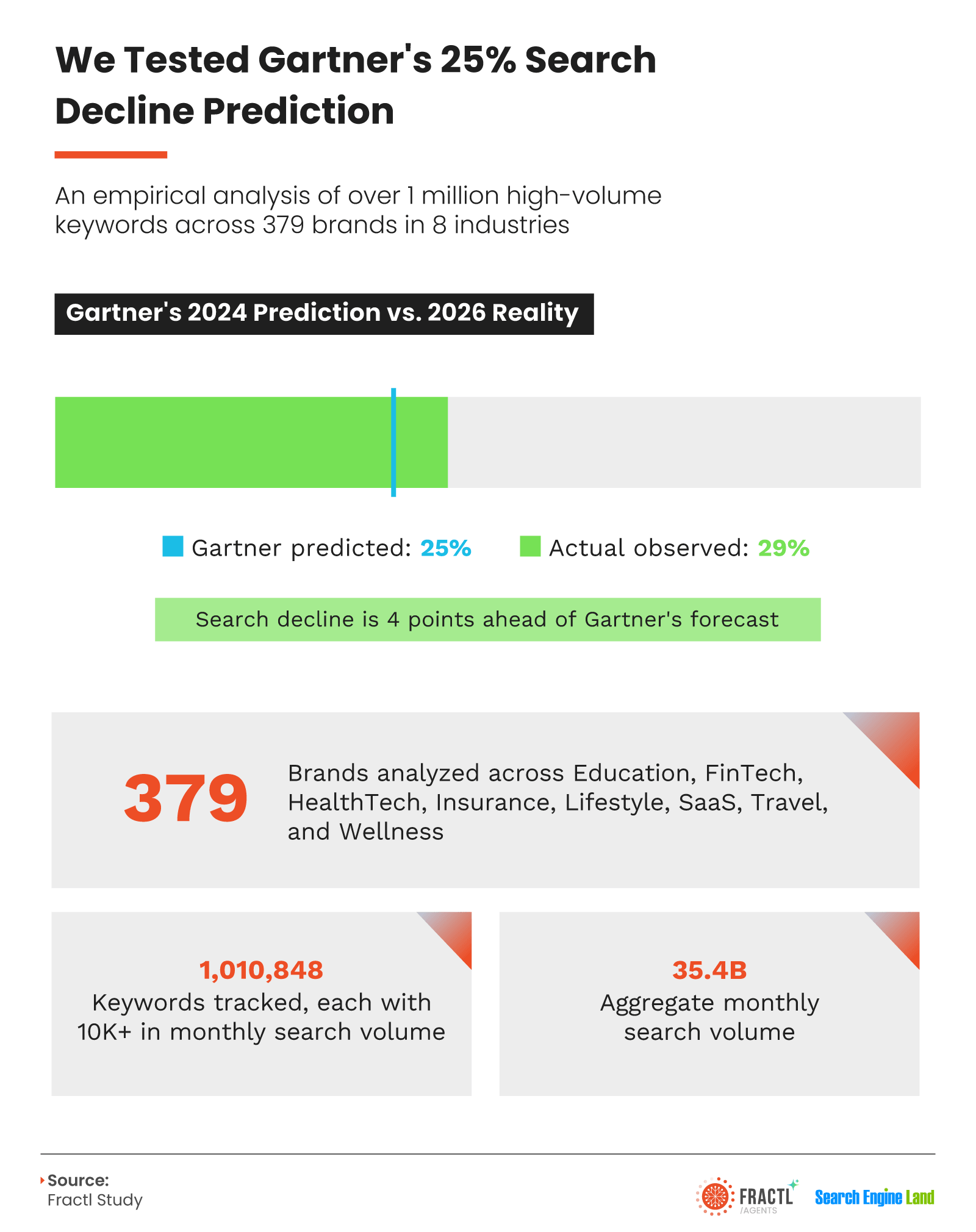
The number on its own is worth pausing on. A 29% decline in less than 2 years is a major shift. But the decline isn’t evenly distributed, and the verticals at the extremes don’t share much beyond a Semrush login.
The category-level average is pulled up by information-heavy verticals, where AI chatbots have the clearest replacement value. For example, pulling a fund prospectus, summarizing a drug interaction, or explaining what a deductible is.
The places where Gartner’s prediction overshot are the categories where the search has more to do than just answer a question.
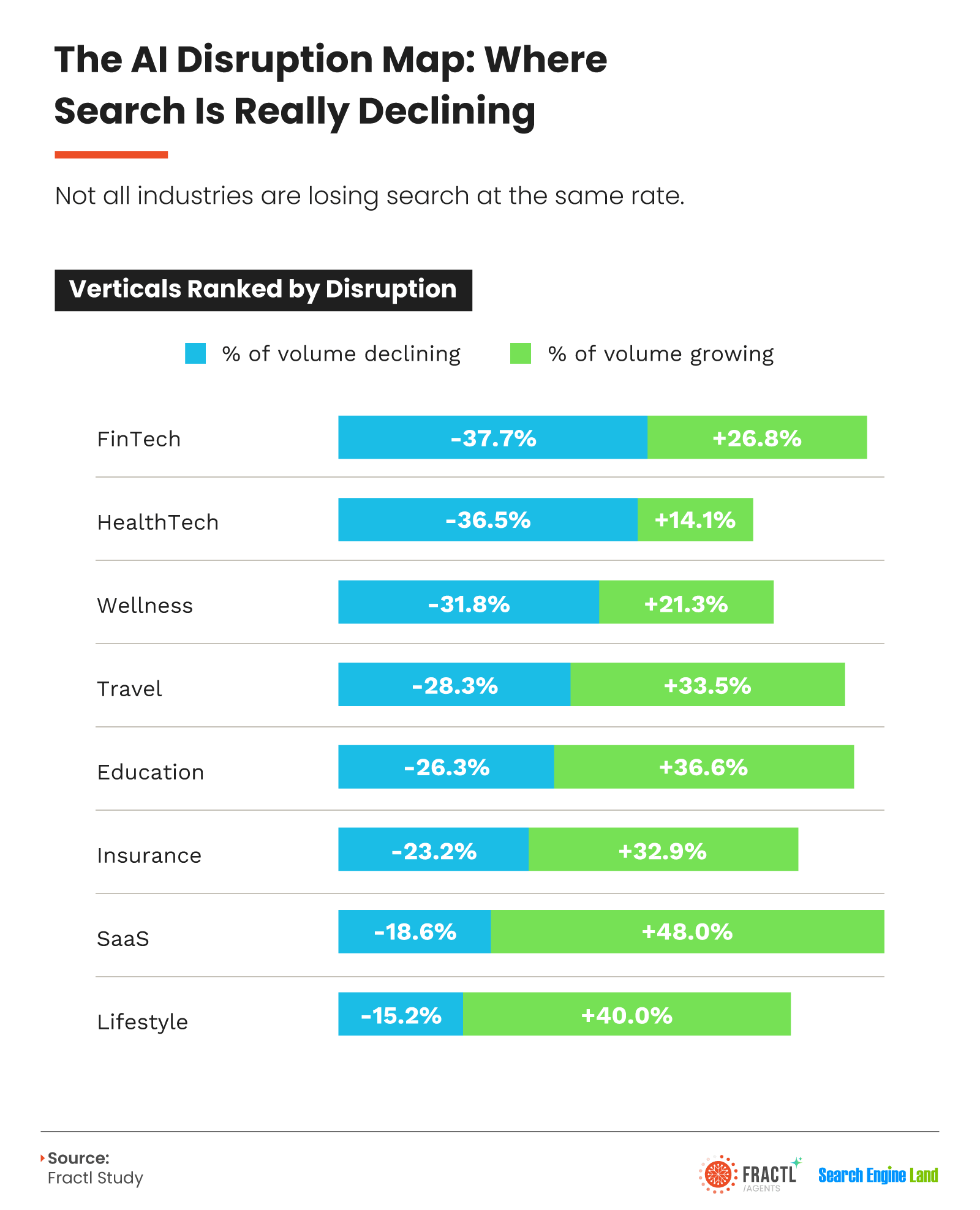
Three of the eight verticals analyzed fall below the 25% Gartner threshold, namely Insurance, SaaS, and Lifestyle. FinTech saw the largest decline (-37.7%), while Lifestyle saw the smallest (-15.2%).
AI disruption correlates with how information-heavy a category is. Where a chatbot can give a confident, conversational answer, search loses. Where the journey requires comparing prices, navigating to a destination, or completing a task, search holds.
Verticals where users need to transact (SaaS, Lifestyle, Insurance, Travel) are growing or near-balanced. Verticals where users just need to understand (HealthTech, FinTech, Wellness) are being hollowed out.
Interpretation: Any strategic conversation that treats AI search displacement as a single number is starting in the wrong place. The variance between FinTech and Lifestyle is wider than the gap between Gartner’s prediction and reality.
The Redistribution in Search
The fact that traditional search is shifting, not ending, is the finding that the trade-press narrative misses entirely. Yes, 40.7% of the high-volume keywords we tracked are in measurable decline (with more than a 15% volume loss). But 20.1% are actively growing by the same threshold. And when you sum the volume on each side of the ledger, the totals match almost exactly.
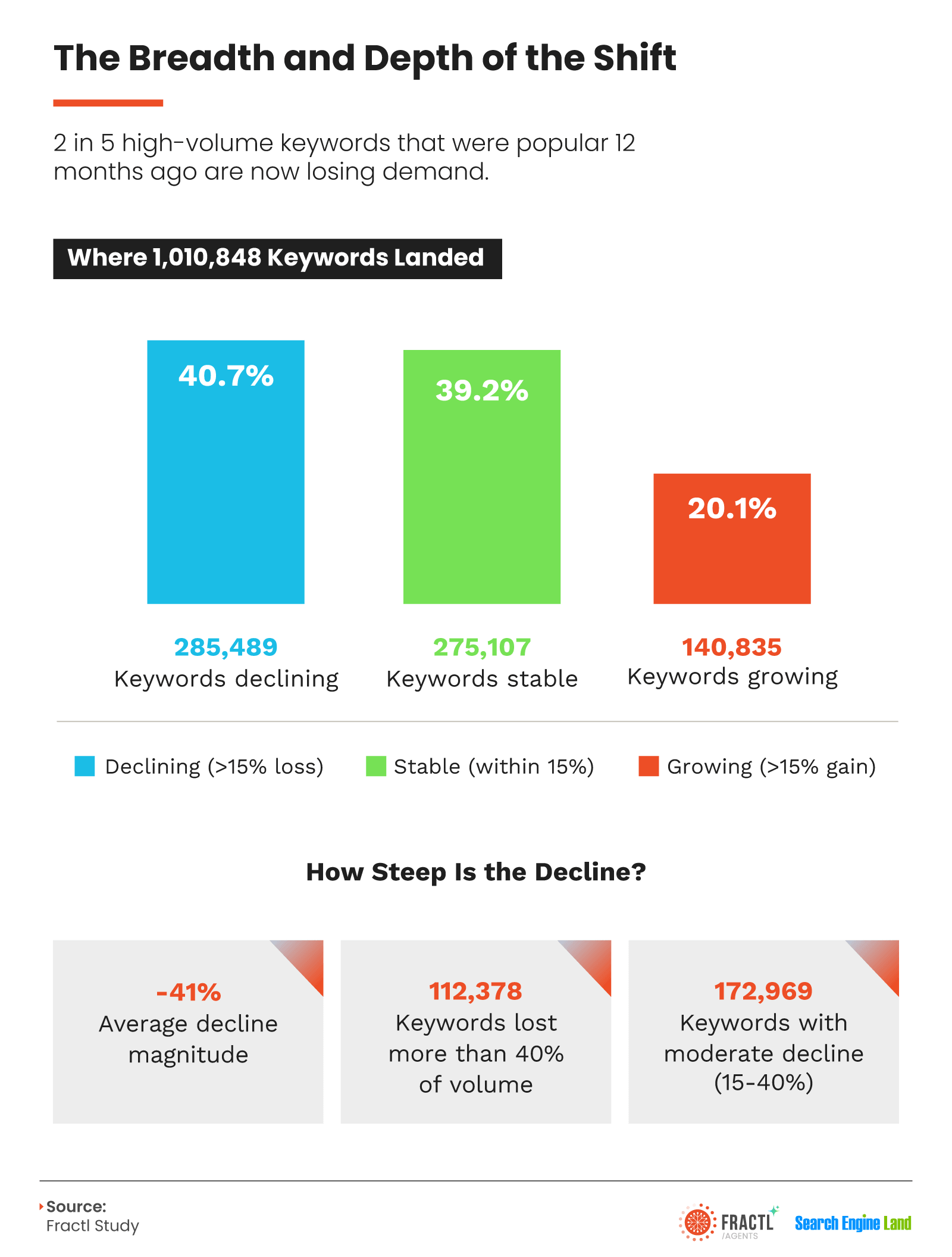
The decline among the affected keywords is real. The average loss is 41%, and 112,378 keywords have lost more than 40% of their volume over the last year. Another 172,969 are in the 15% to 40% moderate-decline band. For the brands whose pages rank on those terms, the impact is far from gentle.
But here’s the math that changes the story.
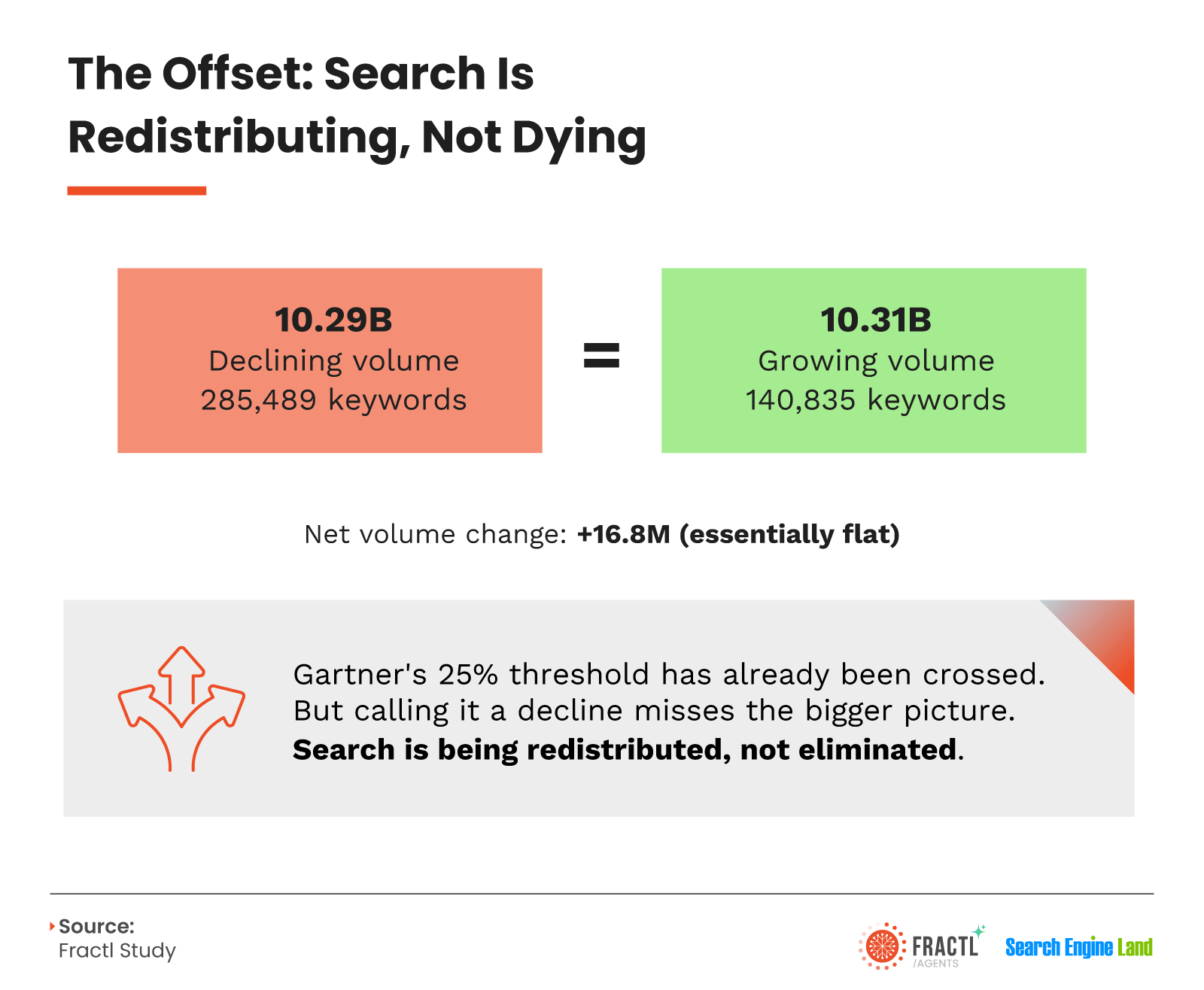
The 285,489 declining keywords represent roughly 10.29 billion in monthly volume. The 140,835 growing keywords represent roughly 10.31 billion. Net change across the entire dataset: +16.8 million searches per month. Essentially flat in this context.
Fewer keywords are growing than declining, but the growing ones carry more volume per keyword. The aggregate search demand for the things people want to know hasn’t collapsed. It has rotated to a different set of words.
That changes the framing entirely. The strategic question for marketers isn’t how to survive the decline of search; it’s: Are you ranking for the words that are growing?
The vertical-level growth-to-decline ratios show where the new demand is concentrating. Lifestyle leads at 2.6x (40% growing vs. 15% declining). SaaS nearly matches it at 2.5x (48% growing vs. 19% declining). Insurance and Education both sit at 1.4x. HealthTech is the only vertical with a meaningfully inverted ratio (0.4x, with 37% declining vs. 14% growing), which is why it shows up as the most disrupted vertical in the dataset.
Non-Branded Queries Are the Vulnerable Class
The next cut in the data explains why the vertical pattern looks the way it does. Non-branded queries (“what is a 401k,” “best running shoes for flat feet,” “how does refinancing work”) are the type AI chatbots are quickly replacing.
There’s no specific destination required. The answer doesn’t need to come from a particular source. The query and the response can both live entirely inside the chat window.
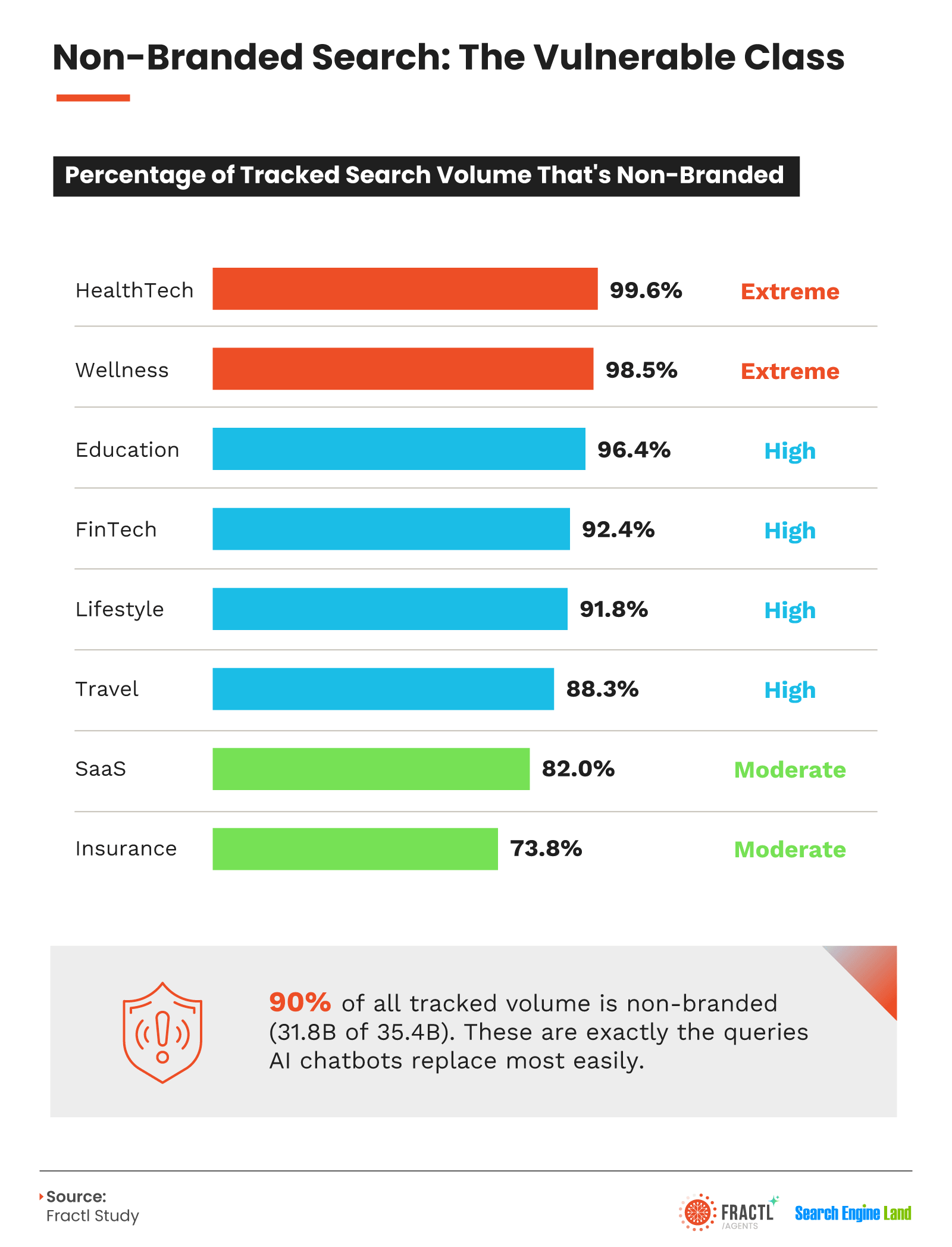
Insurance’s relative resilience is partly a function of its 26% branded share. When a consumer searches for “Geico claims” or “State Farm policy,” a specific destination is required. A chatbot can’t replace that intent without losing the navigational value.
The implication for marketers is uncomfortable. The 90% of search volume that’s non-branded is also the 90% of what most SEO and content teams have spent the last decade chasing. Top-of-funnel, informational, “build authority on the topic” content is the most exposed category in the entire dataset. Branded query share (the share of demand tied to a company specifically) is the asset that holds.
The Marketing Funnel Middle Is Collapsing Faster Than the Top
Conventional wisdom about AI search displacement runs roughly: AI eats top-of-funnel informational queries first, then works its way down. Awareness content goes early, transactional content goes last.
The data says the opposite.
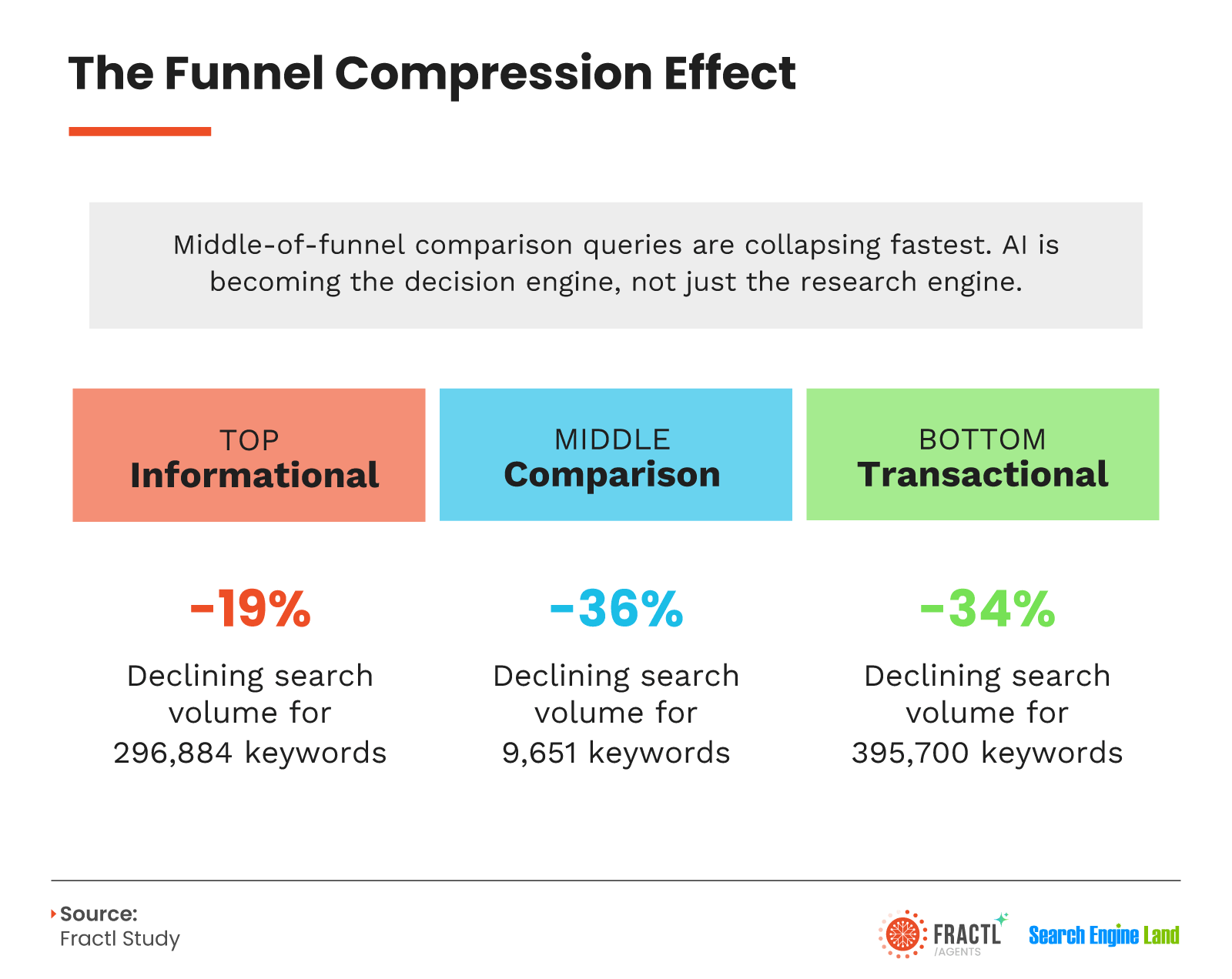
Top-of-funnel (TOFU) informational queries are the least affected, with a 19% decline rate. Bottom-of-funnel (BOFU) transactional queries are next at 34%. The steepest declines hit the middle: 36% of middle-of-funnel (MOFU) comparison queries are losing volume.
Comparison queries are what chatbots have gotten best at. “Best CRM for small business,” “Toyota Camry vs Honda Accord,” “Hims vs. Roman,” “Notion vs. Coda” — these are the prompts a user can type into ChatGPT to get a clean, side-by-side comparison that ends with a recommendation. There’s no need to open multiple review sites and synthesize across them. AI is becoming the decision engine, not just the research engine.
This changes the marketing playbook. For the last decade, “review and comparison content” was the safest investment in B2B and B2C content strategy. It captured high-intent users at the point of decision, it was easier to rank for than transactional terms, and it had the highest conversion potential outside of branded search. That entire content layer is the one most under threat.
By vertical:
- The funnel compression pattern is most extreme in FinTech, where comparison queries like “X vs Y” are losing volume fastest.
- Education shows BOFU declining faster than TOFU, a sign that the act of enrolling, scheduling, or selecting is increasingly happening through AI conversation.
- In HealthTech, BOFU is declining sharply even as TOFU stays relatively stable, because health information searches are still anchored to specific sites (WebMD, Mayo Clinic) in ways that pure comparison searches aren’t.
Four Query Patterns AI Is Actively Replacing
If you want to know which content investments are most at risk, the keyword-pattern data is the cleanest read in the study. Four specific query structures account for most of the displacement, each tied to a different vertical where AI does its job best:
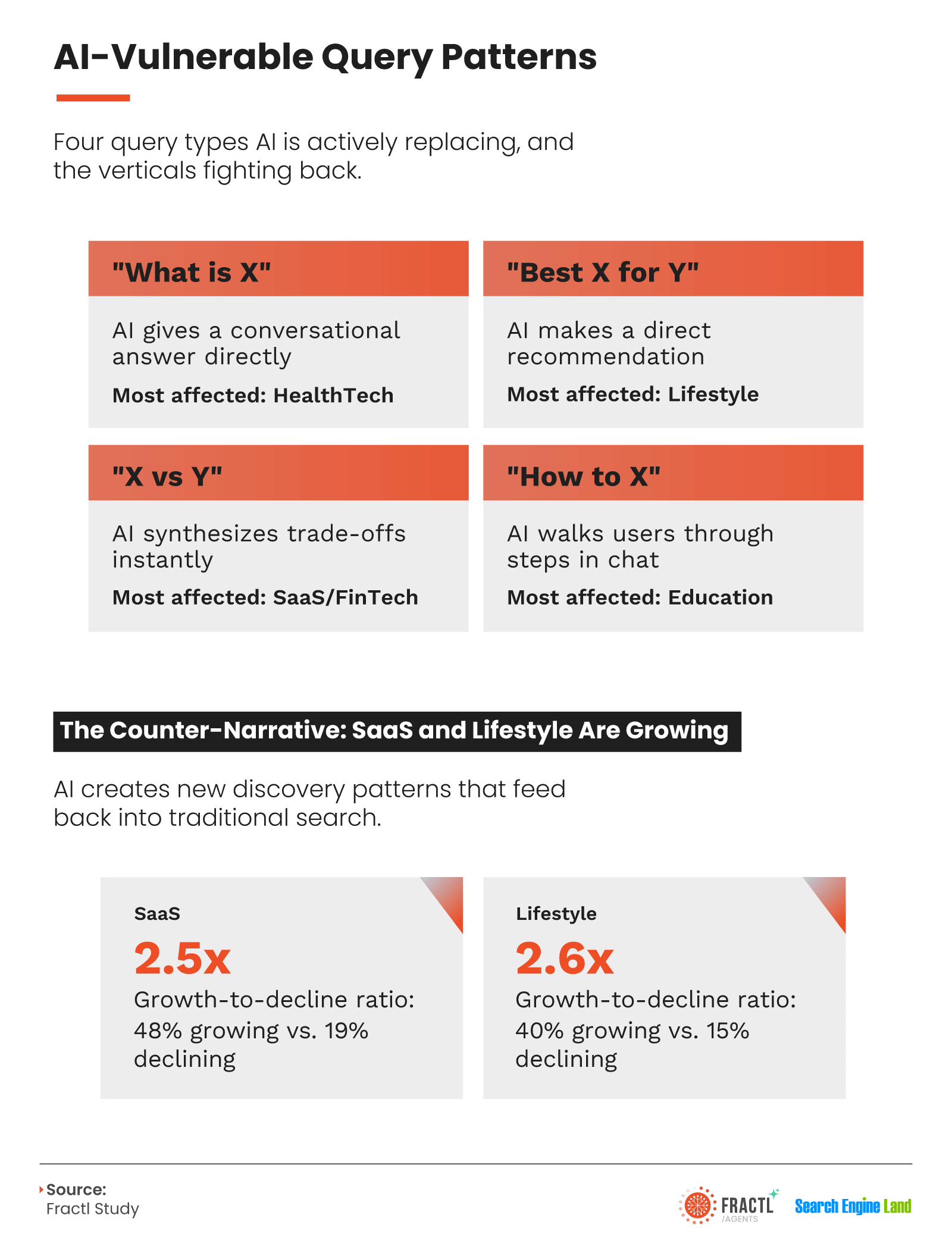
The four patterns, ranked by exposure:
- “What is X” (definitional): AI provides conversational answers directly. Most affected: HealthTech.
- “Best X for Y” (listicle): AI gives direct recommendations. Most affected: Lifestyle, though Lifestyle is paradoxically growing overall.
- “X vs. Y” (comparison): AI synthesizes trade-offs instantly. Most affected: SaaS and FinTech, though SaaS is also growing overall.
- “How to X” (tutorial): AI walks users through steps in conversation. Most affected: Education.
The decline rates by vertical for these specific query patterns:
- FinTech: -29%
- Travel: -27%
- Wellness: -24%
- Insurance: -21%
- HealthTech: -20%
- Education: -19%
- Lifestyle: -14%
- SaaS: -13%
The counter-narrative, and the reason SaaS and Lifestyle can be both heavily AI-targeted and growing, is that AI creates new discovery patterns that feed back into search. A user who asks AI to “find me a cheap couch” still ends up Googling specific product names, retailers, and reviews before purchasing. A user who asks AI to recommend project management tools still searches the recommended names by brand.
The verticals that get the worst of both worlds are the ones where the chatbot’s answer is complete. A definitional health question doesn’t have a downstream search. Neither does a basic finance explainer. That’s where the volume vanishes.
In practice: The safest position in 2026 is branded navigational queries tied to specific destinations. The most exposed position is non-branded mid-funnel comparison content. The middle of most content programs is now also the middle of the funnel that’s getting eaten fastest.
70% of Consumers Are Using AI More. Only 17% Are Using Search Less.
The keyword data tells you what’s happening in the index. The consumer survey tells you what’s happening in the heads of the people doing the searching.
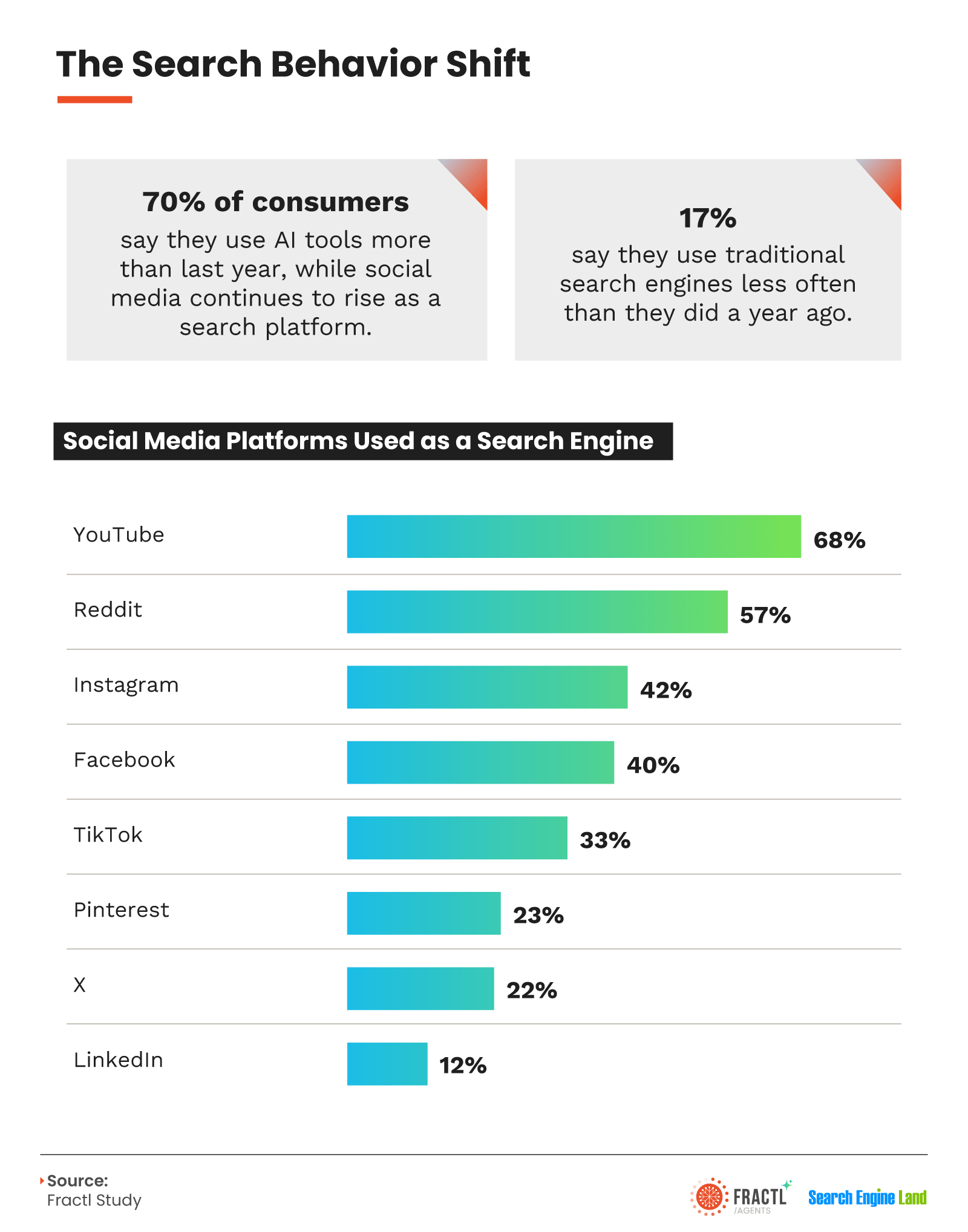
Overall, 70% of U.S. consumers report using AI tools more than they did a year ago. But only 17% report using traditional search engines less. Many consumers are incorporating AI into their information habits, but it’s not fully replacing search. The two tools coexist in most consumer workflows, and the share of users who have actually walked away from Google in a measurable way is still small.
Social platforms are also acting as search engines, and the rankings should sharpen anyone’s content-distribution thinking. YouTube (68%) and Reddit (57%) dominate. Instagram (42%), Facebook (40%), and TikTok (33%) round out the top five. Search behavior has dispersed across platforms in a way that wasn’t true even a few years ago.
Gen X reports the highest increase in AI usage at 74%, followed by millennials and baby boomers, tied at 72%. Gen Z sits at the bottom of the increase rate at 57%, but that’s a function of where they started. Gen Z was already using AI tools at higher baseline rates a year ago, so the year-over-year increase is smaller.
What Has Moved From Google to AI and Where the Zero-Search Buyer Lives
The follow-up question gets at where the displacement is actually happening, task by task, and what happens after a consumer takes an AI’s recommendation as the answer.
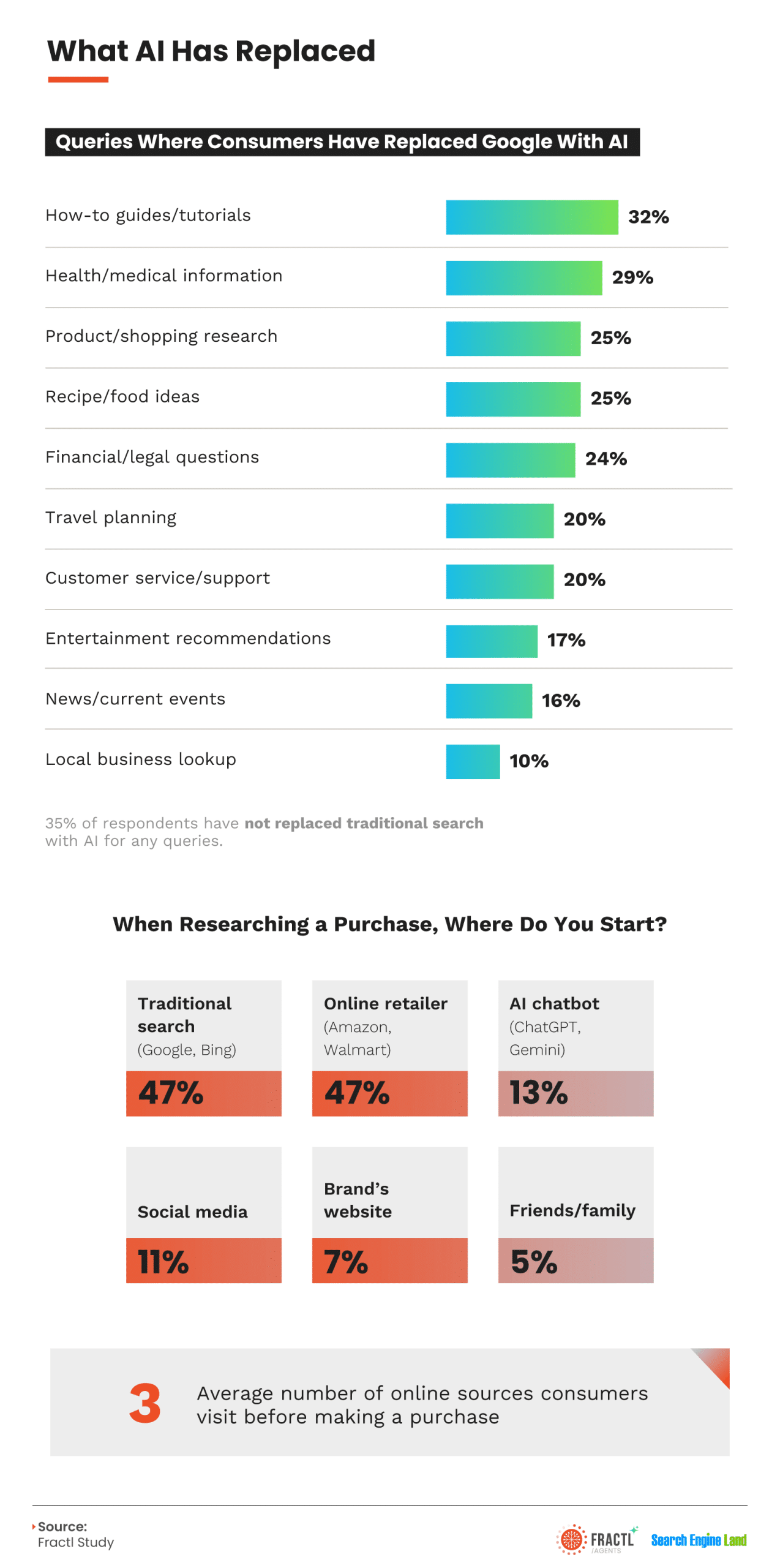
The tasks where consumers have most replaced Google with AI:
- How-to guides and tutorials: 32%
- Health and medical info: 29%
- Product and shopping research: 25%
- Recipe and food ideas: 25%
- Financial and legal questions: 24%
- Travel planning: 20%
- Customer service and support: 20%
- Entertainment recommendations: 17%
- News and current events: 16%
- Local business lookup: 10%
The top of the list (how-to and health) aligns almost perfectly with the keyword data, which shows the steepest declines in those verticals. Local business lookup at the bottom (10%) also tracks. It’s the most navigationally anchored task in the set, and the one AI replaces least cleanly. Overall, 35% of respondents say they haven’t replaced traditional search with AI for any tasks.
Nearly half of consumers still start purchase research with a traditional search engine or online retailer (47% each). Only 13% start with an AI chatbot. Consumers visit an average of three online sources before making a purchase.
But here’s where the data gets strategically interesting. A small but notable share of buying behavior now bypasses search entirely.
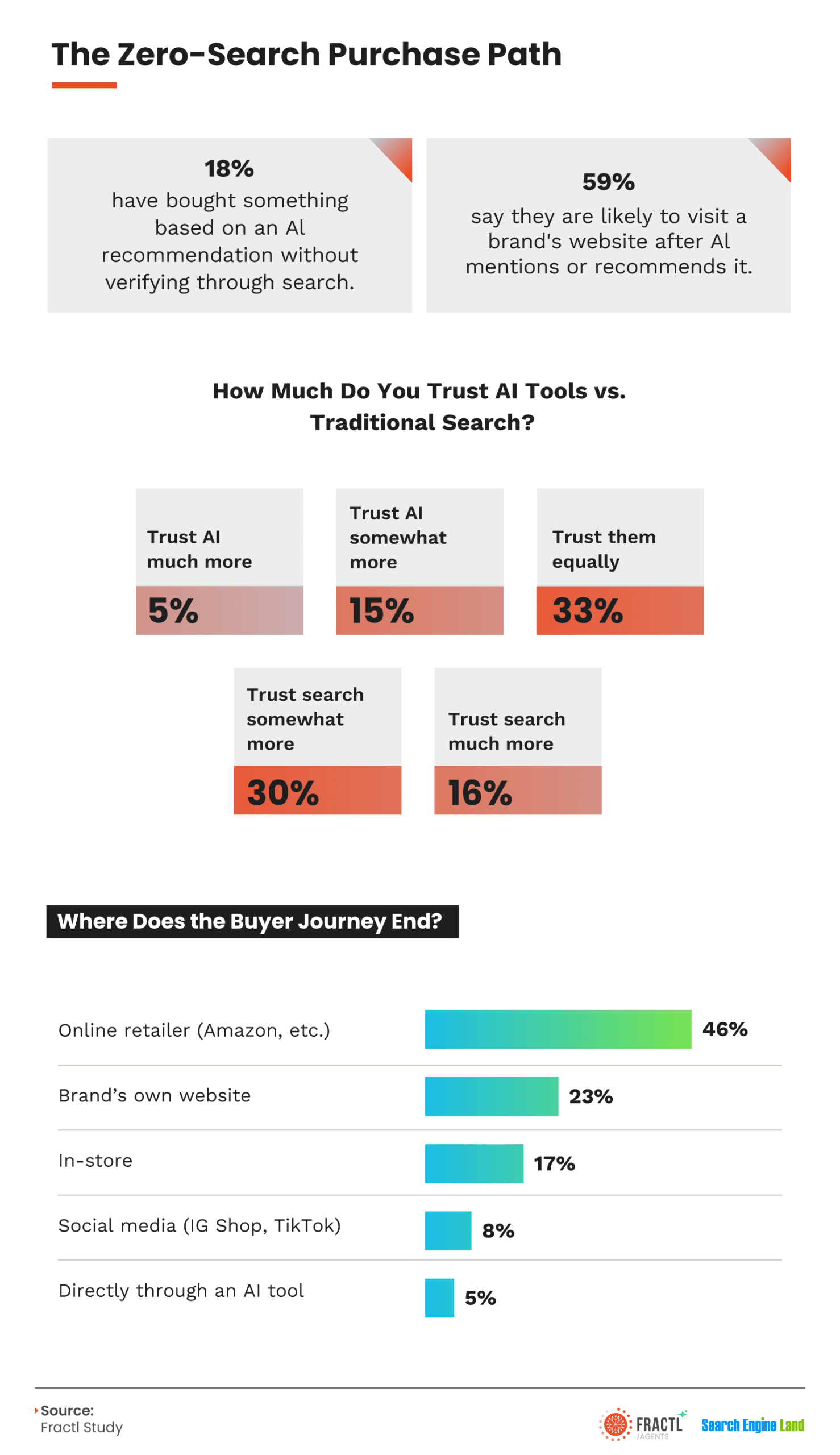
Nearly 1 in 5 consumers (18%) have made a purchase based on an AI recommendation without verifying it through a separate search. That number is small in aggregate but defines a new category of buyer journey, one where the brand never gets a search-driven touchpoint at all. For a product or service to be considered, it has to be one of the names the chatbot returns.
Gen Z and millennials are 2.5x more likely than baby boomers to buy on an unverified AI recommendation (20% vs 7%). The youngest consumers are also the most likely to engage downstream. Gen Z shows the highest “very likely” rate (19%) for visiting a brand’s website after AI mentions it.
Among all consumers, 59% say they are at least somewhat likely to visit a brand’s website after an AI chatbot mentions or recommends it. That’s the new conversion funnel. Brand mentions in the AI answer become the new ranking, and visits to the brand website become the new click-throughs.
The trust picture is more cautious:
- 33% trust AI and search equally.
- 46% still trust traditional search more.
- 20% trust AI more.
More than half (56%) are at least somewhat skeptical of AI product recommendations specifically. The behavior is shifting faster than the trust is. Consumers are using AI to filter and recommend, but most still verify or cross-shop before they buy.
Here’s where the buyer journey actually ends:
- Online retailers: 46%
- Brand websites: 23%
- In-store: 17%
- Social commerce: 8%
- Directly through an AI tool: 5%
The “buy directly through an AI” number is small now, but the platforms are racing to build it out, and the 18% who buy on unverified AI recommendations are the leading edge.
Looking to the Future of Search
When we asked whether Google will still be a consumer’s primary search tool in 5 years, the answer is more split than the trade-press narrative suggests.
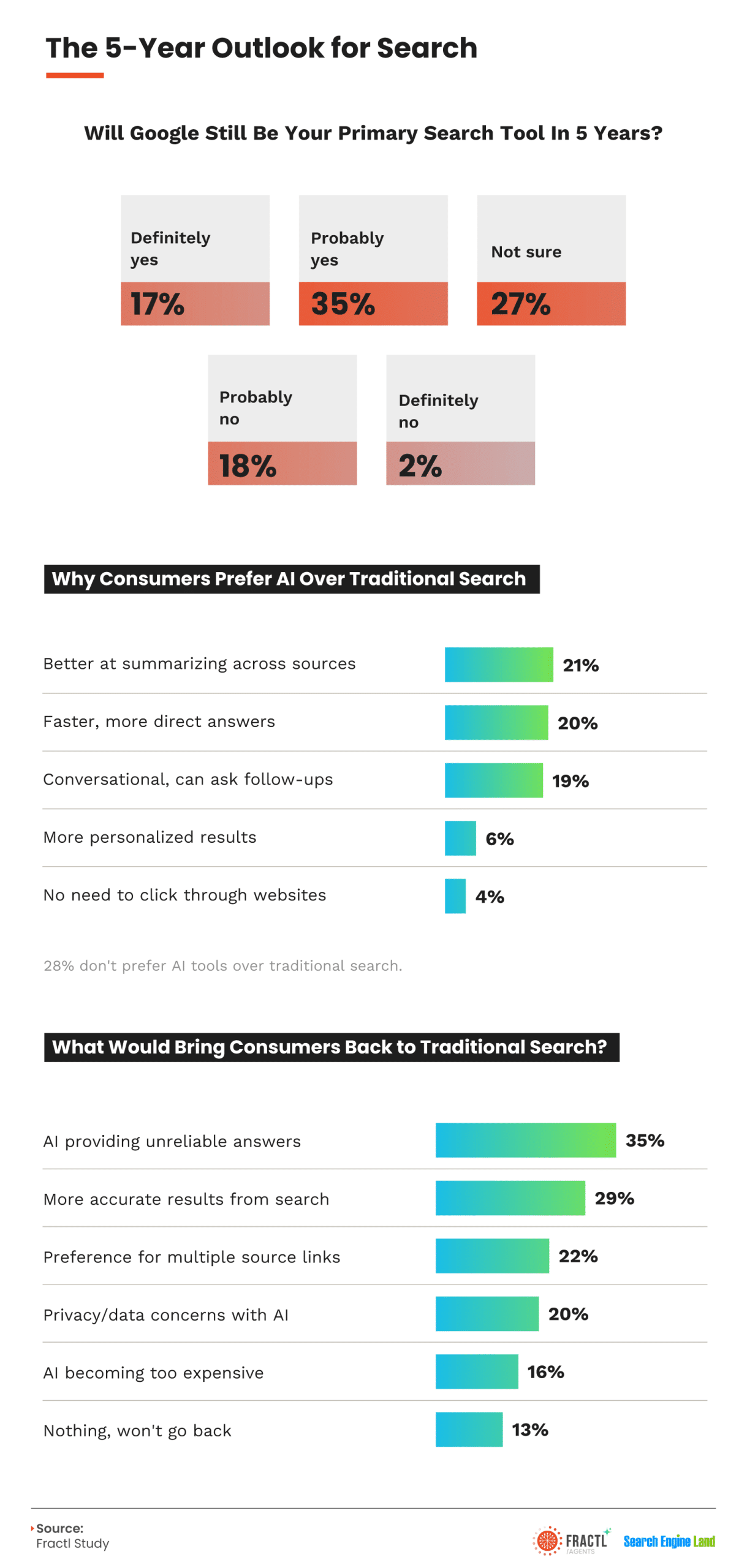
About half of consumers believe Google will remain their primary search tool in 5 years (17% definitely, 35% probably). Another 20% say probably or definitely not, and. 27% aren’t sure. That’s a strong majority betting on Google’s durability, but a meaningful minority is expecting to leave.
The top reasons why consumers prefer AI tools over traditional search are:
- Better at summarizing across sources: 21%
- Faster, more direct answers: 20%
- Conversational, can ask follow-ups: 19%
- More personalized results: 6%
- No need to click through websites: 4%
More than a quarter of consumers (28%) don’t prefer AI tools over traditional search. They’ve adopted it for specific use cases, but most aren’t experiencing it as a wholesale upgrade.
The most strategically interesting question we asked was what would bring consumers back to traditional search if they had largely moved away. The top answers:
- AI providing unreliable answers: 35%
- More accurate results from search: 29%
- Preference for multiple source links: 22%
- Privacy or data concerns with AI: 20%
- AI becoming too expensive: 16%
The future of the search-versus-AI split depends most on whether AI answers are reliable and accurate.
What This Means for Marketers
Gartner’s 25% prediction was the right kind of directional warning. The actual shift is steeper, but framing it as a decline misses the bigger story. The total volume of search demand is essentially flat, even as the words people are searching have rotated underneath it. The brands and content programs that suffer are those still ranking for words that are dying.
The ones that grow are those ranking for the words taking their place, things like branded queries and transactional intent. The work isn’t to defend traditional SEO from AI. It’s to keep moving the content portfolio toward the demand that’s still showing up in the search bar, while taking AI visibility seriously.
Methodology
This study combined two data sources to test Gartner’s 2024 prediction that traditional search engine volume would fall 25% by 2026.
First, Fractl analyzed search volume data via Semrush for 1,010,848 high-volume keywords with 10K+ monthly searches each. Search volume covered 379 brands in 8 verticals, including FinTech, HealthTech, Wellness, Travel, Education, Insurance, SaaS, and Lifestyle, and represented 35.4 billion in aggregate monthly search volume.
Keyword-level year-over-year volume change was measured as of April 2026 and classified as declining (>15% loss), stable (within 15%), or growing (>15% gain). Funnel-stage classification (TOFU, MOFU, BOFU), branded-vs-non-branded split, and query-pattern groupings (“What is X,” “Best X for Y,” “X vs. Y,” “How to X”) were applied at the keyword level to produce the vertical and category cuts.
Second, Fractl surveyed 1,004 U.S. consumers to understand how their search habits, AI tool adoption, and purchase research behavior have shifted over the past year. The demographic breakdown is as follows:
- 52% were women, 46% were men, and 1% were non-binary.
- 49% were millennials, 26% were Gen X, 16% were Gen Z, and 9% were baby boomers.
- The median respondent age was 41, with a range from 18 to 82.
About Fractl Marketing
Fractl is a growth marketing agency that helps brands earn attention and authority through data-driven content, digital PR, and AI-powered strategies. Our work has been featured in The New York Times, Forbes, and Harvard Business Review. Fractl is also the team behind Fractl Agents, where we build AI workflows that help marketers produce content strategies designed to surface across both traditional and generative search.
Fair Use Statement
Fractl encourages journalists and publishers to share findings from this study with proper attribution. Please link back to this page when referencing or citing our research so readers can access the full context and explore the complete dataset behind the insights.