


Key Takeaways
- A creator deal on its own adds little reach. Sponsored posts the brand didn’t boost reached 100,000 views 1.4% of the time. Ordinary posts did it 1.1% of the time.
- The boost is where the reach comes from. Boosted sponsored posts reached 100,000 views 11% of the time.
- A lot of posts isn’t a lot of reach. One product-review community paid for 2,749 sponsored posts. None reached 100,000 views.
- Your category decides whether a deal earns anything. Unboosted deals in food, sports, fitness, and fashion beat ordinary posts. In home, tech, travel, and beauty, they did worse.
Brands pay creators to post, then pay again to push those posts. We wanted to know which payment really does the work, so we looked at 79 million U.S. TikTok posts from August and September 2026. You can judge your own creator deals the same way.
Sephora Bought the Reach
We looked at posts TikTok labeled as paid partnerships that tagged Sephora: 1,728 in our sample. Sephora also paid to boost 1,417 of them as Spark Ads, TikTok’s format for running a creator’s post as an ad.
The 1,417 boosted posts drew 483 million views. The other 311 drew 1.1 million views combined. That’s roughly 340,000 views per boosted post against about 3,500 per unboosted one.
One in eight boosted Sephora posts reached 100,000 views. Two of the unboosted ones did.
Target, Ulta, and Walmart looked the same. Each boosted three-quarters or more of its sponsored posts, and those boosted posts carried 95% or more of the reach.
| Brand tagged | Sponsored posts | Share boosted | Reached 100K, boosted | Reached 100K, not boosted |
|---|---|---|---|---|
| Sephora | 1,728 | 82% | 12.6% | 0.6% |
| Target | 1,372 | 76% | 10.5% | 0.6% |
| Ulta | 1,246 | 79% | 10.8% | 1.6% |
| Walmart | 975 | 77% | 16.6% | 1.3% |
Before you approve a creator’s results, ask what share of the views came from your own ad budget.
The Pattern Holds Across 79 Million Posts
TikTok marks two things on every post: if a brand paid the creator, or paid to boost the post. We sorted all 79 million posts by those two things, then counted how often each kind reached 100,000 views.
A creator deal on its own, with no boost behind it, moves a post from 1.1% to 1.4%. The boost moves it to 11%. Posts creators make to sell through TikTok Shop for a commission did worse than ordinary posts, at 0.9%.
That doesn’t make creator deals a waste. Boosted creator posts beat boosted posts with no creator deal by more than two to one.
The point is, most of the reach a sponsored post shows is reach the brand bought on top of the deal.
Judge a creator on what the post earned before the boost, then budget the boost separately.
Kalshi’s Creators Earned Attention First
Kalshi, the prediction market, was tagged in 436 labeled partnership posts, mostly about football. Its 142 unboosted posts had a median of 18,281 views. Unboosted sports partnerships from every other sponsor had a median of 1,034.
The biggest numbers were still bought. Kalshi boosted two-thirds of its partnership posts. All ten of its most-watched posts were boosted, and those ten carried 94% of the views.
The creators Kalshi chose could hold an audience unpaid. The money then took the best posts to the top.
Pick creators whose unpaid posts already hold attention, then boost the ones that work.
Much of a Brand’s TikTok Voice Is Paid
We counted every post that tagged a brand’s account or used its own hashtag. Then we checked how much of the attention landed on paid posts: boosted posts, labeled partnerships, and TikTok Shop affiliate posts.
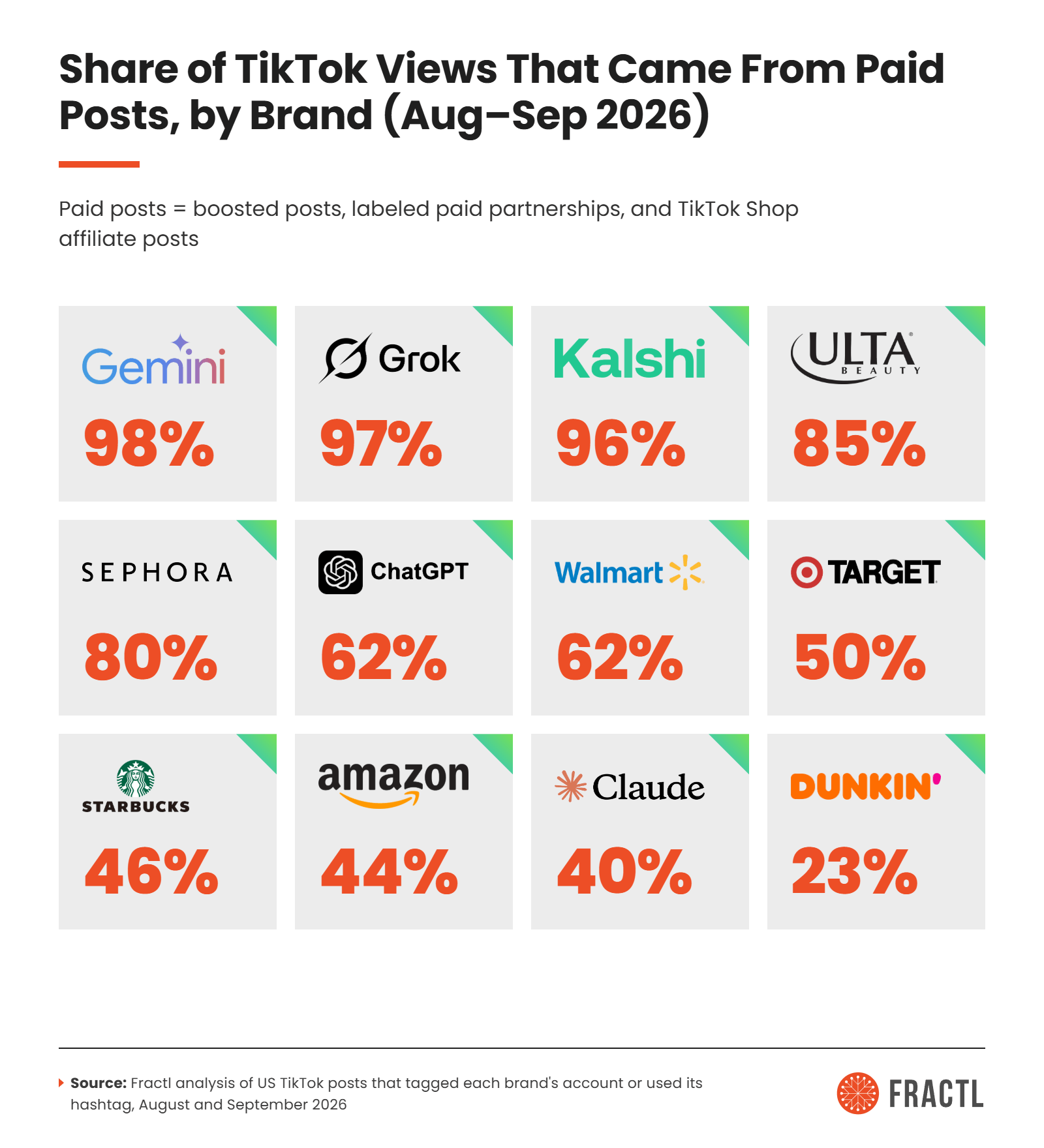
Among AI assistants:
 ChatGPT had the most posts by far. |   Grok and Gemini drew attention almost entirely through paid posts. |
In coffee, Starbucks drew five times Dunkin’s views, and under half of Starbucks’ views came from paid posts.
A brand that seems to be all over TikTok may be paying for most of that attention, and when the spending stops, so can the attention. Before you copy a competitor’s TikTok approach, work out how much of it is bought.
Some Sponsorships Earn Almost No Reach
A sponsorship program can produce hundreds of posts and almost no audience. Here are three examples from our sample, left unnamed:
- A product-review community: 2,749 sponsored posts, a median of 174 views, none at 100,000.
- A drugstore skincare brand: 965 sponsored posts, 70% boosted, none at 100,000.
- A second skincare brand: 923 sponsored posts, 82% boosted, four at 100,000.
These look like product-seeding programs, with many small creators paid in product or a small fee. That can be a sensible way to collect reviews. Reach isn’t what it buys, even with a boost behind it.
Your Category Decides What a Deal Earns
We grouped posts into eight categories by hashtag and compared each kind of post inside its own category. The table shows the share that reached 100,000 views.
| Category | Sponsored, boosted | Sponsored, not boosted | Ordinary | TikTok Shop affiliate |
|---|---|---|---|---|
 Food | 24.1% | 4.2% | 3.6% | 1.1% |
 Sports | 16.1% | 4.7% | 2.6% | 2.2% |
 Fitness | 7.5% | 1.3% | 0.7% | 0.8% |
 Fashion | 4.8% | 1.3% | 1.0% | 1.2% |
 Home | 15.5% | 2.1% | 2.7% | 0.8% |
 Tech and AI | 19.9% | 1.3% | 2.1% | 1.4% |
 Travel | 10.5% | 0.8% | 0.9% | 0.4% |
 Beauty | 5.8% | 0.7% | 1.7% | 0.4% |
In food, sports, fitness, and fashion, an unboosted deal beat an ordinary post. In beauty, it reached 100,000 views less than half as often. A quarter of beauty posts in the sample were paid in some way, against 3% of sports posts. TikTok Shop affiliate posts did worse than ordinary posts in six of the eight categories.
Each category has 231 to 1,970 unboosted sponsored posts, so read the gaps as direction, not precision. Check your category before you assume a creator deal will earn reach on its own.
Judge Deals Before the Boost
Here’s how to use this in your next campaign:
 Judge before the boost Look at what the post earned in its first days unpaid. That is the creator’s part. |  Budget the boost A sponsored post without one did little better than an ordinary post. |
 Read competitors carefully Their presence may be mostly bought. |  Check your category Food, sports, and fitness deals earned reach alone. Beauty deals mostly didn’t. |
The sample isn’t all of TikTok. And we can’t see creators, so we can’t say how much of this comes from the creators a brand picks.
Test One Deal Before the Boost
Pick one live creator deal and write down its unpaid views before any boost. Then decide whether the creator or the budget is carrying the result. We use this research to improve how Fractl Agents works.
If you want help turning findings like these into research and brand coverage, partner with Fractl.
Methodology
- Data: U.S. posts from August and September 2026 in the public TikTok Videos dataset (5.6 billion posts) by datasocial, under a Creative Commons non-commercial license. We kept posts whose numbers were collected at least 14 days after posting: 79,329,383 posts.
- Labels: “Sponsored” means TikTok labeled the post a paid partnership. “Boosted” means TikTok marked it a Spark Ad. “Ordinary” posts carry neither mark nor a TikTok Shop label. We didn’t use hashtags like #brandpartner to find sponsorships.
- Brands: A post counts when its caption tags the brand’s account or uses its hashtag. Brand counts are a floor.
- Categories: A post joins a category by hashtag, and can sit in more than one.
- Limits: We have no creator data and one snapshot per post. “Paid” means labeled, so undisclosed deals look ordinary.
Our first headline said sponsored posts break out five times as often. Splitting by boost showed it was 1.4% against 1.1%. We also dropped a “best time to post” finding, because early-morning posts were mostly boosted ones.