




Most startup failures are the result of several things going wrong at once, not one fatal mistake. Running out of cash (what founders name most) is usually the symptom of a deeper problem that could have been caught earlier. Understanding that difference is the first step to avoiding the same fate.
Comparing failure data over time separates the causes that stay constant from the ones getting worse, which tells you where to put your attention. I’ll walk through CB Insights’ 2026 analysis of recent shutdowns, what our 2017 study of 193 failed startups found, why funding doesn’t save companies the way you’d expect, and the industries where failures cluster.
Why Startups Fail: The 2026 Numbers
In its 2026 analysis of 431 VC-backed startups that shut down since 2023, CB Insights found that running out of capital tops the list, appearing in 70% of failures. But that’s the final cause, not the root one. The other reasons are more telling:
| Ran out of capital: 70% The event that ends most startups, but almost always downstream of a deeper issue. | Poor product-market fit: 43% No amount of runway fixes a product the market doesn’t want. |
| Bad timing: 29% The right idea too early or too late fails just as surely as the wrong one. | Unsustainable unit economics: 19% Growth that loses money on every sale runs out of road. |
The median company in the group had raised $11M, and the median time from its last fundraise to shutdown was just 22 months. Money buys runway, not survival. The through-line across both the 2026 data and older research is product-market fit, which is what our own study of failed startups surfaced too.
What a Decade of Failures Reveals
The 2026 data shows where things stand, but not what’s changed. Set it against our own 2017 study of 193 failed startups, whose founders publicly documented what went wrong, and new insights emerge. The two studies used different samples and definitions, so the figures aren’t a like-for-like comparison, but several themes line up.
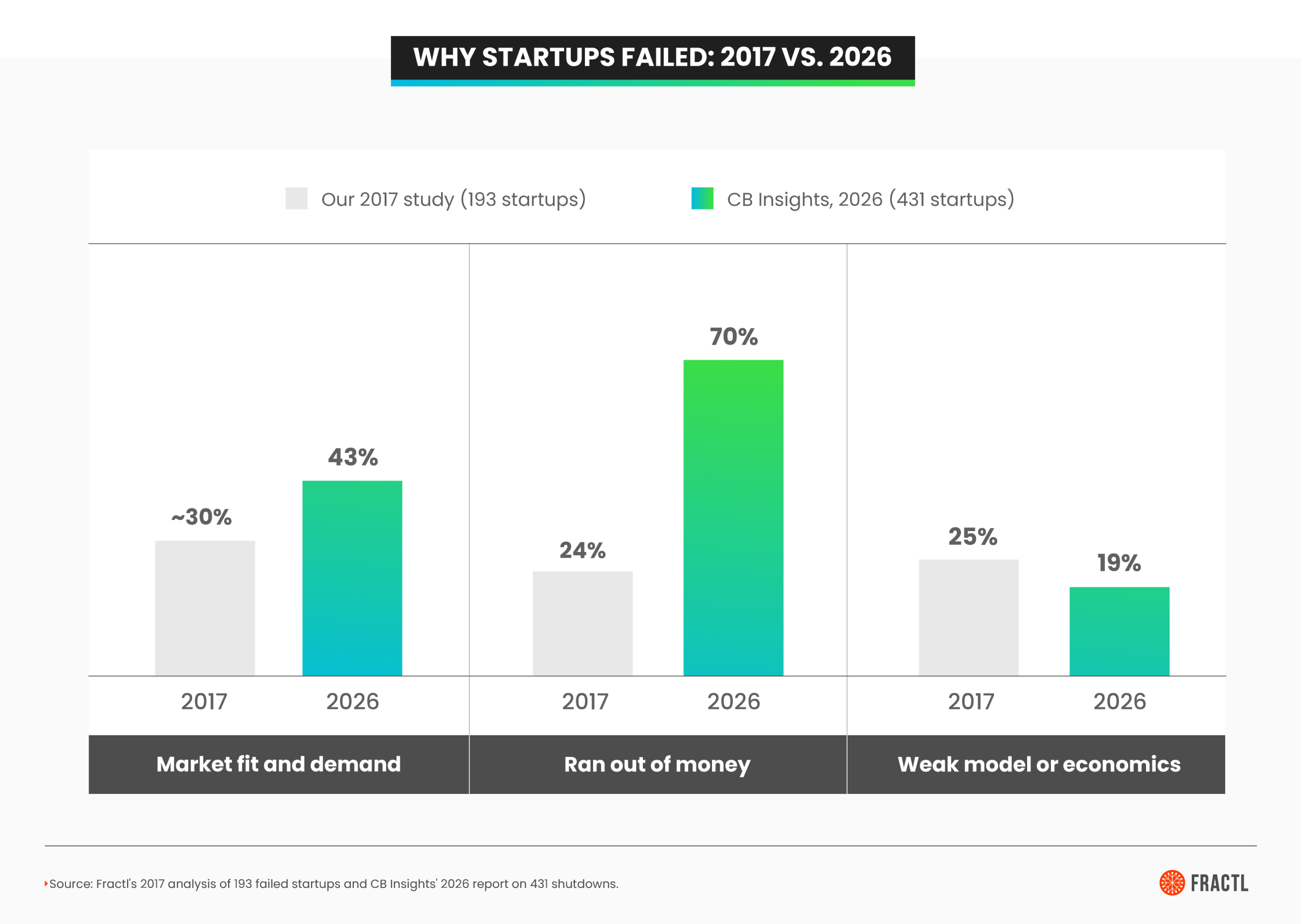
Here’s what all this could indicate:
- Market fit has always been the killer, and its grip is tightening. When we studied 193 startups back in 2017, roughly a third pointed to market problems, split between weak traction and no market need. CB Insights now puts poor product-market fit at 43%. Building something people want has continued to be the decisive factor, which makes validating a target audience before you build, and staying willing to pivot when the demand isn’t there, more important than ever.
- “Running out of cash” went from one cause among many to the most common one. In our earlier research, money problems sat alongside business-model and market issues. By 2026, 70% of shutdowns cite running out of capital. As startups raised more money, running out of it became the failure founders named most.
- Funding was never a safety net. Our study found that among the 76% of startups that had raised money, money was still the most common failure point. The 2026 companies had raised a median of $11M through their fundraising and still died within 22 months. More capital doesn’t fix a broken foundation; it just funds faster spending (a higher burn rate) and bigger promises.
A company chasing growth at all costs on weak fundamentals tends to fail later and more expensively, sliding from a high valuation to liquidation without ever solving what was wrong.
The Industries Where Startups Fail
The failures we studied clustered in a few verticals: social media, mobile apps, software, and e-commerce led the list. Here’s how startups tended to fail in these industries:
 Software and SaaS Founders got lost in the technical build, letting product issues and customer development gaps pile up before confirming anyone would pay. |  Social media Startups struggled to gain traction, turn attention into a viable business model, or avoid being outcompeted. |
 Mobile apps These found no clear path to sustainability, with no predictable way to turn downloads into revenue. |  Retail and fashion These companies most often ran out of cash or failed to raise it. |
Methodology
For Fractl’s 2017 study, we selected 193 startups whose founders had publicly written about their failure or whose shutdowns had enough media coverage to document what happened, sourcing many of them from CB Insights’ startup postmortems list. We then read each founder’s postmortem essay and the press coverage of the shutdown and coded the top one to four reasons for failure, which is why the causes overlap and the percentages don’t sum to 100%.
The 2026 figures come from CB Insights’ analysis of 431 venture-backed startups that shut down since 2023. CB Insights reviewed the failure post-mortems for each company and tallied the reasons cited, so a single startup can appear under more than one cause. Because the two studies drew different samples and defined their categories differently, we treat the comparison as directional.
Beat the Odds With Content That Compounds
Startups fail often, and most are strapped for cash. Content marketing is one of the few growth channels that compounds instead of resetting when the budget does: original research and earned coverage build a following and authority that outlast any single campaign.
If you want to give your startup that edge, reach out to Fractl and we’ll build a content program that helps you grow before the runway runs out.
Frequently Asked Questions
What are some examples of startup failures?
Well-known startup failures include Quibi (a short-form streaming service that shut down within months), WeWork (whose growth-at-all-costs model collapsed before a failed IPO), Juicero (a $400 juicer that solved a problem no one had), Theranos, and FTX (both cases of fraud). Each illustrates a different failure mode, from no market need to unsustainable unit economics.
Is it true that 90% of startups fail?
The “90% of startups fail” figure is widely repeated but overstated. Failure rates vary by stage and source, but BLS data shows only 34.7% of establishments born in 2013 were still operating a decade later, so closer to two-thirds close within ten years. What’s consistent is that most failures trace back to weak product-market fit and running out of cash, not bad luck.
What are the top 10 failed businesses of all time?
Among the most-cited startup and business failures, many documented in CB Insights’ postmortem library, are FTX, Theranos, WeWork, Quibi, Juicero, Pets.com, Webvan, Jawbone, Solyndra, and MoviePass. They span crypto, health tech, real estate, streaming, hardware, and more, but most collapsed from some mix of no market need, bad timing, or unsustainable unit economics.