




Table of Contents
- The Three Jobs Filed Under Lead Marketing
- Which Formats Bring Volume and Which Bring Qualified Leads
- How To Qualify Leads With Scoring and Nurturing
- How To Build a Lead Marketing Plan
- How To Measure Lead Marketing ROI
- Build a Lead Marketing Program That Compounds
- Frequently Asked Questions
Key Takeaways
- Lead marketing starts long before the contact form. Everything you publish, earn, and send decides who fills that form out and whether sales wants the conversation.
- Lead generation, demand generation, and brand demand do different jobs. One captures people who are ready, one creates the interest, and one makes people come looking for you by name.
- Format sorts your leads before scoring does. Educational articles build volume, while case studies, research reports, and whitepapers bring the ones worth a sales call.
- Quality is climbing even as volume gets harder. Marketers report better-qualified leads than a year ago, and generating them at all still ranks among their biggest challenges.
- One client’s explainer content drove a third of its organic leads. Definitional articles answering high-intent questions out-earned every other content type that client published.
Lead marketing is the work of attracting, qualifying, and nurturing potential customers across every stage that comes before a contact form, so the people who fill one out are ready to talk to sales. Most teams treat it as a conversion problem and spend their energy rewriting the call to action. The part that decides the outcome happens months earlier, in what you publish, where it gets cited, and how you sort the replies.
That earlier work got harder in 2026. AI answers absorb a growing share of informational searches, so a brand earns fewer clicks for the same ranking, and generating leads still ranks as a top challenge for 30% of marketers. Lead quality moved the opposite way in that same survey of more than 1,500 marketers, with 93.8% reporting better-qualified leads than the year before. Fewer, stronger conversations are the point of a modern program, and the teams getting them are sorting harder rather than publishing more.
The Three Jobs Filed Under Lead Marketing
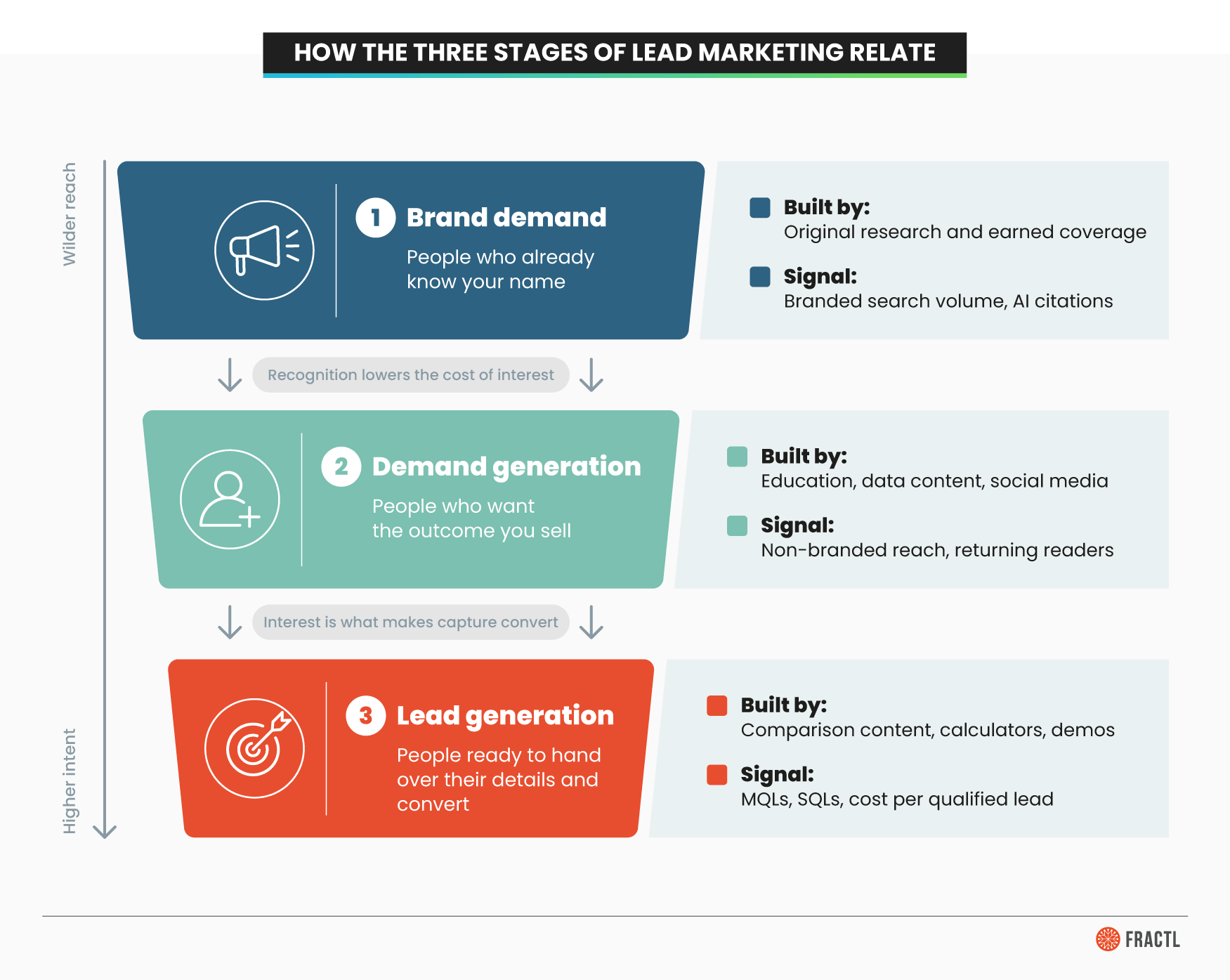
A marketing strategy needs to cover all three of these stages:
 Lead generation Capturing contact details from people already looking for what you sell. Comparison content, pricing questions, and demo requests do this work. |  Demand generation Creating the interest in the first place, through education, original research, and social media, so a market that wasn’t shopping starts to. |  Brand demand Building enough recognition that people search your name, and AI assistants cite you, without a campaign pushing them. |
That order matters: brand demand makes demand generation cheaper, and demand generation makes lead generation convert, which is the logic behind the AIDA model we use to plan client programs at Fractl. A team that only funds the last step competes on paid advertising against everyone else bidding on the same ready-to-buy searches, and pays more every quarter for it.
Generative search changed how brand demand works. When someone asks an assistant which agency to hire, the brands that get named are the ones with brand mentions and citations across high-authority publishers. Optimizing your own service copy moves nothing here, which makes earned coverage a lead marketing tactic.
Which Formats Bring Volume and Which Bring Qualified Leads
In Content Marketing Institute’s survey of 980 B2B marketers, short articles led on usage while video and customer stories led on results.
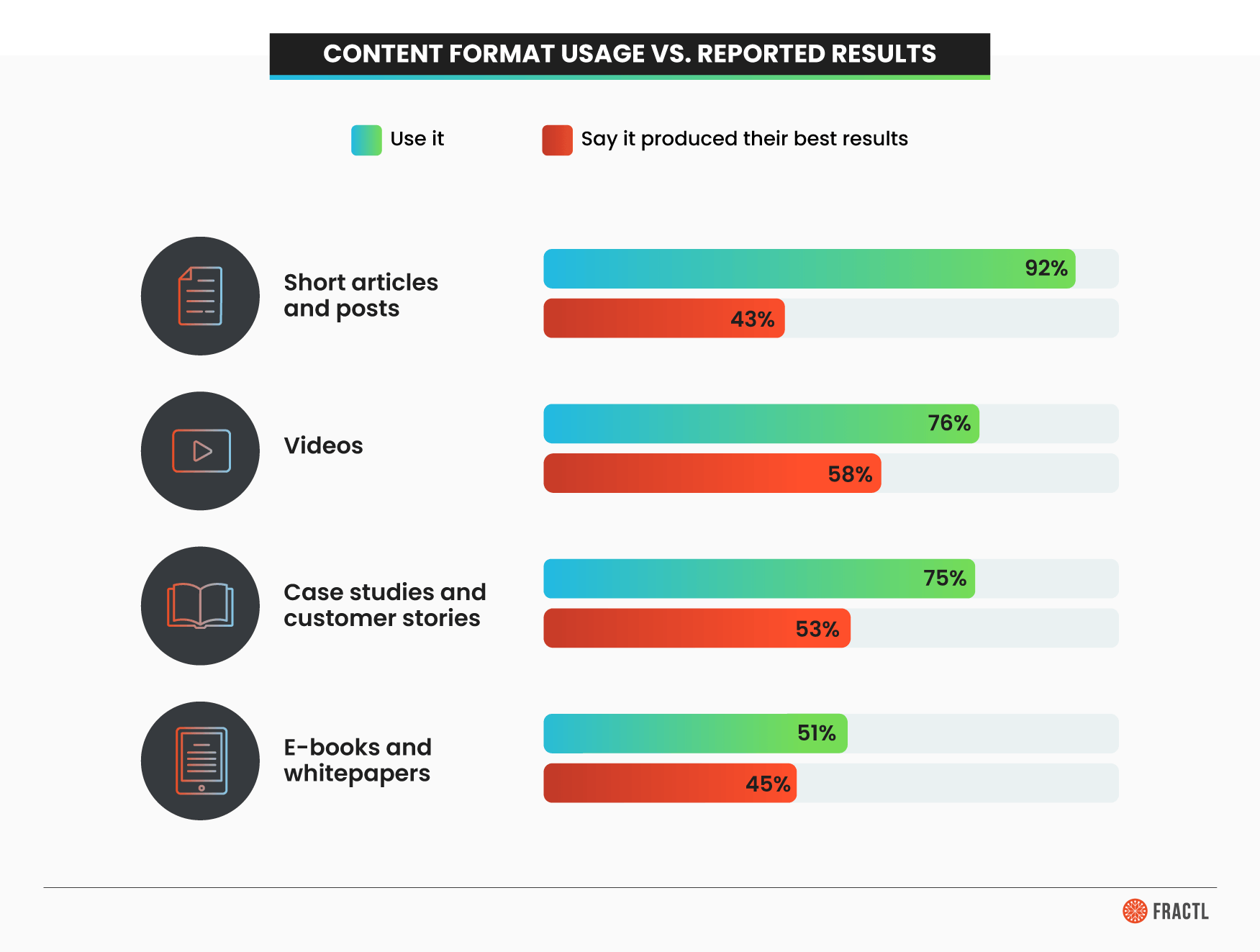
High-usage formats are cheap to produce and easy for a competitor to match, so they compete on volume. The formats clustered lower on usage take effort to build, which is why someone who works through one has told you something about their intent. Research reports earn their place here too, and they carry a second job: original data is what publishers cover and what AI assistants cite, so one study feeds demand generation and brand demand at once.
How One Client’s Organic Leads Broke Down by Content Type
Our own client work says the same thing from the other direction. We sorted a business lending client’s organic leads by the kind of content that earned them, and the educational material outperformed everything written about the company itself.
Definitional articles answering high-intent questions drove roughly a third of that client’s organic leads, about 7,400 of them.
That put explainer content level with the homepage and ahead of everything the client published about its own products and services.
Educational writing generates volume, then, and plenty of it. Those leads arrive from people asking questions rather than from spend, which is what makes the pattern worth building on rather than treating as a nice surprise.
Building programs on that split is part of why we’re ranked first for content marketing on Clutch’s Leaders Matrix out of 30,000 firms. The difference appears further down, where someone who downloaded a benchmark study or worked through an interactive tool converts at a different rate than someone who read a definition and left.
Interactive formats qualify in a way static ones can’t, because anyone using a calculator or a scorecard hands you their situation as they go. A tool that asks for company size, a scorecard that asks what a team already tried, an assessment that returns a tailored answer: each one produces a record that tells sales what to open with. We build these as interactive tools that earn links while they qualify, so the same asset works for demand generation and lead generation.
How To Qualify Leads With Scoring and Nurturing
A lead in marketing is any person who has given you a way to contact them and shown interest in what you sell. That definition is broad on purpose, and it’s why two teams reporting “leads” can mean completely different things. Every stage needs its own definition of progress.
- Marketing qualified lead (MQL). Someone whose behavior suggests interest, like repeat visits, a whitepaper download, or webinar attendance, but who hasn’t asked to buy.
- Sales qualified lead (SQL). Someone your sales team has vetted against budget, authority, need, and timing, and accepted as worth pursuing.
- Lead scoring. The rules that move a contact from one stage to the next, usually points for job title and company fit plus points for actions taken.
Most scoring models fail because they reward activity over intent. One look at your pricing says more than ten blog visits, and a model that scores them alike floods sales with contacts who were reading for work. Weight the actions that only someone close to buying takes, and let your marketing team settle the SQL definition with sales rather than around them.
Lead nurturing is what happens to everyone who isn’t ready yet, which is most of them. Email marketing still carries this stage, and marketing automation makes it survivable at scale, with behavioral triggers firing off what someone read. What a sequence teaches matters more than how often it sends, so the copywriting and the messaging deserve more attention than the schedule.
A sequence that keeps teaching earns the next open, while one that keeps asking for a meeting trains people to ignore you.
How To Build a Lead Marketing Plan
- Map what your target audience asks. Pull the questions people search at each stage, from category definitions through vendor comparisons, and assign every one to a stage so you can see where your coverage stops.
- Match the format to the stage. Short articles and video for early questions, case studies and webinars for evaluation, calculators and comparison content for the decision. Building the set as a connected content hub beats publishing them as unrelated posts.
- Earn authority off-site. Original research pitched to high-authority publishers builds the citations that digital PR converts into rankings and brand mentions, and it puts your name in front of people who have never searched your category.
- Nurture and score what comes in. Route every contact into a sequence tied to what they read, score against fit and intent, and hand sales only what clears the bar.
- Reinvest in what produced pipeline. Cut the formats that generate traffic without conversations, and fund the ones that generated closed business last quarter.
Paid media belongs in the plan, with a clear job, and most digital marketing teams overweight it. Google Ads and Facebook ads buy immediate volume while organic search engine optimization (SEO) and AI search visibility compound, so digital ads work best covering the gap in the first two quarters rather than carrying the program forever. Social media marketing does something different again: it’s where a research campaign gets shared and where a category conversation happens before anyone searches.
How To Measure Lead Marketing ROI
Most teams still just report the easy half. In 2026, 80% of B2B marketers track views, downloads, and shares, while only 63% track business impact such as leads and pipeline influence. The gap between those two numbers is the gap between a content strategy that survives a budget review and one that doesn’t.
- Conversion rates by stage. Visitor to lead, lead to MQL, MQL to SQL, SQL to closed. A drop between two stages tells you which asset to fix.
- Cost per qualified lead. Program spend divided by SQLs, tracked by channel, so you can see what organic earns against what paid rents.
- Pipeline influenced. Revenue in deals that touched your content at any stage, which is the number a chief marketing officer can take to a board.
- Brand and citation share. How often your brand gets named in AI answers and earned coverage for your category terms, tracked with marketing analytics and our Fractl Agents suite.
Attribution stays imperfect, and chasing a perfect model wastes more time than the precision is worth. Pick one reporting standard, hold it for four quarters, and judge the program on the trend.
Build a Lead Marketing Program That Compounds
The brands earning qualified leads in 2026 publish less and earn more: fewer formats, chosen because they sort readers, and enough original research that publishers and AI assistants repeat their name. That’s the program Fractl builds.
Ready to turn your content into a lead engine? Partner with Fractl to build the organic growth strategy, content development, and earned coverage behind it.
Frequently Asked Questions
What is a lead in marketing?
A lead is a person who has shared contact details and shown interest in what you sell, whether by downloading something, attending a webinar, or requesting a demo. Not every lead is ready to buy, which is why teams separate them into marketing-qualified and sales-qualified stages.
What does a lead marketer do?
A lead marketer owns everything between a stranger’s first exposure to the brand and a qualified handoff to sales: the content plan, the channels, the scoring rules, and the nurture sequences. The role belongs to marketing, but the definition of a good lead gets agreed with sales.
What’s the difference between an MQL and an SQL?
An MQL has behaved like someone interested, while an SQL has been vetted by sales and judged worth active pursuit. The handoff between them is where most programs leak, usually because the two teams never agreed on what qualifies.
Is it worth paying for leads?
Purchased lists rarely work, because the contacts never chose to hear from you and the data decays fast. Paying for reach through paid advertising works better, and it works best as a bridge while organic search, earned coverage, and email marketing build compounding volume.