




Table of Contents
- Why the Industry Needs a Shared Language for AI Search
- Every GEO Term Defined: A Practitioner's Glossary
- What the Data Says
- What Surprised Us Most During the Research
- How These GEO Terms Affect Hiring
- 3 Steps Marketers Should Take Now
- What 2026 Looks Like for Search and AI
- Build Brand Visibility Across Every Search Surface
- FAQ
Listen to the full conversation:
The CX Pod — GEO Terms in SEO ft. Kelsey Libert
Every few weeks, a new acronym shows up in the AI search conversation. GEO, AEO, AISO, AIO, LLMO — each one sparks a round of “SEO is dead” takes on social media, followed by confusion about what these GEO terms actually mean and whether they matter for your strategy.
I recently sat down with The CX Pod to unpack this. The timing made sense because I had just published a major study on AI search terminology in partnership with Search Engine Land. That research gave us something most of these debates lack: data.
I’ll walk through every major generative engine optimization term, share what the research actually says about how practitioners and hiring managers use them, and give you a framework for cutting through the noise.
Why the Industry Needs a Shared Language for AI Search
There’s a disconnect between how people talk about AI search online and how teams actually hire, budget, and execute. I see it constantly: Someone posts that traditional SEO is obsolete, a thread of 200 replies argues about definitions, and meanwhile, the people doing the work haven’t changed what they’re doing. They’ve just changed what they call it.
Rankings in AI search are changing, and the fundamentals of brand visibility have expanded.
That’s why I wanted to ground this conversation in real behavior. We partnered with Search Engine Land and triangulated the three primary signals that actually matter in digital marketing strategy:
- What practitioners say they recognize and use
- What people are searching for
- What hiring managers are paying for
Every GEO Term Defined: A Practitioner’s Glossary
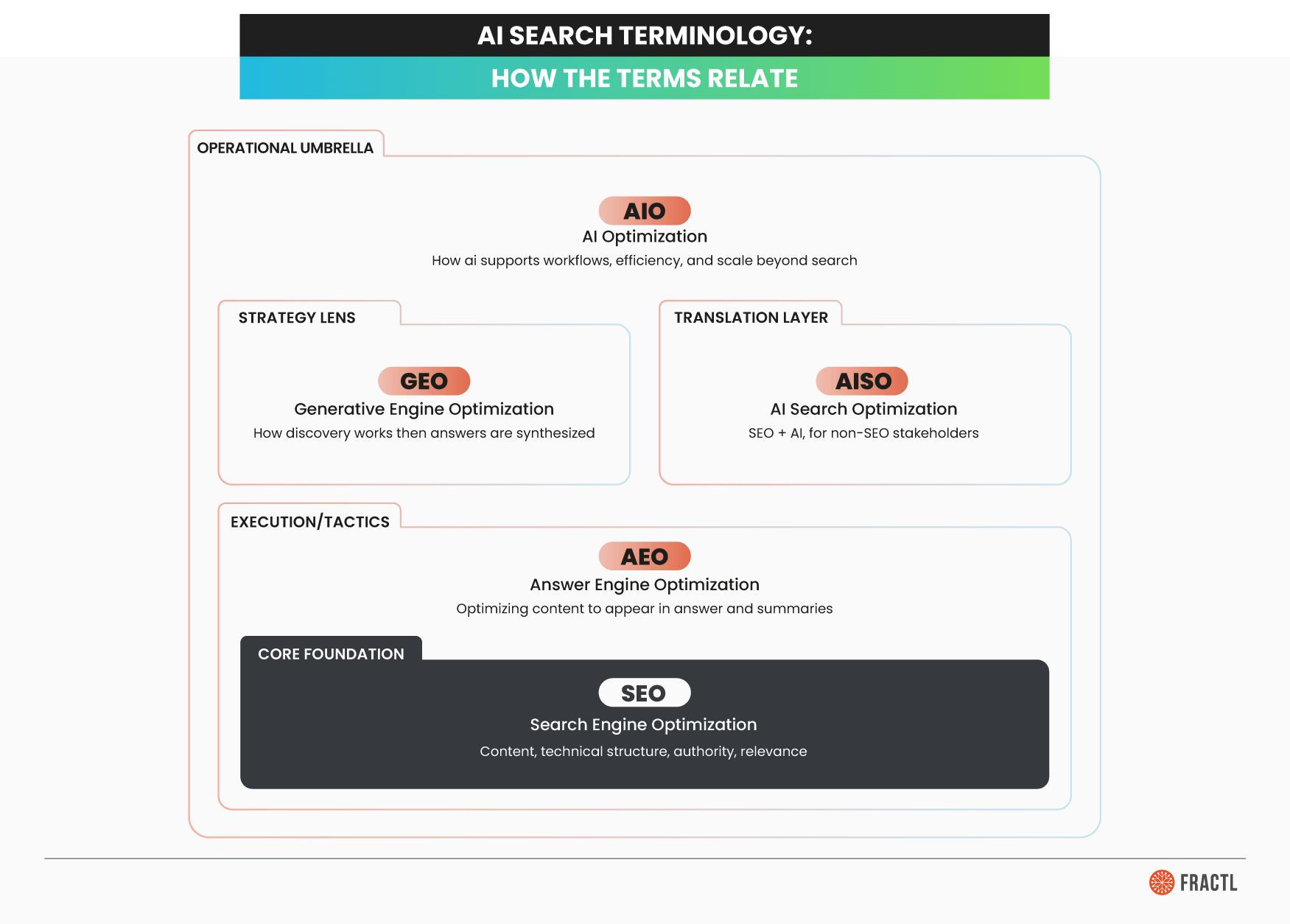
The biggest mistake is treating these terms as competing ideologies. They aren’t; they describe different layers of the same system. SEO is the engine, GEO explains the road system, and AEO and AISO are how you actually drive.
SEO (Search Engine Optimization)
Search engine optimization is the foundation on which everything else is built. Content strategy, technical structure, authority signals, backlinks, and relevance. It’s still doing the heavy lifting across Google search, Bing, and every other traditional search engine.
Our research confirmed what practitioners already feel:
SEO still carries the strongest emotional trust among all the AI search terms.
When people talk about credibility and proven results, they reach for this term rather than the newer ones. The crawlers that index your site, the search rankings you track in your SERP tools, the technical SEO audits you run — that’s all still SEO, and it still matters.
What’s changed is that SEO outputs now feed AI systems as well. The same content quality, structured data, and keyword matching that help you rank in traditional results also determine whether AI models cite you in their responses.
GEO (Generative Engine Optimization)
Generative engine optimization is the strategy lens. It explains how discovery works when answers are synthesized by large language models instead of ranked as a list of links. When someone asks ChatGPT a question, and it cites your content, or when Perplexity surfaces your data in a summary, or when Google AI Overviews pulls from your page — that’s the GEO layer at work.
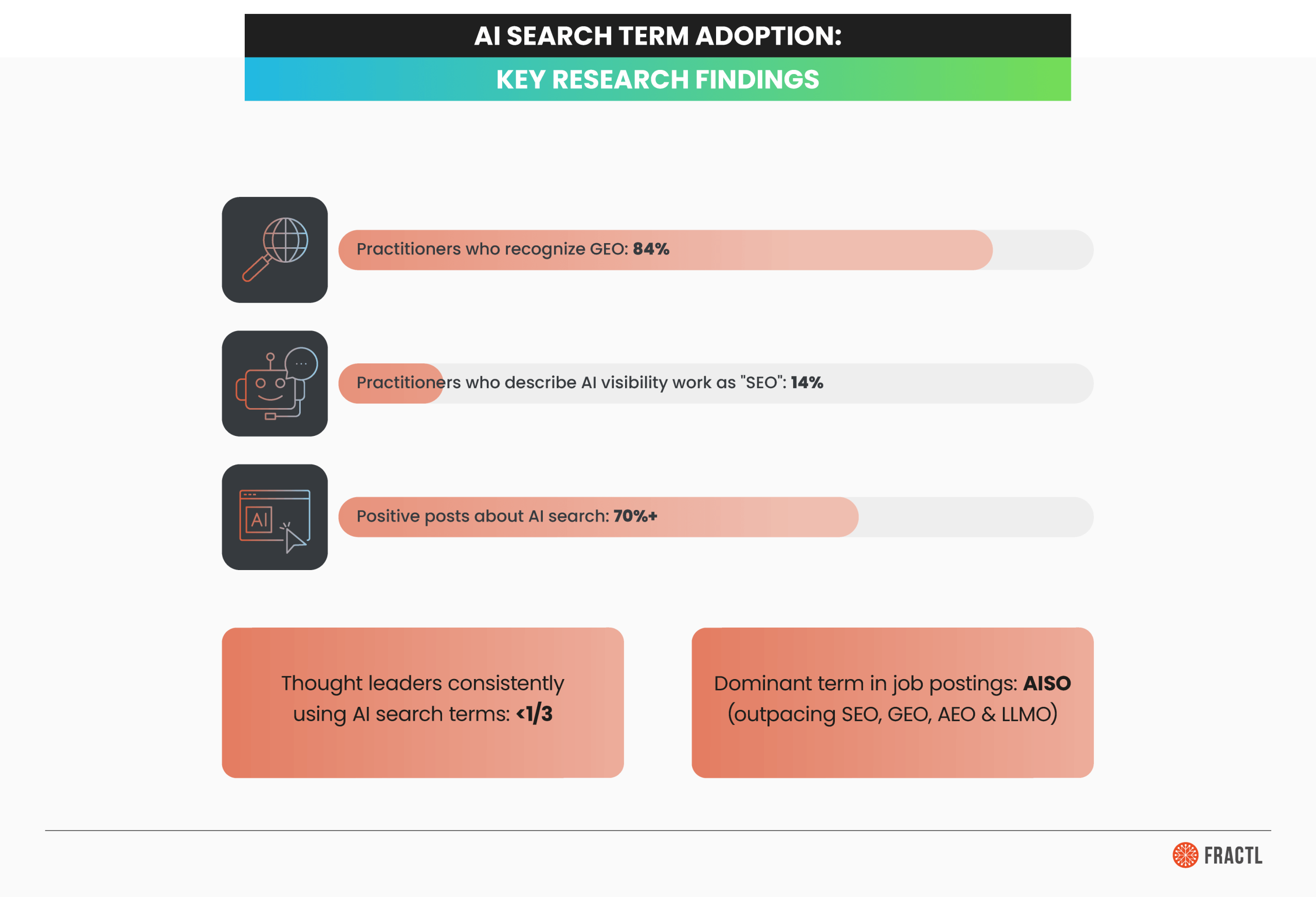
I found that 84% of practitioners recognize the term GEO, making it the most widely known AI search term. But here’s the nuance:
Only 14% actually describe their AI visibility work as “SEO.” The work itself hasn’t changed, but the framing has.
A geo strategy involves understanding how LLMs select sources, how AI-generated responses are assembled, and what makes content citable in these systems. It covers visibility across Gemini, Copilot, ChatGPT, Perplexity, and other AI platforms where your audience is increasingly asking questions. Generative AI hasn’t replaced search. It’s added new surfaces where your content needs to show up.
AEO (Answer Engine Optimization)
Answer engine optimization is the execution layer. If GEO is the strategic “why,” AEO is the tactical “how.”
It’s the specific work of optimizing content to appear in AI-generated answers, summaries, and snippets.
AEO tactics include:
- Structured data and schema markup: Helping AI systems parse your content accurately and pull the right information into their responses.
- FAQ formatting: Structuring questions and answers so they’re easy for AI models to extract and cite.
- Clear headings and readability: Using logical formatting and natural language that AI-generated responses can synthesize cleanly.
- Citation-worthy content: Writing with enough specificity and sourcing that AI systems have a reason to attribute claims to your page.
In our research, AEO drives strong social engagement. Practitioners who talk about AEO tend to share concrete, tactical content, which resonates because it’s immediately actionable. The term has carved out a useful niche as the answer engine counterpart to broader GEO strategy.
AISO / AISEO (AI Search Optimization)
These terms are translation layers. They exist because non-SEO stakeholders (CMOs, board members, clients) need language that says “this is search engine optimization, but with AI in the loop.” When a VP of marketing asks what your team is doing about AI search, “AISO” communicates more than “SEO” without requiring a 20-minute explainer.
Here’s what makes AISO significant: when I analyzed 33,000+ job postings on Indeed, one term dominated. AISO outpaced SEO, GEO, AEO, and LLMO combined in AI-driven job listings. The labor market already made its decision, and it chose the term that signals breadth over buzzwords.
The optimization strategies associated with AISO overlap heavily with both SEO and GEO.
The distinction is audience, not technique: AISO is how you talk about this work to people who aren’t deep in the SEO weeds.
It packages familiar AI tools and tactics in language that resonates with decision-makers and algorithms alike.
AIO (AI Optimization)
AIO is the broadest term in the stack — the operational umbrella. It covers how AI supports workflows, efficiency, and scale beyond just search. This involves content creation pipelines that use AI assistants, chatbots that handle customer queries, AI-powered analytics that surface insights from large datasets, and marketing automation that adjusts in real time.
Where GEO and AEO focus specifically on search visibility, AIO encompasses the full range of AI applications in marketing operations.
If your team uses AI to draft content briefs, optimize ad spend, personalize email sequences, or analyze campaign performance, that’s AIO territory. The outputs are broader than search rankings.
For most SEO practitioners, AIO is less directly relevant to their daily work than GEO or AEO. But for marketing leaders building org-wide AI strategies, it’s the category that captures everything else.
Other Terms To Know
Beyond the five core terms, you’ll run into a handful of related concepts in GEO conversations. Here’s a quick reference:
- LLMO (LLM Optimization): Optimizing specifically for large language model outputs. Narrower than GEO, focused on how models like GPT, Claude, and Gemini select and present information.
- AI Overviews (AIO in Google’s context): Google’s AI-generated answer boxes that appear at the top of search results. A key surface for brand visibility in 2026.
- E-E-A-T (Experience, Expertise, Authoritativeness, Trustworthiness): Google’s quality framework, now more critical than ever. AI systems rely on these signals when selecting authoritative sources to cite, making E-E-A-T a core component of any GEO strategy.
- Share of voice: How often your brand appears in AI-generated responses compared to competitors. An emerging metric for tracking GEO performance across AI platforms.
- Citation rate: How frequently AI systems cite your content as a source in their responses. A more specific measure of attribution than traditional click-through rates.
- Brand mentions: Unlinked references to your brand in AI outputs. Even without a direct link or referral, a mention in an AI-generated answer builds brand recognition and trust.
- Training data: The datasets that LLMs learn from. Your content’s presence (or absence) in training data affects whether AI models “know” about your brand. Copilot, Bing Chat, and other tools also pull from indexed web content in real time. My research on AI media collaborations and brand visibility digs deeper into how this dynamic works.
What the Data Says
Definitions are useful, but they don’t tell you what’s actually happening in the industry. This is where my research with Search Engine Land sets a benchmark. Three headline findings stood out.
Practitioners Aren’t Replacing SEO; They’re Stacking Language on Top of It
The data shows 84% of practitioners recognize GEO, but only 14% describe their AI visibility work using the traditional SEO label. That gap doesn’t mean SEO is dying. It means the same fundamentals (high-quality content, technical structure, earned authority) are being discussed with new vocabulary.
Think of it this way: The underlying work hasn’t disappeared. The rankings still matter. The content still needs to be excellent.
What’s changed is that practitioners need terms that signal awareness of AI search to clients, leadership, and the broader market.
The language is stacking, not replacing.
The Most Popular Term Isn’t Always the Most Powerful
Different GEO terms serve different purposes, and popularity doesn’t equal impact:
 GEO leads in awareness and search growth It’s the term most practitioners recognize and the one gaining the most search volume. |
 AISEO and AEO drive more social engagement Posts using these terms get more interaction because they tend to be more tactical and actionable. |
 SEO still carries the strongest emotional trust When user queries are about credibility and proven results, practitioners default to the original term. |
The takeaway for your strategy:
Use GEO when educating, AEO when sharing tactics, and SEO when establishing quality content credentials.
Each term has a lane, and the metrics confirm it.
The Labor Market Already Made a Decision
This was one of the most striking datasets in the research:
When we analyzed 33,000+ job postings on Indeed, AISO dominated the AI-driven job market.
It outpaced SEO, GEO, AEO, and LLMO combined.
Hiring managers want practitioners who can work across the full search ecosystem, from traditional search engines to AI platforms, and AISO communicates that scope better than any single-channel term.
What Surprised Us Most During the Research
Two findings genuinely caught us off guard. First:
AI-search volatility is the real risk.
When I analyzed 75 SEO thought leaders, fewer than one-third used AI search terminology consistently over time. The loudest voices in the industry changed their framing the fastest. That kind of iteration in language makes it hard for teams to build stable internal frameworks, which is exactly why picking a house language matters (more on that below).
Second:
Sentiment is overwhelmingly positive about AI search.
Over 70% of posts about AI search had positive sentiment. Despite the panic headlines and “SEO is dead” hot takes, practitioners are optimistic about content creation in the AI era. The industry isn’t confused. It’s mid-translation. The algorithms are evolving, and so is the vocabulary, but the people doing the work feel good about where things are headed.
How These GEO Terms Affect Hiring
The terminology debate has real implications for both sides of the hiring table.
For Companies
How you label these roles can shape who finds them, who applies, and how clearly the position is understood from the start.
- Don’t title roles “GEO Manager” yet. You’ll limit your applicant pool to people who’ve adopted one specific term. The market hasn’t standardized.
- Use SEO or AISO in job titles. Describe AI-driven responsibilities inside the role description instead. This attracts candidates who already have the right mental model without requiring them to have adopted your preferred acronym.
- Define what you mean internally. Before writing the job posting, make sure your team agrees on what GEO, AEO, and AISO mean for your organization. Ambiguity in a job post signals ambiguity in the role.
For Candidates
The exact acronym matters less than understanding the shift and showing employers you can do the work behind it.
- You don’t need to rebrand your career every six months. Strong SEO fundamentals plus fluency in AI systems is the winning combination, regardless of which acronym is trending.
- Learn the terms, but lead with skills. Understand what GEO, AEO, and AISO mean so you can speak your interviewer’s language. But your actual value comes from being able to optimize content across both traditional and AI-powered search surfaces.
- Watch the job postings, not the debates. GEO explains the shift. AISO is what actually gets you hired.
3 Steps Marketers Should Take Now
The research points to three things you can do this week to cut through the terminology noise and build a strategy that actually holds up.
- Pick a house language and define it clearly. Decide what your team means by SEO, GEO, and AEO. Write it down. Use it consistently in briefs, reports, and client communications. The worst outcome is having five people on the same team using three different terms for the same work.
- Build for durability, not platforms. Strong content hubs, entity authority, earned mentions, and real expertise compound across every surface: Google, AI Overviews, ChatGPT-style AI assistants, e-commerce search, and community platforms. User intent doesn’t change just because the delivery mechanism does. Optimize content that answers real questions with real depth.
- Stop chasing acronyms and start tracking surfaces. Measure where your brand shows up: AI-generated answers, summaries, citations, and brand mentions, not just traditional search rankings. The metrics that matter in 2026 go beyond click-through rates and SERP position. Track the surfaces where answers actually appear.
What 2026 Looks Like for Search and AI
The pace of change in AI search won’t slow down, but the conversation around it is maturing. I expect fewer debates about naming conventions and more focus on outcomes. Search is becoming a multi-surface ecosystem, and the teams that treat it that way (tracking visibility across Google, AI platforms, social, and community channels simultaneously) will outperform those still optimizing for a single channel.
AI visibility metrics are already moving toward the boardroom. CMOs want to know where their brand appears in AI-generated responses, not just where it ranks on page one. I explored this shift in depth in her piece on what generative search means for brand visibility. It’s a healthier direction for marketers, users, and brands.
As I said on The CX Pod, in a world where answers are synthesized, the brands that win are the ones that are easiest to trust. Generative AI hasn’t changed that principle. It’s made it more important than ever.
Build Brand Visibility Across Every Search Surface

The terminology will keep evolving, but the fundamentals don’t. Create genuinely useful content, earn authoritative mentions, and build brand presence across every surface where your audience discovers information. That’s what we do at Fractl every day, from earned media and digital PR to SEO and GEO strategy, and our AI-powered agents help us do it at scale.
If you’re building a brand visibility strategy for the AI era, we’d welcome the conversation.
FAQ
What is generative engine optimization (GEO)?
Generative engine optimization is a strategy for understanding how discovery works when AI systems synthesize answers instead of ranking links. It covers optimizing content for visibility in Google AI Overviews, ChatGPT, Perplexity, Gemini, Copilot, and other AI platforms. GEO builds on traditional SEO fundamentals but applies them to AI-generated responses and AI-mediated search experiences.
What’s the difference between GEO and AEO?
GEO is the strategic framework for understanding AI-mediated discovery. AEO (answer engine optimization) is the execution layer: the specific tactics like structured data, schema markup, FAQ formatting, and content structuring that help your pages appear in AI-generated answers and summaries. GEO explains why visibility is changing. AEO tells you what to do about it.
Is SEO still relevant in the age of AI search?
Yes. Fractl’s research found that SEO still carries the strongest emotional trust among practitioners. AI systems like ChatGPT and Perplexity rely on traditional search signals (backlinks, E-E-A-T, content quality) when selecting authoritative sources to cite. SEO is the foundation that GEO and AEO build on, and the fundamentals (high-quality content, technical structure, earned authority) haven’t changed.