



Table of Contents
- What Is Organic Search?
- What Is Paid Search?
- SEO Strategy vs. Paid Ads: Cost and ROI
- Advantages of Organic Search
- Advantages of Paid Search
- Combining Organic and Paid: A Balanced Digital Marketing Strategy
- ROI Beyond Traffic: Business Growth Impact
- Which Delivers the Best ROI?
- FAQs for Organic and Paid Search ROI
Key takeaways:
- Organic search compounds over time. Strong rankings keep driving traffic long after publication, while paid visibility stops the moment the budget does.
- Consumers overwhelmingly prefer search over ads. Fractl research found that 99% of consumers used a search engine in the past week, while just 5% say they click on paid ads “always” or “often.”
- Ad blockers limit paid reach. Nearly half of consumers (47%) use an ad blocker (rising to 52% among 18- to 34-year-olds), making organic visibility even more critical.
- Helpful content builds trust. 57% of consumers trust a brand more when they see its research in high-authority publications, and 74% say educational content positively influences their brand awareness.
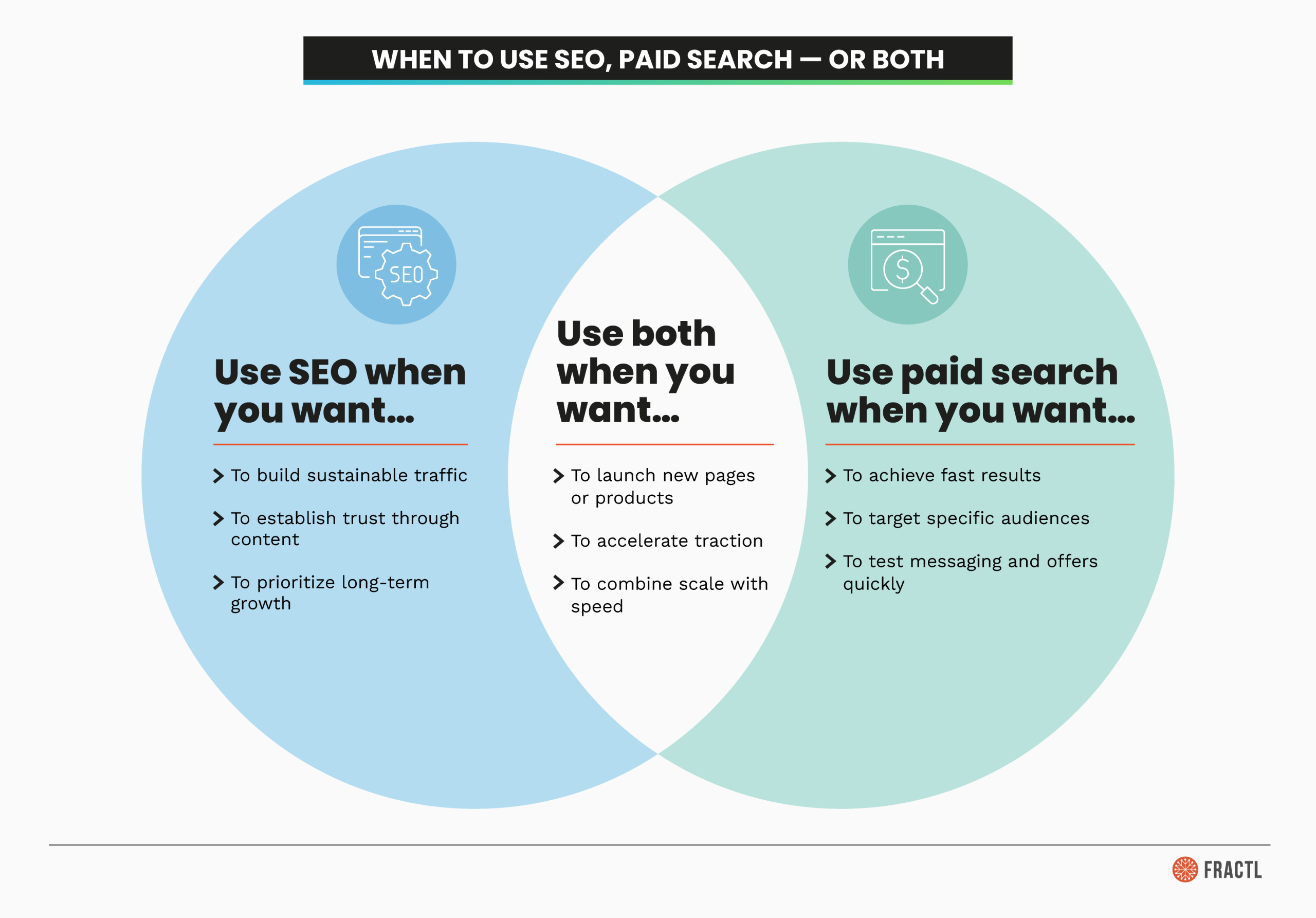
- The strongest strategy combines both channels. Use organic as the long-term engine and paid to accelerate launches, fill gaps and test messaging.
Marketers often wonder whether to put their money into SEO or paid ads. Both drive visibility in different ways, but the real question is, which delivers a stronger return on investment?
In a survey of 1,000 consumers, we found that 99% used a search engine in the past week and that appearing in search results with helpful content is the single most effective way to build a relationship with a potential customer. This clearly signals that organic investment pays off well beyond the click.
Understanding organic search and paid search side by side helps business owners make smarter choices.
What Is Organic Search?
Organic search refers to the unpaid results that appear when someone types a search query into Google search or another engine. These listings are based on relevance, not ad spend, and they generate what is known as organic traffic. When you click through a link on the search results page without an “Ad” label, that’s organic search in action.
Search engine algorithms determine the placement of these links by weighing hundreds of factors. A well-executed search engine optimization (SEO) plan improves organic search rankings by focusing on relevant keywords, technical site health, and high-quality content. The higher a page appears on the SERP, the more visibility and clicks it attracts.
For businesses, organic search results are valuable because they compound over time. Unlike paid ads that disappear once the budget runs out, strong rankings can continue sending traffic month after month. That staying power matters because consumers are actively looking: 86% of consumers say search engines play a significant role in their purchase decisions, and 80% use them multiple times a day.
Backlinko reported that the top result in Google search receives about 27.6% of all clicks, while results on the second page receive far less attention. This gap highlights why investing in SEO and aiming for the first page of search results is critical for long-term visibility.
86% of consumers say search engines play a significant role in their purchase decisions, and 80% use them multiple times a day.
What Is Paid Search?
Paid search is the practice of buying visibility on a search engine results page. Instead of earning a spot through search engine optimization, businesses pay to have their ads appear above or alongside organic listings. These placements are clearly labeled as paid ads and are a central part of many digital marketing strategies.
The most common model is pay-per-click advertising. In this setup, a company pays a fee each time a user clicks on its link. Paid advertising, which can be part of a business model, can quickly drive traffic, making it useful for time-sensitive campaigns or businesses that want immediate visibility.
Unlike organic results, which rely on gradual improvements in content and authority, paid search provides instant placement at the top of the page.
Paid search results also allow for targeting that goes beyond keywords. Marketers can narrow campaigns by location, device type, or demographic, which helps refine their marketing strategies and reach the right audience.
According to WordStream, the average click-through rate for Google Ads across all industries is about 3.17%. While that may sound small, placing ads in front of thousands of searchers can generate significant exposure and traffic.
SEO Strategy vs. Paid Ads: Cost and ROI
When teams compare an SEO strategy with paid ads, cost is the first thing that comes up. SEO is often the more cost-effective path because strong pages can keep earning website traffic long after you publish them. The tradeoff is time. You need high-quality content, solid technical foundations, and patience before rankings start to climb.
Paid search takes the opposite route. A pay-per-click campaign can push you to the top of the page right away, but that visibility pauses the moment the budget stops. In competitive niches with high search volume, costs can rise quickly, so planning matters.
The challenge goes beyond budget, though. We found that 47% of consumers use an ad blocker — and that number climbs to 52% among 18- to 34-year-olds. Plus, just 5% of consumers say they click on paid ads “always” or “often,” meaning a significant share of ad spend may never reach its intended audience.
47%–52% of consumers use an ad blocker.
Clear metrics should judge both channels. Look at conversion rates to see how often visitors become customers. Watch bounce rate to understand whether your pages match search intent.
Ultimately, return on investment decides the winner. Recent benchmark data from HubSpot’s 2026 State of Marketing shows websites, blogs, and SEO among the top channels for ROI, while PPC remains effective for time-sensitive pushes and testing. That’s why many teams build SEO as the core engine and use paid campaigns to accelerate results when it matters.
A simple way to calculate ROI for either channel is:
ROI = (Revenue Generated – Cost of Investment) ÷ Cost of Investment × 100
For SEO, investment includes content creation, optimization tools, and staff time. For PPC, it usually means ad spend plus management fees. Using the same formula makes it easier to compare results side by side.
| SEO vs. Paid Search: ROI Comparison Across Key Factors | ||
|---|---|---|
| Factor | SEO strategy (Organic search) | Paid ads (PPC) |
| Cost | Upfront effort, cost-effective over time | Ongoing spend for every click |
| Speed of results | Slower, months to build rankings | Immediate visibility once launched |
| Metrics to track | Conversion rates, bounce rate, search volume | Conversion rates, cost per click |
| ROI perspective | Consistently cited among the top ROI channels | Strong for time-bound promotions |
Advantages of Organic Search
Organic search is a powerful tool for long-term business success. Below are some of the key reasons to invest in an organic content marketing strategy:
- Supports sustainable growth. Unlike paid ads, organic traffic builds over time without requiring payment for each click. This ongoing traffic supports both organic business growth and long-term sustainability.
- Follows proven SEO best practices. A successful strategy includes publishing high-quality content, targeting long tail keywords, and aligning keyword use with search intent to expand your reach.
- Signals authority to search engines. Backlinks from reputable sites help boost your credibility, improve rankings, and increase visibility — without increasing your ad spend.
- Drives significant website traffic. Organic search accounts for more than half (53%) of all website traffic, making it the most important channel for brand discovery and long-term momentum.
- Builds brand trust through content. 57% of people trust a brand more when they see its research in high-authority publications, and 74% say regularly encountering educational content from a brand positively influences their awareness of it.
Advantages of Paid Search
Our consumer data shows that 47% of people rarely or never click on paid ads, which means brands need a clear ROI strategy to justify spend in competitive verticals.
Still, paid search brings unique advantages that organic strategies can’t match — especially when speed and flexibility are top priorities. Here are some of the main benefits of paid search:
- Delivers immediate visibility. Paid campaigns can push your link to the top of search engine rankings the moment they launch, making them ideal for product rollouts, limited-time offers, or urgent promotions.
- Offers scalability and control. Marketers can quickly scale up or pause budgets, helping them adapt to shifting priorities or market conditions with minimal friction.
- Enables fast, data-driven testing. A/B testing tools enable teams to experiment with variables like ad copy and landing pages, then analyze results to guide strategic decisions.
- Provides near-instant performance insights. With tools like Google Analytics, marketers can connect ad clicks to on-site behavior, track conversions, and fine-tune campaigns based on real-time feedback.
Keep in mind that paid search requires careful budget management. The average cost per click for Google Ads ranges from under $2 in some industries to more than $6 in highly competitive sectors — costs that can add up quickly without a clear ROI strategy.
47% of people rarely or never click on paid ads.
Combining Organic and Paid: A Balanced Digital Marketing Strategy
For most brands, it’s not a choice between organic and paid search. It’s about using both in a single growth strategy. Organic builds durable visibility and trust. Paid accelerates reach when you need results now. Together, they smooth out performance and keep marketing efforts aligned with real business goals.
Our research reinforces this balance: 47% of consumers said appearing in search results with useful articles is the best way for a brand to earn their trust, while only 17% said they clicked on an ad in the past week.
Digital marketing teams often add supporting channels to make this mix stronger. Email marketing keeps your audience warm between launches. Social media helps promote content and test messages in the wild. LinkedIn can reach decision makers, while Bing and Yahoo can provide extra coverage in certain markets. With the right setup, AI tools and automation coordinate campaigns across these touchpoints so creative teams can focus on quality work.
Only 17% of consumers clicked on an ad in the past week.
The takeaway is simple. Treat organic as the engine that compounds over time. Use paid to amplify new releases, fill gaps in coverage, and learn quickly. When these pieces work together in a clear plan, the whole system becomes easier to manage and more resilient over the long term.
ROI Beyond Traffic: Business Growth Impact
The return on investment from search should translate into tangible business outcomes. Strong organic performance supports organic growth strategies that compound over time, while inorganic growth strategies can deliver speed with added risk. Think about how each path touches the bottom line.
How Organic Search ROI Shows Up in the Business
Organic search efforts do more than drive traffic — they fuel measurable business growth. Below are some of the key areas where that ROI becomes clear:
- Customer base expansion. Steady organic traffic brings new customers and deepens the client base.
- Healthier cash flow. Consistent demand supports revenue growth and improves profitability.
- Product lines and markets. Reliable visibility helps launch new products and win early market share.
- Partnerships and capital access. Momentum strengthens partnerships and can improve valuation.
- Operational readiness. A focused leadership team can scale processes in startups and smaller companies.
Where Finance Leaders Feel the Impact
For finance teams, organic search performance influences core metrics and strategic decision-making. Here’s how those effects show up in financial operations:
- Financial services and wealth management. Predictable acquisition lowers client churn and stabilizes assets under management.
- Investment banking and real estate. Durable demand signals support funding conversations and site selection.
The most reliable approach is to build an SEO foundation that earns compounding organic visibility, then use paid campaigns to accelerate launches, fill gaps, and test messages. This keeps long-term ROI on track while giving teams the speed they need for time-sensitive goals.

Which Delivers the Best ROI?
If you want durable gains, organic search supports organic growth that compounds and keeps costs predictable. Paid search delivers faster wins but needs constant budget and tight control. Most business owners do best with a blended plan that aligns with their goals and stages.
Use organic as the engine and deploy paid to test, launch, and fill gaps. Track the bottom line and measure what truly drives revenue. Drive organic growth with a proven framework. Get in touch with Fractl to start planning a growth strategy that drives measurable ROI.
FAQs for Organic and Paid Search ROI
These quick answers clarify common questions, allowing you to choose the right mix for your goals. Use them as a reference when you plan budgets and measure outcomes.
What is organic search?
Organic search refers to unpaid listings on the search engine results page that match a user’s intent. Clicks from these listings generate organic traffic without ad spend.
What is the difference between SEO and organic search?
SEO, or search engine optimization, is the process. Organic search results are the outcome on the SERP. Strong SEO improves relevance, crawlability, and rankings over time.
What is organic and inorganic search?
Organic search earns visibility through content and relevance. In contrast, inorganic growth often relies on short-term tactics like paid placement and aligns with inorganic growth strategies outside of day-to-day SEO.
What is direct search vs. organic search?
Direct search happens when users type your URL or use bookmarks. Organic search traffic arrives from unpaid results. Referral traffic comes from links on other sites, not from a search engine.