





Table of Contents
- What Is Generative Engine Optimization?
- Consumers Aren’t Just Googling Anymore
- GEO vs. Traditional SEO
- How Generative AI Engines Work
- AI Overviews' Impact on Businesses
- Key Factors for Successful GEO
- Best Practices for Optimizing Content for GEO
- Metrics and Measuring GEO Success
- Case Studies and Examples
- Freelance Marketplace Expands Reach Through High-Authority Coverage
- Tips for Building a GEO-Ready Strategy
- FAQs About GEO and SEO
Generative engine optimization (GEO) encompasses the marketing strategies that improve brand visibility in GenAI platforms. While the SEO industry is up in arms about the latest expansion of the SEO glossary — and whether we’ll call it SEO, GEO, or AEO — one thing is clear: the rapid adoption of GenAI platforms demonstrates the need for marketers to embrace this new search landscape.
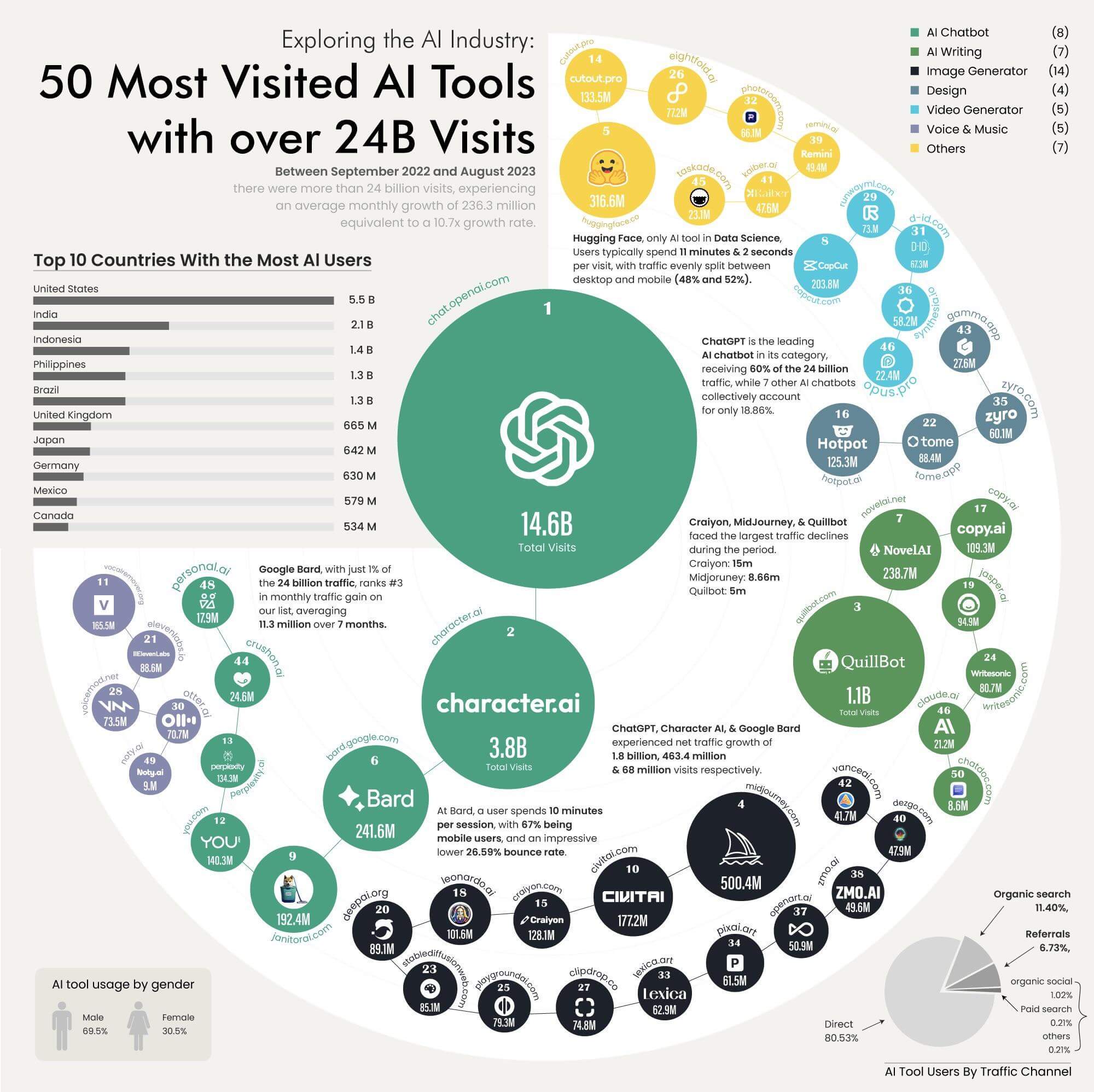
Source: Reddit
Understanding the difference between GEO and SEO, and how they intersect, is key for digital marketing teams navigating the future of search. Below, we break down what generative engine optimization is, how it differs from traditional SEO, and how to build strategies that support both visibility in traditional search engines and in GenAI platforms.
What Is Generative Engine Optimization?
Generative engine optimization is a content strategy designed for AI-driven search engines. It focuses on optimizing for brand visibility in generative AI responses, rather than just aiming for rankings on a search engine results page.
As AI-powered tools like Gemini, ChatGPT, and Perplexity become part of how people get information, GEO helps ensure your brand is included in their answers. These tools don’t always link back to traditional web results. Instead, they synthesize answers based on large language models (LLMs), user intent, and structured content.
Unlike traditional SEO, which relies on keyword rankings and backlinks, GEO prioritizes relevance to natural language queries and alignment with how AI models interpret information. GEO is driven by how users phrase questions, what context they provide, and what generative AI systems consider high-quality content.
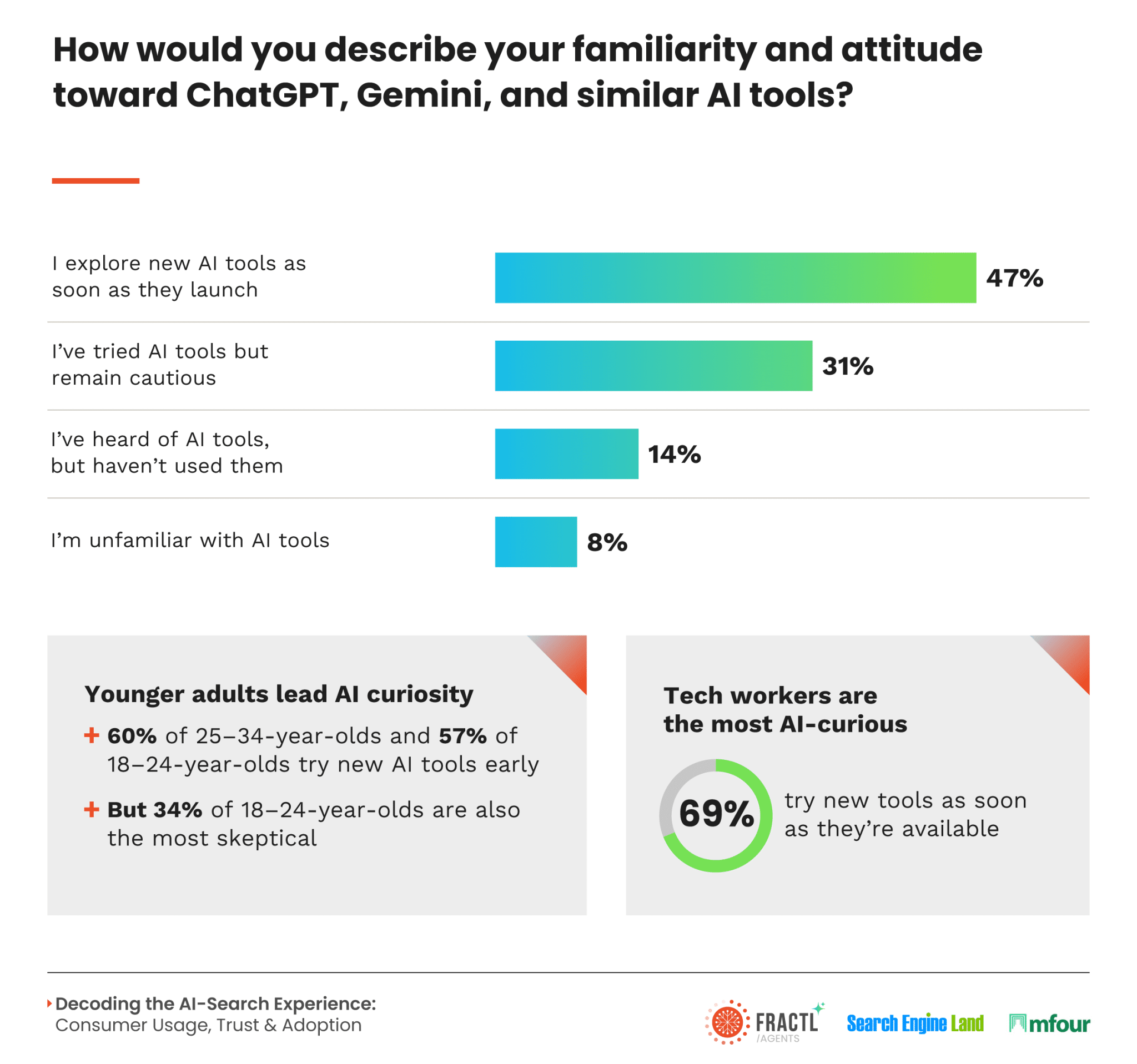
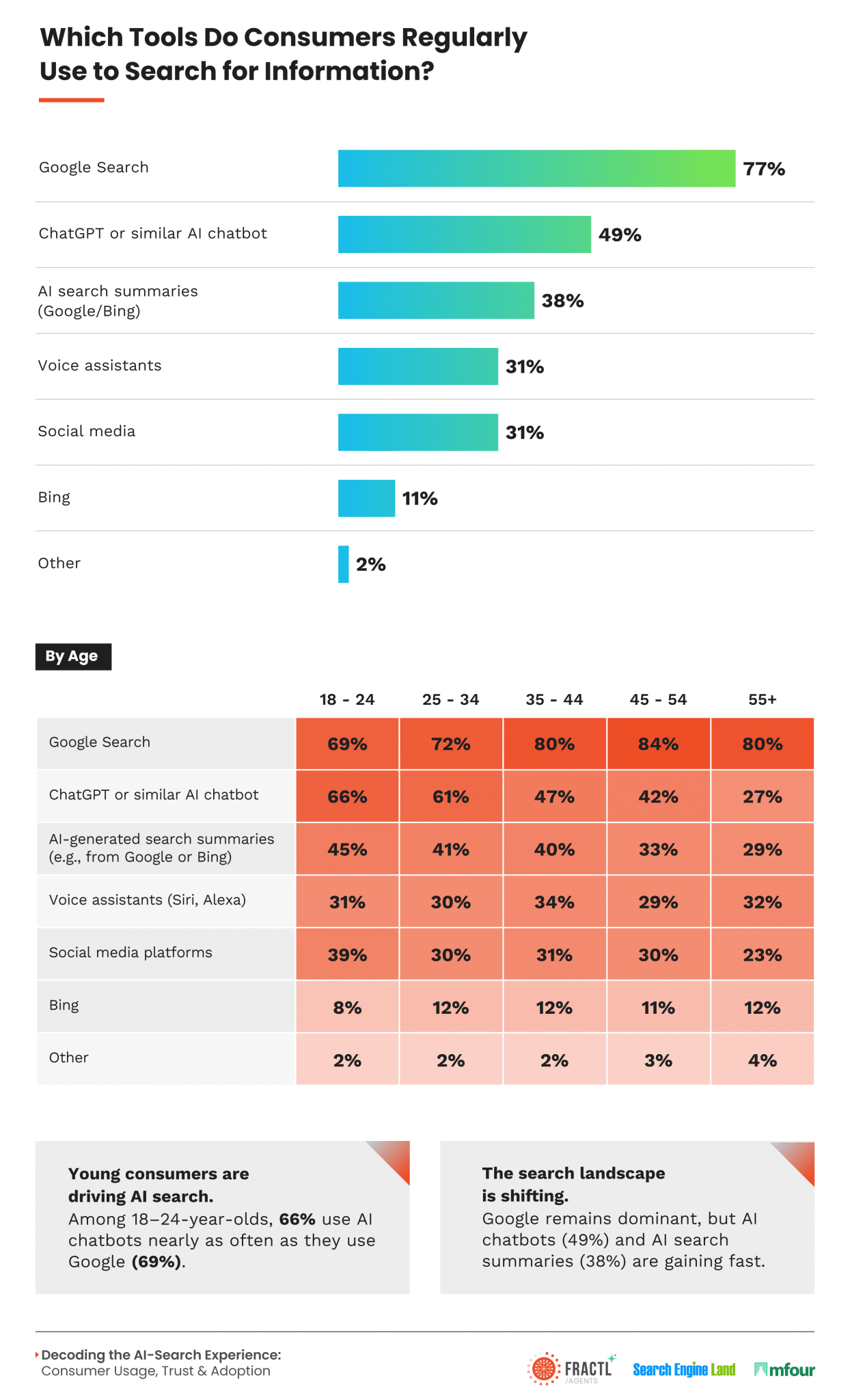
According to a recent study by Fractl and Search Engine Land, consumer adoption of GenAI tools like ChatGPT and Gemini is accelerating — especially among younger users and tech professionals:
To perform well in GEO, marketers need to optimize content for clarity, context, and authority. It’s no longer just about keywords or technical signals.
The Experts Agree
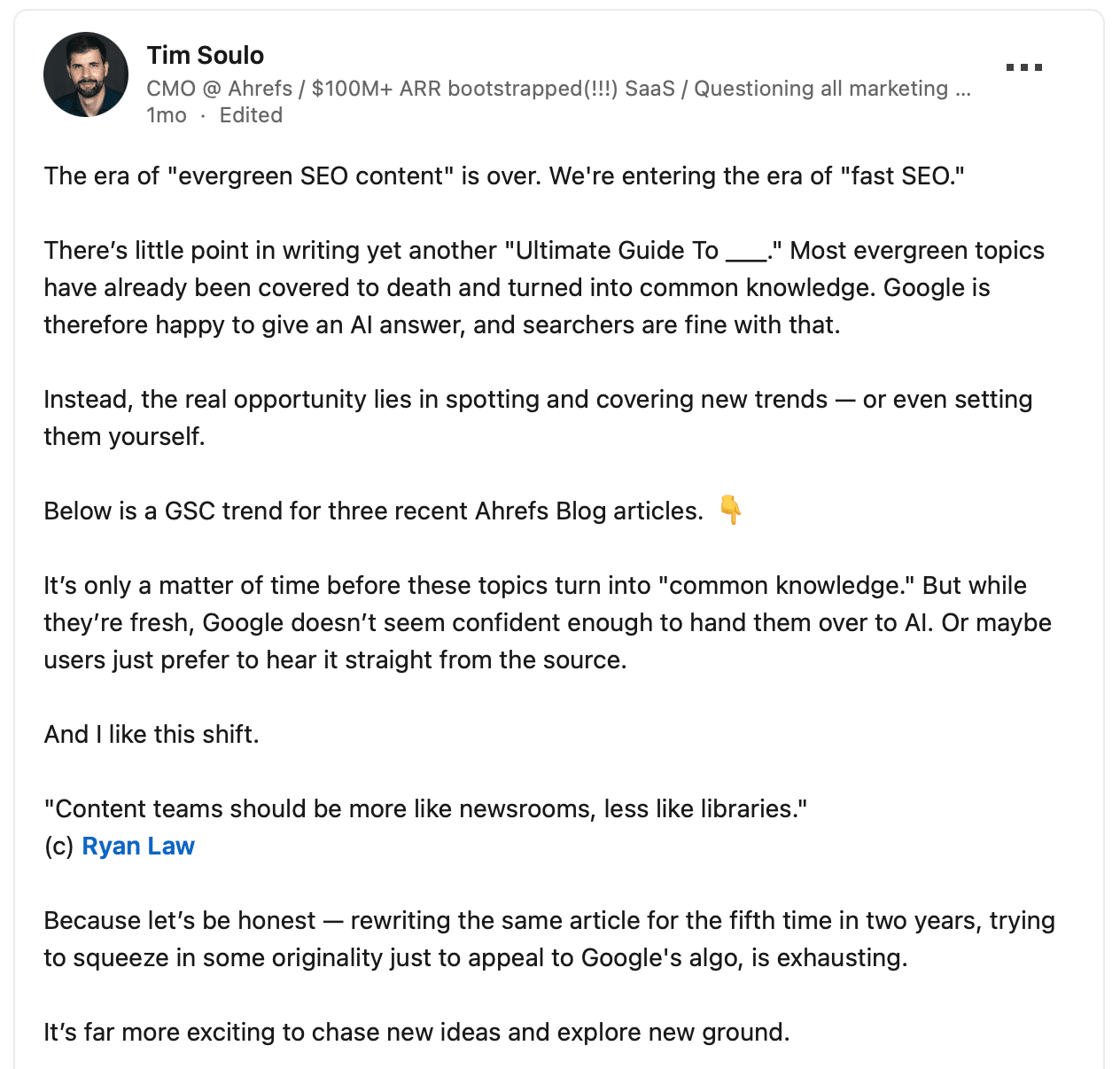
In a recent LinkedIn post, Ahrefs CMO Tim Soulo explained how traditional evergreen content is losing value. As AI-generated answers dominate search results, speed and trend sensitivity are becoming key search visibility factors:
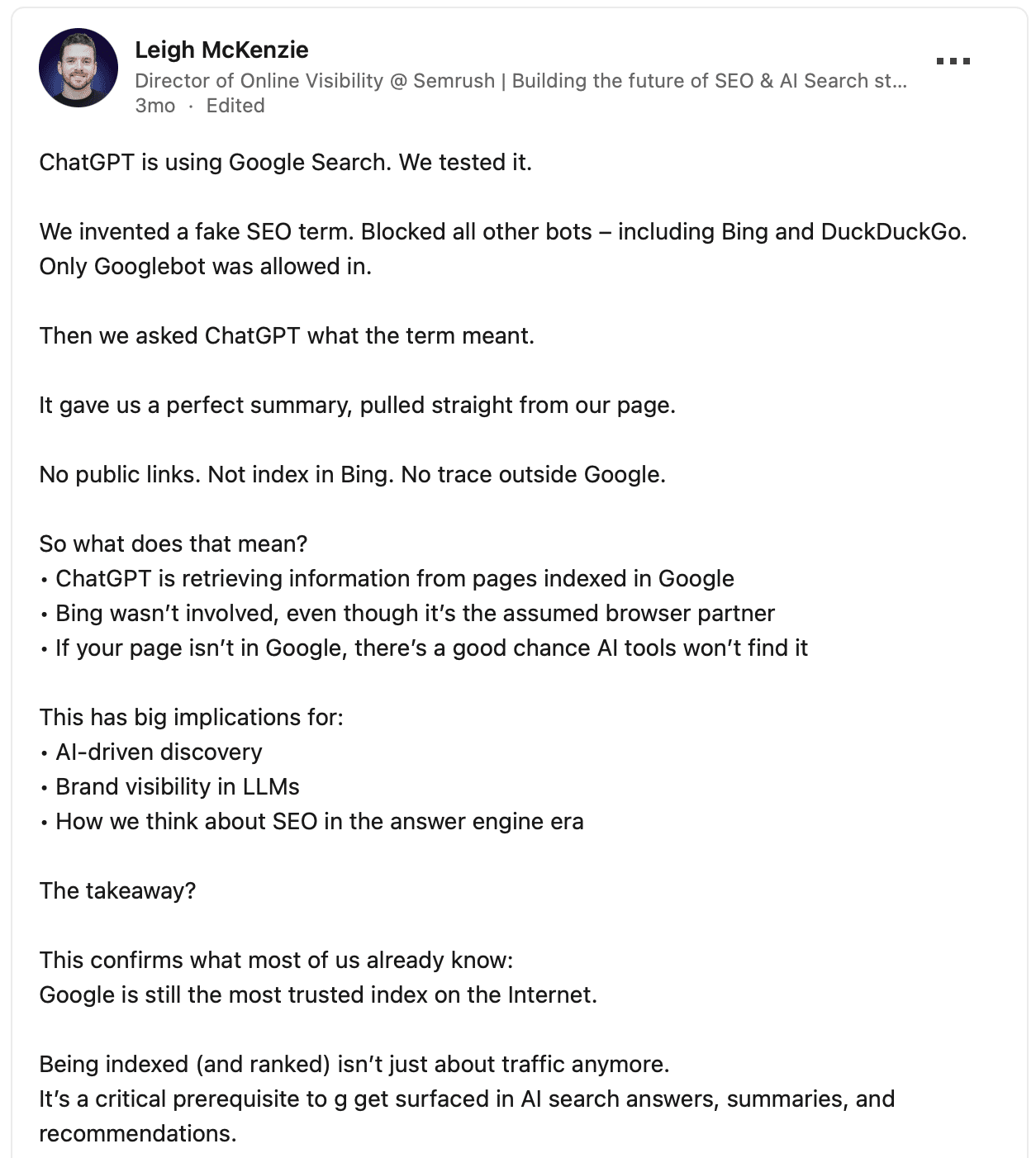
Semrush’s Leigh McKenzie also shared an experiment showing that ChatGPT pulls information directly from pages indexed by Google — highlighting the ongoing importance of traditional SEO in AI-driven search visibility:
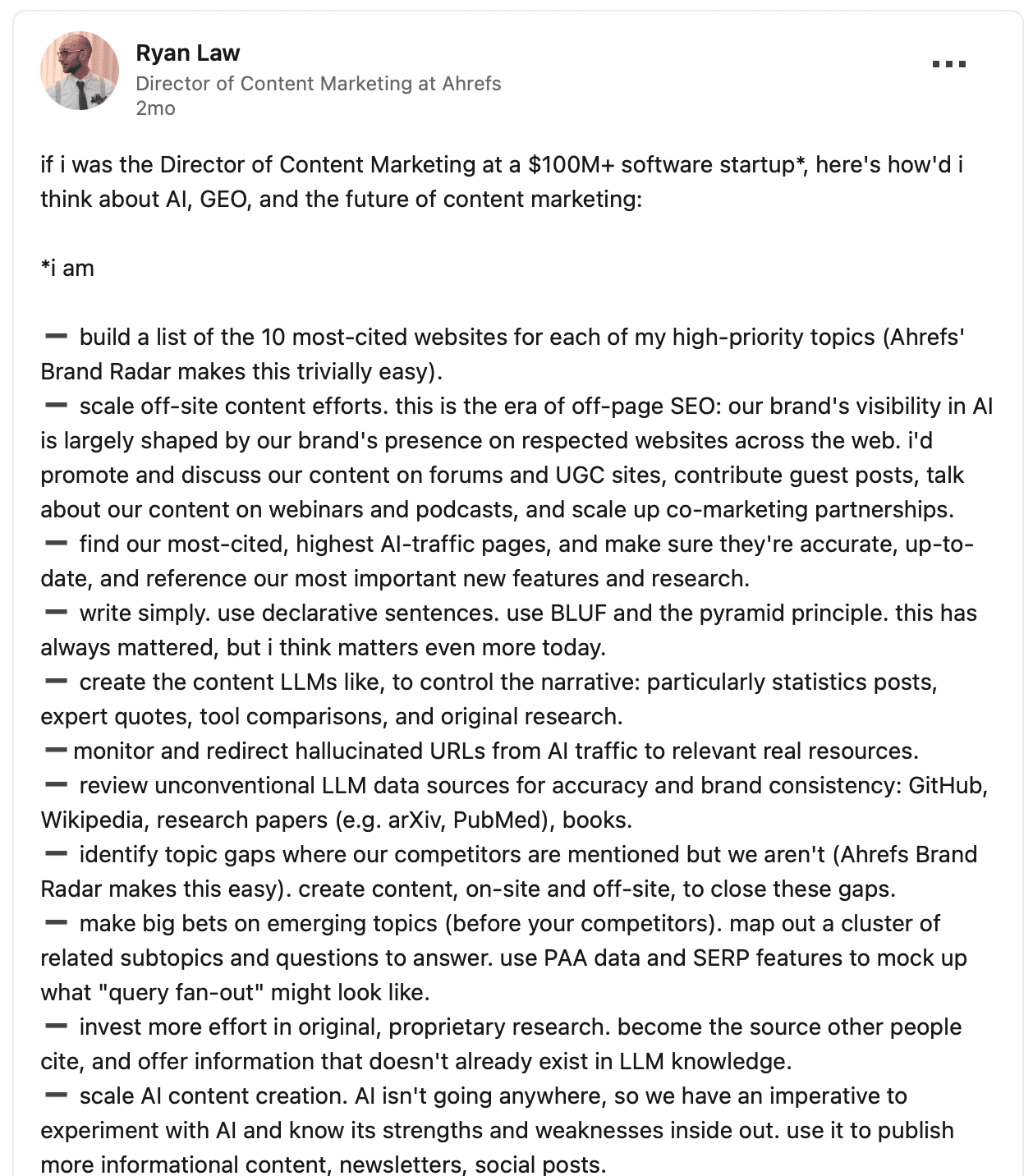
In this LinkedIn post, Ahrefs’ Director of Content Marketing, Ryan Law outlines a research-backed strategy for generative engine optimization, emphasizing off-site visibility, original research, and content designed specifically for how large language models source information:
Consumers Aren’t Just Googling Anymore
While Google still dominates, as we found in our recent survey of 2,000 consumers, 49% of consumers use AI chatbots like ChatGPT to search for information, and 38% rely on AI-generated search summaries from tools like Google’s AI Overviews or Bing. Among younger users, that shift is even sharper: 66% of 18–24-year-olds use AI chatbots nearly as often as they use Google.
For brands, this signals a fundamental change in discovery. To stay visible, content must be optimized not just for traditional search engines, but for these tools that are reshaping how people ask questions, receive answers, and find trusted information.
GEO vs. Traditional SEO
Traditional SEO focuses on visibility in standard search engine results pages. That means optimizing for elements like:
- Keyword targeting. Matching queries through on-page keywords and metadata.
- Backlink building. Increasing authority through inbound links.
- Structured data. Using schema markup to signal relevance to search engines.
- Technical performance. Ensuring fast load times, mobile-friendliness, and crawlability.
At the enterprise level, many companies also work with enterprise SEO agencies to scale these efforts globally.
GEO shifts the focus to how AI engines select and generate responses. Instead of ranking, it’s about being referenced in the generated summaries that tools like ChatGPT or Perplexity provide.
GEO strategies include:
- Context-rich content. Providing clear, factual information with obvious relevance.
- Answer synthesis. Structuring responses to reflect user questions and real-world use cases.
- Adaptability. Using formats and language that LLMs can easily parse and repurpose.
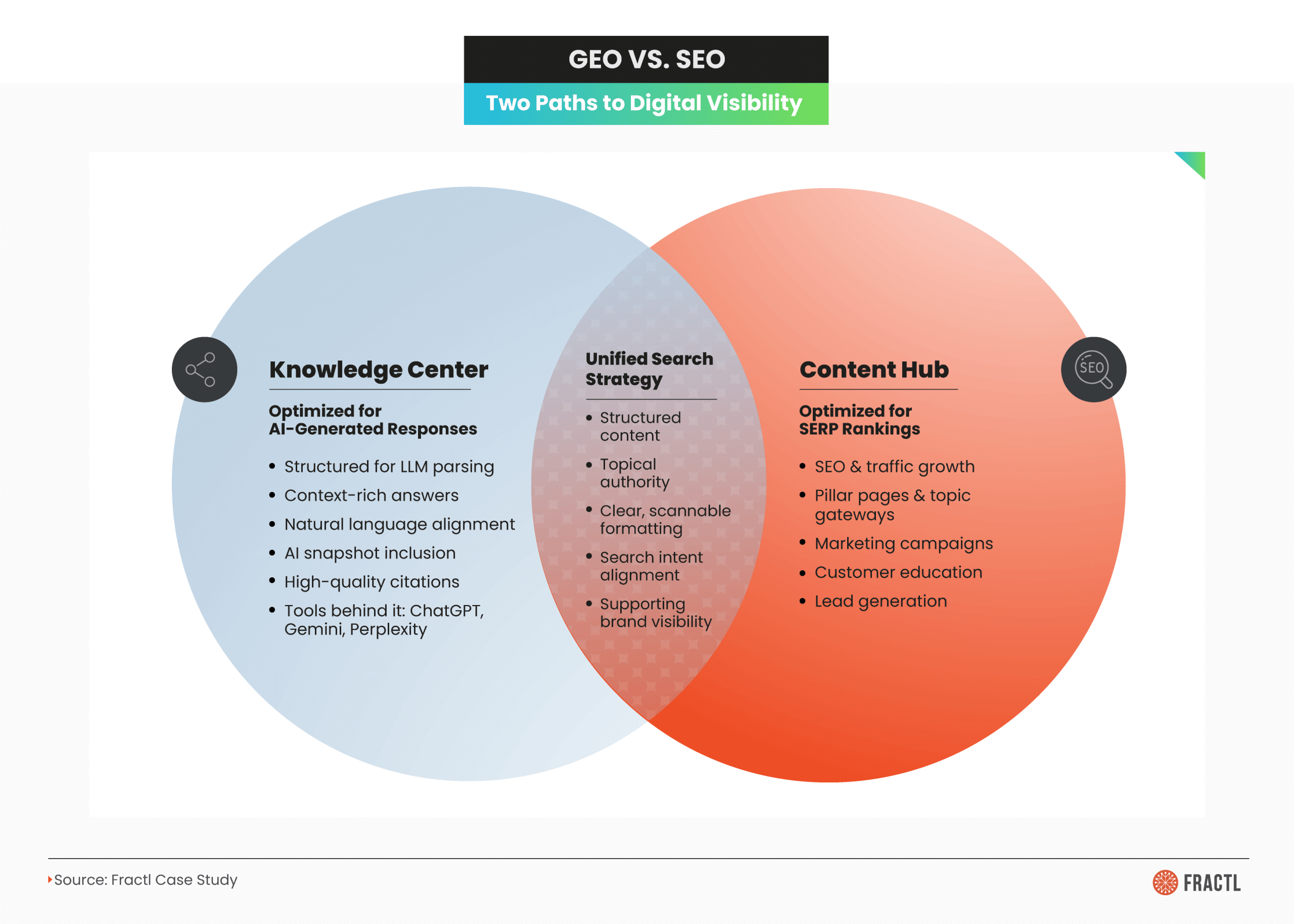
While GEO and SEO have different goals, they complement each other. SEO lays the foundation for search visibility; GEO ensures your content is usable and surfaced by generative engines. Both are now essential for a complete optimization strategy.
How Generative AI Engines Work
Generative AI engines follow a sequence of steps to transform a user query into an AI-generated summary. The process follows these steps:
- Receive the query. A user enters a question or prompt into the search bar.
- Process the language. The query is run through natural language processing (NLP) to analyze the words, structure, and intent.
- Interpret intent. The AI engine determines what the user is really asking and what type of answer is most useful.
- Retrieve relevant data. Algorithms pull information from indexed content and knowledge sources.
- Analyze patterns. The system looks at relationships, context, and patterns in the data it has been trained on, combined with real-time signals.
- Generate a response. Based on this analysis, the engine creates a concise summary that directly answers the query.
- Deliver results. Instead of showing ranked lists of web pages like traditional search engines, generative AI engines surface real-time, AI-written responses.
Tools like Google’s AI Overviews illustrate this workflow in practice. Because these results are created dynamically, clarity, formatting, and high-quality content are critical if you want your brand to appear in AI-generated outputs.
“Google’s AI Answers aren’t the same as raw LLM outputs — they rely on retrieval-augmented generation to interpret and synthesize search results, which is why they diverge from foundation-model responses.”
– Dan Tynski, Fractl Agents, Cofounder
How LLMs Power GEO
Large language models are at the core of generative engine optimization. These models are trained on enormous volumes of text, allowing them to understand how people ask questions and how to build context-rich answers.
When someone searches for information, the LLM behind a generative engine like ChatGPT or Gemini identifies the user’s intent and draws from its data to create a direct summary. This makes GEO strategies especially valuable, since they ensure your content is both discoverable and usable by AI tools.
LLMs also determine which sources get cited, which sentences are excerpted, and what content is shown in AI platforms. That’s why creating optimized content for LLM interpretation is now central to any GEO approach.
Why Formatting and Citations Matter
Generative AI engines favor content that is easy to read, clearly organized, and supported by credible sources. A few key factors make a big difference:
- Organization. Well-organized content with clean sentence structure and concise summaries is easier for AI to parse.
- Headings as signposts. Labeled sections guide large language models, increasing the chance your content will appear in AI-generated responses.
- Consistent citations. Linking to authoritative, primary sources in a reliable format improves credibility.
- Domain authority. Credible sources are more likely to be surfaced in AI summaries.
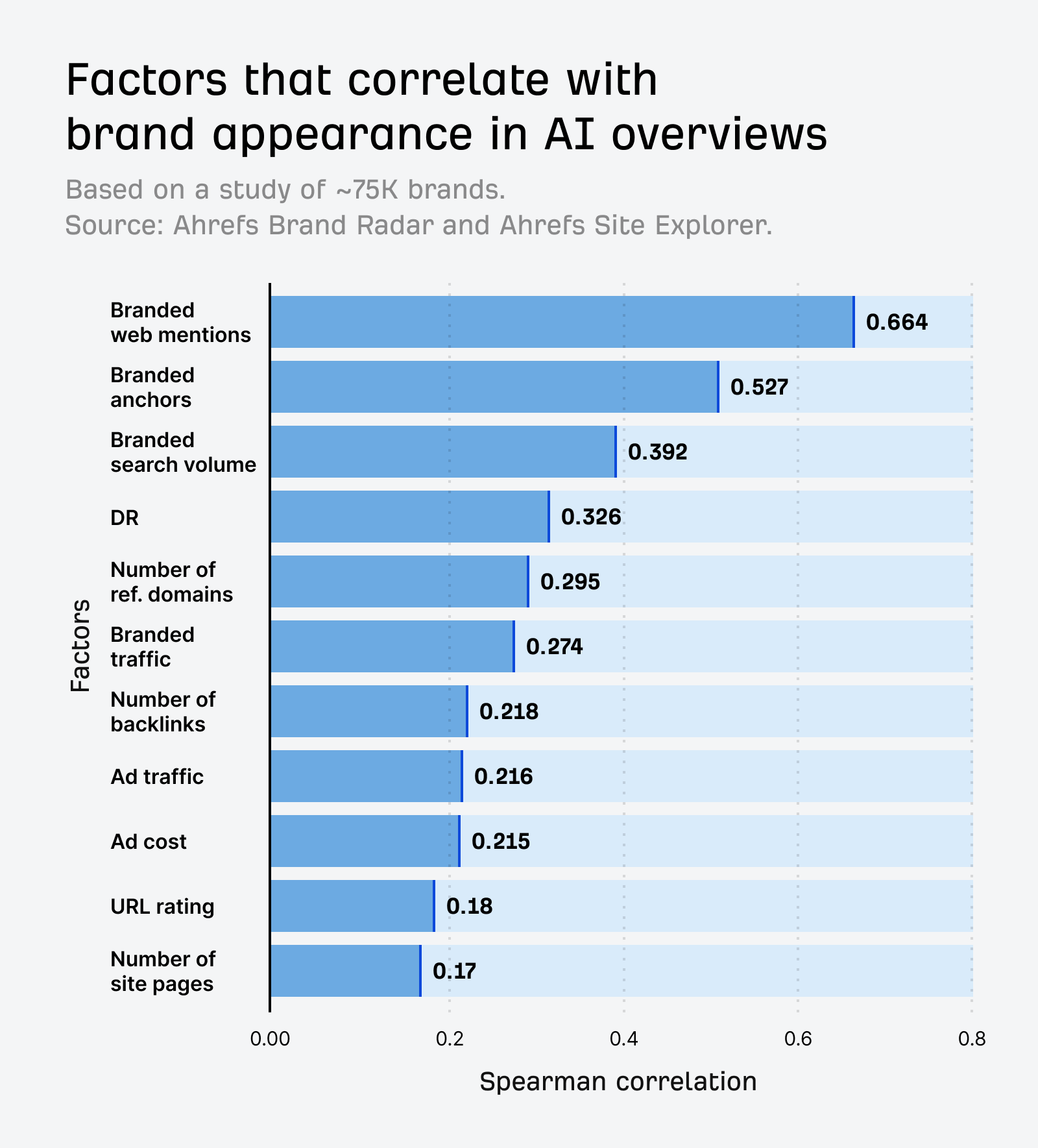
An Ahrefs study of 75,000 brands highlights which factors most strongly correlate with appearing in AI-generated overviews — underscoring the importance of clear formatting, credible citations, and authoritative content:
AI Overviews’ Impact on Businesses
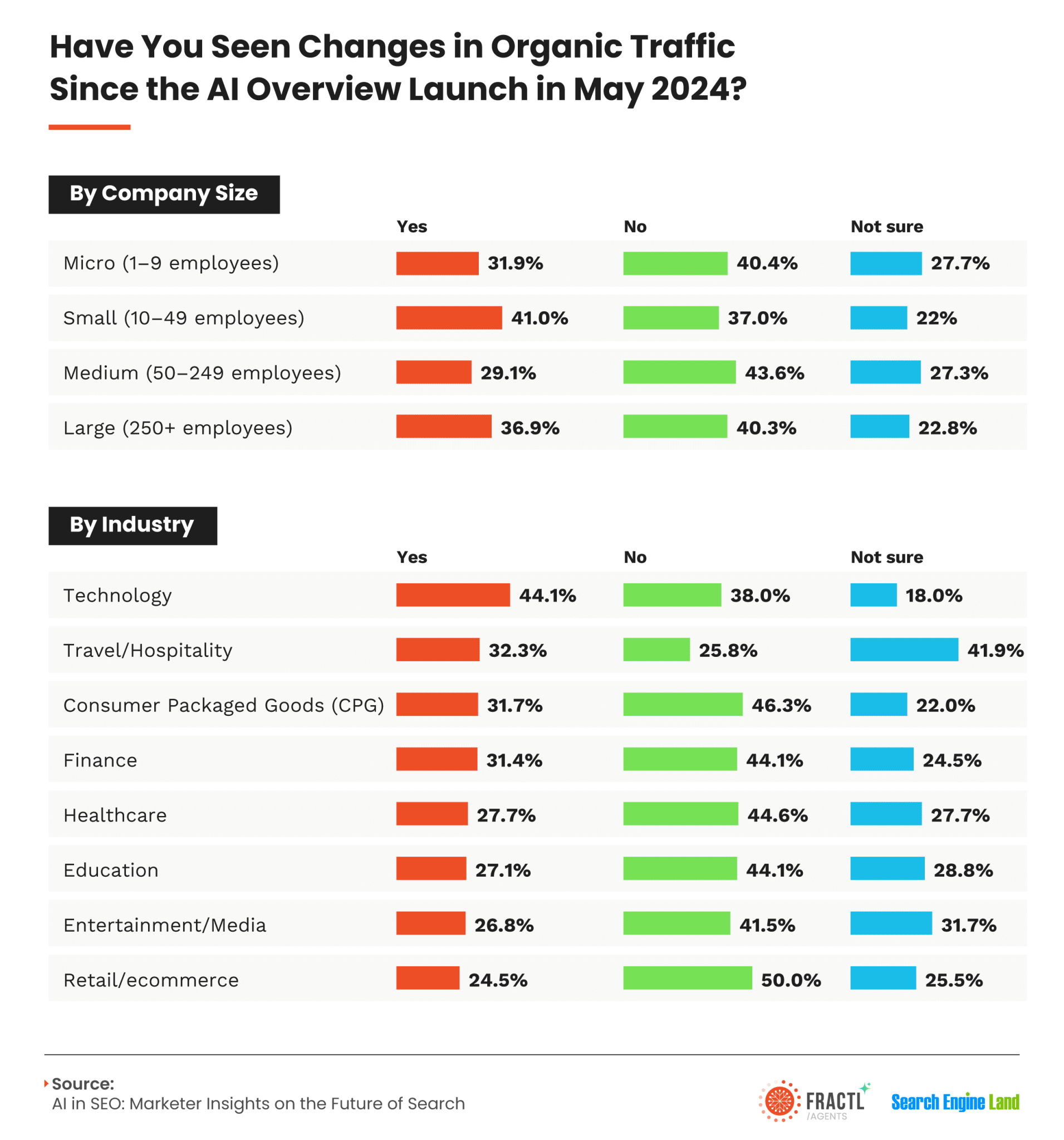
Since the rollout of Google’s AI Overviews in May 2024, many companies have reported noticeable declines in organic traffic — especially in tech, travel, and retail. The chart below breaks down the impact by company size and industry:
Key Factors for Successful GEO
GEO depends on both content quality and strategic alignment with user intent. To increase success, focus on:
- Direct answers. Write content that clearly addresses user questions.
- Content quality. Prioritize clarity, relevance, and substance over keyword stuffing or filler.
- Authoritative sources. Use primary research and trusted citations to build trust.
- E-E-A-T principles. Experience, expertise, authoritativeness, and trust still drive visibility.
- Integration with SEO. GEO works best as part of a broader content marketing strategy, not as a standalone tactic.
Best Practices for Optimizing Content for GEO
Optimizing content for GEO means going beyond keywords. These best practices help improve visibility in AI-generated answers by aligning content with how large language models retrieve, interpret, and surface information — prioritizing clarity, authority, and contextual relevance:
- Use schema markup and metadata. Structured signals help AI engines understand your content’s intent and increase the chances of retrieval in AI search responses.
- Write with clear headings and easy-to-read formatting. Headings organize content and show relevance to AI models, helping structure responses in answer engine formats.
- Answer user questions directly. Include short, clear summaries and direct answers to the questions your audience asks most often.
- Focus on content quality and visibility. Avoid fluff; prioritize clarity, originality, and user-focused information to boost credibility and engagement.
- Earn citations and build authority. Mentions in high-authority, frequently referenced sources improve your brand’s inclusion in LLM training data and generative summaries.
- Monitor AI visibility across LLMs. Use tracking tools to analyze how often your content appears in AI-generated results, and optimize based on phrasing, context, and query intent.
Many of these recommendations are also explored in Fractl cofounder Kelsey Libert’s How to optimize your content strategy for AI-powered SERPs and LLMs.
Metrics and Measuring GEO Success
Measuring GEO performance requires more than traditional SEO KPIs. While rankings, clicks, and traffic still matter, generative search introduces new visibility signals tied to brand authority, citation quality, and multi-platform reach.
The same signals that boost organic rankings — expertise, trust, and authoritative sourcing — now influence how often content appears in AI-generated answers. Tools like Google’s AI Overviews and ChatGPT prioritize information from brands that are consistently cited, widely distributed, and backed by original insights.
Key GEO metrics now include:
- Inclusion in AI-generated responses. Track brand visibility in tools like Google’s AI Overviews, Perplexity, and ChatGPT.
- Citations and earned media. Monitor how often your content is referenced by trusted third-party publishers and data sources.
- Cross-platform content distribution. Evaluate how well your content performs across search, social media, and media platforms — channels that train and influence LLMs.
- User engagement and intent match. Metrics like scroll depth, dwell time, and interaction with FAQs help validate relevance.
- Sustained content authority. Track how frequently your content earns backlinks, citations, and syndication over time.
Ultimately, GEO success is about building layered visibility — in AI answers, organic search, and trusted external ecosystems. For a deeper look at how brands are measuring and scaling this type of cross-channel authority, see Fractl cofounder Kelsey Libert’s playbook for AI-powered cross-channel brand visibility.
Case Studies and Examples
Fractl’s work highlights how effective content marketing and Digital PR strategies inherently build the KPIs that drive brand visibility in both traditional search engines and GenAI. Here are three client examples that demonstrate measurable results.
Educational Gaming Platform Boosts Visibility With Authoritative Content
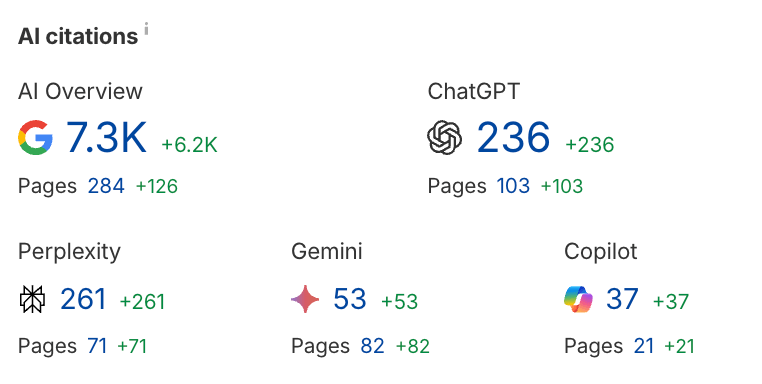
Fractl partnered with an online educational gaming platform to create data-driven campaigns designed to attract media coverage and backlinks. Within just two months, the client saw more than 10,000 new visitors, ranked for over 1,700 new keywords, and secured placements in high-authority outlets like TechCrunch and Forbes. By organizing its content with clear takeaways and citation-friendly formats, the company improved both its SEO foundation and its chances of being surfaced in AI-generated responses.
The Ahrefs snapshot below shows just how dramatically the brand’s generative visibility increased, with citations across AI Overviews, ChatGPT, Perplexity, and other emerging platforms — a clear sign that strategic content and PR efforts can boost reach across both traditional and AI-powered discovery engines:
Freelance Marketplace Expands Reach Through High-Authority Coverage
Fractl worked with a leading freelance marketplace to strengthen its content foundation and improve performance across both traditional search and AI-driven platforms. The strategy focused on publishing high-quality content for their website, aligned with user intent and optimized for AI parsing.
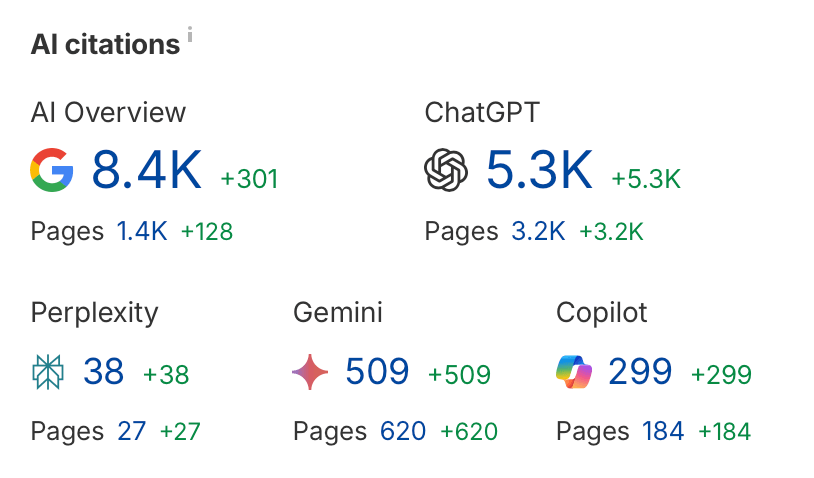
As a result, the client saw notable improvements in keyword rankings and traditional SEO performance — but the impact didn’t stop there. Their generative visibility spiked as well, with citations appearing across major AI platforms.
The Ahrefs snapshot below illustrates just how extensively the content was picked up across emerging search tools — including more than 8,000 citations in Google’s AI Overviews. These numbers show how effective content not only ranks in traditional search but also earns real estate in the GenAI ecosystem.
Tips for Building a GEO-Ready Strategy
As AI tools change how users engage with content, creating a GEO-ready strategy keeps your brand visible and competitive. The shift to generative engine optimization doesn’t replace SEO; it improves it.
To stay ahead, marketers should combine GEO strategies with their current SEO strategy. They should focus on content creation that works for both traditional search engines and AI-generated responses. This approach boosts brand visibility across different search queries and platforms.
Use these key steps to move forward:
- Align SEO and GEO. Ensure your content supports both SERP rankings and generative summaries.
- Arrange content for AI. Use schema markup, clear headings, and concise summaries to help AI engines parse your content.
- Create with purpose. Answer real user questions and optimize for search intent and user experience, not just keywords.
- Track performance. Monitor visibility in AI-generated answers and traditional SERPs to refine your approach.
- Plan for sustainability. Build a process that scales across your content marketing workflow, whether you’re in e-commerce, education, or reentry services.
As brand mentions and trust signals become core drivers of visibility in GenAI platforms, Fractl’s organic growth services are designed to scale your content’s reach and authority — across both traditional search engines and AI-generated responses.
Ready to work with an SEO and GEO partner who delivers lasting impact? Explore Fractl’s organic growth services to see how our team can bring your company to the forefront.
FAQs About GEO and SEO
Let’s review answers to the most common questions about generative engine optimization and how it fits into your broader SEO strategy.
What does GEO mean?
GEO stands for generative engine optimization. It’s a strategy that helps content appear in AI-generated responses produced by tools like ChatGPT, Gemini, and Google’s AI Overviews. This is different from “Geo” as in location-based services, which relates to geography or geotargeting.
What is GEO vs. SEO?
GEO focuses on optimizing content for generative AI engines, while SEO targets traditional search engine rankings. GEO ensures content is visible in AI summaries and answers; SEO aims to rank pages on SERPs. Together, GEO strategies and a strong SEO strategy improve visibility across all search formats.
How do I implement SEO for generative AI?
To optimize content for generative AI:
- Use schema markup and metadata for clarity.
- Write with scannable formatting and strong headings.
- Provide concise answers to user questions.
- Focus on content quality and cite trusted sources.
These steps improve your chances of being featured in AI-generated responses while supporting long-term GEO strategies.