




Table of Contents
- The Language Arms Race: Which AI-SEO Terms Are Actually Resonating?
- How These Terms Land on LinkedIn: General Population vs. SEO Thought Leaders
- Measuring the Mood Swings: Sentiment vs. Volatility
- What This Means for Marketers
- Conclusion
The “SEO vs. GEO” debate has become the search industry’s favorite paradox: everyone is talking about it, yet few agree on what it actually means. In 2025, thought leaders began shifting their stances on AI-driven search so frequently that even seasoned marketers struggle to tell whether these changes reflect genuine learning, strategic repositioning, or simply a reaction to the latest platform update.
Rather than adding another opinion to the pile, this study takes a step back. We quantify how volatile the discourse has become by analyzing what 75 leading SEO voices actually say on LinkedIn, how often they reference emerging terms like GEO, AEO, and LLMO, how positive or negative those references are, and how consistently they frame the future of search in 2026. The result is a first-of-its-kind volatility view that surfaces not just what the sentiment of what the industry is saying, but how stable, or unstable, its most influential narratives really are.
Key Takeaways
- SEO is still king, but new terms are rising in adoption. 63% of thought leaders have posted about Artificial Intelligence Optimization (AIO), and 59% have mentioned Generative Engine Optimization (GEO).
- Acronym fatigue is real, but positivity is high. Over 70% of their posts using an AI-related search term carry a positive tone. Among the emerging terms, Answer Search Optimization (ASO) posts have the highest positivity (86%), followed closely by Generative Engine Optimization (GEO) (82%). Answer Engine Optimization (AEO) had the lowest positivity (65%).
- Volatility is rising. Fewer than one-third of leaders have maintained consistency in their use of AI-related SEO terminology over the past year, indicating that the industry is still negotiating how it defines brand visibility in the AI era.
- Credibility ≠ loudness. The most active posters aren’t always the most trusted. The data shows clusters of frequent posters whose tone fluctuates wildly.
The Language Arms Race: Which AI-SEO Terms Are Actually Resonating?
Before we can talk about credibility, we need to understand the vocabulary shaping the debate. To do that, we examined how often SEO thought leaders reference emerging AI-related search terms and how positively they frame them.
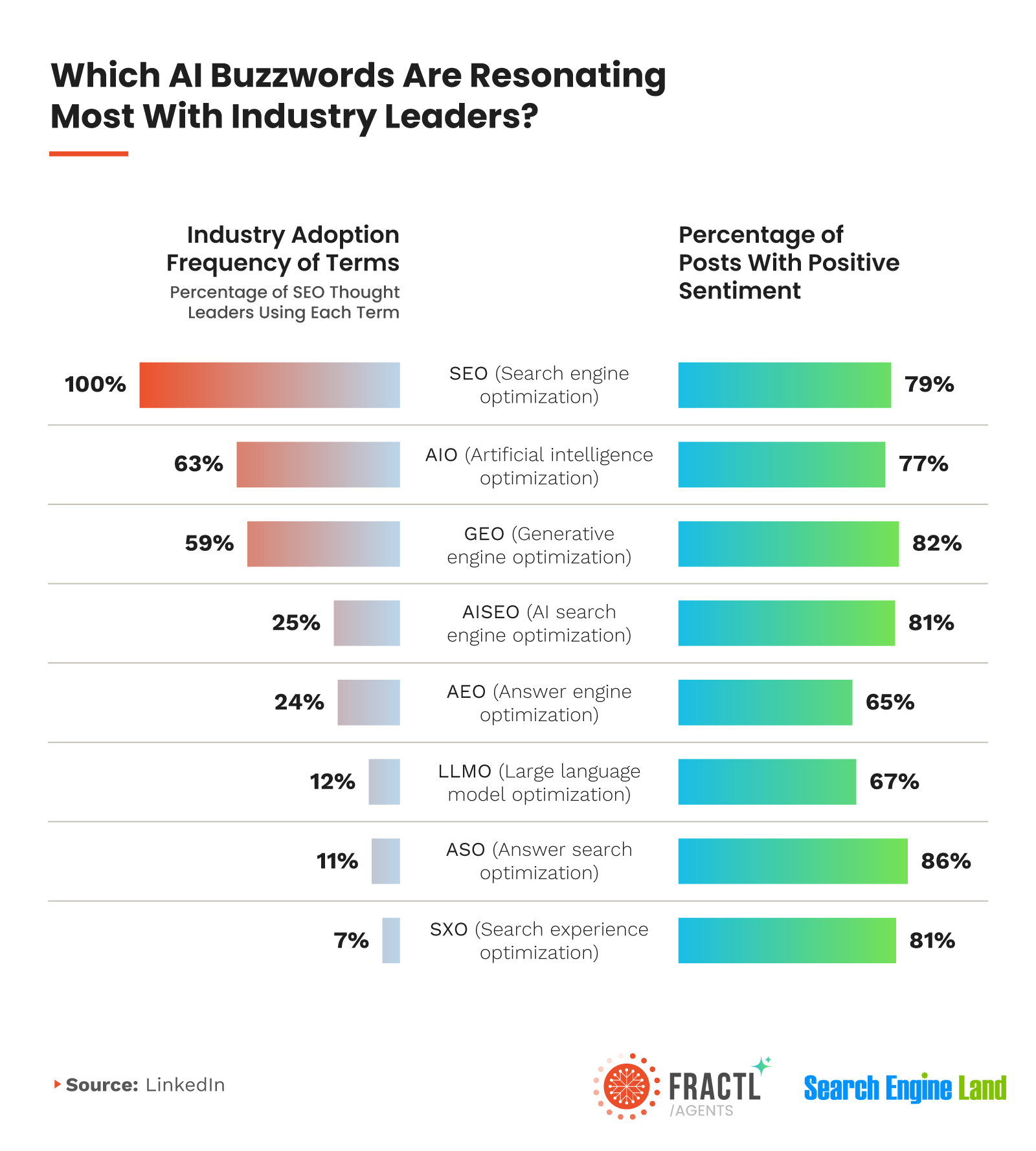
This visualization compares two forces: adoption frequency (how many leaders reference each term in their content) and sentiment (how positively those terms are framed).
Unsurprisingly, SEO remains foundational. While new acronyms dominate discourse, SEO continues to anchor professional identity and context. Forty-three percent of SEO thought leaders explicitly include “SEO” in their LinkedIn headline, compared to 21% who reference “AI” and just 3% who reference “GEO.” In other words, while GEO may dominate conversation, SEO still defines how most leaders describe their expertise.
That contrast shows up in posting behavior as well. GEO is referenced by 59% of leaders and carries a strong 82% positive sentiment, signaling that “generative” has become the shorthand for discussing AI-driven discovery. But its near-absence from bios suggests GEO is still viewed as a conceptual layer, not a durable professional identity.
Other terms reveal similar tension between experimentation and permanence. AIO and AISEO cluster tightly in sentiment (roughly 77–81% positive), indicating convergence around AI-augmented optimization without agreement on naming.
The most striking imbalance belongs to ASO (answer search optimization). Only 11% of leaders reference it, yet it carries the highest positivity at 86%. That gap suggests ASO resonates most with a smaller group of practitioners who care less about how search systems work and more about whether users actually get answers.
Interpretation: Thought leaders are far more willing to talk about new labels than to brand themselves with them. SEO remains the identity anchor, AI is the modifier, and GEO and related acronyms function as explanatory tools rather than professional descriptors.
How These Terms Land on LinkedIn: General Population vs. SEO Thought Leaders
To understand which AI-related SEO terms translate beyond specialists, we compared the percentage of LinkedIn posts with positive sentiment across two groups: SEO thought leaders and the broader LinkedIn population, coming from Fractl’s companion study, The New Vocabulary of AI Search.
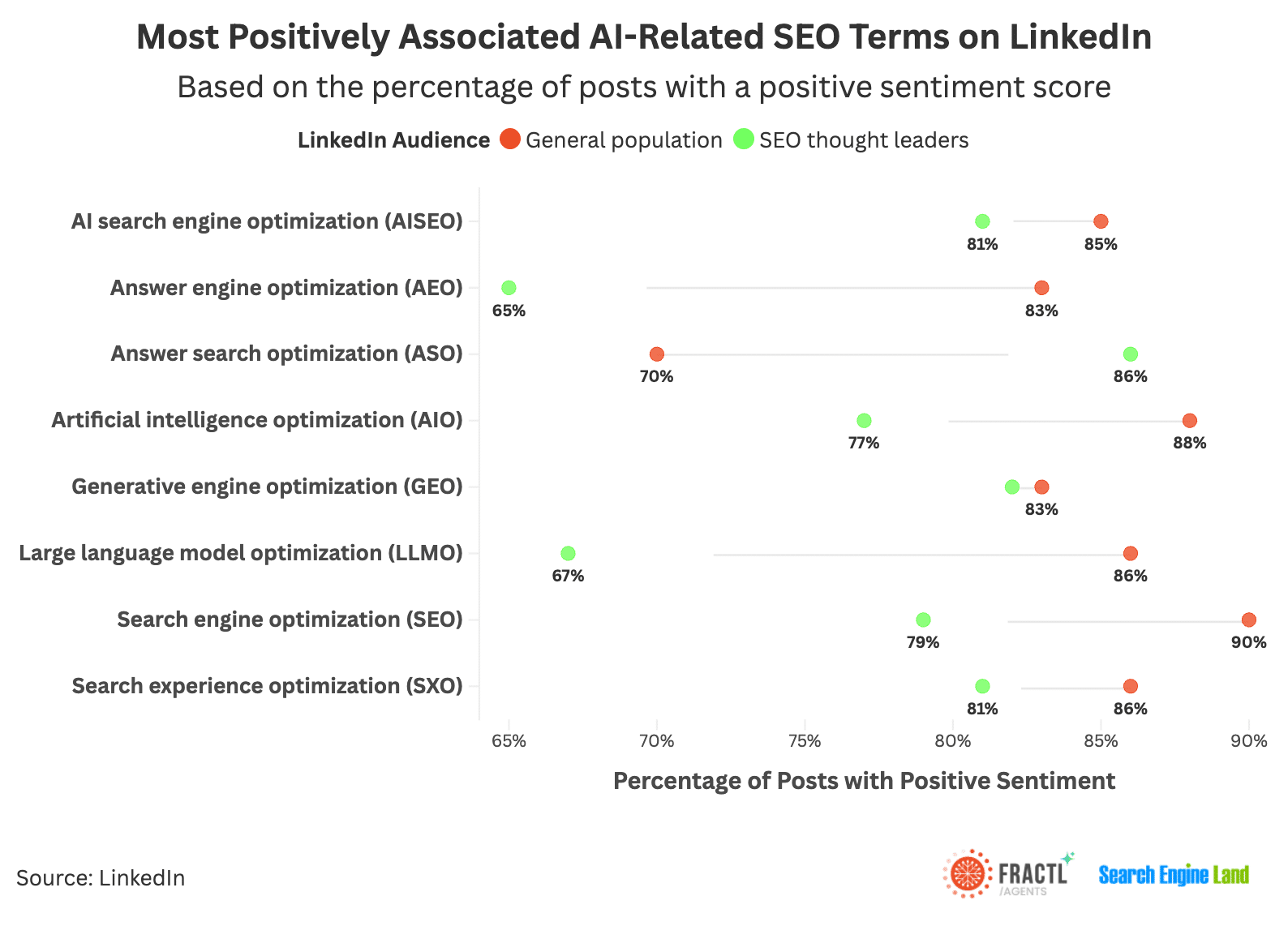
Across most terms, the general audience is more positive than experts. Labels like AEO, LLMO, and AIO generate strong enthusiasm in the broader feed but noticeably cooler sentiment among thought leaders, suggesting they work well as high-level narratives but prompt more caution from those closest to execution.
A few terms break from that pattern. AISEO shows near parity between the two groups, indicating that “AI + SEO” framing is broadly understandable and relatively uncontroversial. ASO flips the dynamic entirely: SEO thought leaders are significantly more positive than the general LinkedIn population, signaling that its value is clearest to practitioners already working within answer-driven discovery systems. GEO stands out for its consistency, with similarly high positivity across both audiences, reinforcing its role as an explanatory concept that resonates beyond the expert bubble.
In practice: When communicating about AI-era search on LinkedIn, treat highly optimistic general-audience terms (like AEO or LLMO) as awareness drivers, not execution frameworks. Use AISEO or GEO when you need language that travels cleanly across teams, clients, and leadership. Reserve ASO for practitioner-facing content, where its intent and value are more immediately understood.
Measuring the Mood Swings: Sentiment vs. Volatility
Adoption and positivity tell only part of the story. Credibility also depends on consistency, whether a thought leader’s framing holds steady or swings with each news cycle.
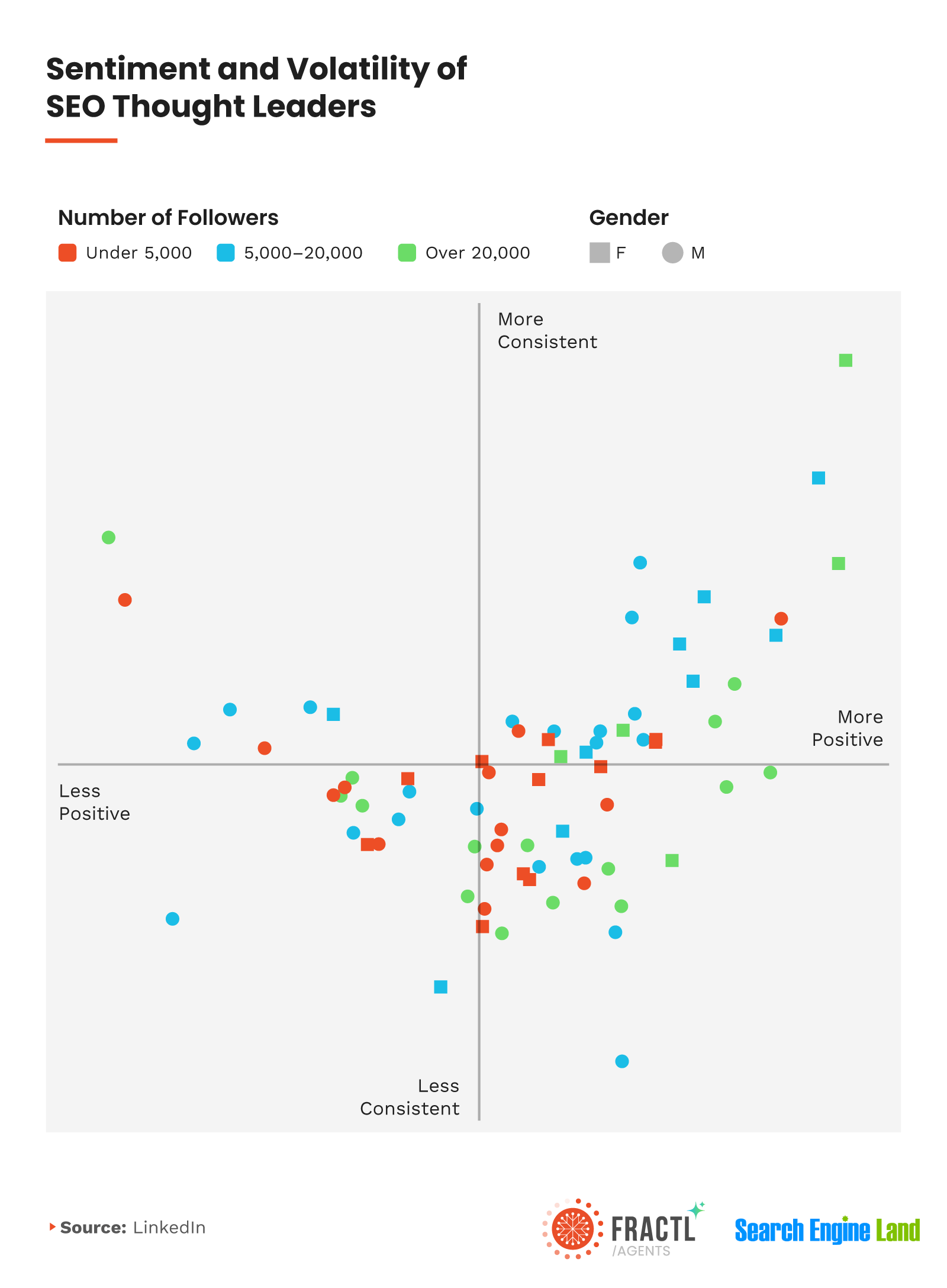
To measure this, we plotted each anonymized thought leader on a quadrant mapping average sentiment (negative to positive) against volatility (consistent to frequently shifting).
The upper-right quadrant — more positive, more consistent — contains just over one-third of the top 75 voices. These leaders maintain measured optimism about AI’s role in search, balancing experimentation with caution and grounding speculation in firsthand data.
The dense middle cluster tells a different story: highly visible voices whose sentiment fluctuates with algorithm updates, platform announcements, or viral discourse. More than a third of thought leaders (35%) positively referenced AI-related search terms but lacked consistency. These leaders are not wrong but are reactive, reflecting the broader anxiety of an industry racing to interpret rapid change.
Interpretation: The loudest voices are not necessarily the most reliable. Volatility correlates with visibility, but consistency correlates with trust. For marketers deciding which perspectives to amplify internally or cite externally, that distinction matters.
What This Means for Marketers
Thought leadership in the AI era isn’t about who posts first. It’s about who remains coherent when the noise peaks. As search evolves, marketers should evaluate not just what trusted voices say, but how consistently they say it.
- Prioritize stable optimism. Consistently positive, data-driven voices often provide the clearest early signals of durable change.
- Interrogate volatility. Shifting sentiment can indicate honest uncertainty, but it also introduces risk when used as strategic guidance.
- Balance hype with human signals. Terms like GEO and ASO may trend, but credibility ultimately rests with those who tie new frameworks back to repeatable, search-grounded outcomes.
Conclusion
The SEO vs. GEO debate reflects an industry negotiating its identity in real time. Our findings show that optimism outweighs cynicism, but consistency is the new currency of trust. In a landscape where definitions shift overnight and platforms evolve weekly, the most credible leaders will be those who treat volatility as a signal to slow down and ground their insights.
For brands and practitioners alike, the takeaway is simple: it’s not about being first to name the next acronym, it’s about being the last to contradict yourself.
Methodology
We curated the top 75 SEO thought leaders based on LinkedIn engagement, network influence, and publication frequency. Using VADER sentiment analysis, we examined the positivity and negativity of recent posts referencing key AI-driven SEO terms, including GEO, AIO, AISEO, AEO, LLMO, SXO, and ASO (short form and long form).
Sentiment was scored on a -1 to +1 scale, and volatility was measured as the standard deviation of sentiment across posts. All data was anonymized to protect individual identities while preserving relational insights.
The top 75 SEO thought leaders we analyzed included:
- Aleyda Solis
- Amanda Farley
- Amanda Natividad
- Andrew Holland
- Andrew Prince
- Andy Crestodina
- Areej AbuAli
- Barry Schwartz
- Beth Nunnington
- Brett Tabke
- Brie E. Anderson
- Britney Muller
- Bruce Clay
- Celeste Gonzalez
- Christian Hustle
- Cindy Krum
- Connor Gillivan
- Crystal Carter
- Cyrus Shepard
- Dana DiTomaso
- Danielle Stout Rohe
- Danny Ashton
- Danny Goodwin
- Darren Shaw
- Dave Davies
- Derek Perkins
- Eli Schwartz
- Eric Enge
- Fabrice Canel
- Felipe Bazon
- Garrett French
- Garrett Sussman
- Gisele Navarro
- Greg Gifford
- Ian Lurie
- James Brockbank
- James Wirth
- Jane Hunt
- Jesse McDonald
- Jordan Koene
- Joy Hawkins
- Kathryn Hawkins
- Kelsey Libert
- Kristin Tynski
- Lee Elliott
- Lidia Infante
- Lily Ray
- Loren Baker
- Marc Sirkin
- Mark Rofe
- Mark Traphagen
- Martha van Berkel
- Matt McGee
- Melissa Popp
- Michael Buckbee
- Michael King
- Michelle Robbins
- Mordy Oberstein
- Neil Patel
- Nick Eubanks
- Nick LeRoy
- Noah Learner
- Paddy Moogan
- Patrick Reinhart
- Paul Aaron Norris
- Paxton Gray
- Rand Fishkin
- Ray Grieselhuber
- Ross Hudgens
- Ross Simmonds
- Samantha Torres
- Steven J. Wilson
- Tony Wright
- Vanessa Raath
- Wil Reynolds
About Fractl Marketing
Fractl helps companies drive cross-channel brand visibility by transforming proprietary data into newsworthy stories that earn authoritative brand mentions across platforms. Our clients have been featured in top-tier publications, including The New York Times, The Wall Street Journal, CNBC, USA Today, and The Today Show, among other trusted outlets. With over a decade of experience, we’ve helped clients across industries achieve measurable results, from qualified organic traffic to lasting brand authority and trust signals.
Fractl is also the team behind Fractl Agents, where we’re beta testing AI tools and workflows that help marketers automate effective content marketing strategies.
Fair Use Statement
You are welcome to reference or republish findings from this study with attribution. Please link back to Fractl and cite the source. For press inquiries or custom data cuts, contact the Fractl team ([email protected]).